
Despite all the noise about rising ad costs and shiny new platforms, let's be clear: Facebook ads are still the single most powerful tool for finding customers and scaling a dropshipping store from zero to hero. Sure, TikTok has its place, but Meta's advertising machine—with its hyper-intelligent algorithm and visually-driven formats—was practically built to showcase products and trigger impulse buys. If you want a reliable, repeatable path to a profitable dropshipping business, this is where you start.
Why Facebook Ads Still Run the Game for Dropshippers
You’ve heard it all before. "Facebook ads are dead." "It's way too saturated." "TikTok is the only thing that works now."
While it's smart to keep an eye on emerging channels, writing off Meta (Facebook and Instagram) is a rookie mistake. Its advertising ecosystem is a sophisticated, e-commerce-focused beast that remains the backbone of countless successful dropshipping stores.
The real secret sauce is the algorithm's deep, almost scary, understanding of user behavior and buying signals. After more than a decade of data collection, it knows precisely what makes someone stop scrolling, click "Shop Now," and pull out their credit card. When you launch a conversion campaign, you’re not just tossing an ad into the void; you're unleashing a powerful AI purpose-built to hunt down buyers for you.
An Unbeatable Audience at Your Fingertips
The numbers alone are staggering. A whopping 68% of all dropshipping stores drive the majority of their traffic straight from Meta's platforms. With a combined user base of over 5.24 billion consumers, your ideal customer isn't just on Facebook or Instagram—they're actively browsing, right now.
Even with the average Facebook CPM (the cost to reach 1,000 people) hovering around $8.77, a sharp strategy turns that expense into a highly profitable investment. This is because the platform’s scale isn’t just about raw numbers; it’s about precision. Whether you’re selling quirky cat toys or minimalist home decor, you can laser-target the exact demographics, interests, and online behaviors that define your perfect buyer.
Engineered for the Impulse Buy
Let’s face it, dropshipping is fueled by impulse purchases. A customer sees a cool, problem-solving gadget in their feed, and a few clicks later, it's on its way. The entire scroll-and-stop nature of Facebook and Instagram is the perfect breeding ground for this kind of spontaneous shopping.
Here's why it works so well for dropshippers:
- Show, Don't Just Tell: Video ads, carousels, and eye-catching images let you demonstrate a product's "wow" factor in seconds, grabbing attention instantly.
- Seamless Shopping Experience: Integrated shops and dynamic product ads remove all the friction. The journey from seeing an ad to completing a purchase is incredibly quick and easy.
- Built-in Social Proof: Every like, comment, and share on your ad acts as a powerful, trust-building testimonial for the next person who sees it.
The true power of Facebook ads for dropshipping isn't just about reaching a ton of people. It's about reaching the right people, at the right time, with a product they didn't even know they wanted until they saw your ad.
Of course, the days of launching a simple image ad and watching the sales roll in are long gone. Success today demands a smart strategy, killer creative, and a solid grasp of your data. If you're still weighing your options, our guide on whether advertising on Facebook works can offer more perspective.
Ultimately, mastering this platform isn’t just a good idea—it’s the cornerstone of building a truly scalable dropshipping empire.
Advertising Channel Comparison for Dropshippers
While Meta is a powerhouse, it's helpful to see how it stacks up against other popular channels. Each platform has its own flavor and is suited for different goals and products.
| Platform | Best For | Key Advantage | Main Challenge |
|---|---|---|---|
| Meta (Facebook & Instagram) | Broad audience targeting, impulse buys, and data-driven scaling. | Unmatched algorithm for finding buyers and a massive, diverse user base. | Rising ad costs and increasing competition require a sophisticated strategy. |
| TikTok | Viral product marketing, trend-driven items, and reaching a younger audience. | Potential for massive organic reach and lower initial ad costs. | Audience has lower direct purchase intent; creative burnout is high. |
| Google Ads (Shopping & Search) | Products with high search intent (people are actively looking for them). | Captures high-quality traffic from customers ready to buy now. | Can be expensive and less effective for unique "discovery" products. |
| Visually-driven niches like home decor, fashion, and DIY. | Users are in a "discovery" and planning mindset, making them open to new products. | Slower to scale and primarily targets a female-dominated demographic. |
This comparison highlights why so many dropshippers start with and continue to rely on Meta—it offers the best all-around combination of scale, targeting precision, and a user base conditioned to shop directly from their feed.
Setting Up Your Ad Account for Success
Before you even think about launching an ad, we need to talk about your foundation. This is where so many dropshippers go wrong. They jump straight into making ads, completely skipping the setup, and then wonder why they’re just burning cash.
Getting these initial steps right is the difference between a profitable ad account and a money pit. Let's build it correctly from the ground up.
The very first decision you’ll make inside Ads Manager is your campaign objective. You’ll see a bunch of options like "Awareness," "Traffic," and "Engagement." For dropshipping, you can ignore almost all of them.
Your North Star is Conversions.
When you choose "Conversions," you’re giving Facebook’s algorithm a crystal-clear command: "Find people who will actually buy my product." You're not paying for cheap clicks or meaningless likes. You're paying for results, and the algorithm will work tirelessly to find users who have a history of pulling out their credit cards online.
Installing Your Data Backbone: The Pixel and CAPI
Running ads without data is like driving with a blindfold on. You need to know what's working and what isn't. Your two most important tools for this are the Facebook Pixel and the Conversions API (CAPI). You absolutely need both.
The Facebook Pixel: This is a snippet of code you’ll add to your store (Shopify makes this super easy). It tracks what users do—viewing a product, adding to the cart, initiating checkout, and of course, making a purchase.
The Conversions API (CAPI): Think of this as the Pixel's much more reliable partner. With all the privacy changes like Apple's iOS 14 update, browser-based tracking (the Pixel) can be spotty. CAPI sends data directly from your store’s server to Facebook’s server, creating a much more stable and accurate connection.
The Pixel is your scout on the ground, but CAPI is the direct line to HQ. Using them together ensures Facebook’s algorithm gets the most accurate data possible, which helps it learn faster and find your ideal customers more efficiently.
My Take: Don't treat this as an optional step. Setting up both the Pixel and CAPI is non-negotiable for serious facebook ads for dropshipping today. If you skip this, you’re essentially telling the algorithm to guess, and that’s a costly gamble.
Choosing Your Budget Strategy: ABO vs. CBO
With your tracking in place, it’s time to decide how you want to manage your money. Facebook offers two main approaches for budgeting: Ad Set Budget Optimization (ABO) and Campaign Budget Optimization (CBO). Understanding when to use each is crucial, especially when you're testing.
This little toggle in your campaign settings holds a lot of power over your strategy.
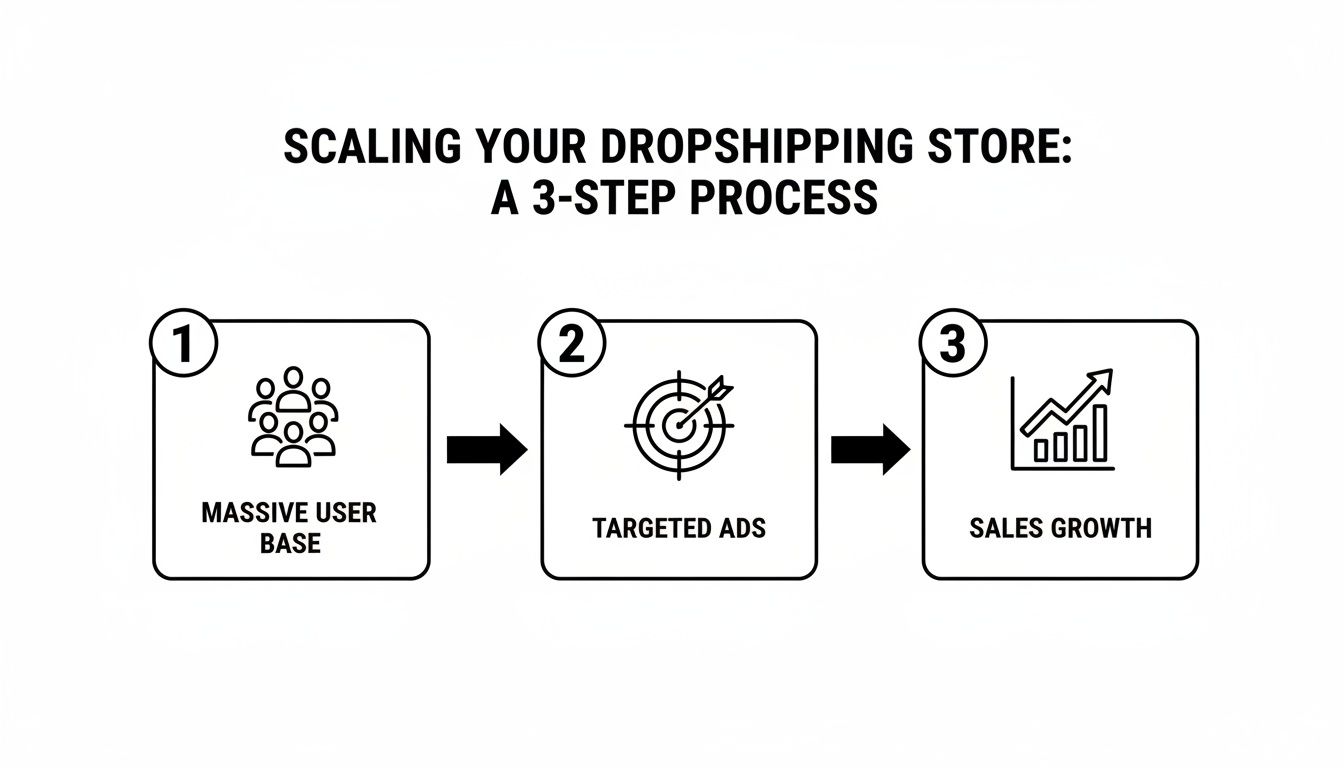
It dictates whether you control the budget for each audience (ad set) or if you let Facebook do it for the whole campaign.
Ad Set Budget Optimization (ABO)
With ABO, you’re in the driver's seat. You set a specific budget for each individual ad set. For example, you could be testing three different audiences and decide to give each one a $10 per day budget. This ensures each one gets a fair shot.
I use ABO when I'm:
- In the early testing phase of a brand-new product.
- Wanting to guarantee that each test audience gets an equal amount of money spent on it.
- Trying to "force feed" a new ad set some budget to see if it has any hidden potential.
Campaign Budget Optimization (CBO)
CBO is where you hand the keys over to Facebook. You set one single budget at the campaign level, and the algorithm automatically allocates it to the best-performing ad sets in real time. If one ad set is crushing it, Facebook will pour more money into it to maximize your results.
I switch to CBO when I've:
- Already identified my winning audiences and creatives from ABO testing.
- Am ready to scale and trust the algorithm to find the cheapest conversions.
- Have several proven ad sets and want them to work together efficiently under one budget.
My rule of thumb has always been simple: Test with ABO, scale with CBO. This two-step approach gives you the control you need upfront to find what works, and then lets you leverage Facebook's powerful algorithm to scale your winners profitably. Nail this foundation, and you're already miles ahead of most beginners.
Creating Ads That Stop the Scroll
Let’s be honest. You can have the most dialed-in audience targeting and a perfect budget, but if your ads are boring, none of it matters. A winning product with a bad creative goes absolutely nowhere on a fast-moving social feed.
This is where your job shifts from analyzing data to genuine persuasion. Your goal is to craft an ad that not only snags attention but actually convinces someone to pull out their wallet.
Think of your ad creative as your single most important lever for success with Facebook ads for dropshipping. It’s your digital salesperson, working 24/7 to show off your product. The good news? You don't need a Hollywood budget. You just need the right assets and a proven game plan.
Sourcing Your Creative Assets with AliSave Pro
One of the first roadblocks for new dropshippers is getting their hands on quality images and videos. Manually saving blurry photos or choppy, low-res clips from your supplier's page is a surefire way to make your brand look amateur. This is where a specialized tool becomes a non-negotiable part of your workflow.
To build ads that actually convert, you need a solid library of raw material. I always recommend using a tool like AliSave Pro, a simple Chrome extension built for exactly this. With a single click, it lets you download every piece of media from an AliExpress product page—high-res images, variant photos, customer review pictures, and all the videos.
Here’s what the extension looks like on the Chrome Web Store.
This little tool solves a massive headache. It organizes everything into a ZIP file, ready for you to slice and dice into high-impact ads. With your media handled, you can get back to focusing on strategy instead of tedious grunt work.
The Power of Authentic, UGC-Style Creatives
The days of glossy, over-produced corporate video ads are pretty much over, especially in the dropshipping world. Today's shoppers are smart; they can spot a slick ad from a mile away and just keep scrolling.
The secret is to create ads that feel native to the platform—content that looks like it belongs in their feed, posted by a real person. This is the magic of User-Generated Content (UGC).
UGC-style ads show real people using your product to solve a real problem. They feel authentic, relatable, and instantly build trust. The data backs this up, too. User-generated content campaigns see a 29% average boost in conversions, and an incredible 92% of consumers say they trust authentic UGC more than any other ad format.
Forget polished commercials. Your best-performing ad will likely be a video that looks like it was shot on an iPhone, because that’s exactly what your audience trusts and engages with every single day.
By grabbing raw footage and customer review photos (which you can easily get with AliSave Pro), you can assemble creatives that don't scream "I'M AN AD!" Instead, they feel like a genuine recommendation from a friend.
Before you start editing, it's crucial to know what elements make a creative effective. This checklist covers the essentials I always review before launching a new ad.
High-Converting Ad Creative Checklist
| Element | Description | Why It Matters |
|---|---|---|
| A Strong Hook | The first 1-3 seconds of your video or the primary image. | You have a tiny window to stop someone from scrolling. It needs to be visually arresting or spark immediate curiosity. |
| Problem/Solution Demo | Clearly showing a common problem and how your product solves it. | Viewers need to instantly understand the "why" behind your product. Don't just show features; show the transformation. |
| Clear Value Proposition | The main benefit communicated quickly. Is it faster, easier, cheaper, or better? | People won't waste time trying to figure out what your product does. Make the core benefit obvious. |
| Authentic Feel (UGC) | The ad looks like it was made by a real customer, not a corporation. | Builds instant trust and relatability, making the ad feel more like a recommendation than a sales pitch. |
| A Clear Call-to-Action | A direct instruction telling the viewer what to do next (e.g., "Shop Now"). | You must guide the user to the next step. Without a clear CTA, even an interested viewer might just scroll on by. |
| Mobile Optimization | The ad is formatted for vertical viewing (9:16 aspect ratio) with large text. | The vast majority of users will see your ad on their phones. If it isn't optimized for a mobile screen, you're losing money. |
Running through this list ensures you haven't missed any of the core psychological triggers that drive action. It's a simple gut check that can save you a lot of wasted ad spend.
A Proven Framework for High-Converting Video Ads
While your ad needs to feel authentic, it can't be random. A video that just shows off the product without any context will fall flat. After testing countless variations, I've found the most consistently profitable video ads all follow this simple, four-part structure:
- The 3-Second Hook: Start with your most visually arresting, problem-focused, or surprising clip. Show the problem in a dramatic way or a "wow" moment that makes people stop and stare.
- Agitate the Problem: Don't just show the problem—make the viewer feel it. Briefly touch on the frustration or inconvenience your product is about to eliminate. This builds an emotional connection.
- Introduce the Solution: Now, your product swoops in as the hero. Clearly and quickly demonstrate how it solves the exact problem you just highlighted. Focus on the benefits and the satisfying result.
- A Strong Call-to-Action (CTA): End with an unmissable instruction. Tell them exactly what to do: "Shop Now," "Get 50% Off Today," or "Click the Link to See More." Use text overlays to hammer the message home.
Crafting Ad Copy That Converts
Your visual creative does the heavy lifting, but your ad copy is what seals the deal. It adds context, smashes objections, and creates a sense of urgency.
The key is to keep it simple. Your copy should be clear, concise, and laser-focused on benefits. If you're stuck, a great tactic is to see what your competitors are doing. You can learn how to spy on competitor ads to get a feel for the copy angles that are already working in your niche.
Here’s a simple but deadly effective ad copy formula to start with:
- Hook/Problem: Start with a question or a bold statement that calls out your target audience and their main pain point.
- Solution/Benefit: Introduce your product as the answer, highlighting 2-3 of its biggest benefits.
- Social Proof: Add a quick mention of happy customers or a short snippet from a 5-star review to build trust.
- Offer/CTA: Clearly state your offer (e.g., "50% Off + Free Shipping Today Only!") and finish with a strong call-to-action.
When you combine powerful, authentic visuals with a structured, persuasive message, you create a complete ad that doesn't just stop the scroll—it drives profitable sales.
Finding Your Perfect Audience
You could have the most incredible product and the most eye-catching ad in the world, but if you show it to the wrong people, you’re just lighting money on fire. This is one of the fastest and most painful lessons for new dropshippers. A brilliant ad hitting an indifferent audience is a guaranteed way to drain your budget with absolutely nothing to show for it.
This is where the real work of Facebook ads for dropshipping begins. Forget about finding some "magic" interest that unlocks a secret waterfall of sales. The reality is much more methodical: it's all about testing different groups of people to discover who actually wants to buy your stuff.
Meta’s platform gives us three main levers to pull when it comes to audience building. Getting a solid grip on how each one works is fundamental to not only finding new customers but also making sure you're profitable.
The Three Core Facebook Audience Types
Your entire targeting strategy will be built on these three pillars. Each one has a specific job, taking you from introducing your brand to total strangers all the way to re-engaging interested shoppers and scaling up your campaigns.
Saved Audiences (Interest Targeting): This is where you start. It’s you telling Facebook, "Hey, go find people who are into things like X, Y, and Z." This is how you reach a cold audience—people who have probably never seen your store or product before.
Custom Audiences (Retargeting): These folks already know who you are. They've visited your site, watched your ad videos, or liked a post on your Instagram page. This is your warm audience, and nine times out of ten, it’s where you’ll see your best returns.
Lookalike Audiences (Scaling): This is your ticket to growth. You hand Facebook a "source" audience (like a list of everyone who has bought from you), and its powerful algorithm goes out and finds millions of new people who share similar behaviors and interests. It's the primary way to scale once you have solid sales data.
Your Initial Testing Framework
When you're launching a new product, the first mission is simple: find out which pockets of people show the most interest. Don't overthink it at this stage. My go-to, battle-tested method is to start with 3 to 5 different Saved Audiences.
The point here isn't to hit a home run on day one. The real goal is to collect data. You're looking for clues and signals—which group is clicking the most? Which one is giving you the most "Add to Carts"? And, hopefully, which one lands you those crucial first sales?
Let’s say you’re selling a portable coffee grinder. Your first round of tests might look something like this:
- Audience 1 (The Obvious Choice): People interested in "Coffee Grinders" and "Espresso."
- Audience 2 (The Hobbyists): People into "Hiking," "Camping," and "Backpacking."
- Audience 3 (The Brand Fans): People who follow brands like "Yeti" or "Stanley."
- Audience 4 (The Lifestyle Angle): People interested in "Digital Nomads" or "Remote Work."
By running these in separate ad sets, you get a crystal-clear picture of what’s working. You might find that the outdoor crowd goes crazy for your product, while the direct coffee lovers are surprisingly quiet. This early data is pure gold.
Pro Tip: Resist the urge to layer a dozen interests on top of each other. In the beginning, a single broad, relevant interest per ad set is often all you need. Let Facebook's algorithm do the heavy lifting to find the buyers within that larger pool.
The Untapped Goldmine: Retargeting
So many beginners pour 100% of their time and money into finding new customers (cold traffic). This is a huge mistake. Your most profitable campaigns, almost without exception, will be your retargeting campaigns.
Think about it—these people have already raised their hands. They’ve been to your website, checked out your product, and maybe even added it to their cart. They are teetering on the edge of making a purchase.
Your job is to gently nudge them back. You need to create Custom Audiences for these high-intent groups:
- All Website Visitors (Last 30 Days): A simple reminder for anyone who showed a flicker of interest.
- Viewed Content (Last 14 Days): People who clicked on specific product pages but didn't take the next step.
- Add to Cart (Last 7 Days): This is your hottest audience. They were just one click away from the checkout page.
- Initiate Checkout (Last 7 Days): Even hotter. Something stopped them at the final hurdle.
For your "Add to Cart" and "Initiate Checkout" groups, you can get hyper-specific. Show them an ad with the exact product they left behind. You can even sweeten the deal with a small discount code like COMEBACK10 to create a little urgency and get them across the finish line. This one tactic alone can dramatically increase your overall Return on Ad Spend (ROAS). Never, ever ignore the low-hanging fruit.
How to Analyze Data and Scale Winners
Launching your ads is just the starting line. Honestly, the real skill that separates a profitable dropshipping store from a flash in the pan is knowing how to read the data and manage your campaigns. This is where you shift from just making ads to becoming a data detective, digging into Facebook Ads Manager to see what's working, what's a dud, and why.
Your ad account is telling you a story every single day. You just need to learn its language. This means focusing on the metrics that actually put money in your pocket and ignoring the vanity stats that do nothing but drain your budget.
Decoding Your Key Performance Indicators
The first time you open Ads Manager, it can feel like you're staring at the cockpit of a 747. Data everywhere. To cut through the noise, you need to laser-focus on a few key performance indicators (KPIs) that are directly tied to your bottom line.
These are the metrics I live and die by:
- CPM (Cost Per 1,000 Impressions): This is your entry fee. It tells you what it costs to get your ad in front of 1,000 people. If your CPM is sky-high, you might be targeting a super competitive audience, making profitability an uphill battle from the start.
- CTR (Click-Through Rate): The percentage of people who see your ad and actually click. A healthy CTR (I always aim for above 1.5% on cold traffic) is a great sign that your creative and copy are hitting the mark.
- CPC (Cost Per Click): This is what you pay for every visitor to your site. It’s a direct result of your CPM and CTR. The lower, the better—it means you're getting more traffic for your ad spend.
- ROAS (Return On Ad Spend): The king of all dropshipping metrics. For every dollar you put into ads, how many dollars in revenue came back out? A 2.0 ROAS means you made $2 for every $1 spent. This is your ultimate report card.
By watching these numbers, you can diagnose the health of your campaigns in minutes.
A high CTR but no 'Add to Carts'? That's not an ad problem—it's a product page problem. Your ad did its job perfectly, but something on your landing page is scaring people away.
I see this all the time. The ad is great, but the product page loads too slowly, the pricing is a shock, or the layout is just confusing. Nailing down these issues is crucial for your conversion rate. Using tools like Google Tag Manager can give you much deeper insights into user behavior on your site. For a complete walkthrough, our guide on setting up https://alisavepro.com/google-tag-manager-on-shopify/ is a fantastic resource.
Making Data-Driven Decisions
Once you know what the numbers mean, you can create a simple framework for making calls. This takes the emotion out of it and lets the data do the talking.
Your Facebook Ads Manager dashboard is where the action happens.

This single view tells you which campaigns are your cash cows and which ones are just burning money.
Here's my dead-simple kill-or-scale framework I use for every new ad set:
- Give it 2-3 Days: Never, ever make a snap judgment after just a few hours. You have to give the algorithm time to find its groove.
- Check the ROAS: After a couple of days, if an ad set is below your break-even point (usually around 1.5-2.0 for dropshipping), kill it. Don't get attached. It's a numbers game.
- Spot the Winners: If an ad set is consistently hitting a profitable ROAS (anything 3.0 or higher is a massive win), you've found gold. It's time to scale.
Scaling Your Winners Profitably
Finding a winning ad set is a huge thrill, but scaling it is how you build a real, sustainable business. There are two main ways I approach scaling successful Facebook ads for dropshipping.
- Vertical Scaling: This is the most straightforward method. You just slowly increase the budget on the winning ad set. My rule is to bump it by 20% every 24-48 hours, as long as the performance holds. Any faster and you risk kicking it back into the learning phase.
- Horizontal Scaling: This is about finding more people to sell to. I duplicate the winning ad set and target new, similar audiences. This could be creating Lookalike Audiences from your customer list or testing out adjacent interests. It's a great way to spread your risk and find new customer pockets.
Once you have a winner, knowing how to grow it without tanking your profitability is the key. For a deeper look at this, you can learn how to scale Facebook Ads effectively with more advanced strategies. By methodically reading your data and using a clear framework, you turn ad spend from a gamble into a predictable, profitable engine for your store.
Common Questions About Dropshipping Ads
Even the sharpest media buyers run into hiccups. Let's be real—managing Facebook ads for dropshipping means you're constantly putting out fires and solving problems on the fly. This is where experience really counts.
I've been in the trenches with these campaigns, and the same questions pop up time and time again. Let’s walk through the most common issues that can grind your progress to a halt and how to handle them like a pro.
What Do I Do if My Ad Gets Rejected?
First off, don't panic. Ad rejections happen. They happen to me, and they'll happen to you. It's almost a rite of passage. For dropshippers, it's usually because the ad copy made a wild claim ("This gizmo will change your life forever!") or the landing page is missing key info.
Your first move is to read the rejection notice carefully. Facebook can be frustratingly vague, but there's always a breadcrumb trail.
- Scrutinize your ad copy. Are you making promises you can't prove? Tone down any sensational language. Stick to benefits, not miracles.
- Audit your landing page. This is a big one. You absolutely need an easily accessible privacy policy, terms of service, and clear shipping information. No exceptions.
- Request a manual review. If you've fixed the issue (or genuinely believe the algorithm made a mistake), you can request a review. I've had many ads approved this way after an automated flag. A real person often understands the context better.
A word of advice: Always fix the problem before you ask for a review. Trying to force a broken ad through the system is the fastest way to get your entire ad account shut down. Don't risk it.
How Much Should I Spend to Test a Product?
This is the million-dollar question, isn't it? But the answer is far more practical than you might think. There's no single magic number, but you need to commit enough to get meaningful data without gambling your entire budget away.
As a rule of thumb, I always recommend a starting budget of $15-$25 per ad set, per day. If you’re testing three to five different audiences like we talked about earlier, your daily testing budget will land somewhere between $45 and $125.
Let it run for at least 2-3 full days. Period. Don't touch it. Making a "kill or scale" decision after just 24 hours is a rookie mistake based on incomplete, often misleading, data. You need to give the algorithm enough time and money to find its footing and exit that initial learning phase.
If you want to dig deeper into budgeting and understand what to expect, there are some great resources on how much Facebook ads cost that can help you plan.
How Do I Handle Ad Fatigue?
So you found a winner. It’s been churning out sales for weeks, and you feel like you've cracked the code. Then, out of nowhere, the numbers tank. Your ROAS is in the gutter, and your costs are through the roof.
Welcome to ad fatigue. It's completely normal and inevitable. Your audience has simply seen your ad too many times, and now they're scrolling right past it.
The key is to spot it early. Keep an eye on your frequency metric. Once it starts creeping above 3-4 for a cold audience, that's your warning sign. It's time to act before the campaign completely dies.
Here's my go-to action plan:
- Swap in a New Creative. This is your most powerful move. Duplicate your best-performing ad set and just switch out the video or image for a fresh one. Sometimes, a new hook in the first three seconds is all it takes to reignite performance.
- Test New Copy. If the visual is still strong, maybe the message has gone stale. Try a completely different angle with your headline or primary text. Focus on a new benefit or pain point.
- Find New People. Take your winning ad and launch it to brand-new Lookalike or interest-based audiences. You're basically giving your best ad a fresh start with people who have never seen it.
Staying ahead of ad fatigue by having your next round of creatives already waiting in the wings is what separates the amateurs from the pros.
At AliSave Pro, we get it. Amazing ads are built on amazing media. The first step to a winning campaign is having high-quality, thumb-stopping images and videos. Our tool was built to cut out the soul-crushing work of manually downloading product assets so you can focus on what actually moves the needle: your strategy. Streamline your creative process and start building better ads today at https://alisavepro.com.