
So, what exactly is the Shopify Partners program? It’s far more than a simple affiliate setup. Think of it as Shopify’s professional ecosystem—a collaborative space designed for freelancers, agencies, and developers who build their businesses on the Shopify platform.
Instead of just earning a one-off commission, partners get access to exclusive tools, educational resources, and long-term revenue-sharing opportunities. This is the framework that allows you to create themes, develop apps, or build entire stores for merchants.
What Is the Shopify Partners Program
The best way to understand the Shopify Partners program is to see it as a launchpad, not just a network. It’s where developers, designers, marketers, and full-service agencies are given everything they need to build and scale their own businesses alongside Shopify. It's the engine that powers a huge chunk of the e-commerce innovation you see today.
If Shopify is the world-class workshop, its partners are the skilled artisans inside. In this ecosystem, you'll find:
- Developers who code innovative apps to solve specific merchant pain points.
- Designers who create beautiful, high-converting themes that make stores stand out.
- Agencies that offer strategic guidance to help merchants grow their brands.
- Marketers who drive targeted traffic and boost sales through clever campaigns.
This environment is built to support everyone, from a solo freelancer just starting out to an established agency with a full team. Shopify provides the structure, and partners provide the creativity and expertise. This symbiotic relationship is what makes the platform so incredibly flexible and powerful for store owners. If you're new to the platform, you can learn more about how Shopify works in our detailed guide.
The core concept is simple: when partners help Shopify merchants succeed, their own businesses grow right alongside them. It's a truly mutually beneficial relationship that has scaled to support thousands of professionals across the globe.
For instance, a partner can use their access to unlimited development stores to build a client's entire website from scratch without any risk or cost. Another partner might create a niche app like Post-Bridge, which solves a common technical headache by helping merchants integrate a WordPress blog into a Shopify subfolder.
This level of flexibility allows partners to deliver tremendous value. Whether you’re a single developer with a great idea or a full-service agency managing multiple clients, the program provides the foundation you need to build, test, and launch e-commerce solutions that generate real revenue. It’s a genuine pathway to building a credible, thriving business in the e-commerce space.
Finding Your Niche in the Shopify Ecosystem
The Shopify Partners program isn't a one-size-fits-all deal. Think of it less like a single highway and more like a major intersection with four distinct roads leading off into the distance. Each one is paved for a different kind of vehicle—your unique skills, business model, and goals. The first, and most important, step is figuring out which road is yours to travel.
You might be a builder, a creator, a connector, or a strategist. While these roles are different, they all feed back into the same vibrant town square: the Shopify merchant. Understanding what each path looks like day-to-day is the key to picking the right one for you.
This diagram gives you a great visual of how everyone works together.
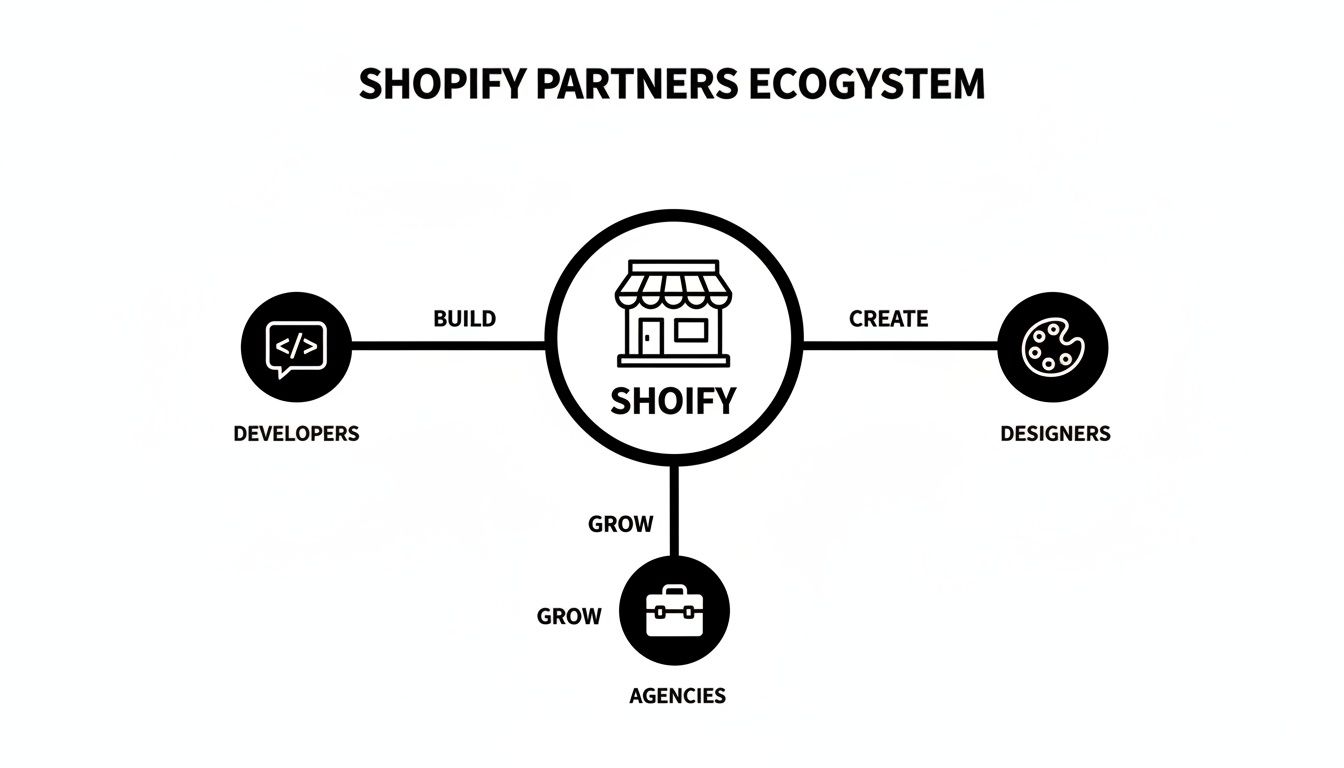
As you can see, while each partner type operates in their own lane, they're all driving toward a common destination: helping merchants succeed.
Path #1: The Builders (App And Theme Developers)
If you're comfortable with code and have a knack for solving problems, this is your fast lane to creating assets that generate recurring revenue. Developers are the architects of the Shopify world, building the very foundations and beautiful facades that merchants rely on every single day.
- App Developers: These folks are the ultimate problem-solvers. They spot a common merchant headache and build a software solution for it. For instance, a developer might create an app like Post-Bridge to seamlessly pull a WordPress blog into a Shopify store—a notoriously tricky task. Earnings come from one-time app sales or, more commonly, monthly subscription fees.
- Theme Developers: These are the visual storytellers and user experience gurus. They design and code the digital storefronts that captivate customers and drive sales. Their focus is on aesthetics, functionality, and conversion. Revenue comes from selling these themes on the official Shopify Theme Store.
Path #2: The Connectors (Affiliate Marketers)
Affiliate marketers are the evangelists, educators, and storytellers of the Shopify universe. Your main job is to introduce aspiring entrepreneurs to the platform and show them what's possible. This path is perfect for content creators, YouTubers, bloggers, and influencers who have built an audience that trusts their advice on e-commerce.
You earn a recurring commission for every single merchant you refer who signs up for a paid Shopify plan. To really succeed here, it’s all about creating genuinely helpful, authentic content that guides people toward the right tools for their business dreams.
Path #3: The Strategists (Shopify Experts, Agencies, And Freelancers)
This is a wide-open category for the hands-on specialists—the freelancers and agencies who get in the trenches with merchants to help them grow. They're the consultants, the project managers, and the implementation pros. A true Shopify Expert doesn't just build a website; they help build a business.
Think of a Shopify Expert as an e-commerce co-pilot. They might be brought in to navigate a tricky migration from another platform, fine-tune the store for better conversions, or take the controls on the merchant’s digital marketing. Revenue comes from project fees and ongoing client retainers.
This role demands a deep, practical understanding of e-commerce strategy. Some of the most common services offered include:
- Store Setup and Design: Building new stores from scratch, customizing themes, and configuring all the essential settings.
- Migration Services: Expertly moving a store from platforms like Magento or WooCommerce over to Shopify without losing data or SEO value.
- Growth Marketing: Running the campaigns that bring in customers, like SEO, paid ads (PPC), and email marketing.
- Conversion Rate Optimization (CRO): Digging into the analytics to find friction points and making data-backed changes to turn more visitors into buyers.
Shopify Partner Paths At A Glance
To help you visualize where you might fit, this table breaks down the four main paths, what they do, and how they make money.
| Partner Type | Primary Activity | How You Earn | Best For |
|---|---|---|---|
| App Developer | Building public apps to solve specific merchant problems | App sales & monthly subscriptions (SaaS) | Coders & product-focused entrepreneurs |
| Theme Developer | Designing and coding beautiful, high-converting storefronts | One-time theme sales on the Shopify Theme Store | Designers & developers with a strong UX/UI focus |
| Affiliate Marketer | Creating content that refers new merchants to Shopify | Recurring commission on referred merchant subscriptions | Content creators, influencers, and educators |
| Agency/Freelancer | Providing hands-on services like setup, marketing, or CRO | Project fees, hourly rates, and monthly retainers | Marketers, designers, and e-commerce strategists |
Each of these avenues offers a powerful way to build a thriving business. Whether you’re someone who writes code, creates compelling content, or crafts brilliant growth strategies, there’s a spot for you in the Shopify Partners program. The trick is to honestly assess your skills and choose the path that gets you excited for the journey ahead.
What Are the Real Perks of Becoming a Partner?
Joining the Shopify Partner program is about much more than just earning a commission. It’s like getting a backstage pass to the entire Shopify ecosystem, giving you a powerful set of tools and resources that can genuinely give your business an edge. This isn't just about money; it’s about building a scalable, more efficient operation.
Think of it this way: Shopify hands you the keys to a fully-equipped professional workshop. Suddenly, you have access to all the high-end equipment, training manuals, and expert support you need to create amazing things for your clients. This access fundamentally changes your approach, letting you move beyond one-off gigs to building a sustainable, long-term business.

Build and Test Without the Risk
One of the best benefits, hands down, is getting access to unlimited development stores. These are fully-featured Shopify stores you can spin up for free to build client sites, test new apps, or just experiment without any financial pressure. You can play around with themes, load up apps, and mess with all the settings you want before a single dollar is spent on a subscription.
This sandbox environment is a total game-changer. If you run an agency, it means you can build a client's entire store and get their sign-off before you ever "hand over the keys." For a dropshipper, you could set up a test store to see if a new niche has legs using a tool like AliSave Pro before you invest any real capital.
Exclusive Training and Priority Support
The partner program isn’t just about the tools—it's also about the know-how. The Shopify Partner Academy is a goldmine of free training courses and official certifications. You can find deep dives on everything from basic store setup to advanced development and business growth strategies, helping you keep your skills sharp.
On top of that, partners get a direct line to specialized support. When you hit a wall with a tricky technical problem that the regular help desk can't solve, you can connect with a team that gets the partner side of things. This can save you hours of frustration and helps you deliver a much better final product to your clients.
The Shopify Partner badge itself becomes a powerful symbol of trust. It immediately tells potential clients you're a vetted professional who knows the platform inside and out, making it that much easier to land new projects.
The entire Shopify ecosystem thrives because of these specialized agencies and certified tech partners. For instance, top-tier Shopify Plus agencies often boost a merchant's sales by 1.5% to 3% just through their expert optimization work. It’s a clear example of the real-world value skilled partners bring to the table. You can read more about how Plus partners and apps drive growth on Shopify.com.
Navigating the Partner Application Process
Getting into the Shopify Partners program is pretty straightforward, but getting approved comes down to how well you present yourself. Think of your application as the very first project you pitch to Shopify. It’s your one shot to show them you’re serious and ready to bring real value to their merchants.
First things first, you'll need to sign up for a free Partner account. This instantly gives you the keys to the kingdom: the Partner Dashboard. This is your command center where you can spin up unlimited development stores, dive into training materials, and eventually, manage your earnings. But just getting in the door isn't the finish line.
What Shopify Looks For in a Partner
The team reviewing your application isn’t just ticking boxes on a form. They're looking for genuine partners who have a clear plan and a professional attitude. They want to see that you've done your homework and have a vision for how you'll help merchants grow their businesses. A vague, half-baked application is the quickest way to get a "no."
To make your application shine, you need to clearly communicate two things:
- Your Expertise: What's your superpower? If you're a developer, link to your portfolio. If you're a marketer, share case studies or results you've gotten for clients. Be specific about the skills you're bringing to the ecosystem.
- Your Business Plan: How are you going to use the program? Maybe you want to build groundbreaking apps, design beautiful themes, or provide hands-on services for clients. Even a simple, clear statement like, "I plan to help local small businesses get online by building custom Shopify stores," speaks volumes.
Presenting a Professional Application
Your application needs to scream professionalism, and that means backing up your claims. If you're new to the game and don't have a long list of clients, don't worry. You can easily build a killer portfolio piece using one of the free development stores you get with your account. Build a beautiful, functional demo store to show what you can do.
The goal is to prove you're not just kicking the tires—you're ready to build a real business on their platform. A polished portfolio, even if it only has one project, shows initiative and tells Shopify you mean business.
Finally, avoid the simple mistakes that trip people up. Make sure your business name sounds legit, your website (if you have one) is clean and professional, and your writing is free of typos. Every little detail adds up to the overall impression you create.
Remember, Shopify is investing in you just as much as you're investing in them. Your application is the first step in building that crucial trust and starting your journey as a Shopify Partner.
How Partners Drive Real-World E-commerce Growth
So, how does all this theory translate into actual business results? The real magic of the Shopify Partners program is how it helps people build smarter, leaner, and more profitable e-commerce businesses from the ground up. For partners, it’s not just about slapping a store together; it’s about architecting a success story for a merchant right from the start.
This partner-led growth is a massive reason why Shopify dominates the market. We're talking about a platform with 4.82 million stores worldwide. Partners are the backbone of this ecosystem, which now drives nearly $1 trillion in global sales. It’s a network that has become essential for sellers, from tiny startups to huge brands.
Let's look at a couple of real-world scenarios to see how different partners put the program's tools to work.

The Agency Workflow: Building for a Client
Picture a digital agency that specializes in launching new brands online. Their day-to-day process is a perfect illustration of how the partner program creates a professional, client-friendly workflow.
Here’s how it usually plays out:
- Discovery & Strategy: It all starts with a client call. The agency digs deep to understand the brand’s vision, business goals, and all the technical requirements.
- Risk-Free Development: Next, they spin up a free development store. This is their sandbox. They build the entire site—customizing the theme, installing apps, and loading up product data—without the client having to pay a dime in Shopify fees.
- Client Review & Tweaks: Once the first draft is ready, the agency sends a password-protected preview link to the client. This is the feedback loop, where they make adjustments until everything is just right.
- The Seamless Handover: With the client’s final sign-off, the agency transfers ownership of the store directly to them. The client picks a paid plan, the "for sale" sign goes up, and the store is officially live.
This methodical approach takes the risk out of the equation for everyone involved. It ensures the final product is exactly what the client envisioned before any money changes hands. A huge part of being a good partner is expertly guiding merchants through the process of launching a Shopify store, setting them up for success from day one.
The Entrepreneur's Path: Validating a Niche
But the program isn't just for big agencies. It's a game-changer for solo entrepreneurs and dropshippers who want to test new ideas without breaking the bank. The development store becomes a free lab for validating a market.
For an entrepreneur, a development store is a zero-cost laboratory. It's a place to build, test, and gather data on a new product idea before committing significant capital, turning a risky guess into a calculated business decision.
Here’s what that looks like in action:
- An entrepreneur spots a hot product niche on a platform like AliExpress.
- They create a free development store and use a tool to pull in high-quality product photos, videos, and customer reviews.
- They quickly build a simple, focused landing page or a small test store around that single product.
- Finally, they run a small, targeted ad campaign pointing to the development store to see if anyone bites. If the ads start converting, they know they've got a winner and can invest in a full launch with confidence.
If you want to dive deeper into making those clicks count, you might be interested in our guide on how to improve your e-commerce conversion rates. You can find it right here: https://alisavepro.com/how-to-improve-ecommerce-conversion-rates/
So you've mastered the basics and are building beautiful, functional Shopify stores. What's next? For partners with bigger ambitions, the path leads straight to Shopify Plus.
Think of Shopify Plus as the enterprise-level, high-performance engine of the Shopify world. It’s designed from the ground up for high-growth, high-volume brands that need serious power, scalability, and customization to compete on a global scale.
As a partner, this is your ticket to the major leagues. You'll move from helping startups get off the ground to collaborating with established industry giants. These brands aren't just running an online store; they're managing incredibly complex global operations, and they need specialized expertise to make it all work. That’s where a Shopify Plus Partner comes in.
The Role of a Shopify Plus Partner
These aren't your average store builders. Shopify Plus Partners are the architects and engineers behind enterprise-grade e-commerce systems. They're brought in to solve the big, hairy problems that keep CEOs up at night.
Their day-to-day work often involves:
- Complex International Expansion: Juggling multiple storefronts for different countries, each with its own language, currency, and local regulations.
- Custom API Integrations: Making Shopify talk to other massive systems like an enterprise resource planning (ERP) platform or a customer relationship manager (CRM). We have a great guide on how to integrate Shopify with Salesforce if you want to see what that looks like.
- Headless Commerce Builds: Separating the customer-facing website from the back-end commerce engine to create completely unique, lightning-fast shopping experiences.
Becoming a Shopify Plus Partner is a powerful growth strategy. By honing these advanced skills, you can graduate from smaller one-off projects to high-value, long-term enterprise contracts, creating a far more stable and profitable business for yourself.
The opportunity is staggering. Merchants on Shopify Plus, who are typically doing between $1 million and $500 million in annual revenue, are experiencing incredible growth—an average year-over-year increase of 126%. That figure absolutely dwarfs the broader industry average and shows why big brands are flocking to the platform. You can dig into more stats about Shopify Plus agency performance on wearepresta.com.
This trend confirms the massive long-term potential for any dedicated Shopify Partner ready to level up their skills and tackle bigger challenges.
Common Questions About the Shopify Partners Program
Jumping into something new always brings up a few questions. To help you figure out if this is the right move, I've put together some straight-to-the-point answers to the things most people wonder about before joining the Shopify Partners program.
The first question on everyone's mind is usually about money. So, is it free? Yes, the Shopify Partners program is completely free to join. There are no sneaky application fees or monthly charges to get started. You get access to unlimited development stores and all their training materials right away, without spending a dime.
How Quickly Can You Start Earning?
This really depends on which path you take. An affiliate marketer who already has an audience could start earning commissions in just a few weeks by simply creating the right content. A freelance developer might land their first paying client project in a month or two, right after they’ve built up a small portfolio to show off their skills.
Of course, some routes take a bit more time to get going.
- App and Theme Developers: Building a genuinely useful product that brings in passive income can easily take several months of coding, testing, and marketing before you see consistent sales.
- Agency Owners: Finding clients who will pay you a monthly retainer often involves a longer sales process, but it pays off with predictable, steady income down the road.
No matter which path you choose, having a clear plan from the get-go is the fastest way to see results.
The main thing to remember is that this isn't a get-rich-quick scheme. It's a professional platform designed for building a real, sustainable business. Your income is directly tied to the value you provide to merchants.
Do You Need to Know How to Code?
Nope, not at all. While coding skills are a must for App and Theme Developers who need to know their way around languages like Liquid, Ruby, and JavaScript, many of the most successful Shopify partners come from non-technical backgrounds.
The program is built to support all kinds of talent. Marketers, designers, SEO experts, and business consultants all run thriving businesses by leaning into what they do best and offering those services to merchants who need them.
Ready to build test stores and validate your product ideas? AliSave Pro helps you quickly gather high-quality product images and videos from AliExpress, making it easier to populate your development stores with compelling media. Streamline your workflow and create stunning mockups in minutes. Download AliSave Pro for free from the Chrome Web Store.