
Let's get one thing straight: "spying on ads" isn't about some underhanded corporate espionage. It's smart, essential market research. It's what separates the e-commerce brands that thrive from the ones that quietly fizzle out. This process uncovers a goldmine of information—from hot-ticket products to the exact marketing hooks that get people to click 'buy.'
Why Spying on Ads Is a Non-Negotiable for E-commerce Growth
Jumping into paid advertising without a clue what your competitors are up to is like trying to navigate a maze blindfolded. Sure, you might stumble upon the exit eventually, but you'll burn through a ton of time and cash hitting dead ends. The hard truth is that your most successful competitors have already torched thousands of dollars figuring out what works.
When you learn to properly analyze their ads, you gain an immediate strategic edge. You're not just scrolling through pretty pictures; you're actually decoding the market.
Crack the Code on Winning Strategies
By digging into your competitors' campaigns, you can essentially reverse-engineer their entire sales funnel. You'll see which products they're pushing the hardest, the types of discounts they're dangling, and the specific customer pain points their ad copy hits on. This isn't about mindlessly copying them. It’s about getting a feel for the market's pulse.
Think about it. If you see a major player in your niche suddenly running dozens of ads for a specific dog toy, that's a massive signal. They’ve already validated the demand for that product, giving you a powerful hint about what customers want right now. You can take that insight and find a similar—or even better—product to bring to your own audience.
Put Your Success on the Fast Track
The biggest win here is speed and efficiency. Instead of building your campaigns from a blank slate, you're starting with a foundation of proven concepts. This gives you a few key advantages:
- Slash Wasted Ad Spend: You get to skip the painful process of testing angles and creatives that have already flopped for others. Right from day one, your budget goes toward strategies with a much higher chance of success.
- Validate Products Faster: See what's gaining traction in real-time. This helps you make smarter inventory and marketing decisions before you sink a bunch of money into a new product line.
- Craft Better Offers: Get a clear picture of the promotions and price points that actually move the needle with your target audience, so you can build more compelling and irresistible deals.
The goal isn't imitation, it's inspiration. By observing what works for others, you can learn the underlying principles of a successful campaign and apply them to your unique brand voice and products.
Ultimately, learning to analyze ads transforms you from a passive advertiser into a proactive market researcher. It gives you the data you need to build campaigns that convert, spot winning products before they're oversaturated, and confidently scale your e-commerce business.
Your Ad Spying Toolkit for Every Major Platform
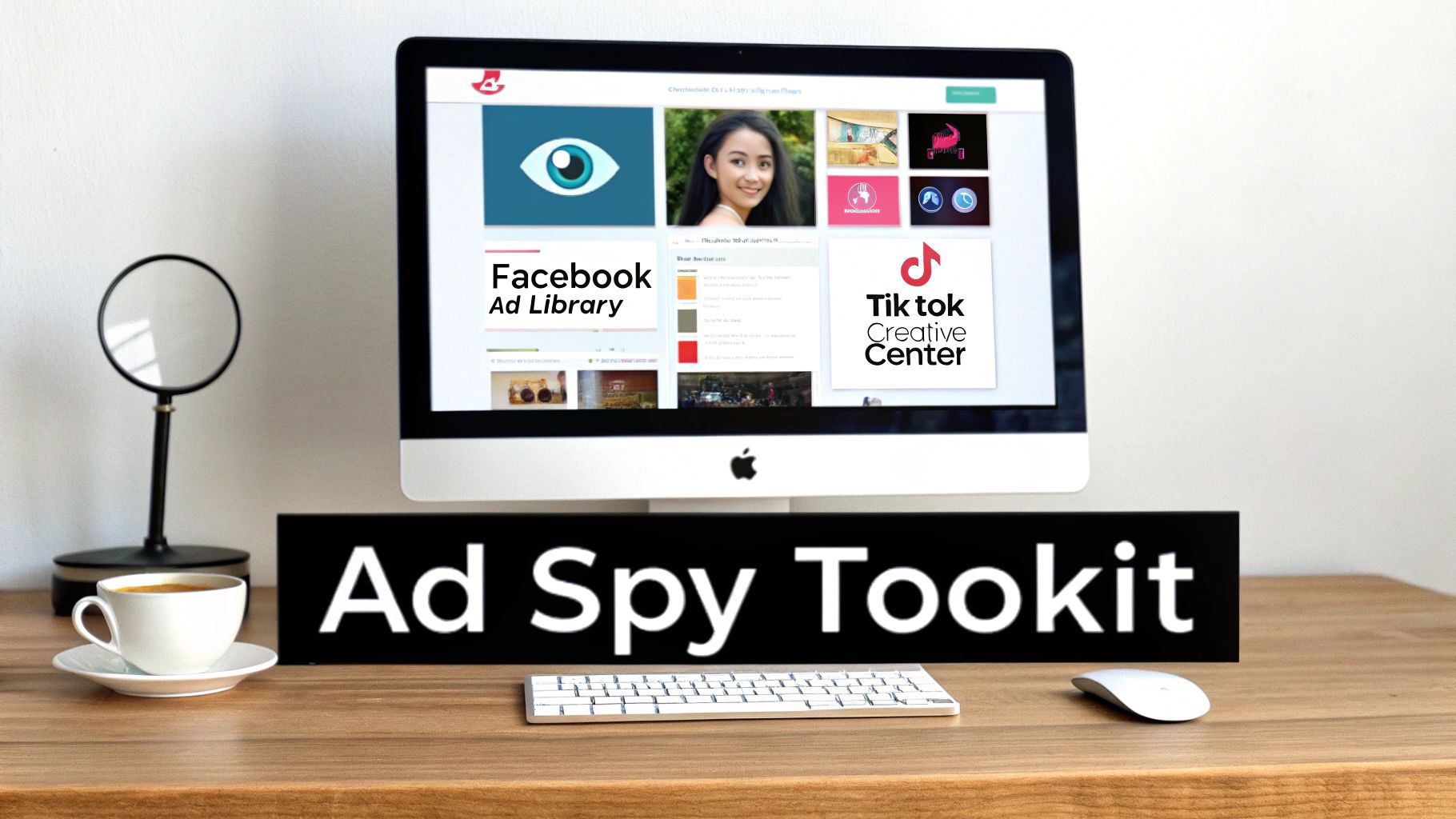
Knowing you need to spy on ads is one thing, but having the right tools turns that idea into a real, actionable strategy. The best part? You don't need to shell out for an expensive subscription to get started. The ad platforms themselves give you incredibly powerful, free resources that are perfect for building a solid research habit.
Think of these native tools as your basic field gear. The data comes straight from the source, so you know it's accurate. This is ground zero for your entire competitor research process.
Mastering the Free Platform Libraries
Every big ad network has some kind of transparency tool, usually called an "Ad Library." These are basically searchable databases of all the ads currently running on their platform. While they were built for public accountability, for e-commerce owners like us, they're an absolute goldmine.
Here are the ones you'll be living in:
- Facebook Ad Library: This is the undisputed king. You can look up any advertiser's page and see every single ad they're running across Facebook, Instagram, Messenger, and the Audience Network. It's shockingly comprehensive.
- TikTok Creative Center: This one is a bit different. It’s less of a direct competitor search tool and more of a trend-spotting hub. It’s fantastic for seeing what’s going viral, what sounds are popular, and what ad formats are killing it right now.
- Google Ads Transparency Center: This is your peek behind the curtain of a competitor's Google Ads strategy. You can see their search ads, display banners, and even video ads, giving you a crystal-clear look at the keywords they're bidding on and the angles they're pushing.
The real pro-move with these libraries isn't just plugging in brand names. The magic happens when you start searching for keywords in your niche. You'll stumble upon competitors you never even knew you had.
A Repeatable Workflow for Daily Research
To turn this from a one-off task into a daily habit, you need a simple, repeatable process.
I always start in the Facebook Ad Library. Pop in a competitor's business page and filter the results by your target country to see only their active ads. Look at their copy, their visuals, and their calls-to-action. One key signal I always watch for is ads that have been running for a long time—that's the market telling you that ad is profitable. For a deeper look at the strategy behind these winning ads, check out this guide on how advertising on Facebook works.
Next, I'll jump over to the TikTok Creative Center. Here, I’m not searching for brands. I’m searching for keywords related to my product. I want to see the style of the winning videos. Is it all user-generated content? Are unboxing videos popular? Or is it a problem-solution format? This is pure creative fuel.
Finally, I’ll take a quick look at the Google Ads Transparency Center. Seeing a competitor's text ads tells me their core value propositions and what offers they think are most compelling to get someone to click and convert.
When to Consider Paid Spy Tools
After a while, you'll start to feel the limitations of the free tools. They’re great for seeing what is running, but they don't give you performance metrics like estimated ad spend, reach, or engagement. They show you the ad, but not the results.
This is the point where you might consider a paid ad spy tool.
These platforms pull in data from millions of ads and layer on a much deeper level of analysis. They are an investment, no doubt. But for a store that's ready to scale aggressively, the insights you can pull from them can pay for the subscription many times over. Think of it as upgrading from basic reconnaissance to having a full strategic intelligence team.
How to Analyze Ad Creatives That Actually Convert
Spotting a competitor's top-performing ad is just the beginning. The real magic happens when you break down why it's working so you can borrow that brilliance for your own campaigns. A folder full of downloaded ads is just noise; the analysis is where you strike gold.
High-converting ads are more than just slick visuals—they're tiny, powerful sales engines. Every single element, from the first frame of a video to the final call-to-action, has a job to do. Your role is to shift from being a spectator to an analyst.
Deconstruct the Hook and Story
You have about three seconds to stop someone from scrolling. That's it. So, what’s the hook? Is it a jarring visual? A provocative question? Or a bold claim that’s impossible to ignore? A powerful opener is non-negotiable, and you need to figure out exactly how your competitors are earning that initial attention.
Once they have the user's attention, look for the narrative. The best ads almost always tell a quick story.
- The Problem: What specific pain point are they twisting the knife on?
- The Solution: How does the product swoop in as the hero of the story?
- The Transformation: What’s the promised land? What will life or business look like after using the product?
This simple framework is a classic for a reason: it creates an emotional connection, which is what actually drives people to click.
Breaking down the hook and story shows you the psychological levers an ad is pulling. It takes you from seeing what the ad shows to understanding why an audience actually gives a damn.
Evaluate the Copy and Call-to-Action
The visuals stop the scroll, but the copy does the heavy lifting. Pay close attention to the headline and primary text. What unique selling proposition (USP) are they hammering home? Is it about speed? Unbeatable quality? A rock-bottom price? The words they choose are a dead giveaway of their core marketing angle.
If you want to dive deeper into making your creatives work harder, you can explore advanced strategies like Dynamic Creative Optimization (DCO), which helps automate finding the most effective combination of ad elements.
Finally, look at the call-to-action (CTA). Is it a lazy "Shop Now"? Or is it something more compelling, like "Claim Your 50% Discount"? A great CTA is specific, creates urgency, and leaves no doubt about what the user should do next. For more on this, we break down several persuasive advertising techniques in another guide.
And here’s a pro tip: don't just look at the ad itself. Dive into the comments section and check the share count. Sky-high engagement is the ultimate social proof. It's a massive flashing sign that an ad isn't just being seen—it's resonating. That real-world feedback is often more valuable than any other metric you can find.
Building Your Creative Swipe File with AliSave Pro
Once you find a competitor’s ad that’s clearly crushing it, just bookmarking the link and moving on is a huge mistake. The ad could be taken down tomorrow. You need a solid system to capture, organize, and reference those golden nuggets of inspiration. This is where a swipe file comes in—it’s your personal, curated library of proven ad concepts that you can tap into anytime you're stuck for ideas.
Sure, you could manually screenshot and screen record everything, but that gets old fast. It’s slow, clunky, and leaves you with a messy desktop full of poorly named files. A tool like AliSave Pro is a total game-changer here, especially if you're in the dropshipping world. It lets you snag high-resolution product photos, variant images, and those all-important video ads directly from an AliExpress page in one go.
A Smarter Way to Collect Ad Assets
For dropshippers, this is how you level the playing field. You get access to the exact same high-quality media your competitors are using, making your own ads look just as polished from the get-go. No more tedious right-clicking and saving dozens of images one by one.
The whole process is incredibly straightforward:
- You spot a product on AliExpress with great-looking photos and videos.
- You use AliSave Pro to download everything.
- The tool zips it all up for you in a tidy, organized package.
This simple workflow completely sidesteps the headache of renaming files and sorting them into folders. We break down the exact steps in our guide on how to download images and videos from AliExpress. Following this method makes getting assets ready for your Shopify or WooCommerce store quick and painless.
Why You Need to Focus on Video Creatives
When you're spying on competitor ads to find what works, you’ll notice a pattern: video is king. This isn't just a hunch; it's a massive shift in the market. Global spending on video ads is on track to hit a staggering $268 billion by 2029, and digital channels now account for over 60% of all marketing budgets.
For anyone running a Shopify store, getting your hands on these video assets is non-negotiable. Top-performing ads often use authentic, user-generated style review videos, which we've seen can lift engagement by as much as 25% compared to a static image. That’s an insight you can use today.
Remember, a swipe file isn't just a folder of random ads. It's an organized, searchable database of market-tested ideas. Think of it as your ultimate shortcut to better, smarter ad creative.
As your collection of spied ads gets bigger, keeping it organized is everything. When you're ready to get serious, you might even look into specialized Marketing Asset Management Software. These tools let you tag, search, and manage your creatives as you scale, turning your simple swipe file into a powerful strategic resource for your next winning campaign.
Staying Ethical: Inspiration, Not Imitation
Let's draw a firm line in the sand right now. When you're digging into competitor ads, the mission is market research, not industrial espionage. You're there to understand strategic patterns and get inspired—not to commit outright plagiarism.
Falling into the copycat trap is more than just lazy. It can land you in some seriously hot water and poison your brand's reputation before it even gets off the ground.
Directly ripping off a competitor's creative or copying their ad text word-for-word is like building a house on a foundation of sand. It's not just the legal headaches like copyright and trademark infringement you have to worry about; it tells the market you have nothing original to say. Customers are smart—they can spot a cheap knockoff from a mile away.
Draw Inspiration, Not Blueprints
The smart, ethical approach is to deconstruct why an ad is working and then apply those principles to your own brand and product. Think of it as analyzing, adapting, and then creating—never just copying and pasting.
When you find an ad that’s clearly a winner, ask yourself these questions:
- What's the core emotion? Are they hitting on fear, desire, urgency, or maybe relief?
- What's the underlying formula? Is it a classic problem-solution story, a simple before-and-after, or are they leaning heavily on social proof?
- What's their unique angle? How are they positioning the product to cut through the noise?
Your job is to take these foundational ideas and filter them through your own brand's unique voice.
For example, if a competitor is crushing it with a user-generated video showing their product solving a common problem, the takeaway isn't to steal their video. The insight is that authentic, user-centric videos are resonating with your audience. That’s your cue to start creating your own.
True market leaders don't get there by being the best at copying. They win by understanding the market better and then delivering something fresh, new, and uniquely their own.
Building a Brand with Integrity
Your long-term success really boils down to building a brand that customers trust. Relying on imitation completely short-circuits that process.
By focusing on genuine inspiration, you start thinking like a real strategist. You develop the skills to innovate, test your own creative ideas, and build a marketing engine that is authentically yours. That’s the mindset that builds a sustainable, defensible, and respected business that can thrive for years.
Treat your swipe file as a book of ideas, not a book of answers.
From Ad Research to a Profitable Campaign
Alright, you've done the digging. You have a folder full of competitor ads, notes on their angles, and a pretty good idea of what's working. Now what? This is where we turn all that passive research into an active, profitable campaign.
The whole process is about connecting the dots. It starts with spotting your top rivals and methodically breaking down their ads using the platform libraries we've covered. Then you dive into their creative formulas—the hooks, the storytelling, the offers—to see what makes their audience tick. The final piece is gathering top-notch media for your own ads, and this is where a tool like AliSave Pro becomes invaluable for quickly downloading high-quality product assets.
With the US digital ad market on track to hit USD 221.12 billion by 2030, just "running ads" isn't enough. You have to be smart about it. This is why successful dropshippers are constantly spying on competitor ads; it’s a critical part of staying ahead. You're not just guessing what visuals or copy will work—you're learning from what's already proven to get clicks. If you're interested in the numbers, you can learn more about these advertising market trends and see why this is so important for e-commerce.
Putting Your Ad Spying Plan into Action
So, how do you make this a repeatable system? I've found the most effective way is to follow a simple three-stage process for every single winning ad you find.
This isn't about mindless copying. It's a strategic workflow for analysis, adaptation, and creation.
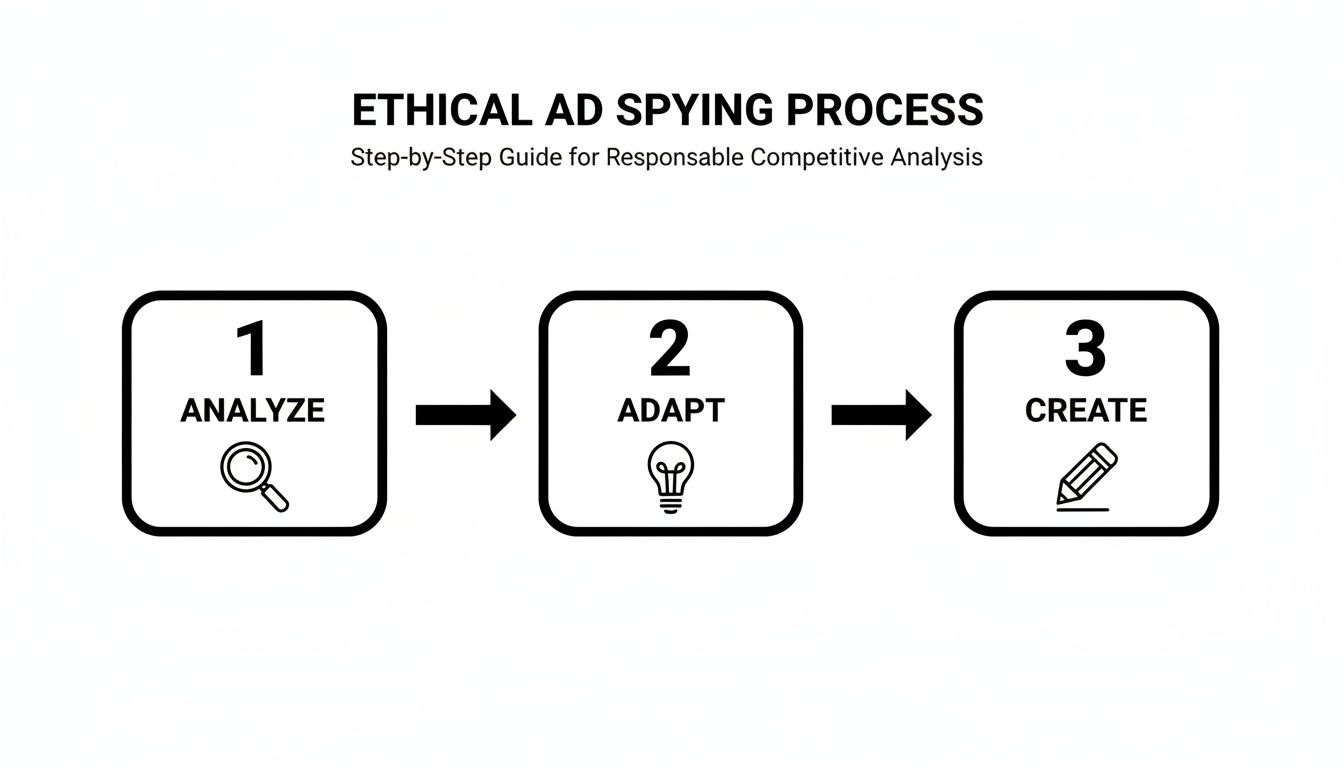
Think of it as a funnel. You start broad by understanding why something works, then you narrow it down to create something that's uniquely yours but built on a successful foundation.
Analyze: First, you have to be a detective. Break down the ad piece by piece. What's the core message? What emotion are they tapping into? Is it urgency, curiosity, or relief? Pinpoint the exact call-to-action they use to get the click.
Adapt: This is the most crucial step. You're not stealing their ad; you're borrowing the strategy behind it. Take the underlying principles—the hook style, the problem they solve, the offer structure—and brainstorm how to apply them to your product and brand voice.
Create: Now, it's time to build. Using the high-quality assets you've gathered, produce your own fresh, compelling ad. It’s inspired by a proven concept, but the execution is entirely yours.
To make this even clearer, here’s a quick-reference table summarizing the entire workflow.
Ad Spying Workflow Summary
| Stage | Key Action | Best Practice |
|---|---|---|
| Analyze | Deconstruct a competitor's winning ad | Identify the hook, emotional trigger, and call-to-action (CTA). |
| Adapt | Brainstorm applications for your own product | Focus on the underlying strategy, not the exact creative. |
| Create | Build a new ad using your gathered media assets | Produce a unique ad inspired by the proven formula. |
Following this simple Analyze, Adapt, and Create model keeps you on the right side of the ethical line while ensuring your ad budget is spent on concepts with a much higher chance of success. It transforms competitor research from an academic exercise into a repeatable system for launching winning ads.
Got Questions? We've Got Answers
Even the most seasoned marketers have questions when they start digging into competitor ads. It's only natural. Let's tackle some of the most common ones that come up.
Is This Even Legal?
Yes, it absolutely is. Think about it: platforms like the Facebook Ad Library and Google’s Ads Transparency Center were built specifically for public viewing. Using these public resources for market research is completely fine and exactly what they're there for.
The line you don't want to cross is plagiarism. Taking inspiration is one thing; directly ripping off a competitor's ad copy, video, or image is another. That's where you can run into real trouble with copyright laws.
How Do You Spot a Winning Ad?
This is the million-dollar question. While the ad libraries won't give you a direct look at a competitor's ROAS, there are some dead giveaways that an ad is crushing it.
- How long has it been running? This is my number one signal. Nobody keeps pouring money into an ad that isn't making it back. If you see a campaign that's been active for weeks or even months, you can bet it's profitable.
- What does the engagement look like? A ton of likes, comments, and shares is a massive clue. This social proof tells you the ad is hitting a nerve with the right people.
- Are they testing variations? When you spot a brand running multiple versions of the same core ad—maybe with different headlines or visuals—it’s a sign they've struck gold. They're not just running a successful ad; they're actively trying to scale a winning formula.
Pro Tip: Time is the truest test. If an ad has been live for more than 30 days, treat it like a proven winner. It's a concept you should dissect and learn from.
What if I Can't Find My Competitor's Ads?
This happens all the time, so don't panic. You search for a brand, and… crickets. It might mean they’ve paused their campaigns, or they could be running ads under a completely different brand name or page—a common tactic.
When a direct search fails, it's time to pivot. Instead of searching by the brand, start searching by keywords related to your products or niche. Honestly, this is often a better approach anyway. It forces you to look beyond your known rivals and discover the "hidden" players in your market, giving you a much richer picture of what's actually working.
Ready to stop screenshotting and start building a real swipe file of winning creatives? With AliSave Pro, you can instantly download all the high-resolution product photos and videos you need from any AliExpress listing. One click is all it takes.
Download AliSave Pro for free from the Chrome Web Store and start building your library of high-converting assets today.