
Let's get right to it: Yes, advertising on Facebook still absolutely works. But it's not a magic money machine. Think of it less like buying a lottery ticket and more like planting a garden—success depends on having the right seeds (your offer), good soil (your audience), and consistent care (your strategy).
The Real Answer to "Does Facebook Advertising Work?"
The question isn't really if Facebook ads are effective. The real question is how to make them effective for your specific business. It's all about alignment. Trying to sell snow shovels in Miami is a losing game, no matter how brilliant your ad campaign is. The product and the audience just don't match.
Facebook gives you a massive stadium and a powerful microphone, but you still have to know who's in the crowd and what you want to say. For ecommerce and dropshipping stores, the platform’s power is in its incredibly granular targeting. You can zero in on potential customers based on their interests, what they buy, and who they are with a precision that old-school advertising could only dream of.
Why It's Still a Go-To Channel for Growth
Despite all the talk about new platforms and changing algorithms, Facebook remains a dominant force. The numbers alone tell a compelling story.
Here's a quick look at the core metrics that underscore why savvy businesses continue to invest heavily in the platform.
Facebook Advertising At a Glance
| Metric | What It Means | Why It Matters for Your Business |
|---|---|---|
| 2.9 billion monthly active users | This is the sheer number of people logging into Facebook every month. | It means your target audience, no matter how niche, is almost certainly on the platform and reachable. |
| $142 billion in annual ad revenue | This is the amount of money businesses globally spend on Facebook ads. | Big spending signals strong ROI. Businesses wouldn't pour this much money into something that didn't deliver results. |
These figures aren't just vanity metrics; they represent a massive, engaged audience and a proven, trusted advertising ecosystem. You can dig deeper into the lasting effectiveness of Facebook Ads at graphicwise.com to see how it continues to drive growth.
Ultimately, getting Facebook ads to work boils down to nailing a few key things:
- Audience-Offer Match: Are you showing the right product to the right people?
- Compelling Creative: Do your images and videos stop someone mid-scroll and make them pay attention?
- Clear Call to Action (CTA): Is it obvious what you want them to do next?
When you get these pieces right, Facebook advertising shifts from a costly gamble to a predictable, scalable engine for growing your business. This guide is all about showing you how to build that engine, step by step.
How Facebook Ads Pinpoint Your Customers
Ever find yourself scrolling through your feed and suddenly see an ad for something you were just thinking about? It's not magic, and your phone isn't listening in. It's the incredibly smart (and slightly creepy) power of Facebook's advertising platform at work.
Think of it less like a traditional auction where the top bidder simply wins the ad spot. Instead, it’s more of a sophisticated matchmaking service, designed to connect your specific product with the people most likely to buy it.
This whole system runs on a staggering amount of data. Facebook doesn't just know basic demographics like age and location; it understands interests, purchase behaviors, and online interactions. It's like a massive digital library where every user has a detailed profile, cataloging everything from the pages they've liked to the videos they've watched.
The Brains Behind the Machine
When you set up an ad campaign, you're not just blasting a message out to millions of random people. You're giving Facebook a detailed profile of your ideal customer. You can tell it to find users who are into dropshipping, follow key e-commerce figures, or even people who recently checked out a competitor's online store.
Facebook's algorithm then sifts through its enormous library to find the profiles that are a perfect match for your criteria. This is the secret sauce. This level of precision is why Facebook ads can be so incredibly effective. The numbers back it up, too; for instance, the average click-through rate (CTR) for Facebook lead-gen ads hovers around 2.53%, with conversion rates hitting an average of 8.78% across all industries. You can dive deeper into the data on why Facebook advertising remains a powerful tool on graphicwise.com.
Your Secret Weapon: The Meta Pixel
So, how does Facebook know someone visited your competitor or added one of your products to their cart? The key is a tiny but mighty tool called the Meta Pixel.
The Pixel is a small snippet of code you install on your website. It acts like a silent scout, anonymously reporting back to Facebook on the important actions visitors take.
Think of the Meta Pixel as your direct hotline to Facebook's algorithm. It feeds the system critical data on who is buying from you, which then allows the algorithm to go out and find more people just like them. This is how powerful Lookalike Audiences are built.
Here's just a sample of what the Pixel can keep an eye on:
- Page Views: Who’s browsing your product pages.
- Adds to Cart: Who has shown serious interest but hasn't pulled the trigger yet.
- Purchases: Who your actual, paying customers are.
This data is pure gold. It unlocks the ability to run razor-sharp retargeting campaigns, like showing a specific ad to someone who abandoned their cart, gently nudging them to complete their purchase. Once you grasp how Facebook's tools actually find your customers, you stop guessing and start making smart, data-backed decisions that drive real sales.
What Good Performance on Facebook Really Looks Like
So, you want to know if your Facebook ads are actually working? The only way to find out is to stop guessing and start measuring. Without solid benchmarks, you're just throwing money into the wind, hoping something sticks. Defining what "good" looks like for your business is the first real step toward building a campaign that actually makes you money.
Performance isn't a one-size-fits-all metric. It changes wildly from one industry to the next. A dropshipper selling niche gadgets will see totally different numbers than a local plumber running ads for emergency repairs. Knowing these differences helps you set goals that are ambitious but achievable.
Setting Your Performance Baseline
Think of metrics like Click-Through Rate (CTR), Cost Per Click (CPC), and Conversion Rate (CVR) as your campaign's vital signs. They tell you a story about how well your ads are resonating with the people you’re trying to reach. A low CTR might mean your creative is boring, while a high CPC could signal you're in a super competitive niche.
The good news? Recent data shows that advertisers are getting better at grabbing attention on Facebook. The average CTR has shot up from 0.9% to 2.0%—that's a massive 122% jump. Meanwhile, the average CPC has actually fallen by nearly 20%, from $1.72 down to $1.38, suggesting that targeting is getting sharper across the board.
This chart gives you a quick visual breakdown of how ad effectiveness stacks up across a few key business types.
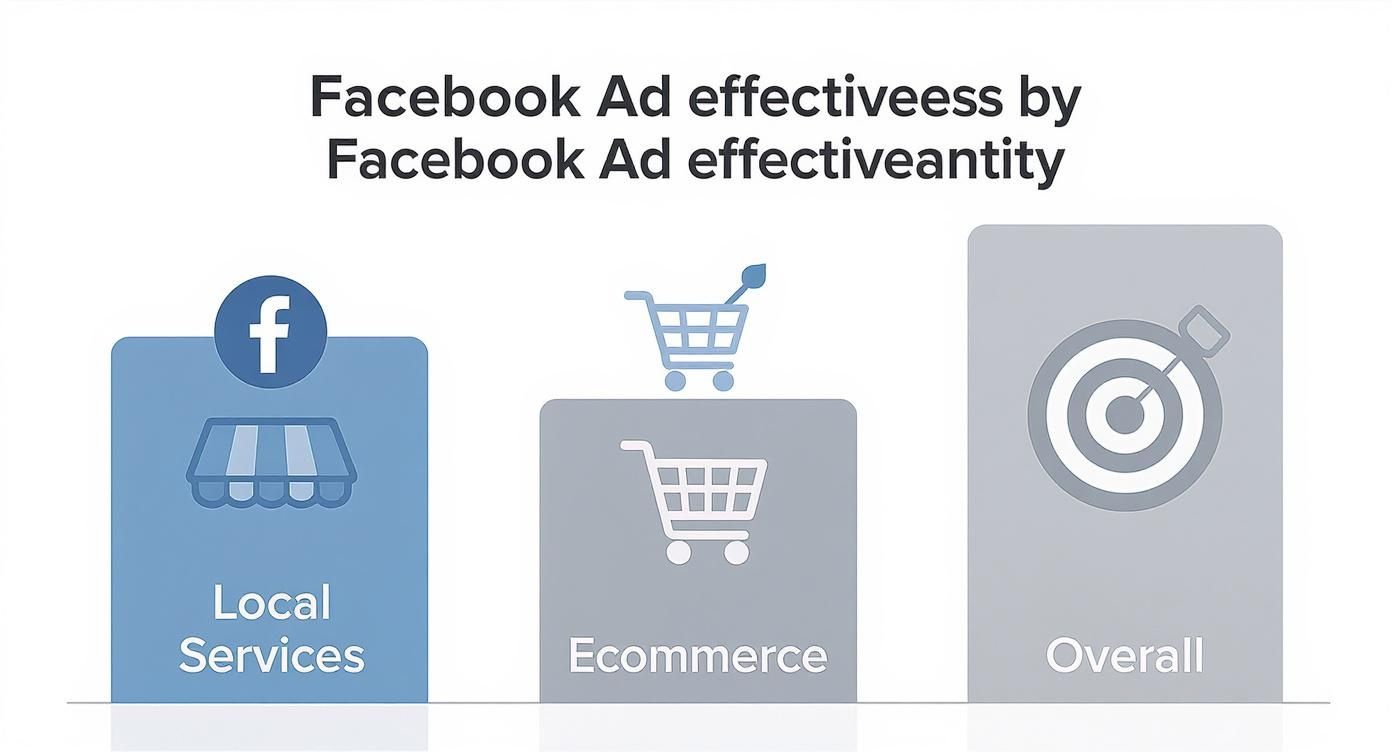
As you can see, specialized sectors like e-commerce often pull ahead of the general average. It’s a clear sign that a well-aimed, targeted strategy pays off.
Facebook Ads Industry Benchmarks Comparison
To give you a clearer picture, here's how some of the core metrics stack up across different industries. Remember, these are just averages—your mileage may vary.
| Industry | Average CTR | Average CPC | Average CVR |
|---|---|---|---|
| Retail | 1.59% | $0.70 | 3.26% |
| Apparel | 1.24% | $0.45 | 4.11% |
| Beauty | 1.16% | $1.68 | 3.73% |
| Technology | 1.04% | $1.27 | 2.31% |
| Fitness | 1.01% | $1.90 | 14.29% |
Use these numbers as a starting point. If your CVR is way below your industry's average, it might be time to look at your landing page or your offer. If your CPC is sky-high, maybe your audience is too broad or your ad creative isn't compelling enough.
Looking Beyond Individual Metrics
While benchmarks are handy, don't get tunnel vision. A high CPC might look scary at first glance, but if it leads to a big sale, who cares? I’d much rather pay $5 for a click that turns into a $200 purchase than $0.50 for a click that goes nowhere.
The ultimate scoreboard here isn't about low costs; it's about high profits. The only metric that truly matters is your Return on Ad Spend (ROAS). For every dollar you put in, how many are you getting back?
As you dial in your strategy, it’s also smart to get a feel for other costs, which involves understanding what is a good CPM (Cost Per 1,000 Impressions). This helps you see the full picture of your ad efficiency, from the first time someone sees your ad to the moment they click "buy." At the end of the day, a winning Facebook ad strategy is simply one that brings in more money than it costs. Period.
Why Some Facebook Ad Campaigns Win and Others Fail
Success on Facebook isn't about luck or stumbling upon some secret "hack." It's the predictable result of a smart, cohesive strategy versus a disjointed one. The line between a campaign that prints money and one that just burns it often comes down to a few fundamental elements done right.
Winning campaigns treat the ad as the start of a conversation, not the end of one. They nail the combination of a scroll-stopping visual, a clear offer, and a message that connects with a very specific audience. On the flip side, losing campaigns usually make a handful of classic mistakes that kill their results before they even have a chance.
The Anatomy of a Winning Campaign
The best advertisers have a knack for thinking just like their customers. They engineer a smooth, seamless journey from the moment someone sees their ad to the final click at checkout. That consistency is everything.
These campaigns almost always crush it in three key areas:
- Audience-Message Match: The ad feels like it was made just for you. It speaks directly to a well-defined audience’s problems or aspirations, making the offer feel both relevant and urgent.
- High-Quality Creative: They use authentic, eye-catching images and videos that build trust and show off the product in the best possible light. Sourcing professional-grade media, for example, can give your performance a massive lift.
- Congruent Experience: The landing page is a perfect reflection of the ad's promise. The visuals, the tone, and the offer all match up, creating a frictionless path to purchase.
A winning ad doesn't just sell a product; it solves a problem. It connects an emotional hook in the ad to a logical solution on the landing page, making the purchase feel like the only sensible next step.
Common Reasons Facebook Ads Fail
Failing campaigns are usually a story of missed connections. You might have a fantastic product but completely botch how you communicate its value. Or maybe you're reaching thousands of people who couldn't care less about what you're selling. The root cause typically falls into one of these buckets.
Frequent Stumbling Blocks:
- Vague Targeting: Trying to advertise to everyone is the same as advertising to no one. Without a specific customer profile in mind, your message gets completely lost in the noise.
- Weak or Generic Creative: Low-resolution images, boring copy, or ads that look identical to every other one in the feed are the fastest way to get ignored. You can explore more persuasive advertising techniques to make your creative pop and actually drive action.
- A Disconnected Funnel: This is a big one. If your ad screams about a 50% discount but the landing page is silent about it, you instantly create distrust and lose the sale.
At the end of the day, making Facebook ads work is a game of alignment. When your audience, creative, offer, and landing page are all singing from the same hymn sheet, you build a powerful, predictable engine for growth.
Your Game Plan for Getting Started on Facebook
Theory is one thing, but making a profit is what really matters. For anyone in ecommerce and dropshipping, winning on Facebook isn't about luck; it's about a disciplined, test-driven approach. Forget dumping a huge budget into an unproven product. The smart money starts small and learns fast.
Your first objective isn’t to strike it rich. It's to collect data. You can learn a surprising amount with a modest test budget—think $15-$25 per day. Let it run for at least 3-5 days before you touch anything. This gives Facebook's algorithm enough time to breathe and start finding the right people for your offer.
During this initial phase, you need to be laser-focused on one thing: A/B testing. It's just a fancy way of saying you're running a simple experiment, pitting different ad elements against each other to see which one performs best. The key is to change only one thing at a time.
How to Structure Your First Test Campaign
The easiest—and most powerful—place to start is by testing your ad creative. The photos and videos you use are what will make someone stop scrolling, and it's your first, best chance to make an impression. A blurry, generic photo screams "amateur," but a sharp, professional video can build trust in a matter of seconds.
Here's a straightforward testing framework to get you going:
- Lock in Your Audience: For this first test, keep your audience the same across all ads. A broad interest group related to your product is a great starting point.
- Write One Set of Ad Copy: Craft one solid headline and description that you'll use for every ad in the test.
- Vary Your Creative: This is the one piece you'll change. Create at least three different ads using the same audience and copy, but switch up the media:
- Ad 1: A clean, high-resolution product photo on a simple white background.
- Ad 2: A lifestyle shot showing your product in a real-world setting.
- Ad 3: A short, punchy video that highlights the product's main benefit.
After a few days, the data will do the talking. You'll see which ad creative is getting the most clicks, engagement, and hopefully, sales. That winning creative then becomes your control group for the next round of tests, where you might start experimenting with different audiences or headlines. Learning how to create video ads that actually convert is a skill that pays dividends here, turning good creative into profitable campaigns.
The Unfair Advantage of Top-Notch Media
Especially for dropshippers, finding great product photos and videos is a total game-changer. The generic supplier photos everyone else is using are tired and unconvincing. Taking the time to find or create unique, high-quality visuals isn't just a "nice to have"—it's how you stand out from the crowd.
Sourcing premium product photos and videos is the single highest-leverage activity you can do to improve ad performance. It builds trust, justifies price, and dramatically increases the perceived value of your offer before a user even clicks.
This is where tools built for dropshippers can give you a serious leg up. Many successful sellers use browser extensions to quickly grab all the media for a product, including user-submitted photos from reviews. This authentic content is often pure gold for ads.
Once you build a library of high-quality assets, you have the fuel to continuously test new business advertising ideas and keep your campaigns fresh. It all comes back to a methodical process: test, learn, and scale what works, all powered by creative that truly shines.
How to Measure Your True Return on Ad Spend
Impressions, clicks, and even a spike in "add to carts" feel great, but they don't pay the bills. When it comes down to it, the real test for any Facebook ad campaign is painfully simple: for every dollar you put in, how many dollars do you get back?
That simple ratio is your Return on Ad Spend (ROAS).
But here’s where a lot of advertisers get tripped up. They live and die by the ROAS number they see inside the Facebook Ads Manager. While that dashboard is a fantastic starting point, it only gives you a piece of the puzzle. It shows you the revenue your ads brought in, not the profit you actually put in your pocket.
Calculating Your True Profitability
To figure out if your campaigns are actually making you money, you have to dig a little deeper. You need to factor in all the real-world costs of getting that product into your customer's hands.
Here’s a quick breakdown of what you need to subtract from your revenue:
- Cost of Goods Sold (COGS): This is what you paid your supplier for the product itself.
- Shipping & Handling Costs: The price of postage, boxes, and everything else involved in shipping.
- Transaction Fees: The cut that payment processors like Stripe or PayPal take from every sale.
Once you subtract these costs, you'll see your actual profit margin. This is the only way to know for sure if you're in the black. For a full breakdown of the math, check out our guide on how to calculate retail margin and get a grip on your real numbers.
Your goal isn't just a high ROAS in Ads Manager; it's a profitable ROAS for your business. A 3x ROAS on a low-margin product could be a loss, while a 2x ROAS on a high-margin item could be a huge win.
Why a Break-Even Sale Can Be a Win
Thinking about the long game completely changes how you view your ad performance. Sometimes, just breaking even to get a brand new customer is a fantastic move. Why? Because of something called Customer Lifetime Value (LTV).
If that customer loves your product and comes back to buy again—this time without you having to pay to advertise to them—your overall profit from that single acquisition just shot through the roof.
This is where Facebook's targeting really shines. The platform's ability to dial in on specific interests helps advertisers achieve an impressive 5.1x average ROAS, which is well ahead of many other channels. And savvy advertisers know that bringing people back is key; 65% of advertisers push at least 30% of their budgets toward retargeting campaigns. As the tools have gotten better, their accuracy has improved by over 14%, making every dollar work harder. You can dive into more of these fascinating Facebook Ad statistics and findings here.
Got Questions About Facebook Ads? We've Got Answers.
Even with a solid plan, a few practical questions always pop up. Let's tackle some of the most common things ecommerce and dropshipping owners wonder about when they're getting started with Facebook ads.
How Much Money Should I Actually Spend on Facebook Ads?
When you’re first dipping your toes in, a daily budget of $10-$20 per ad set is a great starting point. It's a low-risk way to let the ads run for about a week and see what happens without burning through your cash.
The goal here isn't to spend a lot of money; it's to give Facebook's algorithm enough data to start learning who your best customers are. Once you find an ad and an audience that are clearly working, you can start inching the budget up. A good rule of thumb is to increase it by 15-20% every few days—this slow-and-steady approach keeps performance stable and prevents the algorithm from getting confused.
Are Facebook Ads Still Worth It After All the iOS Updates?
Absolutely, but the game has changed. Apple's privacy updates definitely made it harder to track what people do after they click an ad, but it didn't kill Facebook advertising. Success just requires a smarter, more well-rounded strategy.
The secret sauce is setting up Meta's Conversions API (CAPI) to work alongside your Pixel. Think of it as a direct, server-to-server data line that doesn't rely on browser tracking, giving you a much more accurate view of how your campaigns are performing.
These days, you'll want to focus more on broader targeting, creating ads that are genuinely interesting, and looking at the overall lift in your business—not just obsessing over every single click.
How Long Until I Start Seeing Results?
Patience is key here. Every new campaign goes through a "learning phase" that typically lasts 3-7 days. During this time, Facebook is essentially running small experiments, showing your ad to different groups of people to figure out who is most likely to buy. It's super important not to mess with the campaign during this window.
After about a week, you can start to get a feel for how things are going. But getting to the point of consistent, profitable sales? That often takes a few weeks of careful testing and making small adjustments. Don't get discouraged if you're not an overnight success.
Ready to create ads that stop the scroll and actually drive sales? The difference-maker is often your product visuals. With AliSave Pro, you can download high-resolution product photos, videos, and even customer review images directly from AliExpress with just one click. It's the fastest way to upgrade your ad creative, build trust, and give your campaigns the professional polish they need to stand out. Get started for free and see the difference it makes.