
So, what's the secret sauce for figuring out if a product is actually making you money? It all comes down to a simple, yet powerful, calculation: retail margin.
The formula is straightforward: (Retail Price – Cost of Goods Sold) / Retail Price. The result, expressed as a percentage, tells you exactly how much of the final selling price is pure profit. It's one of the most important health metrics for any ecommerce business, period.
Your Quick Guide to Calculating Retail Margin

Getting a grip on your retail margin is the first real step toward building a profitable online store. It's about looking past the flashy revenue number and finding out how much you actually keep from each sale after paying for the product itself.
This single number is your North Star for making smart pricing decisions, figuring out which products are worth your effort, and ultimately, keeping the lights on.
Let's use a quick example. Say you're selling a watch for $100. It cost you $60 to source it from your supplier. Your gross profit is a tidy $40. Using the formula—($100 – $60) / $100—we get 0.40.
That means you have a 40% retail margin. In plain English, for every dollar this watch brings in, 40 cents is your profit.
Breaking Down the Formula
To make sure your calculations are spot-on, let's be crystal clear about what each part of the formula means.
Here’s a simple breakdown of the components you'll be working with.
Retail Margin Formula Components at a Glance
| Component | Definition | Example Value |
|---|---|---|
| Retail Price | The final price you charge your customer for the product. | $100 |
| Cost of Goods Sold (COGS) | The total direct cost to get the product. This includes the supplier's price plus any shipping or import fees you paid. | $60 |
| Retail Margin | The percentage of the retail price that represents your profit. | 40% |
Understanding these terms ensures you're plugging the right numbers into your calculation every time.
This isn't just academic, either. It's especially critical in business models like dropshipping, where margins can often be thin. If you want to learn more about that world, our guide on how to start dropshipping is a great place to begin.
When you know your margin, you can confidently set prices that not only cover your costs but also give you the cash flow needed to grow your business.
Why Your Retail Margin Is the Ultimate Health Check for Your Store

Knowing how to calculate retail margin is one thing. But truly understanding why it's the heartbeat of your business is what separates the stores that last from the ones that fizzle out. Stop thinking of it as just a math problem—it’s the most honest indicator of your store's financial health.
When you consistently track your margin, you can look right past those big, flashy revenue numbers and see what's really going on. It’s the one metric that tells you which products are actually bankrolling your growth and which ones are just dead weight, maybe even costing you money. This insight is where all your smart pricing decisions should start.
Using Margin Data to Navigate a Shaky Market
In a calm market, a healthy margin is your foundation for growth. In a volatile one? It’s your lifeline.
Picture this: your supplier costs suddenly jump, shipping fees go through the roof, or a new competitor starts a price war. Your margin data is what tells you exactly how much wiggle room you have. It shows you precisely where you can adjust your pricing without torpedoing your own profitability.
This isn't just a small-shop concern. The retail giants live and die by this number. We saw major players like Walmart and Target get squeezed by margin pressure, forcing them to completely rethink their strategies to protect their bottom line. Walmart, in particular, demonstrated how sharp, margin-focused pricing can help you outperform the competition, even when the economy gets rocky.
Your retail margin isn't just about this month's profit. It's about building a resilient business that can survive economic storms and jump on new opportunities. It tells the real story of your financial strength.
Getting the Full Picture of Your Business Performance
At the end of the day, strong margins are what give you the cash and the confidence to reinvest in your business. Want to ramp up your marketing? Develop that next great product? Create an amazing customer experience? Solid margins make it all possible. Without a clear view of your per-product profitability, you're just guessing.
While retail margin is a superstar metric, it doesn’t work alone. It’s most powerful when you look at it alongside other essential ecommerce performance metrics like your conversion rate and customer acquisition cost. Together, they paint the complete picture of your store’s success.
Margin vs Markup: Don't Make This Costly Mistake
Confusing margin and markup is one of the most common—and frankly, most dangerous—mistakes new ecommerce sellers make. I’ve seen it happen time and time again. They seem similar because they both involve profit, but they look at it from completely different angles.
Mixing them up is a fast track to underpricing your products and silently eating away at your bottom line.
Think of it this way: Retail margin is your profit as a percentage of the selling price. It answers the real-world question, "For every dollar a customer pays me, how many cents are actually mine to keep?"
On the other hand, markup is your profit as a percentage of your cost. This answers a different question: "How much did I mark up my product's cost to decide on a price?"
Let's break it down with a simple, real-world example to make this stick.
An Example That Explains Everything
Imagine you're selling a phone case. The total cost to get that case ready to sell (your COGS) is $10. You decide to sell it in your store for $20. Easy enough, your gross profit is $10.
Here's where the path splits:
- To find your retail margin: You take your profit ($10) and divide it by the selling price ($20). That gives you 0.50, which means you have a 50% margin.
- To find your markup: You take that same $10 profit but divide it by your cost ($10). This gives you 1.0, or a 100% markup.
That's right—a 100% markup only gets you a 50% margin. This is the trap. So many sellers hear "100% markup" and assume they're making a massive profit, but the numbers tell a different story. If you mistakenly aim for a "50% markup" thinking it's a 50% margin, you'd price your product at just $15. Your actual margin would plummet to 33.3%.
This isn't just about semantics; that difference is what pays for your marketing, software subscriptions, and ultimately, your salary.
Key Takeaway: Margin is your reality check. It's based on the final sale price and gives you a true picture of how profitable each sale really is. Markup is a tool for setting prices, but it doesn't tell the whole story about your business's health.
To really hammer this home, let's put them side-by-side.
Margin vs Markup Key Differences
This quick table uses our phone case example to show the two metrics in action.
| Attribute | Retail Margin | Markup |
|---|---|---|
| Calculation Base | Selling Price | Cost of Goods Sold (COGS) |
| Formula | (Price – Cost) / Price | (Price – Cost) / Cost |
| Perspective | Profitability as a % of revenue | Price increase relative to cost |
| Our Example | ($20 – $10) / $20 = 50% | ($20 – $10) / $10 = 100% |
When you're trying to figure out how healthy your business is, always, always focus on margin. It's the most accurate reflection of your actual profitability.
Calculating Margin in Real-World Ecommerce Scenarios
Theory is great, but your business lives in the real world of messy, unpredictable numbers. Let's move past the basic formulas and walk through how to calculate retail margin with practical examples every e-commerce seller runs into. This is where you'll see just how much hidden fees and variable costs can eat into your actual profits.
Let's start with a pretty straightforward scenario: you're selling handmade candles sourced from a local artisan.
- Cost per candle: $12.00
- Packaging cost: $1.50 per box
- Total COGS: $13.50
- Selling Price: $30.00
Plugging those numbers into the formula—(Price – COGS) / Price—we get ($30.00 – $13.50) / $30.00. That gives us a 55% margin. Not bad at all. But as you know, online retail is rarely this clean, especially once you start sourcing products from overseas.
Tackling a Complex Dropshipping Example
Now for a more complex, and far more common, situation: dropshipping a gadget from AliExpress. This is exactly where I see tons of new sellers trip up and miscalculate their way out of business.
Your Cost of Goods Sold (COGS) isn't just what the supplier charges you. You absolutely have to factor in every single expense it takes to get that product into your customer's hands. To get a true picture of your costs, you need a detailed breakdown, which is why a guide to calculate cost per unit is a lifesaver for anyone dropshipping.
Let’s map out the real costs for one gadget:
- AliExpress Product Price: $15.00
- Shipping to Customer: $5.00
- Payment Processor Fee (2.9% + $0.30 on a $45 sale): $1.61
- Total COGS: $21.61
If you price this gadget at $45.00, your real margin calculation looks like this: ($45.00 – $21.61) / $45.00. That works out to a 52% margin.
Notice the difference? If you had forgotten to include shipping and transaction fees, you'd think you were making a 67% margin. That’s a dangerously inflated number that could lead to some very poor business decisions.
Key Takeaway: Always calculate your margin using the fully "landed" cost of your product. This includes the item cost, shipping, transaction fees, and any import duties. It's the only way to know your true profitability on every single sale.
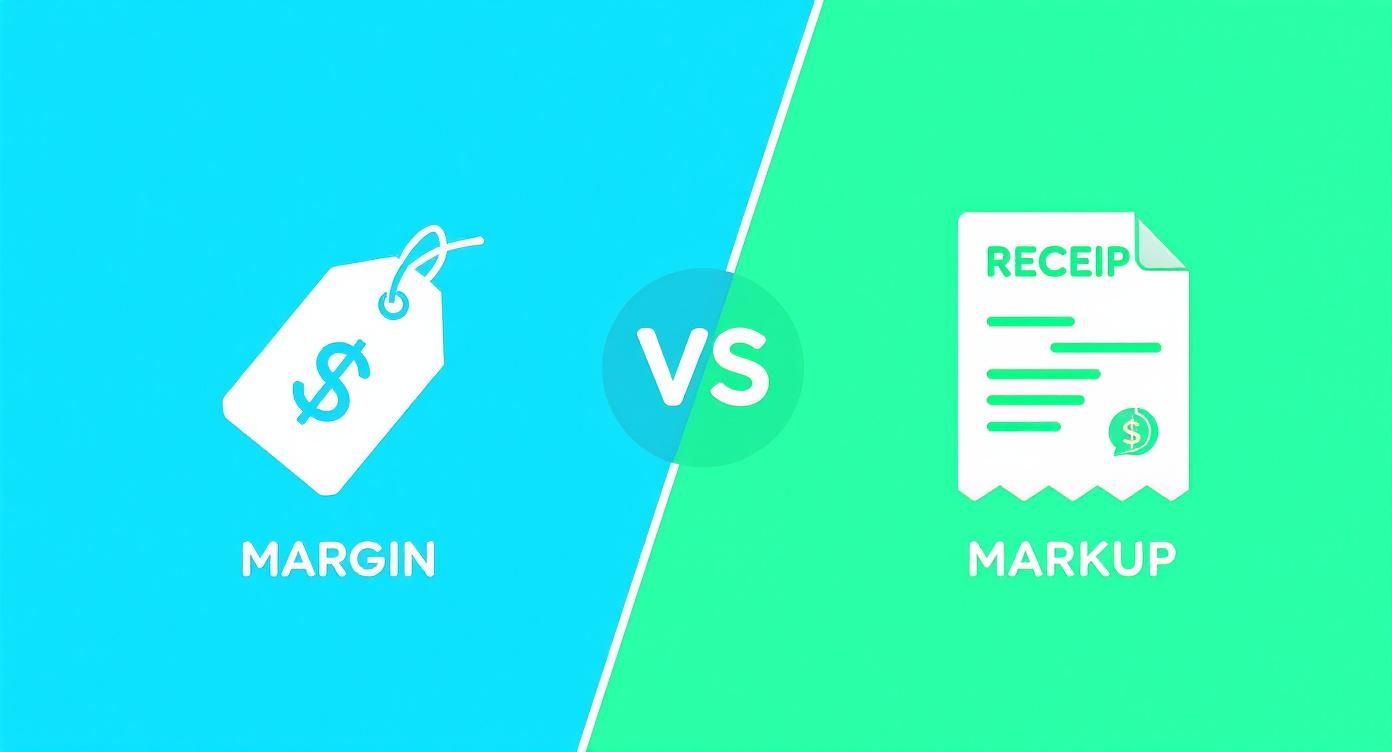
This infographic breaks down the crucial difference between calculating margin (based on the final price) and markup (based on your initial cost).
Getting this right is critical. Online-first retailers often have to work with tighter margins than traditional brick-and-mortar stores to stay competitive and win customers. To make sure your business is built to last, you have to know your numbers inside and out. If you're looking to optimize your store and stay on top of these details in a fast-moving market, you might want to explore comprehensive e-commerce solutions.
Actionable Strategies to Improve Your Retail Margin
Knowing how to calculate retail margin is like a doctor's diagnosis—it tells you what’s wrong. Improving it is the cure. Just tracking your numbers without taking action is a recipe for stagnation. Real growth happens when you actively work to widen that gap between what you pay for a product and what you sell it for.
This isn't just about hiking up your prices. It means getting smart about every single part of your business, from who you buy from to how your customers check out.
Strengthen Supplier Relationships and Reduce COGS
Your Cost of Goods Sold (COGS) is the biggest lever you can pull to directly impact your margin. Don't ever feel like you're too small to negotiate with suppliers. It's a normal part of business.
Ask about getting a small discount for paying invoices early. See if a slightly larger bulk order would knock a few cents off the per-unit cost. These small wins add up fast.
Building a solid, long-term relationship can also open doors to better pricing down the road. Think of it as a partnership—if you're growing and ordering more, they're growing, too.
It's also a good habit to regularly shop around for your suppliers. Are you still getting the best deal? Can a competitor offer similar quality for less? A tiny reduction in your unit cost can translate into a huge boost to your overall margin when you're selling hundreds or thousands of items.
Remember, a 5% reduction in your COGS can often be more impactful to your bottom line than a 5% increase in sales. Focus on what you can control.
Implement Smart Pricing and Bundling Tactics
Instead of a simple price increase, get creative with how you present value to your customers. Product bundling is one of my favorite ways to increase the average order value (AOV) while also selling more inventory.
Try out a few of these strategies:
- Pure Bundles: Pair a popular, high-margin "hero" product with a lower-cost, complementary accessory. This makes the customer feel like they're getting a great deal and boosts your total profit on the sale.
- Tiered Discounts: Encourage bigger buys with offers like "Buy 2, Get 10% Off." This increases your AOV without resorting to a sitewide sale that might devalue your brand.
Tactics like these don't just pump up your margin; they can actually make the shopping experience better. If you want to dive deeper into optimizing your sales funnel, check out our guide on how to reduce shopping cart abandonment.
Recent industry data on retail profitability metrics shows a fascinating trend: revenue is often growing faster than net profit. This tells us that many businesses are struggling to stay profitable as they scale. It’s a clear sign that focusing on operational efficiency and smart, data-driven pricing is more important than ever for long-term success.
Answering Your Top Retail Margin Questions
Once you start digging into the numbers that really drive your business, a few questions always seem to pop up. Getting a firm grip on these concepts is the difference between guessing and making smart financial decisions. Let's tackle some of the most common questions sellers have when they get serious about calculating retail margin.
What's a Good Retail Margin for an Ecommerce Business?
This is the million-dollar question, but there's no single magic number. The right margin can vary wildly from one industry to the next. A luxury handbag brand might be hitting margins of 60% or more, while a shop selling competitive electronics might have to survive on a much leaner 10-20%.
For most general ecommerce stores, a healthy and realistic target to aim for is somewhere in the 30-50% range. Your best bet is always to do some digging into your specific niche to see what the benchmarks are.
At the end of the day, a "good" margin is any number that covers all your operating costs—marketing, software, shipping supplies, you name it—and still leaves you with a decent net profit to reinvest and grow the business.
How Do Discounts and Promotions Affect My Margin?
This is a big one, and it trips up a lot of new sellers. When you're calculating the margin on an item sold during a sale, you have to use the final discounted price as your "Revenue." It's a mistake to use the original, full price; doing that will give you a dangerously inflated sense of your profitability.
Think about it this way: you have a product that costs you $50. You normally sell it for $100, which gives you a nice, clean 50% margin. But then you run a weekend sale and sell it for $80. Your margin on that sale just changed. The new math is ($80 – $50) / $80, which works out to a 37.5% margin.
Before you launch any promotion, always run the numbers to see how it will impact your margins. It's a quick check that can prevent you from accidentally selling at a loss or cutting into your profits more than you can afford.
Is Cost of Goods Sold Just the Product Cost?
Definitely not. Thinking this way is one of the most common and costly accounting mistakes a seller can make. Your true Cost of Goods Sold (COGS) needs to include every single direct cost involved in getting that product ready to sell.
That means you should be factoring in:
- The price you paid your supplier for the item.
- Inbound shipping and freight costs to get it to your warehouse.
- Any import duties or tariffs you had to pay.
- Product-specific packaging, like custom boxes or branded labels.
If you forget to include these "landed costs," your margin figures will look much better on paper than they are in reality, leading you to think your business is more profitable than it truly is.
Should I Focus on High Margin or High Volume?
Ah, the classic retail dilemma. There’s no single right answer here—it’s all about finding the strategy that fits your brand and your products.
High-margin products often move in lower quantities, but every sale packs a big profit punch. On the other hand, high-volume products typically have thinner margins and depend on selling a ton of units to generate a significant overall profit.
The most resilient businesses often have a mix of both. Take a look at your product catalog and try to identify your reliable "cash cows" (high volume, steady margin) and your exciting "stars" (high margin, big growth potential). Building a balanced portfolio means you aren't putting all your eggs in one basket.
One of the biggest time-sinks for sellers is just getting product media organized. With AliSave Pro, you can download every AliExpress product image and video with a single click, which means you can get your listings live so much faster. Give the free Chrome extension a try and see for yourself. Install AliSave Pro from the Chrome Web Store.