
So, what exactly is ecommerce order fulfillment? It’s the entire behind-the-scenes dance that takes a product from your online storefront to a customer's doorstep. Think of it as the engine powering your online business—it covers everything from storing your products and packing boxes to shipping orders and even handling the occasional return.
A rock-solid fulfillment process is the secret sauce behind happy customers and repeat business.
The Journey from Click to Customer
Let's use an analogy. Imagine your online store is a busy restaurant. When a customer places an order, it's like a waiter sending a ticket to the kitchen. Ecommerce order fulfillment is everything that happens in that "kitchen" to get the product prepared, packaged, and delivered perfectly to the customer's table. It’s this intricate series of steps that turns a simple click into a real-world, satisfying experience.
When this process runs like a well-oiled machine, customers get their orders fast and accurately, leave glowing reviews, and become loyal fans. But if it breaks down—think slow shipping, wrong items, or damaged packages—you can lose a customer's trust in an instant. Getting this right is about more than just logistics; it’s about delivering on the promise you make with every sale.
Core Components of the Fulfillment Process
At its core, the fulfillment journey is a chain of crucial steps that need to work together seamlessly. Each stage builds on the one before it, starting the second a customer hits that "buy" button.
Here’s a quick breakdown of what goes on behind the curtain.
The Core Stages of Order Fulfillment
| Stage | Description |
|---|---|
| Receiving Inventory | This is the first stop. Your products arrive from the supplier and are officially checked into your warehouse or storage facility. |
| Warehouse Storage | Once checked in, items are sorted and stored strategically so they can be found quickly when an order comes through. |
| Order Picking | A new order is in! Warehouse staff locate the correct items on the shelves and gather them for packing. |
| Order Packing | The picked items are carefully placed in the right-sized box or mailer with protective materials to ensure they arrive safely. |
| Shipping | Finally, the packed order is labeled, handed off to a shipping carrier, and starts its journey to the customer. |
This process ensures that every digital order becomes a physical reality delivered right to your customer.
This entire system is so much more than just moving boxes from point A to point B. It's the physical proof of your brand's reliability. A fantastic product is only half the story; getting it into your customer's hands quickly and correctly is what truly closes the loop.
The Growing Importance of Fulfillment
As online shopping has exploded, so has the demand for the infrastructure that supports it. The global market for ecommerce order fulfillment platforms is expected to grow from around $2.1 billion in 2025 to $3.1 billion by 2031. You can dive deeper into these numbers in this e-commerce fulfillment platforms market report.
This growth sends a clear signal: investing in a smart fulfillment strategy isn't just a good idea anymore—it's essential for survival and growth.
Choosing Your Fulfillment Model
https://www.youtube.com/embed/PWMrsDd36vE
Picking the right order fulfillment model is a lot like choosing the engine for your car. Your decision will directly impact your speed, efficiency, and how well you can handle the road ahead. Every successful brand has an operational backbone that perfectly matches its size, budget, and growth plans.
This isn't about finding a single "best" option. It's about finding the best fit for your business, right where it is today. Let's break down the four foundational models to see how they really stack up.
In-House Fulfillment: Total Control and a Personal Touch
In-house fulfillment (or self-fulfillment) is exactly what it sounds like: you handle everything yourself. From storing inventory in your garage to picking, packing, and shipping every single order, you’re in the driver's seat. It's the classic starting point for most new businesses.
The biggest perk here is the incredible control you have over your brand experience. Want to use custom packaging, tuck in a handwritten thank-you note, or just double-check every item? You can. This hands-on method is perfect for businesses with low order volumes, products that need special handling, or founders who want to keep a close, personal connection with their customers.
But that control comes at a price—your time and your ability to grow. As orders pick up, packing boxes can quickly eat up the hours you should be spending on marketing or product development. Before you know it, your living room has become a warehouse, and daily trips to the post office are a major bottleneck.
Third-Party Logistics (3PL): Scaling Up with the Pros
When you’re drowning in bubble wrap and shipping labels, it's time to call in the experts. A Third-Party Logistics (3PL) provider is a company that handles your warehousing, inventory management, and all the picking, packing, and shipping for you. You send your products to their fulfillment center, and they take over the moment a customer clicks "buy."
This model is built for scale. 3PLs have the warehouses, the tech, and the experienced teams to manage huge order volumes without breaking a sweat. They can also negotiate much better shipping rates than a small business ever could, which often translates into big savings. The trend is clear: 37% of ecommerce businesses now fully outsource fulfillment, while 60% do it at least partially.
The main trade-off? You have to let go of some direct control. You’re trusting another company to represent your brand at that final, crucial touchpoint. That’s why it’s so important to find a partner whose quality standards are as high as your own.
Dropshipping: The No-Inventory, Low-Risk Model
Dropshipping is a wildly popular fulfillment model where you don’t hold any inventory at all. When a customer places an order on your site, you simply pass it along to your supplier. That supplier then ships the product directly to the customer. Your profit is the difference between what you charge the customer and what the supplier charges you.
The biggest draw here is the incredibly low barrier to entry. You don't have to invest thousands of dollars in inventory upfront, which completely removes the risk of getting stuck with unsold stock. It’s a fantastic way for entrepreneurs to test out new product ideas or for anyone starting with limited cash. You can pour all your energy into what matters most: marketing and getting customers.
On the flip side, that lack of control can be a major headache. You're completely at the mercy of your supplier for product quality, shipping times, and even knowing if an item is in stock. Managing customer expectations can be a real challenge when you're not the one sending the package.
Key Takeaway: Your fulfillment model isn't a life sentence. Many businesses start with in-house fulfillment, move to a 3PL as they grow, and might even use dropshipping to test new product lines—all at the same time. The right strategy is one that evolves with your business.
Fulfillment by Amazon (FBA): Tapping into a Behemoth
Fulfillment by Amazon (FBA) is a powerful hybrid model where you use Amazon’s massive logistics network to do the heavy lifting. You send your products to an Amazon warehouse, and they handle the storage, packing, and shipping—whether you sell on the Amazon marketplace or your own website.
The instant you join FBA, your products become eligible for Amazon Prime's free two-day shipping, which is a massive conversion booster. It gives you immediate access to Amazon’s millions of loyal customers and its world-class reputation for fast, reliable delivery.
The catch? FBA comes with strict rules for inventory and packaging, and the storage fees can get expensive if your products don't sell quickly. You also give up a lot of branding control, since your items arrive in an Amazon box. You're playing in Amazon's sandbox, which means you have to play by their rules. For a deeper dive into managing shipping, our guide on finding the best shipping for small business is a great place to start.
Comparison of Ecommerce Fulfillment Models
Feeling a bit overwhelmed by the options? Don't be. Each model serves a different purpose and is designed for a different stage of business growth. This table breaks down the key differences to help you see which one might be the right fit for you.
| Model | Best For | Initial Cost | Control Level | Scalability |
|---|---|---|---|---|
| In-House | Startups, niche products, brands wanting a personal touch. | Low to Moderate | High | Low |
| 3PL | Growing businesses ready to scale and outsource logistics. | Moderate to High | Medium | High |
| Dropshipping | New entrepreneurs, testing products, low-capital ventures. | Very Low | Low | Moderate |
| FBA | Sellers focused on the Amazon marketplace, leveraging Prime. | Moderate | Low | High |
Ultimately, the best choice depends on your products, your budget, and your long-term vision. Use this comparison as a starting point to think critically about what your business needs not just today, but a year or two down the road.
Building Your End-to-End Fulfillment Workflow
Let's pull back the curtain on what really happens after a customer clicks "buy." A well-oiled ecommerce order fulfillment workflow is the invisible engine that turns a digital sale into a happy customer holding a package. Every step is a crucial link in the chain connecting your product to its new home.
Think of it like a relay race. A sloppy handoff at any point can lose you the race. The goal is to move the order smoothly and quickly through each phase, from a warehouse shelf all the way to the customer's front door.
Step 1: Receiving and Storing Inventory
The whole process kicks off long before an order is ever placed—it starts the moment your products arrive from the supplier. This isn't just about getting boxes off a truck; it's a careful, systematic check-in.
During receiving, your team (or fulfillment partner) has to:
- Inspect for Damage: First things first, check if the shipment arrived intact. Are the products up to your quality standards?
- Verify Quantities: Count everything. Does the number of items match what you ordered?
- Log into the System: Scan each item into your inventory or Warehouse Management System (WMS). This is the moment it officially becomes available for sale.
Once everything is checked in, products are put away. Smart storage isn’t about just finding an empty shelf. It's about organizing products so that your bestsellers are in the easiest-to-reach spots and using a clear labeling system (like SKUs) so you can find anything in a flash.
Step 2: Processing the Order
The instant a customer places an order, your ecommerce store pings your fulfillment center. This is where the digital world meets the physical warehouse. The order details flow into your WMS, which automatically confirms the item is in stock and generates a "picking list" for the warehouse crew.
This little automated check is your best defense against overselling. It prevents the nightmare scenario of telling a customer their item is out of stock after they’ve already paid for it.
Step 3: Picking and Packing the Items
With a picking list in hand, a warehouse team member zips through the aisles to grab the right items. Accuracy here is everything. Picking the wrong size, color, or a completely different product is a fast track to an unhappy customer and a costly return.
After being picked, the items head to a packing station. This part is way more than just stuffing things in a box.
The packing stage is your last chance to make a physical impression. It’s where you ensure the product arrives safely while also reinforcing your brand identity through custom boxes, branded tape, or thoughtful inserts.
A key part of your fulfillment plan is choosing the right e-commerce packaging solutions to keep products safe and make your brand look good. The right packaging protects against damage during transit and can even save you money on shipping by keeping the package size and weight down.
Step 4: Shipping and Final Delivery
Once packed and sealed, the box is weighed and a shipping label is printed. Then, it's handed off to your carrier of choice—be it USPS, FedEx, or DHL—to start its journey to the customer.
This is also the trigger point for your system to send out an automated shipping confirmation email with a tracking number. This simple step gives customers peace of mind and drastically cuts down on "Where is my order?" questions.
Step 5: Mastering Returns and Reverse Logistics
The job isn't done when the package is delivered. A truly great fulfillment process has a plan for returns, a process often called reverse logistics. Getting this right is just as important as getting orders out the door.
A smooth returns process typically includes:
- Giving customers a simple way to start a return.
- Inspecting returned items to check their condition.
- Processing refunds or sending out exchanges quickly.
- Getting undamaged items back into your inventory and ready to sell again.
As brands grow, this whole workflow gets more complicated. In 2025, a whopping 36% of ecommerce brands are planning to expand internationally, and 78% already sell on two or more channels. These numbers show why you need a fulfillment system that can handle orders from multiple places and ship them all over the world. These growing fulfillment trends make it clear: building a scalable workflow from the start isn’t a nice-to-have, it's essential for survival.
Tracking the Metrics That Actually Matter
You can't fix what you can't see. In the world of ecommerce fulfillment, your data is your roadmap, pointing the way toward efficiency and, ultimately, profit. If you're not tracking the right numbers, you're essentially flying blind, leaving money on the table and risking customer loyalty.
By keeping a close eye on a handful of Key Performance Indicators (KPIs), you can turn your fulfillment operations from a necessary expense into a real competitive edge. These metrics give you a clear, honest look at the health of your process, helping you make smart decisions that protect your bottom line and keep customers coming back.
This infographic breaks down the core steps in any fulfillment workflow, and these stages are exactly where we'll pull our most important metrics from.
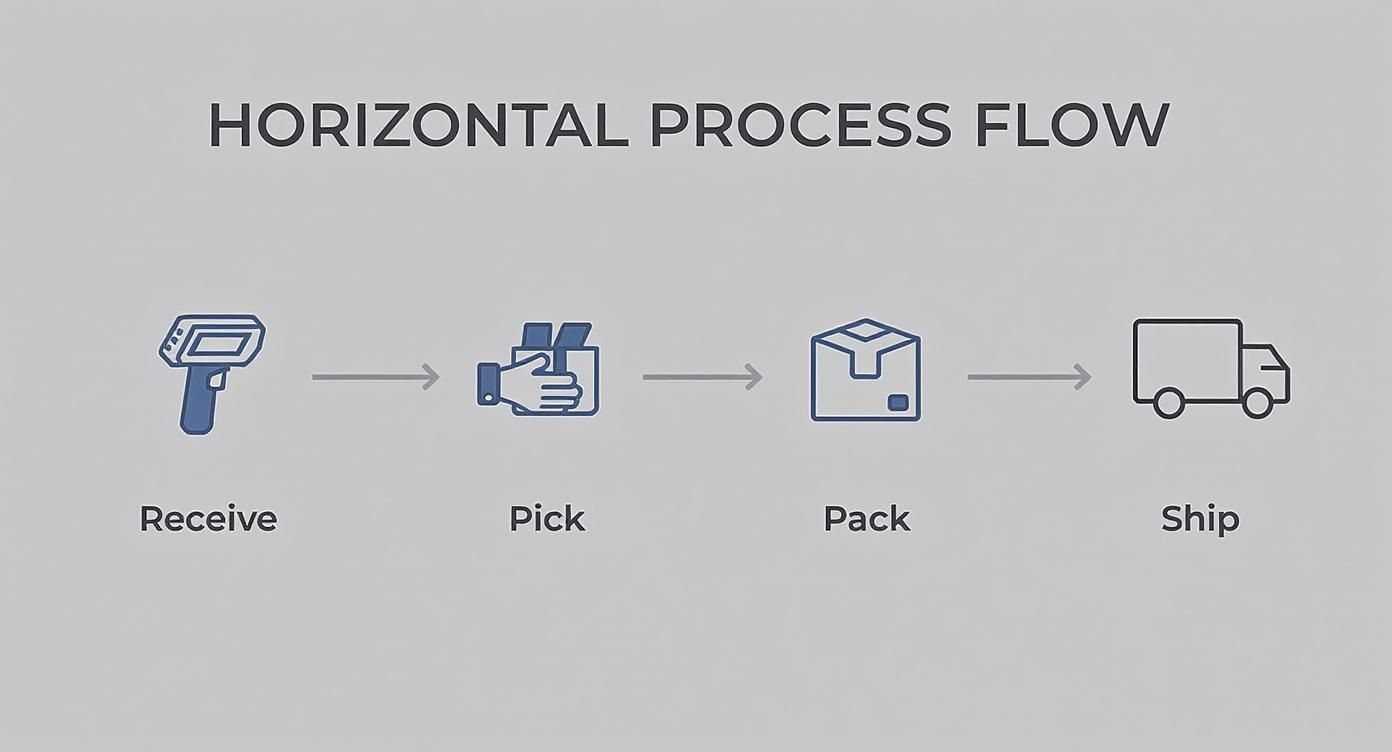
From receiving inventory to picking, packing, and shipping, every step is a chance to measure performance and find ways to get faster and more accurate.
Essential Fulfillment KPIs
Let's get into the specific numbers that successful ecommerce brands watch like a hawk. These KPIs paint a crystal-clear picture of how well your operation is running.
Order Accuracy Rate: This is the big one. It's the ultimate measure of quality, telling you what percentage of your orders go out the door without a single mistake—no wrong items, incorrect quantities, or damaged products. A high rate here means happy customers and, just as importantly, fewer profit-draining returns.
- The Math: (Total Orders Shipped Without Error / Total Orders Shipped) x 100
- The Goal: You should be aiming for 99.5% or higher. Anything less is a red flag that something in your picking and packing system is broken.
On-Time Shipping Rate: This KPI tracks how often you get orders out the door within your promised timeframe. In an era where two-day shipping is the norm, this metric is directly linked to customer satisfaction. Missed deadlines lead to lost trust.
- The Math: (Number of Orders Shipped on Time / Total Number of Orders Shipped) x 100
- The Goal: Push for 99%. If you’re consistently falling short, you're damaging your brand's reputation with every late package.
Fulfillment is a game of precision and speed. Your Order Accuracy Rate is your precision score, while your On-Time Shipping Rate is your speed score. Nailing both isn't just a nice-to-have; it's how you build a loyal customer base in a ridiculously competitive market.
Financial and Inventory Metrics
Beyond the warehouse floor, you need to connect your operations to your bank account. These next metrics show you how fulfillment activities are directly impacting your profitability.
Inventory Turnover
This number tells you how many times your entire inventory is sold and replaced over a given period. A high turnover is a great sign—it means products are flying off the shelves instead of collecting dust and tying up your cash. A slow turnover, on the other hand, could point to weak sales or a costly overstocking problem.
Cost Per Order (CPO)
Simply put, this is the total expense of getting one order from your warehouse to a customer's doorstep. It includes everything: labor, packing supplies, warehouse storage, and shipping fees. Knowing your CPO is absolutely critical for setting your prices correctly and protecting your profit margins. If you need to get granular, you can learn more about how to calculate cost per unit and other expenses to see the full financial picture.
Deconstructing Your Fulfillment Costs
To get an accurate Cost Per Order, you have to know all the individual pieces that make up the whole. Fulfillment isn't one line item; it's a bunch of smaller costs that can spiral out of control if you're not paying attention.
Here are the usual suspects to track:
- Storage Fees: What you pay to keep your inventory in the warehouse, usually calculated by the pallet or cubic foot.
- Picking and Packing Labor: The wages for the team members who find the products and get them ready to ship.
- Packaging Materials: The cost of boxes, mailers, tape, filler, and any cool branded inserts you use.
- Shipping Expenses: The actual carrier fees to send the package. It's crucial to accurately calculate shipping charges, as this is often the biggest and most variable part of your CPO.
By consistently watching these KPIs and costs, you gain the insight needed to fine-tune your entire ecommerce order fulfillment strategy and build a business that can scale profitably.
Using Technology to Automate Your Fulfillment
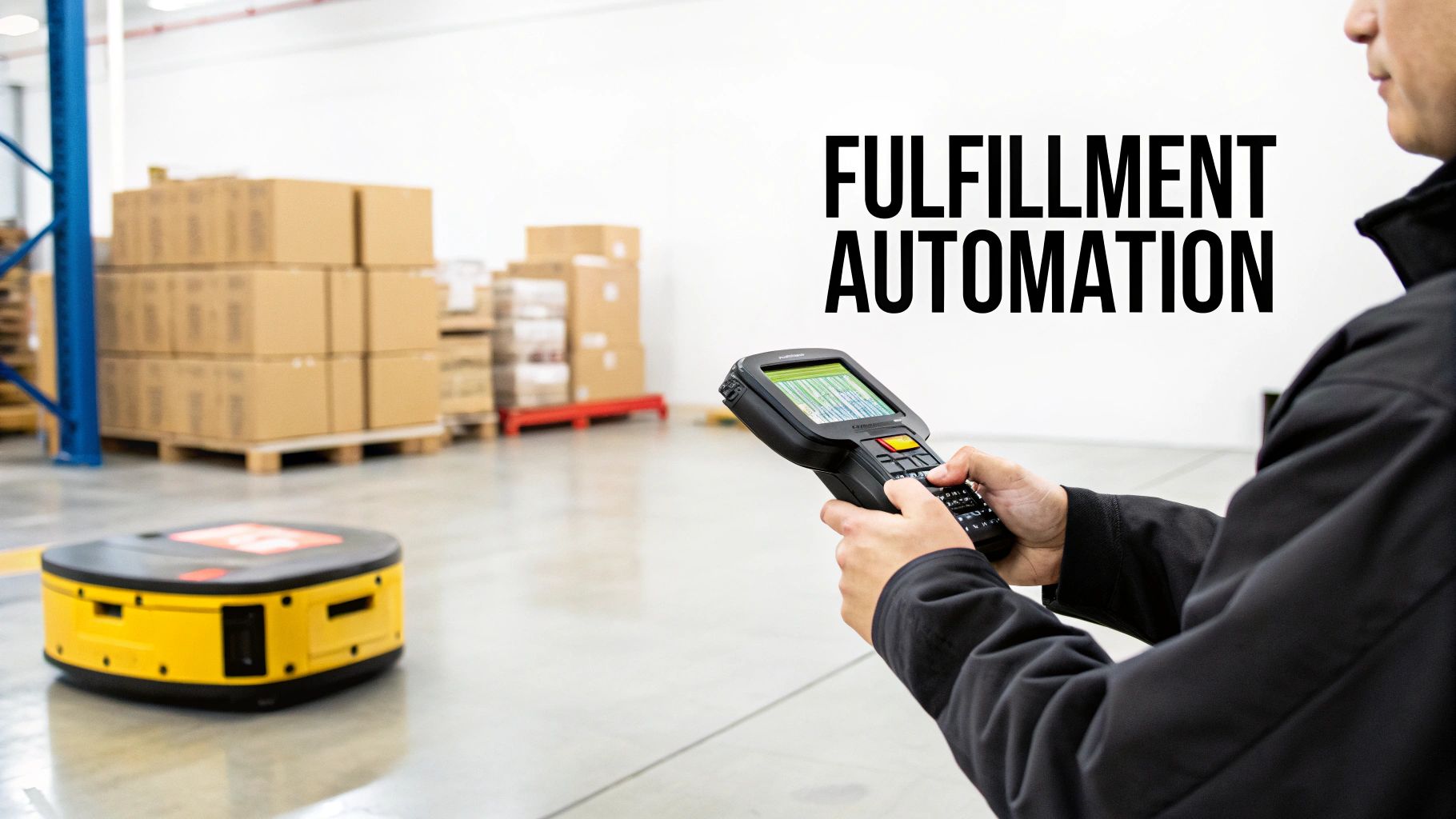
In today's ecommerce game, speed and accuracy are non-negotiable. Trying to run your fulfillment by hand—manually entering orders, tracking inventory on a spreadsheet, and printing shipping labels one by one—is like trying to win a Formula 1 race on a bicycle. You're going to get left in the dust.
Technology is the engine that drives a modern fulfillment operation. It’s what transforms a series of complicated, error-prone manual steps into a smooth, automated workflow that just works. At the center of it all is a set of software tools that act as the brain of your entire operation, ensuring every order gets from your customer's click to their doorstep without a single hiccup.
The Core Software Trio
The real power of a modern fulfillment setup isn't in any single piece of software, but in how they all talk to each other. Think of it as a team: you have an Order Management System (OMS), a Warehouse Management System (WMS), and an Inventory Management System (IMS) all working in concert.
Order Management System (OMS): This is your mission control. The OMS grabs every order as it comes in—whether from your website, Amazon, or a social media shop—and routes it to the right place for fulfillment. It keeps an eye on the order’s entire journey, from payment confirmation all the way to the final delivery scan.
Warehouse Management System (WMS): This is the manager on the warehouse floor. A WMS directs the physical movement of goods, telling your team where to put away new inventory and generating the most efficient routes for picking items for an order. It’s all about optimizing the pick, pack, and ship process.
Inventory Management Software (IMS): Your IMS is the official bookkeeper for your stock. It provides a real-time, bird's-eye view of your inventory levels across every location. More importantly, it helps you forecast demand, preventing you from running out of a bestseller or tying up cash in products that aren't moving.
When these three systems are connected, they create a powerful, self-correcting machine that slashes human error and ramps up your speed.
Practical Automation in Action
Don't just picture giant robots in a massive warehouse when you hear "automation." While that's true for giants like Amazon, for most businesses, automation starts with simple, practical tools that solve real-world headaches.
Something as basic as a barcode scanner can nearly eliminate picking errors, making sure the right product goes into every box. Automated shipping software is another game-changer. It can instantly pull rates from different carriers, batch-print hundreds of labels, and automatically send tracking updates to customers. No manual data entry needed.
The real goal of fulfillment automation is to get rid of manual touchpoints. Every single time a person has to type an address, count inventory, or pick a shipping service, it opens the door for mistakes and delays. Technology closes that door.
Taking it a step further, AI-powered forecasting tools can analyze your sales history to predict future demand with surprising accuracy. This insight helps you stock the right products at the right time, keeping your inventory lean and your money working for you.
Automation for the Dropshipping Model
What if you don't have a warehouse at all? Even dropshippers can—and should—rely heavily on automation. For them, the process doesn't start when an order is placed, but way earlier: when they're trying to get a supplier's product listed on their own store.
This is where a huge, often overlooked bottleneck exists. Many dropshippers burn hours manually saving product images, copying descriptions, and organizing all that data from supplier pages. It's tedious, mind-numbing work.
Tools like AliSave Pro are built to solve this exact problem for anyone dropshipping from AliExpress. Instead of right-clicking and saving dozens of images one by one, a tool like this lets you download all the product media—high-res photos, variant images, and even videos—with a single click.
By automating this crucial first step, dropshippers can populate their stores infinitely faster and with much higher-quality visuals. This is just one piece of the puzzle; you can explore other dropshipping automation tools that handle everything from syncing orders to monitoring price changes. It all starts with getting the product listed efficiently, setting the stage for a hands-off fulfillment process where customer orders flow directly to your supplier.
Avoiding Common Fulfillment Mistakes
Even the slickest ecommerce order fulfillment strategy hits a few bumps. The real trick is knowing where those bumps are likely to be so you can build an operation that keeps customers happy, not hanging. Learning from the mistakes others have made is the fastest way to protect your brand’s reputation and your bottom line.
Most fulfillment headaches boil down to a few usual suspects: bad inventory data, a messy warehouse, and shoddy packaging. Each one can set off a chain reaction, leading to stockouts, late shipments, and broken products—and all of them kill customer trust. Let's dig into these common pitfalls and how to steer clear of them.
Inaccurate Inventory Counts
There’s nothing worse than selling something you don’t actually have in stock. This happens when the number in your system doesn't match what's physically on the shelf, forcing you to cancel orders and deal with frustrated customers. If you're only counting your inventory once a year, you're flying blind in a business that moves by the minute.
The solution is to start cycle counting. This just means counting small, manageable sections of your inventory on a regular schedule, like daily or weekly.
- Benefit: It’s way less disruptive than shutting everything down for a full-blown inventory count and gives you a constantly updated, accurate picture of your stock.
- Result: You'll spot problems early, avoid overselling, and can easily maintain an inventory accuracy rate above 99%.
An Inefficient Warehouse Layout
Are your pickers walking a marathon just to fill a single order? A poorly designed warehouse layout is a massive time-sink, slowing down the entire process. Stashing your best-sellers in a hard-to-reach corner is a classic rookie mistake that costs you time and money on every single sale.
A smart way to fix this is with ABC analysis.
ABC analysis is just a simple way to group your inventory. 'A' items are your superstars that sell all the time, 'B' items are your steady sellers, and 'C' items are the slow-movers.
Once you know what's what, rearrange your warehouse. Put all your 'A' items in the most accessible spots, right near the packing station. This single change can slash the time it takes your team to pick an order, which directly boosts your efficiency and lowers labor costs.
Poor Packaging and Damaged Goods
Let's be honest—packages get thrown around. A lot. Using a flimsy box, skimping on bubble wrap, or choosing the wrong size mailer is just asking for your products to show up smashed. That doesn't just cost you a replacement and a return shipping label; it leaves a lasting bad taste in your customer's mouth.
The fix here is simple: invest in good packaging and test it yourself. Don't just cross your fingers and hope for the best. Pack a few of your most delicate items and mail them to yourself or a friend. This simple stress test will show you exactly where your packaging fails before a real customer has to find out for you. Spending a little extra on better materials upfront will save you a fortune in returns and protect your brand's reputation.
Common Questions About Ecommerce Fulfillment
Let's tackle some of the most common questions that pop up when you're digging into order fulfillment. Getting these fundamentals right can save you a ton of headaches down the road, whether you're shipping your first order or your ten-thousandth.
Warehouse vs. Fulfillment Center: What’s the Real Difference?
It’s easy to use these terms interchangeably, but they serve very different purposes. Think of a warehouse as a place for long-term storage. It's like a garage for your inventory—safe, secure, but mostly inactive.
A fulfillment center, on the other hand, is a beehive of activity. It’s a dynamic space designed for the rapid movement of goods. Here, products are received, sorted, picked from shelves, packed into boxes, and shipped out to customers, often all in the same day. It’s the operational heart of your ecommerce business.
How Do I Figure Out My Fulfillment Costs?
Calculating your true cost per order is crucial. It’s not just about what the shipping label says. To get the full picture, you need to add up a few key components:
- Storage Fees: What you pay to rent the shelf space for your inventory.
- Labor Costs: The wages for the team members picking and packing each order.
- Packaging Materials: The cost of every box, mailer, roll of tape, and piece of bubble wrap.
- Shipping Fees: The actual postage you pay to carriers like USPS or FedEx to deliver the package.
When should I switch from packing my own orders to using a 3PL?
A solid rule of thumb is when you’re consistently hitting 10-15 orders per day. At that point, the time you spend taping up boxes is almost always better spent on marketing, product sourcing, and actually growing your business.
Ready to stop wasting hours getting products ready for your store? With AliSave Pro, you can grab all the AliExpress product images, videos, and variant photos you need in one click. Build your product listings faster and get back to making sales.