
Figuring out the best shipping for your small business really comes down to your product and what you prioritize most. For lightweight packages under one pound, USPS is almost always your cheapest bet. Once you get into heavier packages or need time-sensitive deliveries, that's where UPS and FedEx really shine. The truth is, there's no single "best" solution; it's about creating a smart mix of carriers and fulfillment methods that fit your business like a glove.
Your Guide to Small Business Shipping Solutions
Choosing a shipping strategy is one of those make-or-break decisions for any ecommerce business. It has a direct line to your profit margins, keeps your customers happy, and can either bog down or smooth out your daily operations. With the global package delivery market projected to hit a staggering 407 billion packages by 2025, nailing your shipping is non-negotiable if you want to compete.
This decision tree offers a straightforward visual to help you pick a carrier based on what matters more: cost or speed.
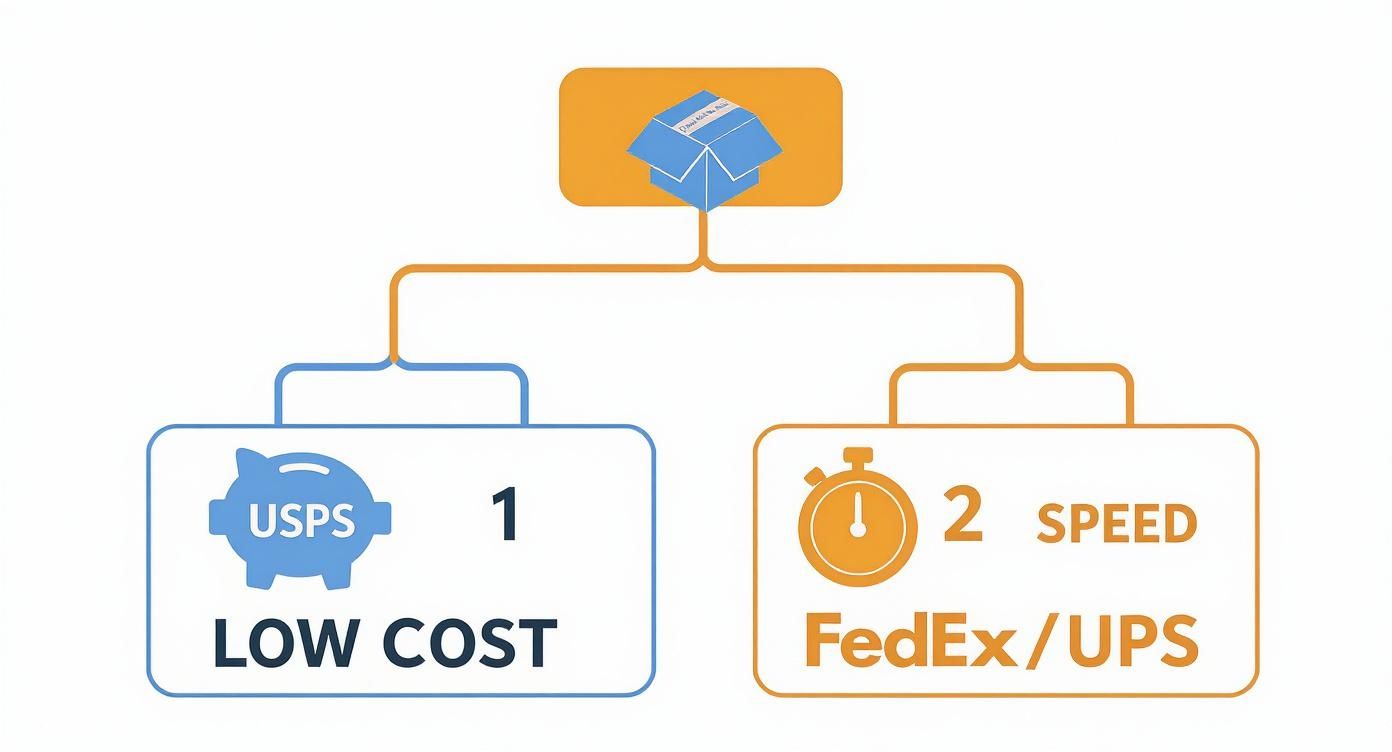
As you can see, the initial choice is pretty clear. If you're scrapping for every penny, USPS is your go-to. If getting it there fast is the name of the game, FedEx and UPS are your top players.
To get you started, I've put together a quick-reference table below. It maps common business needs to the carrier and fulfillment model that usually makes the most sense. Use this to find your footing and align your shipping strategy with your main goals. If you want to go even deeper, check out this guide on simplified small business shipping solutions that covers the entire process from A to Z.
Quick Shipping Solution Selector for Small Businesses
Use this table to quickly identify the best starting point for your shipping needs based on common business priorities.
| Primary Business Need | Best Carrier Option | Best Fulfillment Model | Ideal For |
|---|---|---|---|
| Lowest Possible Cost | USPS (especially for lightweight items) | In-House Fulfillment | Startups, Etsy sellers, and businesses with low order volume who can manage packing themselves. |
| Fastest Delivery Speed | FedEx or UPS (for express services) | Third-Party Logistics (3PL) | Businesses prioritizing customer experience and competing with major retailers on delivery times. |
| Maximum Scalability | A mix of UPS, FedEx, and regional carriers | Third-Party Logistics (3PL) | Growth-stage businesses preparing for volume spikes and seeking national 2-day delivery coverage. |
| Operational Simplicity | A single carrier with a business account | In-House or Dropshipping | Entrepreneurs who want to minimize complexity and handle a manageable number of daily orders. |
Comparing the Major Shipping Carriers
Picking a shipping carrier is one of those foundational decisions that can make or break your business. It directly impacts your costs, how quickly your products reach customers, and ultimately, how happy they are. While the "big three"—USPS, UPS, and FedEx—are the names everyone knows, the smartest strategy often involves using a mix of them, and sometimes even smaller regional players, to get the absolute best deal for every single package you send.
Let's move past the generic pro/con lists and dig into how each carrier performs in real-world situations you’ll face every day. We'll look at where they shine, where they fall short, and how you can use their unique strengths to your advantage.
United States Postal Service (USPS) The Lightweight Champion
If you're shipping anything small and light, USPS is almost always your answer. Their pricing is simply unbeatable for packages weighing less than a pound, which is why they are the go-to for so many sellers of apparel, cosmetics, jewelry, and other small consumer goods.
The USPS Ground Advantage service is the workhorse here, bundling previous services into one reliable 2-5 day delivery option that includes tracking. For budget-conscious shipping, it's the undisputed king.
Key Differentiator: USPS has a legal mandate to deliver to every single address in the U.S., including P.O. boxes and remote rural areas, usually without extra fees. Private carriers like UPS and FedEx often tack on hefty surcharges for these exact same deliveries.
Don't overlook their Priority Mail Flat Rate boxes, either. These are a game-changer. If your item is heavy but compact enough to fit in one of their standard boxes, you pay one flat price. It doesn't matter what it weighs or where it's going domestically. This kind of predictable pricing is a huge relief for anyone selling dense items like books, small electronics, or auto parts.
United Parcel Service (UPS) The Ground Game Expert
UPS built its reputation on rock-solid, day-definite ground shipping. Once your packages start tipping the scales—usually over five pounds—UPS Ground becomes incredibly competitive and frequently beats USPS on price. Their massive logistics network means you get consistent transit times and detailed, real-time tracking that your customers will love.
UPS is also your best friend for handling bigger, bulkier items that would cost a fortune to ship with USPS. If you're selling home goods, equipment, or large subscription boxes, you'll want UPS in your corner.
- Best for: Businesses shipping heavier items (5-70 lbs) where ground delivery speed and reliability are top priorities.
- Pricing Advantage: Often the most economical choice for larger packages compared to FedEx Ground.
- Tracking: Widely seen as the leader for its incredibly detailed, step-by-step package tracking.
They've also rolled out services like UPS Simple Rate, which is their take on flat-rate shipping. It’s another great tool for locking in predictable shipping costs.
FedEx The Speed and Express Specialist
When you think of speed, you think of FedEx. If your business relies on getting packages to customers overnight or with a guaranteed two-day delivery, FedEx Express services are the industry benchmark. Their roots are in air freight, and it shows. This gives them a clear advantage for high-value goods, critical documents, or anything perishable.
Of course, they have strong ground options too. FedEx Ground and FedEx Home Delivery (which includes weekend service at no extra cost) are robust services. While they can sometimes be a bit pricier than UPS Ground for comparable packages, the performance and delivery guarantees can be well worth it if speed is a core part of your brand promise.
When to Consider Regional Carriers
While the national players dominate the conversation, regional carriers can be a secret weapon, especially if you have a lot of customers nearby. These couriers focus on specific parts of the country, like the West Coast or the Northeast, and can offer some serious perks.
They often provide faster local delivery for a lower price, sometimes even offering next-day service within their zone for the cost of ground shipping. Because their network is so focused, they can be more nimble and personal than the giants. To learn more, check out this great overview of how regional carriers benefit small businesses on ShipSavvy.com.
Carrier Comparison for Common Small Business Scenarios
Choosing a carrier isn't just about the base rate; it's about matching the right service to the right situation. This table breaks down which carrier typically comes out on top for the shipping scenarios you'll encounter most often.
| Shipping Scenario | USPS Strength | UPS Strength | FedEx Strength |
|---|---|---|---|
| Lightweight Items (Under 1 lb) | Winner: Unbeatable pricing with Ground Advantage. | Not cost-effective for this weight class. | Not cost-effective for this weight class. |
| Heavy Packages (Over 10 lbs) | Can be expensive; weight limits apply. | Winner: Excellent rates and reliability with UPS Ground. | Competitive, but often slightly pricier than UPS. |
| Fastest Delivery (Overnight) | Priority Mail Express is an option, but not always guaranteed. | Strong Next Day Air services with guarantees. | Winner: Industry leader in time-definite overnight delivery. |
| Shipping to P.O. Boxes | Winner: Delivers to all P.O. boxes as standard service. | Cannot deliver to P.O. boxes directly. | Cannot deliver to P.O. boxes directly. |
| International Shipping | Good for low-cost shipping of small, non-urgent items. | Strong network, especially in Europe and the Americas. | Excellent global reach with robust customs support. |
At the end of the day, there is no single "best" shipping carrier. The smartest approach is to build a flexible strategy that leverages the unique strengths of each one. Doing so will save you a ton of money and keep your customers coming back.
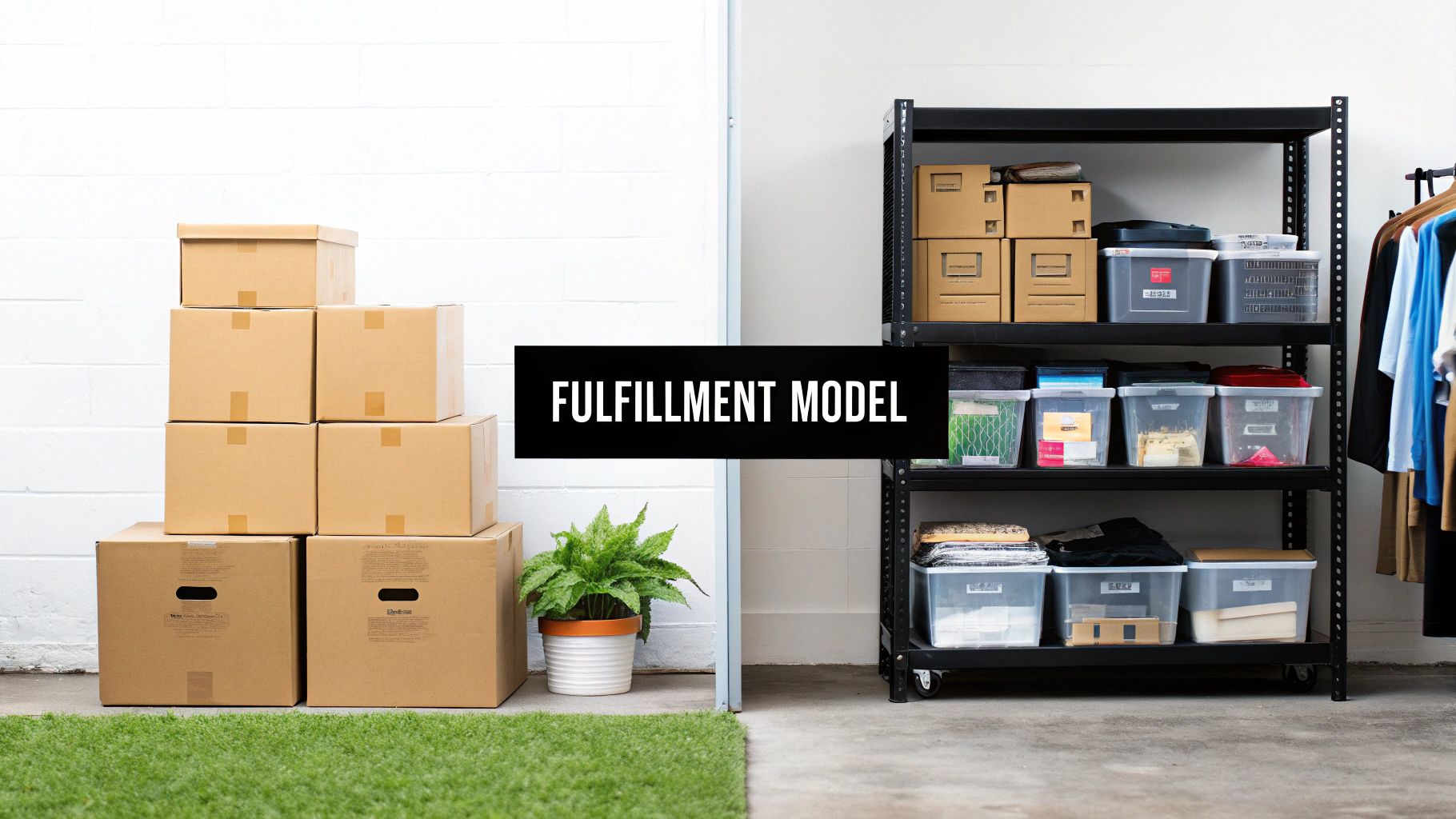
Choosing Your Fulfillment Operations Model
Figuring out the best shipping for your small business is about more than just which carrier to use. It’s about building a solid system for how you store, pack, and send out your products. This whole process is your fulfillment operation, and it’s the real engine behind your online store. You’ve got three main ways to go about it.
Each approach—doing it yourself, hiring a third-party logistics (3PL) partner, or dropshipping—strikes a different balance between control, cost, and your ability to grow. The right choice really hinges on where your business is today, how many orders you're getting, and what you want your company to look like down the road. Let’s dig into how each one plays out in the real world.
In-House Fulfillment: Maximum Control
Handling fulfillment in-house means you’re the one doing it all. You store the inventory, you pick and pack the orders, and you get them to the post office or UPS store. It’s the classic "garage startup" model and, frankly, it’s where most of us start.
The biggest win here is the unmatched control you have over the customer's experience. You can slip in a handwritten thank-you note, use your own cool branded packaging, and personally check every order to make sure it’s perfect. That direct oversight is incredibly powerful for building a loyal following when you're just starting out.
But that control comes at a price: your time and your space. As you start getting more orders, you’ll spend more hours taping up boxes, which pulls you away from things like marketing or developing new products. Sooner or later, you'll run out of room, and the daily grind of packing can seriously slow down your growth.
Key Insight: In-house fulfillment is a perfect fit for businesses with a low-to-moderate order volume—think under 10-15 orders per day—or those selling highly customized or fragile items that need a personal touch. It lets you nail your brand experience right from the start.
Third-Party Logistics (3PL): Scaling with Experts
A third-party logistics (3PL) provider is a company you hire to handle your warehousing, picking, packing, and shipping for you. You ship your inventory to their fulfillment centers, and when an order hits your store, it’s automatically sent to the 3PL to get it out the door. This is the perfect middle ground between doing everything yourself and holding no inventory at all.
The huge advantage of a 3PL is immediate scalability and efficiency. These guys are pros. They have massive, optimized warehouses, a trained staff, and get deeply discounted shipping rates you could never get on your own. A good 3PL can help you offer fast, 2-day shipping and handle a huge spike in orders during the holidays without breaking a sweat.
Of course, this service isn’t free. You’ll pay fees for receiving inventory, monthly storage, and a per-order fulfillment charge. You also hand over some control of the unboxing experience, though many 3PLs are getting better at offering custom branding options. If you're weighing your options for outsourced fulfillment, it's smart to compare Amazon FBA vs FBM to see how different platforms handle it.
Dropshipping: Zero Inventory Management
Dropshipping is the most hands-off model of all. You never actually see or touch the products. When a customer buys something from your website, you simply pass that order along to your supplier, who then ships it directly to the customer. Your profit is whatever is left after you pay the supplier their wholesale price.
The main attraction here is the extremely low startup cost and minimal risk. You don't have to buy inventory upfront, so you can't get stuck with a garage full of products that won't sell. This makes it a great way for new entrepreneurs to test out product ideas or for anyone who wants to run a business with as little operational hassle as possible.
The trade-off, however, is a near-total loss of control over your supply chain. You’re completely at the mercy of your supplier for product quality, keeping items in stock, and how fast they ship. This can lead to headaches, like when a customer's order gets stuck in what pending fulfillment means because your supplier ran out of stock. On top of that, profit margins are often razor-thin, and it’s tough to build a unique brand when you can't even control the box it arrives in.
Proven Strategies to Lower Shipping Costs
Shipping is one of those non-negotiable costs that can absolutely eat into your profit margins if you're not careful. Paying full retail price at the post office for every package is a fast track to shrinking your bottom line. But beyond the obvious advice, there are some genuinely powerful strategies you can use to cut down what you spend on getting products into your customers' hands.
If there's one thing you do, make it this: stop paying retail rates. The easiest way to do that is by using shipping software or the tools built right into your ecommerce platform. This immediately unlocks commercial pricing—deeply discounted rates that carriers normally reserve for their biggest clients.
Access Deeply Discounted Commercial Rates
Platforms like Shopify Shipping, Pirate Ship, or Shippo have already done the hard work of negotiating massive discounts with carriers like USPS, UPS, and DHL. This means even a brand-new business can get enterprise-level savings from day one, without needing to ship thousands of packages a month.
Just how good are these rates? It’s not uncommon to save 30% or more on common services like USPS Ground Advantage and Priority Mail. The software pulls in your order details, lets you compare carrier rates for each shipment side-by-side, and prints the label. It’s a simple switch that instantly boosts your profit on every single order.
Optimize Your Packaging to Beat Dimensional Weight
Carriers don’t just care about how heavy your package is; they also care about how much space it takes up on their truck. This is known as dimensional (DIM) weight. If you ship a lightweight item in a box that’s way too big, you’re literally paying to ship air, and it can inflate your costs significantly.
The solution is to get smart about your packaging.
- Right-Size Your Boxes: Keep several box sizes on hand that fit your products snugly. The goal is to minimize empty space while still leaving just enough room for protective filler.
- Switch to Poly Mailers: For anything that isn't fragile—like apparel, accessories, or books—poly mailers are a game-changer. They're feather-light, take up almost no space, and can slash your shipping costs compared to a rigid box.
- Use Lightweight Void Fill: Ditch the heavy packing peanuts. Lightweight air pillows or crumpled kraft paper do the job just as well and save you precious ounces on the scale.
Key Insight: One of the most common mistakes I see is businesses using one or two "standard" box sizes for everything. A small upfront investment in a variety of packaging options pays for itself almost immediately by helping you dodge those painful DIM weight surcharges.
Negotiate Directly with Carrier Representatives
Once you start shipping with some consistency—even just 15-20 packages a day—you have more leverage than you think. Don't hesitate to get in touch with the business development reps at UPS and FedEx. Their entire job is to bring in and keep business customers like you.
Before you call, have your data ready. Know your average monthly shipping volume, typical package weights, and where you ship to most often. Armed with that information, you can negotiate for a custom rate card that beats their standard small business programs. Even a 5-10% discount can translate into thousands of dollars in savings over a year.
Implement a Smart Returns Strategy
Returns are simply a part of doing business online, but if you don't manage them, they can become a massive drain on your resources. The trick is to create a policy that keeps customers happy without killing your profits.
Instead of a blanket "free returns for everyone" policy, think more strategically. You could offer free returns for store credit but charge a small shipping fee for cash refunds. This encourages shoppers to buy from you again and helps you recover some of your logistics costs. Whatever you decide, communicate your policy clearly to set the right expectations from the start. For businesses that lean on automation, looking into dropshipping automation tools can streamline both the initial fulfillment and the returns process.
Navigating International Shipping with Confidence
Taking your small business global is a huge step, but it’s one of the most effective ways to grow. When you start shipping internationally, you’ll run into new hurdles like customs, duties, and a whole different set of carrier services. The trick is to have a solid plan and be completely upfront with your customers from day one.
This kind of proactive planning is already working for a lot of businesses. A recent DHL survey found that 68% of small and medium-sized US companies are hitting or even beating their goals by keeping costs in check while reaching new markets. It just goes to show that with the right strategy, going global is completely achievable. You can read more about these resilient business findings on DHL.com.
Mastering Customs Documentation
If there's one thing that trips people up with international shipping, it's the paperwork. Every single package that crosses a border needs a customs form detailing what's inside, how much it's worth, and where it came from. Mess this up, and you’re looking at delays, returned packages, or surprise fees for your customer.
The good news is that most shipping software and carrier websites will generate the right form for you—usually a CN22 or CP72—based on your package's details. Your only job is to fill it out with painstaking accuracy.
- Be Specific: Don't just put "clothing." Be descriptive: "100% cotton men's t-shirt." This level of detail helps customs agents clear your package without a second thought.
- Be Honest About Value: It's tempting to declare a lower value to save on duties, but don't do it. You risk hefty fines or having the package seized entirely. Always state the actual price the customer paid.
- Use HS Codes: The Harmonized System (HS) code is like a universal product ID for customs. Including the right HS code helps officials in any country quickly identify your item and apply the correct taxes.
Calculating Duties and Taxes Upfront
There is no faster way to ruin an international customer's experience than hitting them with an unexpected bill for duties and taxes when their package arrives. This "landed cost" isn't from the shipping carrier; it's levied by the government of the destination country. The best approach for small business owners is to make these costs clear at checkout.
Key Insight: The responsibility for these fees comes down to shipping incoterms. Delivered Duty Unpaid (DDU) means your customer is on the hook for them upon delivery. Delivered Duty Paid (DDP) means you collect the fees at checkout and handle them yourself, giving your customer a much smoother experience.
Many e-commerce platforms and shipping apps now have tools that can calculate these fees for you in real-time. By offering DDP shipping, you get rid of nasty surprises and significantly improve the customer's journey, which is a surefire way to build trust and earn repeat business. For more on what the customer sees, you might find our guide on understanding AliExpress tracking numbers and their meaning helpful.
Answering Your Small Business Shipping Questions
Shipping can feel like its own little world, full of confusing rules, acronyms, and costs that seem to pop up out of nowhere. I get it. To cut through the noise, I’ve put together direct answers to the most common questions I hear from small business owners. Think of this as your cheat sheet for making smarter shipping decisions.
What Is the Absolute Cheapest Way to Ship a Small Lightweight Package?
For anything under a pound, USPS Ground Advantage is almost always your cheapest bet for domestic shipping. It's not just a budget option, either—it’s a solid service that includes tracking and gets your package delivered in a reliable 2-5 business days.
The real trick is to never pay retail rates at the post office. Always use shipping software to access commercial pricing, which is significantly lower and will save you a ton of money over time.
And don't overlook the humble USPS Padded Flat Rate Envelope. If your item fits, it’s a game-changer. You pay one flat price regardless of weight or destination, which is fantastic for shipping small but dense products across the country.
When Should My Business Switch from In-House Fulfillment to a 3PL?
The right time to switch to a third-party logistics (3PL) partner isn't about hitting a specific number of orders per day. The real signal is when packing boxes is actively holding your business back from growing.
Here are the tell-tale signs that it’s time to start looking for a partner:
- You're a Packer, Not a Founder: You spend hours every single day printing labels and taping boxes instead of focusing on marketing, product development, or talking to customers.
- Inventory is Taking Over: Your garage, spare bedroom, or office is overflowing with products, and you have zero room left to expand.
- Service is Slipping: As orders ramp up, you're starting to see shipping delays, packing mistakes, and the negative customer reviews that follow.
- You Can't Compete on Speed: You want to offer 2-day shipping to keep up with the big guys, but it’s just not financially or logistically possible on your own. A 3PL's distributed warehouse network and negotiated rates make it achievable.
If you’re nodding along to these points, it's a strong sign that the cost of a 3PL will pay for itself. You're not just buying warehouse space; you're buying back your time and your ability to scale.
How Do I Manage Dimensional Weight Pricing?
Dimensional (DIM) weight is how carriers charge you for a package's size, not just its actual weight. It’s their way of making sure a giant box of lightweight pillows pays its fair share for the space it takes up on a truck.
The key to managing DIM weight is simple: package optimization. Your goal is to use the smallest box that will safely transport your product.
Here’s how to put that into practice:
- Stock Multiple Box Sizes: Keep a variety of box sizes on hand. A small upfront investment here prevents you from constantly overpaying to ship what is essentially empty air.
- Use Mailers When Possible: For non-fragile items like apparel or textiles, ditch the box entirely. Switching to a poly mailer dramatically shrinks your package's volume and cost.
- Choose Lightweight Filler: If you need padding, use modern, lightweight materials like air pillows instead of old-school packing peanuts or heavy crumpled paper.
Because every carrier calculates DIM weight a little differently, you should always compare your final package dimensions in your shipping software before you commit to printing a label.
Is Shipping Insurance Worth It for a Small Business?
This really comes down to a gut check on your product's value, how much you ship, and your own tolerance for risk. There's no one-size-fits-all answer.
First, know that carriers like USPS and UPS already include up to $100 of declared value coverage on most of their services for free. If your items are worth more than that, buying extra insurance is a smart move to protect yourself from loss or damage.
You can buy that extra coverage directly from the carrier, but it’s often cheaper through a third-party provider like Shipsurance, which plugs right into most shipping software. For lower-value goods, many sellers choose to "self-insure"—they just set aside a small amount from their budget to cover the occasional lost package, which is often more cost-effective than paying a premium on every single shipment.
Ready to streamline your product sourcing? AliSave Pro is the ultimate tool for downloading high-resolution AliExpress product images and videos in just one click. Speed up your store setup, create stunning ads, and leave the hassle of manual saving behind. Download AliSave Pro for free from the Chrome Web Store and see why over 20,000 sellers trust it to build their stores faster.