
Picking the best dropshipping app for Shopify isn't a one-size-fits-all decision; it really boils down to your specific business plan. There’s no single champion. If you're looking for an enormous product catalog straight from AliExpress, DSers is the official, go-to tool. But if your customers demand quick shipping, Spocket is brilliant for its network of vetted US and EU suppliers. And for those focused on building a memorable brand with custom packaging, Zendrop is a serious contender.
Choosing Your Shopify Dropshipping Partner
Choosing a dropshipping app is a lot more than just clicking "install." Think of it as picking a business partner. This decision will define everything from where you source your products to how quickly you can fulfill orders and, ultimately, how well you can scale.
The right app has to align perfectly with your goals. Are you trying to offer the largest product selection possible? Or is fast, reliable shipping your top priority? Maybe building a unique brand identity from day one is your main focus. To make the right call, you have to look past the shiny feature lists and dig into how each platform actually supports your strategy.
This guide will walk you through a detailed, side-by-side comparison of the leading Shopify dropshipping apps. My goal is to give you the clarity you need to pick the right partner for your store by breaking down the critical differences in their supplier networks, automation features, and what truly makes each one unique.
Key Players in the Shopify Ecosystem
The Shopify App Store has no shortage of options, but a handful of apps consistently lead the pack because they’re feature-rich, reliable, and trusted by thousands of merchants. DSers, as the official AliExpress dropshipping solution, is arguably the biggest name in the game.
It's no secret that dropshipping apps are among the most popular tools in the Shopify world. DSers is at the top, with over 131,000 users as of early 2025, which really shows how vital it is for merchants sourcing from AliExpress. You can dive deeper into these kinds of Shopify statistics on PageFly.io.
This just scratches the surface of a very competitive field where apps fight to stand out with better supplier locations, unique branding options, and smarter automation. Each one is built for a slightly different type of entrepreneur, which is why a direct comparison is so important. Once you have an app in mind, figuring out how to find dropship suppliers that work well with it is the crucial next step.
Top Shopify Dropshipping Apps at a Glance
To help you get started, here's a quick look at the top contenders, their main supplier networks, and the kind of store owner they're best suited for. This table should give you a good initial feel for where you might fit.
| App | Primary Supplier Network | Best For |
|---|---|---|
| DSers | AliExpress | Beginners and sellers who need a massive product catalog. |
| Spocket | US & EU Suppliers | Merchants who want to prioritize fast shipping and product quality. |
| Zendrop | Vetted US & China Suppliers | Brand-builders focused on custom branding and faster fulfillment. |
| CJdropshipping | Global Warehouses & Sourcing | Scaling businesses that need an all-in-one sourcing and fulfillment solution. |
Think of this as a starting point. As we dive deeper into each app, you'll get a much clearer picture of the specific features and workflows that will either supercharge your business or hold it back.
Before we jump into a side-by-side showdown of the top apps, let’s talk about what actually matters. When you’re picking the best dropshipping app for Shopify, it’s easy to get lost in a sea of features. But not all bells and whistles are equal. Some are just nice to have, while others are the bedrock of a business that can actually grow.
Let's build a mental checklist right now. This will help you cut through the marketing noise and figure out which app truly fits what you’re trying to build.
Product Sourcing: Variety vs. Reliability
The most obvious feature is product sourcing, but it's more nuanced than just the sheer number of products. An app that plugs you into AliExpress gives you a massive sandbox to play in—perfect for testing out weird niches and finding quirky products. On the other hand, an app with a curated list of US or EU suppliers offers something entirely different: faster shipping and usually better quality.
Faster shipping means happier customers, which often translates to better reviews and repeat business. Your choice here really boils down to your brand. Are you going for volume and variety, or are you building a premium brand where customer experience is everything?
Automation and Order Fulfillment
This is where the magic happens. A good dropshipping app isn't just a product catalog; it's an automation engine. At the bare minimum, it should have one-click order fulfillment, so you’re not manually typing in customer details for every single sale. But the really powerful platforms go way beyond that.
Look for things like automated supplier mapping. This feature lets you connect one of your products to several different suppliers. If your main supplier suddenly runs out of stock, the app automatically sends the order to your backup. It’s a small detail that becomes a lifesaver when you start getting consistent sales, preventing stockouts from killing your momentum.
The real test of a great app is how it handles chaos behind the scenes. Your goal is to build a business that runs itself as much as possible, so you can focus on marketing and talking to customers, not putting out operational fires.
When you're evaluating dropshipping apps, one of the most critical things to look at is how they play with other tools; understanding robust app integration capabilities is key for a well-rounded store. A connected ecosystem means all your business tools are talking to each other, which prevents a lot of headaches down the road.
Inventory Syncing and Pricing Rules
One of the cardinal sins of dropshipping is selling something you can't actually ship. This happens when your supplier runs out of an item, but your store still shows it as "in stock." It leads to canceled orders, angry customers, and a black eye for your brand. That's why real-time inventory syncing isn't just a feature—it's a requirement.
A solid app will constantly check your supplier's inventory and update your Shopify store automatically. This connection needs to be fast and reliable, so what your customers see is always what they can get.
Just as critical are bulk pricing rules. Imagine having to price 1,000 products one by one. It’s a nightmare. The best apps let you set rules that apply markups across your entire store or specific collections.
For instance, you could set up rules like:
- Add a flat $20 to the supplier's cost.
- Multiply the cost by 2.5x to get your retail price.
- Use tiered pricing, like a 3x markup for items under $10 and a 2x markup for everything else.
This kind of automation saves an incredible amount of time and protects your profit margins as you scale. It’s one of those core functions that separates a casual side-hustle from a serious e-commerce operation.
A Detailed Comparison of Leading Dropshipping Apps
Picking the right dropshipping app for your Shopify store isn't about finding a one-size-fits-all winner. It's a strategic choice. You're navigating a series of important trade-offs, and the "best" option is simply the one whose strengths perfectly match your business model, target market, and ambition.
Let's put the top contenders—DSers, Spocket, Zendrop, and CJdropshipping—head-to-head. We'll skip the generic feature lists and instead dive into the real-world scenarios where each app truly shines, helping you see exactly how it would fit into your store's daily operations.
These apps are all built to handle the three pillars of any dropshipping operation: sourcing, automation, and syncing.
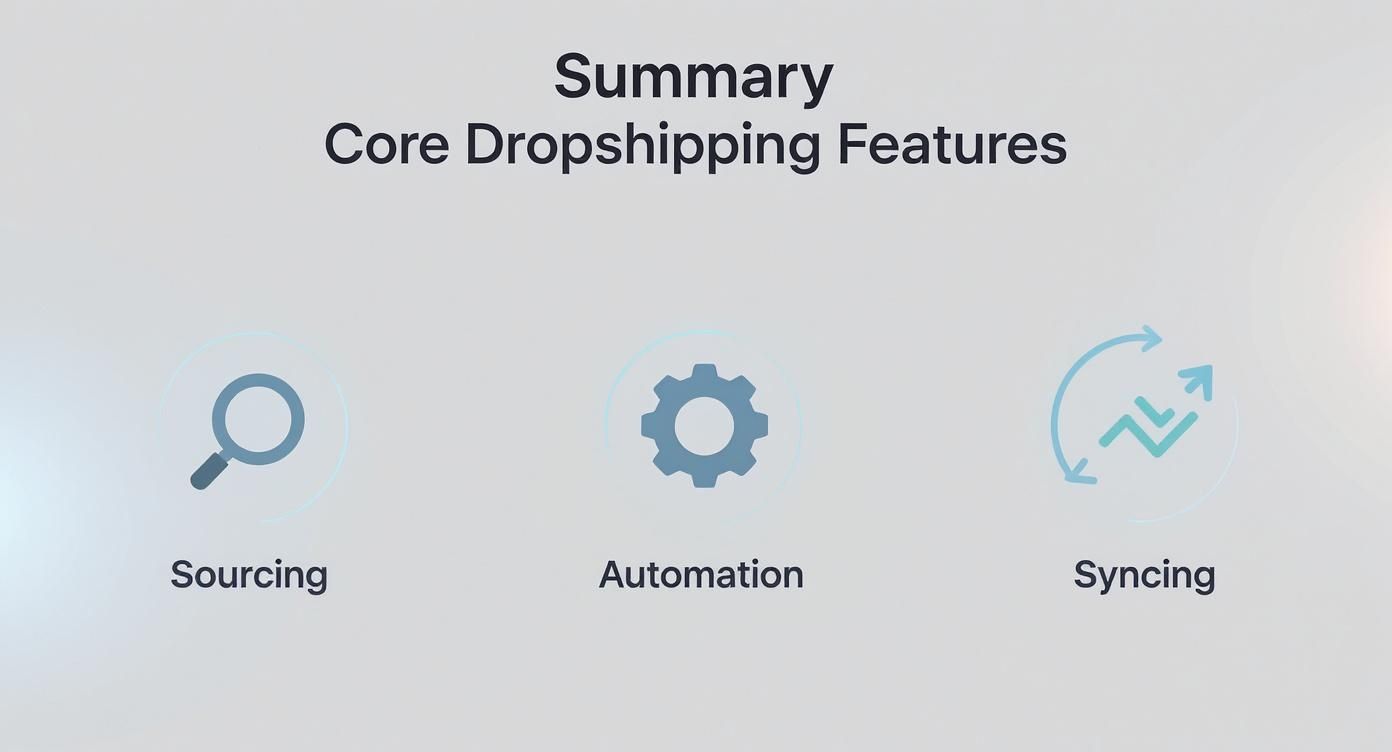
Your final decision will come down to what you value most: endless product variety, lightning-fast shipping, powerful branding, or an all-in-one logistics partner.
DSers: The AliExpress Powerhouse
As the official dropshipping solution for AliExpress, DSers is the clear leader for anyone whose strategy relies on the platform's massive, near-limitless product catalog. Its tight integration makes finding products and, more importantly, processing orders incredibly efficient.
The real magic of DSers is its bulk order processing. You can place up to 100 orders in a single click. This isn't just a nice-to-have feature; it becomes absolutely essential as your store scales and you're no longer fulfilling a handful of orders a day. It saves you from the mind-numbing manual work that holds so many growing stores back.
DSers also has a clever supplier mapping feature. You can assign multiple AliExpress suppliers to a single product in your store. If your main supplier unexpectedly runs out of stock, DSers automatically reroutes the order to your backup. No lost sales, no angry customers.
Key Differentiator: DSers is built for volume. If your plan is to rapidly test hundreds of AliExpress products and scale the winners hard, its bulk processing and supplier optimization tools are in a class of their own.
For beginners on a shoestring budget or experienced merchants focused on the sheer variety and rock-bottom costs of AliExpress, DSers is the most logical place to start.
Spocket: Curated Quality and Speed
Spocket takes a completely different path. It’s not about offering everything under the sun. Instead, it’s a curated marketplace of suppliers, with a heavy emphasis on vendors based in the US and Europe. This completely changes the game.
The immediate benefit? Dramatically faster shipping times. While an AliExpress package can feel like it’s arriving by sailboat, many Spocket suppliers deliver products to customers in North America and Europe in just 3-7 days. This speed is a massive competitive edge and a key reason you can often charge more for your products.
On top of that, Spocket vets all its suppliers. This means product quality is generally higher and far more consistent than what you’d find by chance on AliExpress. You're less likely to deal with unreliable vendors, shoddy items, and a flood of customer returns.
- Use Case: Imagine you're building a premium lifestyle brand for US customers who won't tolerate a three-week wait for their order.
- The Solution: Spocket lets you compete on customer experience, not just price. You can confidently promise quick delivery, which builds trust and brings customers back.
The trade-off is a smaller product catalog and higher base costs per item. But for any store where brand reputation and customer loyalty are top priorities, Spocket is an investment that pays for itself.
Zendrop: The Brand-Builder's Choice
Zendrop was born out of the frustrations of its founders, who were dropshippers themselves. They were tired of the usual AliExpress headaches—slow shipping, unreliable suppliers, and zero branding. So they built a solution for serious entrepreneurs.
Its most compelling feature set is built around branding. Zendrop offers custom packaging and branded invoicing, letting you create a professional and memorable unboxing experience. This is something that's practically impossible when you're sourcing from a dozen different AliExpress vendors.
Zendrop also delivers faster fulfillment than the AliExpress standard, with many of its popular products warehoused in the US for quick delivery. While its supplier network isn't as vast as Spocket's, the focus is squarely on reliability.
Key Differentiator: Zendrop is for merchants ready to graduate from just reselling products to actually building a brand. The ability to add your logo to the package transforms a generic item into your product.
If your long-term vision is a recognizable brand with a loyal following, Zendrop's features give you a clear and direct path to get there.
CJdropshipping: The All-In-One Solution
CJdropshipping is a true beast of a platform. It combines sourcing, order fulfillment, and warehousing into a single, integrated service. It’s not just an app; it’s a logistics partner.
While DSers is a bridge to AliExpress, CJdropshipping can source products directly for you from other major Chinese marketplaces like 1688 and Taobao. Find a product that isn't already in their catalog? Their team will go out and source it for you, often at a better price.
Their global warehouse network is a massive advantage. You can choose to stock inventory in their US or European warehouses to offer your customers Amazon-like shipping speeds. This hybrid model is perfect for scaling—you can test products with traditional dropshipping, and once you find a winner, stock it closer to your customers to slash delivery times.
- Use Case: You have a best-selling product, but the 2-week shipping time is hurting your conversion rate.
- The Solution: Have CJdropshipping store that product in their US warehouse. They'll handle quality control and ship it in a few days, giving you the perks of a fulfillment center without the upfront cost and complexity.
CJdropshipping is the ideal choice for growing businesses that have outgrown basic sourcing apps. It's a robust supply chain partner for entrepreneurs ready to get serious about optimization.
Feature Showdown Dropshipping App Comparison
To put it all into perspective, here's a direct comparison of how each app handles the most critical functions for a dropshipping business.
| Feature | DSers | Spocket | Zendrop | CJdropshipping |
|---|---|---|---|---|
| Primary Supplier Source | AliExpress | Vetted US & EU Suppliers | Vetted US & China Suppliers | Global Sourcing & Warehouses |
| Best for Shipping Speed | Varies (slow to moderate) | Excellent (fast domestic) | Good (faster than AliExpress) | Excellent (with warehousing) |
| Branding Options | None | Branded Invoicing | Custom Packaging & Invoices | Custom Packaging |
| Unique Strength | Bulk Order Processing | Curated Supplier Quality | Brand-Building Features | All-in-One Sourcing & Fulfillment |
This table makes one thing crystal clear: the "best" app is entirely situational. Your decision truly hinges on what you prioritize most—unbeatable product variety (DSers), premium quality and shipping speed (Spocket), a memorable brand experience (Zendrop), or a scalable, all-in-one fulfillment partner (CJdropshipping).
Understanding Pricing Models and Total Cost
When you're picking a dropshipping app for your Shopify store, it's easy to get fixated on the monthly subscription price. But that's a rookie mistake. A cheap plan might look great on paper, but if it’s riddled with hidden fees or missing key features, it can quietly eat away at your profits. The real goal is to figure out the total cost and make sure you’re getting more value than you’re paying for.
Plenty of apps dangle a "free" plan to get you in the door, and they’re genuinely useful for getting a feel for the dashboard and basic workflow. But let's be real—these free tiers are almost always designed to make you upgrade. You might hit a wall after importing just 25 products or fulfilling a handful of orders.
Think of them as a test drive, not the car you'll use for a cross-country road trip. They’re perfect for kicking the tires but won't get a growing business very far.
Decoding Paid Tiers and ROI
Once you start looking at paid plans, your mindset has to shift from "What does it cost?" to "What's my return?" A $49/month plan from an app like Spocket might seem steep next to a $19/month plan from DSers, but you're not comparing apples to apples. The higher price often buys you something tangible, like access to a better network of suppliers.
For instance, Spocket's US and EU suppliers can mean faster shipping and higher-quality goods. Sure, the subscription costs more, but selling a better product lets you charge a premium. You also cut down on customer service headaches from slow shipping, which directly boosts your bottom line and reputation.
The smartest way to evaluate pricing is to connect the cost to a specific capability. Ask yourself, "What specific business advantage does this higher-priced plan give me, and can I turn that advantage into more profit?"
This approach reframes the monthly fee from a simple expense into a strategic investment in your store's efficiency and brand.
Calculating the True Cost of an App
The subscription fee is just the tip of the iceberg. To understand what you're really paying, you need to account for all the other costs that hit your profit margin.
- Transaction Fees: Some apps quietly skim a small percentage off every order you process. It might not seem like much on one sale, but these fees can become a significant expense as your order volume grows.
- Product Costs: The base price of your products can vary wildly from one platform to another. An app with a low monthly fee might connect you with suppliers whose higher unit costs completely wipe out your margins.
- Hidden Charges: Always read the fine print. You might find extra fees for essentials like branded invoicing or access to premium supplier lists that aren't included in the advertised price.
Getting a handle on these variables is the only way to accurately forecast your profitability. You need to know your numbers inside and out, starting with your cost per unit. For a deep dive, our guide can help you calculate cost per unit with precision, so you can price your products for actual success.
Matching Your Plan to Your Business Stage
Ultimately, the right plan is the one that fits where your business is right now and where you want it to go. It makes zero sense for a brand-new store to splurge on an enterprise plan with features it won't touch for another six months.
Here’s a practical way to think about it:
- Beginner (Testing Phase): Stick with a free or low-cost plan. Your only job is to learn the process and see if your product ideas have legs, all with minimal financial risk.
- Growing (Consistent Sales): Once you’re getting daily orders, it's time to upgrade. A mid-tier plan that offers automation like bulk order processing and real-time inventory sync will save you a ton of time.
- Scaling (High Volume): When you have winning products and high order volume, invest in a premium plan. This is where you get features like private labeling, custom packaging, or dedicated warehousing that help you build a real brand and improve the customer experience.
By matching your plan to your needs, you stop overspending on useless features and ensure your app is an asset that fuels your growth, not a liability that holds you back.
Fine-Tuning Your Product Sourcing Workflow
Picking the right Shopify dropshipping app is a great start, but it's really just setting the stage. Your day-to-day workflow—the actual process you follow to find products, get them ready, and list them—is what separates the pros from the amateurs. A slow, clunky system will hold you back, while an efficient one lets you outpace the competition.
One of the biggest time-sinks for any dropshipper is handling product media. You know the drill: manually saving a dozen blurry images from a supplier's page, fighting with watermarks, and then resizing everything for your store. It’s tedious work that absolutely kills your momentum.
This is where a dedicated tool can completely change the game. By creating a repeatable system, you can drastically cut the time it takes to get a promising product from the supplier’s site onto your storefront.
Speeding Up Media Prep with AliSave Pro
Let's walk through a real-world scenario. You find a potential winner on AliExpress. The listing has 15 great photos, 5 variant images, a slick video, and even customer photos showing the product in use. If you were to save all of that manually, you'd easily spend 15-20 minutes just clicking and saving—and that’s before you've even touched an editor.
This is exactly the problem a tool like AliSave Pro solves. It’s a Chrome extension that lets you download every piece of media from an AliExpress page in one go.
Instead of the endless right-click-save routine, the tool grabs all images, videos, and review photos in their original high resolution and bundles them into a neat ZIP file. It sounds simple, but when you're scouting multiple products daily, that saved time adds up fast.
The goal is to automate the low-value, repetitive tasks. Your expertise is better spent on marketing and building your brand, not manually downloading JPEGs. A fast media workflow is a genuine competitive advantage.
By automating this first step, you free yourself up to focus on what actually makes you money: perfecting your product presentation and writing compelling copy. You can learn more about this in our guide to dropshipping automation tools that can really tighten up your operations.
From Download to Live Listing in Minutes
With all the media assets on your computer, your workflow shifts from tedious collection to creative optimization. Having high-quality images and videos ready to go means you can immediately start editing them to fit your store's vibe.
Here’s a simple, powerful workflow you can put into action today:
- One-Click Download: Use AliSave Pro to grab all product photos, variant images, and videos from the supplier's page.
- Fast Edits: Open the downloaded files. Use a simple image editor to remove supplier logos, brighten the images, or add your own branding.
- Smart Upload: Upload your polished visuals directly to your Shopify product page, making sure the best ones are front and center.
- Launch: With your listing live in a fraction of the usual time, you can get straight to running ads and making sales.
This approach turns a frustrating, multi-step chore into a streamlined process. Building this kind of efficient, repeatable system is crucial for staying agile. It lets you test more products, jump on trends faster, and stay well ahead of competitors still stuck doing everything by hand.
Making the Right Decision for Your Store
So, how do you actually choose the best dropshipping app for your Shopify store? It really boils down to one simple question: what are you trying to achieve?
After breaking down all the features, pricing, and who each app is really built for, the final decision comes down to matching an app’s core strengths with your specific game plan. There’s no magic "best" platform—only the one that’s best for you.
This final breakdown cuts through the noise and gives you clear, scenario-based recommendations to make your choice easier.
Finding Your Perfect App Match
The right solution will feel like it was made for your store. Let's look at a few common dropshipping scenarios to see where you fit in.
For the budget-conscious beginner: If your main goal is to dive into a massive product catalog without spending a dime upfront, DSers is the logical starting point. Its direct pipeline to AliExpress and a surprisingly robust free plan give you everything you need to start experimenting with products right away.
For the quality-focused seller: Are you targeting customers in the US and EU? If so, you know that competing on fast shipping and reliable quality is non-negotiable. This is where Spocket really shines. Its curated network of suppliers takes a lot of the guesswork and risk out of the equation, helping you build a brand people trust.
For the dedicated brand-builder: When your ambition goes beyond just moving products and into creating a legitimate brand experience, Zendrop is in a league of its own. Features like custom packaging and branding inserts are invaluable for creating that professional touch that turns one-time buyers into loyal fans.
Your dropshipping app is the engine of your store, but your product presentation is the fuel. Selecting the right app gets you halfway there; the other half is convincing customers to buy.
Choosing the right app is a huge step, but your success ultimately depends on how well you present your products. For some great pointers on creating listings that actually sell, check out this guide on how to write compelling product descriptions.
By aligning your primary goal—be it minimal cost, fast shipping, or brand building—with the app that was designed for that exact purpose, you can confidently pick a partner to help your store grow.
Frequently Asked Questions
Jumping into dropshipping always brings up a few questions, especially about the nitty-gritty details of running your store. Let's tackle some of the most common ones I hear from other store owners.
Can I Switch Dropshipping Apps Later On?
The short answer is yes, you can. But it’s not as simple as flipping a switch. Think of it this way: your products are "married" to the app you used to import them. That connection is what makes automated order fulfillment possible.
When you decide to move to a new app, you’re essentially breaking that connection and will have to re-import your catalog. It's a bit of a project, so you'll want to plan it out to avoid chaos.
Here’s a quick game plan for a smoother transition:
- Don't pull the plug on old products right away. Keep your existing listings active until the new ones are fully set up and ready to go live.
- Export your current products to a CSV file. This gives you a backup and a template to work from, saving you tons of time when recreating listings.
- Set up URL redirects. Once you swap the old product pages for the new ones, use redirects to point the old links to the new pages. This is huge for preserving your SEO and preventing customers from hitting dead "404 Not Found" pages.
How Do I Handle Returns with Multiple Suppliers?
This is where things can get tricky. Every supplier you work with will have their own rules about returns—some are great, some not so much. Your job is to create a single, unified return policy for your store that works for all of them.
My advice? Find your supplier with the strictest return policy and build your own store's policy around that. This way, you're always covered.
Be upfront about your return process on your website. A clear, honest policy builds way more trust than trying to hide it. Customers appreciate knowing what to expect, even if you can't offer Amazon-level flexibility.
If you’re ever unsure about a specific supplier’s process, don't guess. Reach out to the support team for your dropshipping app; they can usually give you the rundown.
What Strategies Can I Use for Long Shipping Times?
Ah, the classic dropshipping dilemma. Long shipping times are a reality when you're sourcing products from halfway around the world. The absolute best thing you can do is be radically transparent about it.
Don't hide shipping times in the fine print. State them clearly on your product pages, in the shopping cart, and again in the order confirmation email. Setting realistic expectations from the start prevents a lot of angry customer emails later.
Offering a small discount on a future purchase can also help ease the pain of waiting. Of course, the best long-term solution is to find a dropshipping app that connects you with suppliers closer to home, like in the US or EU. Faster shipping is always a winning strategy.
Ready to slash your product prep time and get your listings live in minutes, not hours? With AliSave Pro, you can download every single product image and video from an AliExpress page with just one click. Grab this essential, free tool today at https://alisavepro.com.