
Finding the right dropship supplier isn't as simple as a quick Google search. You'll need to dig into a mix of supplier directories, massive online marketplaces, and even reach out to manufacturers directly. The goal is to find a partner who truly gets your brand—someone who can meet your standards for quality, shipping times, and pricing.
Honestly, a great supplier relationship is the bedrock of any successful dropshipping store.
Why Your Supplier Is Your Most Important Partner
Before we jump into how to find a supplier, let's talk about why this choice is so critical. Think of your supplier as the invisible engine of your entire ecommerce operation. They're the silent partner who has total control over product quality, stock levels, and—most importantly—how fast an order gets to your customer.
You’re the one building the brand, running the ads, and creating a great online experience. But behind the scenes, your supplier is handling the entire physical side of the business. Their performance is your brand's reputation, plain and simple.
The Real-World Impact of Your Supplier Choice
A fantastic supplier gives you a serious edge over the competition. They get orders out the door quickly, pack them well, and give you a heads-up when stock is running low. When you have that kind of reliability, you can focus on what you do best: scaling the business. You can confidently run ads, create content, and build your brand, knowing the operations are solid.
On the flip side, a bad supplier is a recipe for disaster. Their mistakes become your headaches, and you'll quickly find yourself dealing with:
- Late Shipments: This always leads to a flood of angry customer emails and tanks your credibility.
- Poor Product Quality: Get ready for bad reviews, a ton of returns, and painful chargebacks.
- Damaged Goods: You'll be stuck managing refunds and replacements, which eats away at your profits.
- Zero Communication: Nothing is worse than not being able to answer a customer's simple question: "Where is my order?"
If you pick the wrong partner, you'll spend all your time putting out fires instead of growing. This is a huge reason why only about 10% of dropshippers ever really make it big—they stumble at finding a supplier they can count on.
Your hunt for a supplier isn't just a box to check. It's the single most important strategic decision you'll make, defining your customer's experience and whether your store survives for the long haul.
Navigating a Growing Market
Finding a great partner is getting more competitive as the industry booms. The global dropshipping market hit an estimated $365.67 billion in 2024 and is expected to grow by 22.0% each year through 2030.
This explosive growth means more stores are all fighting for the attention of the best suppliers. While platforms like AliExpress are a popular starting point, the most successful sellers I know have learned to look beyond the obvious. They dig deeper to find the hidden gems.
You can learn more about these trends from Grand View Research's industry analysis. It really highlights why taking your time to vet suppliers isn't just a good idea—it's absolutely essential to your survival and growth.
Where to Find Your Next Great Supplier
Finding a solid dropshipping supplier isn’t about casting a wide net with endless Google searches. It's about knowing which doors to knock on. The right sourcing channel can put you on the fast track, while the wrong one can lead to dead ends and a lot of wasted effort.
Let's break down the most common hunting grounds for reliable partners. Each has its own vibe—some are built for convenience, others for low costs, and some for finding truly unique products. Getting a feel for these options is the first real step in building a supply chain you can count on.
Comparison of Top Supplier Sourcing Channels
Before we dive deep, this table gives you a quick snapshot of the main ways to find suppliers. It's a handy reference for seeing which channel might be the best fit for you right now.
| Sourcing Channel | Best For | Pros | Cons |
|---|---|---|---|
| Supplier Directories | Beginners looking for safety and convenience. | Pre-vetted, legitimate suppliers; easy to search; saves time. | Subscription fees; may have more competition on popular products. |
| B2B Marketplaces | Sellers needing a massive product selection at low costs. | Huge variety; competitive pricing; established review systems. | Can be overwhelming; quality varies wildly; communication barriers. |
| Direct to Manufacturer | Experienced sellers wanting unique products and better margins. | Best pricing; exclusive product access; builds brand credibility. | Requires more research and outreach; some brands may say no. |
Each path has its trade-offs, but understanding them upfront helps you make a smarter decision based on your budget, experience, and business goals.
The Curated World of Supplier Directories
Think of supplier directories as a vetted, members-only club for e-commerce. Platforms like SaleHoo, Worldwide Brands, and Doba do the initial legwork for you by screening thousands of suppliers to make sure they're legitimate and know the ropes of dropshipping.
You pay a subscription fee, and in return, you get access to a clean, organized database of wholesalers and manufacturers ready to do business. It's a huge time-saver, especially if you're new to the game and worried about getting burned by a shady operator. SaleHoo, for instance, lists over 8,000 pre-vetted suppliers, giving you a safe and solid pool to start from.
The main upsides are:
- Trust and Safety: These suppliers are verified, which dramatically cuts down your risk.
- Efficiency: You can filter by niche, location, or shipping terms to quickly find what you need.
- Direct Contact: All the info you need to start a conversation is right there.
The only real downside is the cost. You're essentially paying for convenience and peace of mind, which, for many new store owners, is a worthwhile investment to avoid the classic beginner mistakes.
Tapping into Giant B2B Marketplaces
Marketplaces like AliExpress and Alibaba are the undisputed titans of product sourcing. They're a universe of products at incredibly competitive prices, making them the default choice for countless dropshippers.
AliExpress is built for buying single items, which fits the dropshipping model perfectly. Alibaba is traditionally for bulk wholesale, but don't count it out—many of its suppliers are open to dropshipping if you just reach out and ask. If you're unsure which one fits your needs, our guide on the difference between Alibaba and AliExpress breaks it down clearly.
The sheer volume on these sites can feel like drinking from a firehose. The key is to use their filtering tools to narrow your focus to suppliers with strong ratings and a solid history.
A pro tip for these platforms: look past the flashy product photos and dig into the supplier's metrics. Their store rating, how long they've been in business, and recent customer reviews will tell you a much more honest story.
With the dropshipping market projected to hit nearly $470 billion in 2025, the number of suppliers is only going to grow. This means more options, but it also means vetting becomes even more critical.
Going Straight to the Source: The Manufacturer
This is a more advanced tactic, but it can be a game-changer. Instead of using a middleman, you contact the brand or manufacturer of a product you want to sell and ask if they have a dropshipping program.
It definitely requires more hustle. You have to do the research, find the right contact person, and make a professional pitch. But the rewards can be massive.
Why bother going direct?
- Better Margins: Cutting out intermediaries means you often get the absolute best price.
- Exclusive Products: You can get access to products that aren't already sold by thousands of other stores.
- True Authenticity: You become an official retailer for the brand, which adds a ton of credibility to your shop.
Many smaller and niche brands are surprisingly open to this. It helps them grow their sales footprint without the headache of managing a complex retail network themselves. The principles for building these relationships are universal, whether you're selling tech gadgets or fashion. For a great example of this in action, check out this guide on finding the best wholesale jewelry suppliers; the outreach and vetting strategies apply to almost any industry.
How to Properly Vet Your Dropshipping Suppliers
Finding a list of potential suppliers is just the starting line. The real work—the part that truly separates the successful stores from the ones that never get off the ground—is the vetting process. Think of it as your quality control filter, designed to methodically weed out the unreliable operators and pinpoint genuine long-term partners.
Skipping this stage is a huge gamble. A supplier's fancy website can promise you the world, but it's their actual performance that will dictate your customer satisfaction, your brand's reputation, and, ultimately, your bottom line. A solid vetting process takes the guesswork out of the equation and gives you confidence built on facts.
First Contact: The Initial Litmus Test
Your very first interaction with a potential supplier speaks volumes. Before you even get into product details or pricing, just send a simple, professional inquiry. Then, sit back and pay close attention to how they handle it.
This simple test gives you a surprising amount of insight into their professionalism and how they run their business.
- Response Time: How long did it take them to get back to you? A reply within 24-48 business hours is a great sign. Anything longer could signal a disorganized or understaffed team.
- Quality of Response: Did a knowledgeable person write the email, or was it a generic, copied-and-pasted template? A good supplier will answer your questions directly.
- Communication Channels: Do they have multiple ways to get in touch, like email, a phone number, or a dedicated support portal? A single, unresponsive email address is a massive red flag.
Treat this like a job interview. If they're slow and unhelpful when they're trying to win your business, just imagine what it'll be like when you have an urgent customer problem on your hands.
Do a Little Online Detective Work
Once you've had a positive first contact, it's time to do some online reconnaissance. A legitimate supplier will have a professional and verifiable digital footprint. A shady one, on the other hand, often leaves a trail of inconsistencies and angry customers.
Start by searching for their company name plus terms like "reviews," "scam," or "complaints." Dig through forums, social media, and industry review sites. While a few bad reviews are normal for any business, a consistent pattern of complaints about shipping delays, poor product quality, or awful customer service is your cue to walk away.
Pro Tip: A supplier's digital footprint is their public resume. Scrutinize their online reviews, business history, and overall professionalism to gauge their reliability before you even think about partnering up.
Next, give their website a thorough look. Does it have a clear "About Us" page? Can you find a physical address and a contact phone number? Be really wary of sites that feel generic, are full of broken links, or are missing basic business information.
Confirm They're a Legitimate Business
Now it's time to make sure you're dealing with a real, established business and not just some middleman posing as a wholesaler. One of the quickest ways to do this is to simply ask for their business license or tax ID number.
Any legitimate wholesale supplier will provide this without hesitation. If they get defensive, make excuses, or flat-out refuse, you've found a huge red flag. This one step confirms they are legally registered and operating above board.
While you're at it, dig into their policies, which should be easy to find on their site. Pay close attention to:
- Return and Refund Policy: Is it clear and fair for both you and your customer? Who pays for return shipping on defective items versus a simple change of mind? Vague or non-existent policies are a recipe for future headaches.
- Shipping and Fulfillment: Do they give you clear estimates for shipping times to different countries? Do they provide tracking numbers for every single order?
- Dropshipping Know-How: Ask them directly if they have experience with dropshipping. A true dropshipping partner understands things like blind shipping (sending packages without their branding) and can efficiently handle orders for a single item. Our comprehensive guide to getting started with AliExpress dropshipping is a great place to learn more about these core concepts.
The Final, Non-Negotiable Step: Order Samples
You can do all the research in the world, but nothing beats seeing things for yourself. Always, always, always order samples. This is, without a doubt, the single most important step in the entire vetting process.
Placing a few test orders lets you assess the most critical factors firsthand:
- Product Quality: Does the item actually look like the photos and match the description? Is it well-made, or does it feel cheap and flimsy? Remember, you're the last line of defense before a product reaches your customer.
- Packaging: How did it arrive? Was it thrown in a flimsy bag, or was it packed securely enough to survive its journey? Professional packaging is a sign of a professional operation.
- Real-World Shipping Time: Forget their estimates. How long did it actually take from the moment you clicked "buy" to the package arriving at your door? This is the most accurate preview of what your customers will experience.
- The Overall Experience: Was the ordering process smooth? Did you get an order confirmation and a tracking number right away?
Go through the entire process as if you were a customer. Pay attention to every single detail. This small investment of time and money can save you from the nightmare of partnering with a supplier who will sink your business with junk products and snail-paced shipping. It's the final piece of the puzzle to finding a dropship partner you can truly count on.
How to Reach Out and Negotiate Like a Pro
https://www.youtube.com/embed/3_tdHHx57NM
That first email you send to a potential supplier is more than just an introduction. It's the handshake that sets the tone for your entire business relationship. How you present yourself right out of the gate will determine if they see you as just another inquiry or a serious partner they want to work with.
Forget firing off a generic, one-line message. A well-crafted email shows you've done your homework and you respect their time. This simple act alone will set you apart from the dozens of low-effort emails they probably delete every single day.
Crafting the Perfect First Message
Your goal here isn't just to ask, "Do you dropship?" You want to open a real conversation, ask intelligent questions, and show them you're a legitimate business owner. Vague questions get vague answers, but professional, specific outreach commands attention.
Once you’ve got your shortlist of potential suppliers, it’s time to make contact. Knowing how to find business email addresses quickly can be a huge time-saver here, helping you get your message in front of the right person on the first try.
Here’s a simple, professional template you can adapt. It’s concise but still packs in all the essential details.
Subject: Dropshipping Partnership Inquiry – [Your Store Name]
Hi [Contact Person's Name or Supplier Name],
My name is [Your Name], and I am the owner of [Your Store Name], an online retailer specializing in [Your Niche]. I'm currently expanding my product line and am very impressed with the quality of your [Specific Product Type].
I am looking for a reliable dropship supplier and would like to inquire if you offer a dropshipping program. If so, could you please provide some information on the following:
- Your dropshipping process and any associated fees.
- Your average shipping times to [Your Target Country, e.g., the USA].
- How you manage inventory and communicate stock levels.
I look forward to the possibility of working together.
Best regards,
[Your Name]
[Your Store Name]
[Your Website URL]
This email works because it gets straight to the point. It gives them context about your business and asks smart, specific questions that prove you understand the operational side of dropshipping.
Asking the Right Questions Beyond Price
While cost is always a factor, the operational details are what will make or break your business. A cheap product from an unreliable supplier is a fast track to angry customers and a failed store. You need to dig into the logistics that directly impact your customer's experience.
After they've confirmed they dropship, follow up with these critical questions:
- Per-Order Fees: Is there a flat fee for each order they process? This is standard practice, usually between $2 to $5, to cover the cost of packing materials and labor. It's an acceptable cost of doing business.
- Inventory Management: How do they handle out-of-stock items? Can they provide a live inventory feed, or will they send daily updates? There's nothing worse than running a successful ad campaign for a product that just went out of stock.
- Return Policy: Get a clear picture of their process. How do they handle returns for defective products versus simple customer remorse? Figuring this out upfront will save you massive headaches down the road.
- Shipping Specifics: Do they provide tracking numbers for every single order? Can they "blind ship" so the package has no trace of their company's branding on it? This is crucial for building your brand, not theirs.
This simple flow chart breaks down the vetting process into its essential stages, from that first email to your final decision.
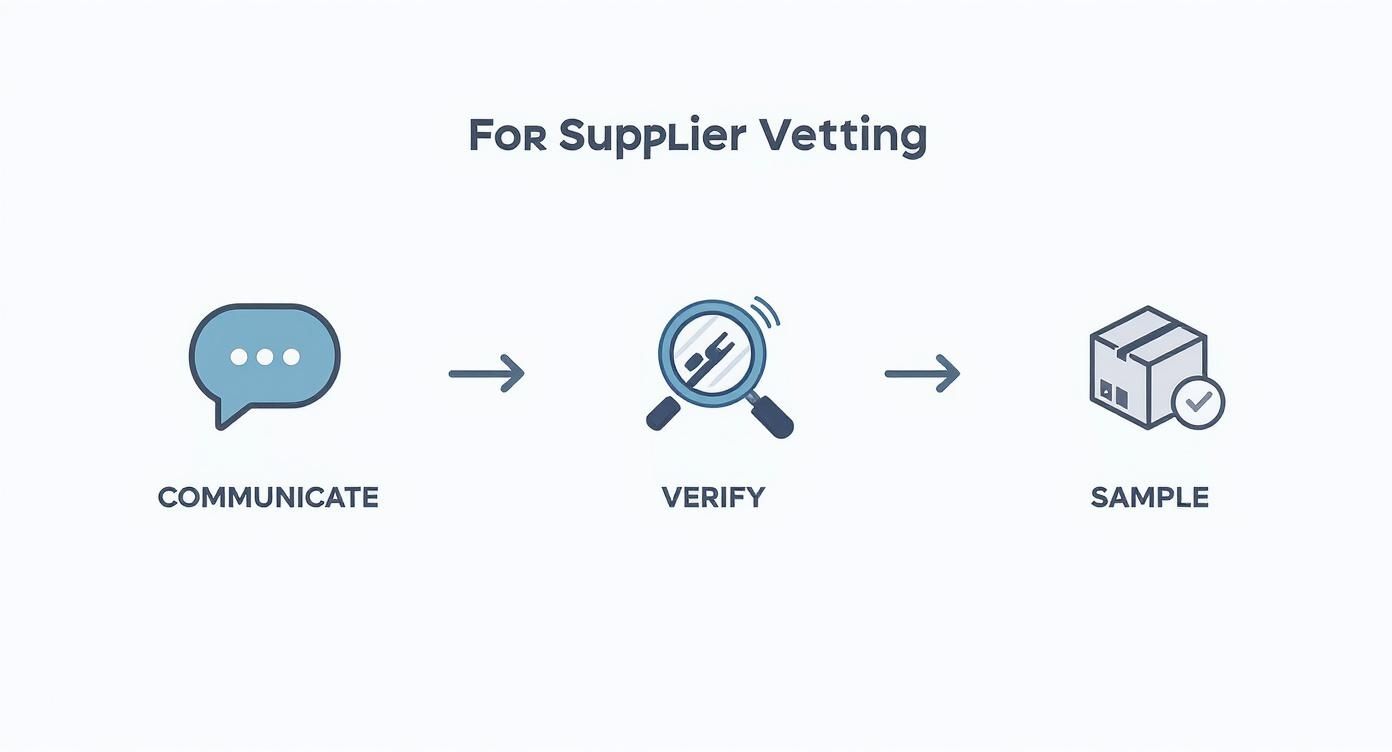
Stick to this simple workflow—communicate, verify, and then sample—and you'll have all your bases covered before committing to a partnership.
Navigating Key Negotiation Points
Don't assume negotiation is only for the big players. Even as a new dropshipper, you have some leverage, especially when you frame yourself as a long-term partner with serious growth potential.
A common hurdle is the Minimum Order Quantity (MOQ). This is more of a wholesale thing, but some dropship suppliers use it to weed out sellers who aren't serious. If you run into an MOQ, politely explain your business model and ask if they’d be open to waiving it for a trial period. Pitch it as a chance for them to see your sales volume firsthand.
Payment terms are another area ripe for discussion. When you start, you'll almost certainly be paying per order. But once you've built up a consistent sales history over a few months, don't be shy about asking to move to weekly or even monthly invoicing. This can do wonders for simplifying your accounting and improving your cash flow, freeing up capital to reinvest in your marketing. The key is to prove your worth first, then make the ask.
Supplier Red Flags and Scams to Avoid
Finding a great supplier is only half the battle. You also have to get good at dodging the bad ones. The dropshipping world is full of amazing partners, but it's also got its share of middlemen, slow-moving operators, and flat-out scams.
Learning to spot the warning signs is your best defense against losing money and wrecking your store's reputation before you even make your first sale. Think of this as your personal checklist for avoiding partnerships that could sink your business from the start.
Unreasonable Fees and Financial Demands
Right off the bat, if a supplier is asking for ongoing monthly fees just for the “privilege” of working with them, that's a huge red flag. A real wholesale partner makes their money when you make sales—that's how the relationship works. They shouldn't be charging you a subscription.
Now, a small, per-order drop fee is totally normal. You can expect to see charges around $2-$5 to cover the cost of picking and packing a single item. Anything beyond that deserves a closer look.
Be on the lookout for:
- Ongoing Membership Fees: If they want a monthly or annual fee simply to view their product catalog, you're almost certainly dealing with a middleman, not a genuine supplier.
- Vague Setup Costs: A one-time setup fee might be legitimate for a complex API integration, but if they can't give you a straight answer on what it covers, it’s best to walk away.
- High Minimum Orders: A supplier who demands a massive initial order isn’t set up for dropshipping. They don't get the business model, and they’ll be a headache to work with.
These kinds of financial traps are designed to make money from you, not with you.
Poor Communication and Lack of Transparency
How a potential supplier communicates with you before you sign on is a direct preview of the support you'll get when a customer's order goes missing. If you're getting vague, slow, or unprofessional replies now, imagine how it'll be when there’s a real problem.
Pay close attention to how they handle your initial questions. Are they giving you clear, specific answers about shipping times and their return policy? Or are you getting canned responses that don't really help? A good partner will be transparent and ready to give you the details you need.
A supplier who hesitates to send product samples is a massive red flag. It often means they either don't stand behind their product's quality or they aren't equipped for the single-unit orders that define dropshipping.
Identifying Fake Wholesalers
This is a classic rookie mistake: accidentally partnering with a retailer who is just pretending to be a wholesale supplier. These operations buy products at wholesale, mark them up a bit, and then pose as the source. Working with them destroys your profit margins and adds an unnecessary delay to your supply chain.
Here’s how to spot them:
- They Sell to the Public: A true wholesaler won't sell to just anyone. They’ll require you to apply for an account and prove you're a real business, usually by asking for an EIN or business license.
- Their Pricing Isn't Competitive: Do a quick comparison. If their "wholesale" prices are almost the same as what you see on public retail sites, they're not a real wholesaler.
Building a business on massive platforms like AliExpress means you need a sharp eye for these details. To get a better handle on this, check out our guide on whether AliExpress can be trusted for your business. It’s crucial knowledge for anyone learning how to find dropship suppliers who are the real deal.
Common Questions (and Answers) About Finding Dropship Suppliers
As you get closer to choosing a partner, a few key questions always seem to pop up. Think of these as the final hurdles. Getting them sorted gives you the confidence to lock in a supplier and build a business that can weather the inevitable bumps in the road.
Let's walk through the most common questions I hear from entrepreneurs who are just starting out.
Can I Use More Than One Supplier?
Not only can you, but you absolutely should. Putting all your eggs in one basket by relying on a single supplier is just asking for trouble. What's your plan when they unexpectedly run out of your best-seller during Black Friday?
Think of using multiple suppliers as a smart way to de-risk your business. It's a strategy that pays off in several ways:
- A bigger, better product catalog: You can offer a much wider variety of products by sourcing from suppliers who specialize in different niches.
- A built-in backup plan: If your main supplier drops the ball—and eventually, they will—you can flip the switch and route orders to your secondary source without missing a beat.
- A chance to A/B test your partners: You can see who really performs best over time. Who has the better product quality? The faster shipping? The most responsive support? Let the data decide.
The only catch is managing your customer's expectations. If items in one order are coming from different places, just be upfront about the possibility of separate packages and slightly different delivery times.
Should I Go with a Domestic or an Overseas Supplier?
This is one of the biggest forks in the road you'll face, and honestly, there's no single right answer. It boils down to a classic trade-off: do you want to prioritize cost or speed?
A domestic supplier (like one in the US or EU) is your ticket to lightning-fast shipping. We're talking days, not weeks. That speed is a massive advantage for keeping customers happy. Plus, communication is usually a breeze since you're in the same (or similar) time zones. The downside? Product costs are almost always higher, which can put a real squeeze on your profit margins.
On the other hand, an overseas supplier—often in Asia—will almost always offer jaw-droppingly low product costs and a product catalog that feels endless. The trade-off is, of course, much longer shipping times and the potential for language or cultural barriers.
Many savvy store owners end up using a hybrid approach. They'll source their proven best-sellers from a domestic supplier for speed and then test new, unproven products from an overseas partner to take advantage of the better margins.
How Do I Deal with Returns?
Handling returns is a two-sided coin. First, you need a return policy on your own website that is dead simple for your customers to find and understand. This is your policy, and it sets the rules for your buyers.
Second, you have to know your supplier's return policy inside and out before you ever start working with them. You're the one who will be talking to the customer, but you're operating under the supplier's rules.
For items that arrive broken or defective, any decent supplier will cover a full refund or a replacement, no questions asked. But for "buyer's remorse" returns—where the customer just changed their mind—the process changes. Typically, the customer will have to ship the item back to the supplier's warehouse, and they'll probably have to pay for that shipping themselves.
You absolutely must clarify who pays for return shipping in every possible scenario. Getting this wrong is a surefire way to kill your profits and infuriate your customers.
What’s a Normal Fee for a Dropship Supplier?
This one is simple: real wholesale suppliers make their money when you make a sale, not by charging you a bunch of junk fees.
A small per-order fee, often called a "drop fee" or a "handling fee," is totally normal. You can expect this to be somewhere in the $2 to $5 per order range. This covers the supplier's cost to have someone physically walk through a massive warehouse, pick one item, pack it securely, and get it ready for shipment.
Be very, very careful if a supplier asks for a big monthly or annual fee just for the "privilege" of accessing their products. This is a huge red flag. It often means you're not dealing with a true supplier at all, but a middleman directory that's just reselling access. Real partners want to build a relationship where you both win by selling great products.
Finding the perfect products is one thing, but getting all the professional-looking photos and videos onto your store listings is a whole other headache. That's where AliSave Pro comes in. It cuts out the tedious, manual work of right-clicking and saving every single image. With one click, you can grab all the product images, variant photos, and videos from an AliExpress page. Everything downloads into a neat folder, ready to upload. It's an essential tool for getting your products live and selling faster. Download the free Chrome extension and see how much time it'll save you.