
Finding the right wholesale suppliers for dropshipping is probably the most critical decision you'll make for your ecommerce business. Think of your supplier as a silent partner—they’re in charge of product quality, how fast things ship, and ultimately, whether your customers are happy. Nail this choice from the get-go, and you'll save yourself a world of headaches.
Building Your Foundation with the Right Supplier
Your dropshipping journey doesn't kick off with a slick website or a clever ad campaign. It starts with sourcing. The quality of your partners directly shapes the quality of your business. And while giant marketplaces like AliExpress are a common first stop, the world of wholesale suppliers is much, much bigger. Before you get too far, make sure you really understand what is dropshipping and how the entire model hinges on these third-party relationships.
The global dropshipping market is absolutely exploding. In 2025, it's valued at around USD 447.37 billion and is expected to grow at a compound annual growth rate (CAGR) of 26.1% through 2032. That growth could push the market to an incredible USD 2,268.19 billion. This boom is great news—it means more opportunity. But it also means more competition, making your choice of supplier more important than ever.
The first major fork in the road is deciding whether to work with domestic or overseas suppliers. Each route has its own set of pros and cons that fit different business goals.
Domestic vs. Overseas Sourcing
So, what's the difference? Domestic suppliers, located right in your target country, mean faster shipping and much easier communication. That’s a massive plus if you're building a brand around quick delivery and top-notch customer service. The downside? They usually have higher product costs and a smaller selection to choose from.
On the flip side, overseas suppliers—mostly from Asia—offer a practically bottomless catalog of products at much lower prices. This gives you room for healthier profit margins, but it comes with its own challenges: longer shipping times, potential language barriers, and trickier returns. There’s no single "best" answer here; it really depends on what promise you're making to your customers.
The core trade-off is pretty simple: you're balancing speed and quality control against cost and product variety. The most successful dropshippers I know don't just pick one; they align their supplier choice with their brand identity and what their customers expect.
This infographic breaks down the key differences to help you see it more clearly.
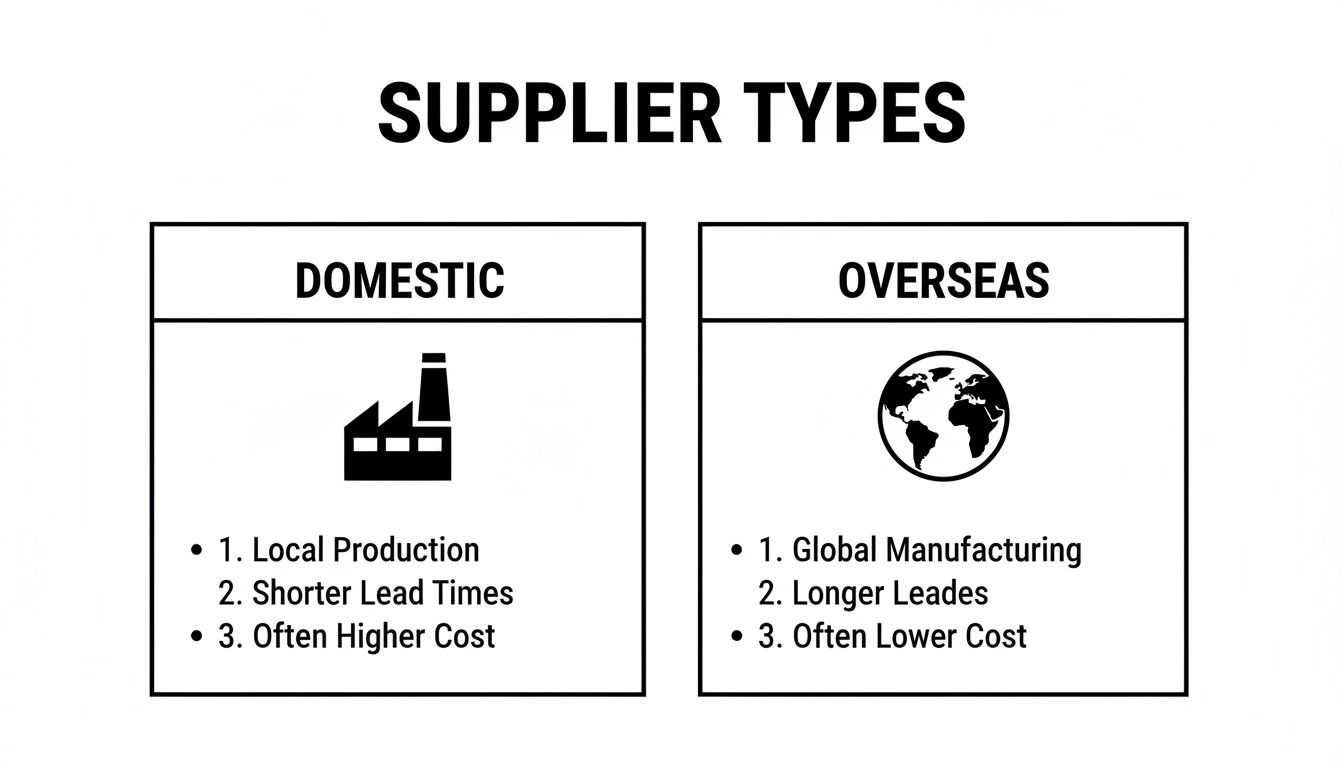
As you can see, the choice you make has a direct ripple effect on your shipping speed, cost structure, and how easily you can communicate.
Here's a quick table to break down the key differences when you're weighing your options.
Comparing Supplier Types Domestic vs Overseas
| Factor | Domestic Suppliers (e.g., USA, UK) | Overseas Suppliers (e.g., AliExpress) | Best For |
|---|---|---|---|
| Shipping Time | Faster (2-7 days) | Slower (2-4 weeks) | Domestic: Brands prioritizing speed & customer satisfaction. |
| Product Cost | Higher | Lower | Overseas: Businesses focused on maximizing profit margins. |
| Product Variety | More limited selection | Vast, almost unlimited | Overseas: Niche stores needing a wide product range. |
| Communication | Easier, no language barrier | Can be challenging (time zones, language) | Domestic: Newcomers who need straightforward communication. |
| Quality Control | Easier to verify and manage | Harder to assess without samples | Domestic: Sellers of high-ticket or complex items. |
Ultimately, this decision shapes your entire customer experience. Choose wisely based on what you want your brand to be known for.
Beyond Marketplaces
While platforms like AliExpress are a great starting point, don't stop there. So many successful dropshippers I've worked with found their best partners by looking beyond the obvious places. These alternatives can unearth unique products and offer much better terms.
Give these a look:
- Supplier Directories: Think of services like SaleHoo, Worldwide Brands, or Doba as a curated "phonebook" of pre-vetted suppliers. You’ll usually pay a membership fee, but it saves a ton of time and cuts down on the risk of partnering with someone unreliable.
- Direct to Manufacturer: If you’re serious about building a long-term brand, going straight to the source is a power move. It takes more legwork, but it can land you exclusive deals and even open the door to private labeling. If that sounds like your path, we have a great guide on https://alisavepro.com/how-to-find-manufacturers-that-dropship/.
- Trade Shows: Attending industry trade shows (even the virtual ones) is a fantastic way to meet suppliers face-to-face, build real relationships, and actually see the products before you commit.
Your first real task is to build a shortlist of potential partners. Once you understand the full landscape of wholesale suppliers for dropshipping, you can make a smart, informed decision that sets your business up for real, sustainable growth.
How to Vet Suppliers and Build Strong Partnerships
Alright, so you've got a shortlist of potential wholesale suppliers for dropshipping. That's a great first step, but the real work starts now. This is the vetting phase—the part where you separate the genuine partners from the headaches waiting to happen.
A slick website is easy to fake. What you're looking for is a solid operational backbone that can support your business as it grows. A bad supplier can sink your brand with shoddy products, late shipments, and ghost-like customer support. Let's make sure that doesn't happen.
Initial Credibility Checks
Before you even draft an email, it's time to do some digging. Think of yourself as a private investigator. A few smart searches can tell you almost everything you need to know about a supplier's reputation and whether they're even a legitimate business.
Here's where I always start:
- Business History and Reviews: How long have they been around? A company with a decade of history is usually more stable than one that popped up last month. Hunt for reviews on third-party sites, not just the testimonials on their homepage. Look for patterns in negative feedback—are people constantly complaining about the same thing?
- Real Contact Information: Do they have a physical address and a phone number listed? Legitimate businesses aren't afraid to tell you where they are. If all you can find is a generic contact form, be very cautious. That's a huge red flag.
- Professional Vibe: Read the copy on their website. Is it filled with typos and grammatical errors? It might seem small, but it's often a window into their overall attention to detail.
Vetting is a game of patterns. One bad review isn't a deal-breaker, but a dozen reviews all complaining about the same issue—like slow processing times—is a clear signal of a systemic problem you don't want to inherit.
If you’re struggling, you’re not alone. Finding the right supplier is the biggest hurdle for 84% of online sellers jumping into dropshipping. With the market projected to explode from USD 365.7 billion in 2024 to USD 464 billion by the end of 2025, a rock-solid supplier is your ticket to getting a piece of that pie. You can find more data like this in a great dropshipping statistics report.
Making First Contact and Asking the Right Questions
Once a supplier passes your initial sniff test, it's time to reach out. Your first email is your first impression, so make it count. Be professional, direct, and show them you're serious. Ditch the generic "I want to sell your products" message that they get a hundred times a day.
Introduce your brand, mention the specific product lines you're interested in, and then get straight to the point with some crucial questions.
Here’s what you absolutely need to ask:
- What are your Minimum Order Quantities (MOQs)? Even with dropshipping, some wholesalers require a certain commitment or have rules for new accounts. Clarify this upfront.
- What are your real-world shipping and processing times? Don't accept vague answers like "fast shipping." Ask for specifics: "How many business days from order placement to shipment?"
- How do you handle returns and damaged goods? Get the full story. Who covers return shipping costs? What's the process for a customer who receives a broken item?
- Is tracking information provided automatically? You do not want to be chasing down tracking numbers manually. Automation here is non-negotiable for scaling.
Pay as much attention to how they answer as you do to what they answer. A prompt, detailed, and professional response is a great sign. If you get a lazy, one-sentence reply a week later, imagine how they'll act when you have an urgent customer issue.
The Non-Negotiable Sample Order
I'm going to say this clearly: never, ever skip ordering samples. A product photo can be deceiving. The only way to truly know what your customers will receive is to experience it yourself.
This is your chance to evaluate the entire process from their perspective.
When the package arrives, put on your most critical customer hat and check everything:
- Product Quality: Does it look and feel like the pictures promised? Is the construction solid or flimsy?
- Packaging: Was the item protected, or was it just tossed in a cheap mailer? The unboxing experience is a direct reflection of your brand.
- Shipping Time: Did it actually show up within the timeframe they quoted you?
- Overall Experience: Was the whole thing smooth and painless?
Think of a sample order as a cheap insurance policy against a future catastrophe. If a supplier balks at sending samples or makes it difficult, just walk away. A partner who is proud of their products will have no problem sending them to you. For those using platforms like AliExpress, this step is even more critical. You can learn more about navigating that ecosystem in our guide on whether AliExpress can be trusted.
Mastering Your Product Media Workflow
In dropshipping, your product photos are your storefront. Customers can’t physically touch the product, so your images and videos have to do all the heavy lifting. The problem is, the default media from many wholesale suppliers for dropshipping is often generic, low-res, and sometimes even covered in watermarks.
Using those standard-issue photos is one of the fastest ways to kill your conversion rate. They practically scream "dropshipper" to shoppers and do nothing to build the trust you need to make a sale. Your visuals have to stand out and tell a story that makes someone want to click "add to cart."
Moving Beyond Default Supplier Images
The easiest first step? Just ask for better assets. As you're vetting a new supplier, make your media needs part of the initial conversation. You'd be surprised how many suppliers have a library of high-quality, unbranded photos and videos they just don't list publicly.
The key is to be specific. Don't just ask for "better photos." Frame your request professionally to show you're a serious partner.
- Request lifestyle shots: "Do you have any lifestyle images of this product in use? We need them for our social media campaigns."
- Ask for different angles: "Could you provide images of the product from the back and side, along with a close-up of the material?"
- Inquire about video content: "We're creating video ads and would love any short clips you have demonstrating the product's features."
A request like this shows you mean business. Honestly, their response is also a great little test of how supportive they'll be as a partner down the road.
Creating a Streamlined Media Gathering Process
Manually requesting and organizing media is a huge time sink, especially if you’re sourcing from platforms like AliExpress. You need a much more efficient workflow. The good news is, you can practically automate the entire process and build a full media library in minutes.
Tools like AliSave Pro were made for this. Instead of the old right-click-and-save routine, a simple browser extension can download every single image and video from a product listing in one go.
The real magic here is getting more than just the main product photos. You also unlock a treasure trove of user-generated content from customer reviews—photos that are often far more authentic and persuasive than any polished studio shot.
This instant download gives you everything you need for your store and your marketing:
- High-Resolution Main Images: The crisp, clean shots for your product page.
- Product Variant Photos: Instantly grab images for every color, size, and style.
- Product Videos: Download clips showing the product in action.
- Customer Review Images: Collect real-world photos from actual buyers to use as powerful social proof.
With this workflow, you're solving several problems at once. You get around watermark issues, save yourself hours of tedious work, and end up with a diverse library of assets that are perfect for A/B testing ads. For a closer look at the technical steps, our guide on https://alisavepro.com/how-to-download-images-from-websites/ breaks it down further.
That organized ZIP file becomes your content hub. You can pull from it for your Shopify listings, Facebook ads, and Instagram stories. You can even take it a step further and explore how AI social media content creation can help turn that raw media into engaging posts with minimal effort. Nailing this workflow is a true game-changer for launching products faster and looking more professional from day one.
Getting Your Store and Supplier in Sync: How to Automate Order Fulfillment
Finding a great supplier is a huge win, but it’s only half the job. If your online store can't communicate with their warehouse, you’re setting yourself up for a world of pain. You'll quickly find yourself buried under a mountain of manual, repetitive tasks that will absolutely kill your ability to grow.
This is where automation changes everything. It turns your dropshipping business from a time-consuming hobby into a well-oiled machine.
The goal is simple: create a seamless link between your storefront and your supplier's systems. When a customer clicks "buy," a chain reaction should fire off automatically. The order details get sent, inventory updates itself, and tracking info comes back to your customer—all without you lifting a finger. Let's break down how to make that happen.
The Starting Point: Manual Order Forwarding
When you're brand new, the most straightforward approach is just manually forwarding orders. An order comes in, you copy the customer's details, and you go place that exact order on your supplier’s website. It’s low-tech, costs nothing extra, and is a great way to learn the ropes of the fulfillment cycle.
Be warned, though: this method doesn't scale. At all. Manually processing more than a handful of orders a day becomes a mind-numbing chore and is incredibly prone to human error. A single copy-paste mistake could send a package to the wrong address, creating a customer service nightmare you definitely don't have time for.
The Sweet Spot: Using Dropshipping Apps and Plugins
This is where most successful dropshippers operate. Dedicated dropshipping apps and plugins act as the bridge between your e-commerce platform (like Shopify or WooCommerce) and your wholesale suppliers for dropshipping. These tools are built specifically to automate the most critical parts of the process.
Most of these apps can handle the heavy lifting for you:
- Order Syncing: The moment a customer places an order, the app instantly pushes it to your supplier's system. No manual entry required.
- Inventory Updates: The app constantly monitors your supplier's stock levels and adjusts your own product listings, preventing you from selling out-of-stock items.
- Tracking Information: Once the supplier ships, the app grabs the tracking number and automatically sends it to your customer.
This level of automation frees you up to focus on marketing, customer service, and finding new products—the things that actually grow your business. The monthly cost of an app is a small price to pay for the time you save and the costly mistakes you avoid.
Key Takeaway: You don't scale a dropshipping business by working harder; you scale it by building better systems. Automating your order fulfillment isn't a luxury—it's the core engine that allows your business to run and grow without you becoming the bottleneck.
The Power Move: Advanced Integration with an API
For high-volume stores, a direct API (Application Programming Interface) connection is the gold standard. Think of an API as a private, super-efficient communication channel built directly between your store's software and your supplier's warehouse management system. It’s more complex to set up, but it offers unmatched speed, reliability, and customization.
With a direct API, you can tailor the data flow to your exact needs, like creating unique inventory rules or syncing customer data in a specific way. While it often requires a developer to implement, some of the more tech-savvy suppliers offer easier API integrations for major e-commerce platforms.
This is especially critical for sellers on massive marketplaces. Look at eBay; it’s a dropshipping giant with 17.6 million active sellers and 134 million buyers. Its global seller breakdown—31% from the U.S., 29% from the UK, and 12% from China—shows just how much the platform relies on automated cross-border fulfillment.
This kind of scale is only possible through robust automation. It’s the engine driving the entire dropshipping market’s growth from USD 287.36 billion in 2023 toward a projected USD 1,253.79 billion by 2030. You can dive deeper into these powerful dropshipping statistics to see the full picture.
Ultimately, the right automation method depends on your order volume and technical comfort. Start simple, but always have a plan for a future where your systems do the work for you. That's the only sustainable way to build a profitable, long-term brand.
Navigating Shipping and Returns Like a Pro
In dropshipping, the real test of your brand begins after the customer clicks "buy." You don't physically pack the boxes or slap on the shipping labels, but when something goes wrong, your customer is coming to you. Nailing your shipping and returns process is what separates a legitimate, professional store from one that gets torpedoed by bad reviews.
Think of it this way: your supplier’s logistics are your logistics. Before you even think about listing a product, you need to understand their entire fulfillment operation inside and out. Vague promises of "fast shipping" just don't cut it. You need the nitty-gritty details to set crystal-clear expectations for your customers.
A customer who’s told their order will arrive in 5 days is happy. A customer who’s told "soon" and is still waiting 15 days later is already drafting a negative review.
Clarifying Shipping Policies Upfront
This isn't a conversation you have after you've made a sale. This is a critical part of the vetting process, long before a product ever goes live on your site. The goal is to paint a complete picture of their fulfillment workflow so there are zero surprises when orders start rolling in. That transparency is what will protect both your brand's reputation and your bank account.
Here are the non-negotiable questions you need to ask every potential wholesale supplier for dropshipping:
- Processing Time: How many business days does it take you to get an order out the door after I send it to you? This is totally separate from shipping time and a classic source of unexpected delays.
- Shipping Methods & Costs: Which carriers do you use—USPS, FedEx, ePacket, etc.? Can I choose a specific service? I’ll need a concrete rate sheet or a link to your shipping calculator.
- Delivery Estimates: What are your real-world, average delivery times for my key markets, like the domestic US, the UK, or Australia?
- Tracking Information: Does every single order get a tracking number, no exceptions? And how quickly is that tracking info sent over once the package ships?
Getting these details in writing, even just in an email, creates a baseline service agreement. It's your go-to reference for what to expect and what you can confidently promise your customers.
Crafting a Bulletproof Return Policy
Your return policy is one of the most important—and most overlooked—pages on your entire website. So many new dropshippers make the massive mistake of just copying a generic template. This is a recipe for disaster.
Your policy must be a direct reflection of your supplier's terms. If there's a mismatch, you're the one who gets caught in the middle, forced to issue refunds straight out of your own pocket.
Don't ever offer a more generous return policy than your supplier provides. If your supplier has a strict 14-day return window, your policy cannot be 30 days. This misalignment will absolutely destroy your profit margins when a customer initiates a return on day 25.
First things first: get a copy of your supplier’s complete return policy. Find out who pays for return shipping, if they charge a restocking fee, and the exact steps for handling a damaged item versus a simple "I changed my mind" return. Once you have those facts, build your customer-facing policy around them. Keep it simple, clear, and easy to find.
Handling the Inevitable Problems
Even with the best suppliers on the planet, things go wrong. Packages get lost. Items show up damaged. Customers get upset. How you handle these moments is what truly defines your customer service.
Have a simple playbook ready for the most common issues:
- Lost Package: Start by confirming the shipping address with the customer—typos happen. Then, check the tracking status yourself. If it looks genuinely lost, contact your supplier immediately with the order number and details to get their replacement or refund process started.
- Damaged Item: The first step is always to apologize sincerely. Ask the customer for clear photos of the damaged product and the packaging it arrived in. Forward this evidence directly to your supplier to process the claim. Critically, never ask the customer to contact the supplier directly. You are the storefront; the problem is yours to solve.
A proactive and empathetic response can turn a logistics nightmare into a moment of incredible customer service, earning you a loyal customer for life.
Tools of the Trade: Your Supplier Vetting Kit
Alright, let's put all this theory into practice. I've pulled together a few go-to resources I use when I'm sourcing new suppliers. Think of this as your personal toolkit for building solid partnerships and keeping your sourcing organized right from the start.
Taking a structured approach from day one is the best way to dodge the common mistakes that trip up new sellers. It's easy to get excited and skip a step, but that's what leads to headaches down the road.
The Can't-Skip Supplier Checklist
Before you even think about signing an agreement, every potential partner needs to pass this simple gut check. This isn't just a formality; it's a process that forces you to dig deeper than a slick website and look at the things that actually matter.
- Are they legit? Look for a verifiable physical address and a business registration number. If you can't find it, that's a red flag.
- How's their communication? Send an email. Do they reply professionally within 24-48 hours? Slow or sloppy responses now mean disaster when you have a real customer issue.
- What's their shipping reality? Ask for their real-world, documented processing times and average shipping estimates to your key markets (like the US, UK, etc.). Don't accept vague answers.
- What happens when things go wrong? Find their return and refund policy. Is it crystal clear? More importantly, does it give you enough room to create a policy that keeps your customers happy?
- Can you get your hands on the product? Always ask if they can provide samples. A supplier who is confident in their quality will have no problem with this.
The Outreach Email That Actually Gets a Reply
That first email is your digital handshake. It immediately separates you from the dozens of amateur dropshippers filling their inbox. Forget generic, copy-paste messages—you need to sound like a serious business owner they'll want to work with.
Here’s a template that has worked for me time and again.
Subject: Partnership Inquiry from [Your Store Name] – [Product Category]
Hello [Supplier Contact Name],
My name is [Your Name], owner of [Your Store Name], an online store focused on [Your Niche]. I'm currently expanding our product catalog and was really impressed with the [Specific Product Type] I saw on your site.
We're searching for a reliable dropshipping partner for what we hope will be a long-term relationship. Could you send over some information on the following?
- Details about your dropshipping program and how to get an account set up.
- Your typical order processing and shipping times to [Your Target Country].
- How you handle returns or items that arrive damaged.
Looking forward to hearing from you and hopefully working together.
Best regards,
[Your Name]
[Your Store Name]
[Your Website URL]
Common Questions About Finding a Wholesale Dropshipping Supplier
Getting started with wholesale dropshipping can feel like a maze. I get it. You're trying to find great partners without getting bogged down by red tape. Let's clear up a few of the most common questions I hear from sellers.
Do I Really Need a Business License?
Short answer: Yes, almost always.
Think of it from the supplier's perspective. They're a legitimate wholesale business, and they need to make sure you are too. Asking for your business license or an Employer Identification Number (EIN) is their way of filtering out hobbyists and ensuring they're partnering with a serious retailer.
Having these documents ready from the get-go shows you mean business. It’s a standard first step in building a professional relationship.
How Do I Get Around Minimum Order Quantities (MOQs)?
This is a classic dropshipping dilemma. The whole point is to avoid buying inventory, right? But then you run into a great supplier who has a Minimum Order Quantity (MOQ). Don't panic; you have a few options here.
- Just ask. You'd be surprised how many suppliers are willing to waive the MOQ for a new dropshipping partner, especially if you can show them your store has real potential. A little friendly negotiation goes a long way.
- Focus your search. Plenty of suppliers and directories are built specifically for dropshippers and have no MOQs. Start by looking for these "dropship-friendly" partners to make life easier.
- Place a small test order. If you've already validated a product and you're confident it will sell, it might be worth buying a small batch to meet the MOQ. You can then use a 3PL (third-party logistics) service to handle the shipping for you.
Pro Tip: Always ask about MOQs right upfront. The last thing you want is to build an entire marketing campaign around a product only to discover the supplier's terms don't work for a dropshipping model.
Can I Work with More Than One Supplier?
Not only can you, but you absolutely should. Putting all your eggs in one basket by relying on a single supplier is a huge risk.
What happens if they suddenly run out of stock of your best-seller during a big sale? Or if they go out of business? Your store grinds to a halt.
Working with multiple suppliers gives you a safety net. If your main supplier for a popular gadget is out, you can just reroute the orders to your backup supplier. This simple strategy makes your business much more resilient and keeps the sales coming in, no matter what hiccups your partners run into. Just make sure your store's backend can handle routing orders to different places.
Stop wasting hours saving product photos one by one. With AliSave Pro, you can grab all the high-res images, videos, and even customer review photos from any AliExpress listing in a single click. It's a game-changer for building beautiful product pages fast. Download AliSave Pro for free and see for yourself.