
Alright, let's talk about where to actually find reliable manufacturers who are willing to dropship. This is where the rubber meets the road. It really comes down to three main avenues: the massive B2B platforms, curated supplier directories, and good old-fashioned industry events.
Exploring Key Sourcing Channels
Each option has its own rhythm and requires a slightly different approach. There's no single "best" way—it's about finding the channel that aligns with your budget, timeline, and how hands-on you want to be.
To help you figure out where to focus your energy first, I've broken down the pros and cons of each.
Comparing Your Sourcing Channel Options
This table gives you a quick, at-a-glance look at what you can expect from the major sourcing channels. Think of it as a cheat sheet to help you decide where to dive in.
| Channel | Pros | Cons |
|---|---|---|
| Large-Scale Platforms | Huge selection of suppliers; powerful search and filtering tools make it easy to narrow down options. | Can feel like the Wild West; quality varies wildly and competition is fierce. |
| Specialized Directories | Suppliers are often pre-vetted, saving you a ton of research time; less noise to cut through. | Usually requires a subscription fee; the selection can be more limited than the big platforms. |
| Industry Trade Events | Invaluable for building real relationships; you can negotiate terms and see products in person. | Requires an investment of time and money to attend; you're tied to the event schedule. |
As you can see, you're trading convenience for quality, or breadth for exclusivity. The right choice often depends on the niche you're in and your own experience level.
A Closer Look at Each Channel
Let's dig a little deeper into what working with each of these looks like in practice.
On massive platforms like Alibaba or AliExpress, you're dealing with a sheer volume of suppliers. The key is to get smart with your search. Don't just look for your product; use keywords like "dropship" or "no minimum" in your searches. You'll often find the dropshipping-friendly options hidden in the advanced search filters.
Then you have specialized directories. A service like Worldwide Brands does a lot of the initial legwork for you by vetting their suppliers. This can be a huge time-saver, but it comes at a cost—expect to pay a subscription fee, typically somewhere between $50–$200 annually. It’s a trade-off: money for time and a bit more peace of mind.
Finally, never underestimate the power of showing up in person at trade shows. This is where you can have real conversations, negotiate minimum order quantities (MOQs) on the spot, and often get access to products or terms you'd never find online. It's a different game when you can shake someone's hand.
The dropshipping model isn't just a small-time gig anymore. The market blew past $365 billion and is projected to hit over $464 billion by 2025. There's a reason more than 27% of online stores use dropshipping—it just works. If you want to see more on these numbers, Dropship Lifestyle published a great analysis of these projections.
Visualizing this growth helps put the opportunity into perspective.
That steady climb you see in the chart is exactly why getting your sourcing right is so critical. You're tapping into a market with serious momentum.
So, Where Do You Start?
My advice is always the same: don't try to boil the ocean. Pick one channel and run a small, low-risk test to see how it feels.
- For platforms: Find a promising supplier and order a single sample. Pay attention to everything—packaging, shipping time, product quality, and how they communicate.
- For directories: Reach out to a few listed suppliers. See how quickly they respond. If it takes them more than 48 hours to get back to you, that's a potential red flag for future support.
- For trade shows: Many now have virtual components. Book a quick video call with an exhibitor to feel them out before committing to an in-person event.
This approach lets you gather real-world data without a huge upfront investment. You'll learn more from one sample order than you will from a week of just browsing listings.
Once you've done a few small tests, you can make a much more informed decision. Maybe you'll find that the supplier communication from the directory was far better, or that the product quality from the Alibaba vendor blew you away.
Pro Tip: When you're shortlisting products from sites like AliExpress, a browser extension like AliSave Pro can be a lifesaver. It helps you quickly download product images and details, which makes building your product pages so much faster.
Your goal here is to find the sourcing method that you can confidently and repeatedly rely on. Start small, validate everything, and then you'll be ready to scale.
Laying the Groundwork: Your Product Sourcing Blueprint
Before you even think about searching for a supplier, the most important work needs to happen. Seriously. Diving into sourcing without a solid plan is a recipe for disaster—it wastes time, burns cash, and almost always ends in frustration. The first, non-negotiable step is to create a detailed product sourcing brief.
This isn't just a rough idea scribbled on a napkin. It's a professional document that spells out every single detail of your product. Think of it as the ultimate guide for a potential manufacturing partner, giving them everything they need to understand your vision and give you an accurate quote.
Nailing Down Your Product Specs
A killer product brief leaves zero room for guesswork. It gets you and the manufacturer on the same page from the very first email, preventing misunderstandings down the line.
Get granular with the core details of your product. Let's say you want to dropship custom-designed phone cases. A vague request won't get you far. Instead, your brief should meticulously outline:
- Materials: Are you after flexible TPU, a rigid polycarbonate shell, or a mix of both? What about the finish? Be precise—specify "matte soft-touch" or "high-gloss."
- Dimensions & Weight: List the exact measurements for each phone model you plan to support. Include target thickness and weight, as this affects shipping costs and how the product feels in hand.
- Color Requirements: "Blue" isn't good enough. Use Pantone color codes (like Pantone 293 C) to ensure your brand's specific shade of blue is perfectly matched on every single unit.
- Branding & Logos: Show, don't just tell. Specify the exact placement, size, and printing method for your logo (e.g., silk-screened, laser engraved, debossed).
Walking into a conversation with this level of detail immediately shows a manufacturer you're a serious professional, not a tire-kicker. I've seen it time and again—this simple preparation can completely change the quality of the responses you get.
Pro Tip: Your product brief is your single most powerful negotiation tool. Ambiguity is where hidden costs and production delays hide. When a manufacturer sees you've done your homework, they're far more likely to give you their A-game on pricing and terms right out of the gate.
Don't Forget Packaging and Order Volume
The product experience doesn't stop at the item itself. How it arrives at your customer's door is just as important, especially with dropshipping. Your brief needs to cover your packaging requirements because they have a direct impact on your costs and logistics.
Make sure to include specifics like:
- Packaging Type: Do you want a basic poly bag, a custom-printed box with your branding, or maybe some branded inserts or thank-you cards included?
- Labeling: Will the package need a specific barcode, an SKU label for your inventory system, or country-of-origin information?
Finally, give them a realistic idea of your expected order volume. You don't need a crystal ball, but providing a thoughtful projection helps them see the long-term potential. Something like, "We're forecasting 50-100 orders per month to start, with a goal of scaling to 300+ within the first year," is perfect. This helps them quote you properly and shows you're thinking about growth.
By putting all this together, you're not just sending a casual inquiry—you're making a serious business proposal.
Using Platforms To Find Your First Partner
Many entrepreneurs start their manufacturer search on AliExpress and Alibaba. But if you treat them like a basic search engine, you’ll miss out on top-tier suppliers. Success here comes from digging deeper with smart filters and targeted keywords.
A few years back, I needed a source for leather journals. My first query—“leather journal manufacturer”—returned thousands of listings, yet none would dropship single units. So I refined my approach: “leather journal dropship private label” plus the Verified Supplier filter. Instantly, I uncovered a hidden partner and cut my product costs by 15%, transforming an endless search into a steady supply line.
Decoding Supplier Listings
Shortlisting potential partners is only half the battle. Now you’ve got to separate the reliable from the risky. Skim star ratings, yes, but dive into customer reviews for nuggets on communication speed, shipping accuracy, and product quality.

Click into each supplier’s page and note their minimum order quantities, sample policies, and shipping methods. If you’re juggling multiple leads, consider a data scraper to speed things up. For example, an Alibaba Supplier Listings Scraper can compile specs in minutes, freeing you from tedious manual collection.
Key Metrics To Evaluate On Platforms
Before you send that first inquiry, focus on the numbers that reveal a supplier’s dependability:
- Supplier Since: Look for 3+ years of activity to ensure they’ve weathered market ups and downs.
- Response Rate: A 90%+ response rate signals they’re engaged and quick to address issues.
- On-time Delivery Rate: This is non-negotiable for dropshipping—high percentages here mean fewer upset customers.
Expert Insight: One metric never tells the whole story. A supplier might boast excellent ratings yet falter in your target region. Always cross-reference multiple data points before sealing the deal.
Platforms may seem alike at first glance, but their focus varies. AliExpress excels at single-item B2C dropshipping, while Alibaba is built for bulk B2B orders. You can explore the key differences between Alibaba and AliExpress to pick the right marketplace for your needs.
When you’re weighing options, a side-by-side look at top platforms helps you decide which one fits your business model.
Evaluating Top Dropshipping Platforms
| Platform | Integration Options | Average Shipping Time | Dropship Focus |
|---|---|---|---|
| AliExpress | API plugins, browser extensions | 14–30 days | Single-item, B2C |
| Alibaba | Custom integrations, third-party tools | 20–45 days | Bulk, B2B |
| Global Sources | ERP connectors, CSV exports | 15–35 days | Electronics, Accessories |
| DHgate | Shopify apps, CSV import | 10–25 days | Low MOQ, Mixed Orders |
This comparison highlights each platform’s integration ease, delivery speed, and dropship specialization. Use these insights to match your product type and order volume.
Because e-commerce trends evolve, marketplaces constantly refine their vetting and shipping processes. Discover more insights about dropshipping platform statistics on analyzify.com. Mastering these platforms lays a solid foundation for a thriving dropshipping operation.
Looking Beyond the Usual Suspects
While the big, popular platforms are a decent place to start, let's be honest: the best manufacturing partners are rarely the most obvious ones. If you want to find truly reliable, high-quality suppliers, you need to venture off the beaten path.
This means digging into less crowded spaces like niche B2B directories and even old-school industry trade shows. It's in these places you'll uncover the real experts—manufacturers who specialize in their craft, not just generalists churning out whatever is trending.
Sure, this approach takes a bit more effort. But the reward is worth it. You get access to suppliers who aren't just in a race to the bottom on price, which means you can build a brand around quality and create something with real staying power.
Tapping into Niche B2B Directories
Think of it like this: a general supplier platform is a massive department store, but a niche directory is a specialty boutique. You’ll find a curated selection and vendors who genuinely understand their products and your market.
These industry-specific directories are goldmines. Since they cater to specific markets, the suppliers they list are often highly specialized and have already been vetted by people who know the industry inside and out. If you’re selling high-end audio gear, a directory focused on fast fashion isn't going to help you.
For instance, a platform like Megagoods is all about consumer electronics, while a supplier like Trendsi is a known player in the fashion and apparel space. A quick search for specialized directories in your own industry can cut your vetting time in half.
I've found that suppliers on these niche platforms are often more open to unique setups, including private label dropshipping. They already get the nuances of branding within their category. If you want to dive deeper into this, we have a complete guide on how to build your brand with private label drop shipping.
Key Takeaway: Niche directories often have much tougher verification processes. This means you’re not wasting time sifting through questionable suppliers. Instead, you're starting conversations with proven manufacturers who actually get what you're trying to do.
The Untapped Goldmine of Trade Shows
Trade shows are probably the single most powerful—and most overlooked—resource for finding top-tier manufacturers that dropship. Nothing can replace a face-to-face conversation. It’s your chance to actually touch and feel the products, see the quality for yourself, and build real rapport.
You'd be surprised what you can accomplish in person that’s just impossible over email. I know one entrepreneur who almost skipped a regional home goods show. He ended up striking a deal with his most profitable supplier there, negotiating a 10% lower unit cost and an exclusive dropshipping agreement for a new product line—all because he had a real conversation.
But you can't just wander in and expect results. The real work starts before you even get there.
- Vet the Exhibitor List: Weeks ahead of the event, get your hands on the exhibitor list. Go through it and research every company that seems like a potential fit. Check out their websites, hunt for reviews, and see if they mention anything about wholesale or distribution programs.
- Schedule Meetings in Advance: Don't just show up and hope for the best. Send a professional email to your top prospects and book a quick, 15-minute meeting. It shows you're serious and that you respect their time.
- Prepare Your Pitch: Walk in knowing exactly what you want. Have your product requirements ready and be prepared to talk about your brand, who you're selling to, and what kind of volume you're projecting.
The connections you make at these events can lead to exclusive deals, better pricing, and a first look at new products before anyone else. It's an investment, for sure, but it’s one that can set your business miles apart from the competition still scrolling through the same crowded online platforms.
Nailing Your First Contact and Negotiation
Alright, you’ve put in the legwork and have a solid shortlist of potential manufacturers. Now for the make-or-break part: making contact. This isn't just about sending an email; it's about making a first impression that tells them you're a serious partner, not just another window shopper.
A generic, copy-pasted message will land you straight in the trash folder. But a thoughtful, professional inquiry? That’s how you open the door to a real business relationship.
Your first move should be figuring out who to actually talk to. Don't just fire off a message to a general info@ or sales@ address. Your goal is to get in front of a decision-maker. Taking the time for finding the owner's direct email address or the contact info for a sales manager can dramatically increase your chances of getting a real, thoughtful response.
How to Write an Outreach Email That Actually Gets a Reply
Keep it clear, concise, and professional. You need to give them just enough information to see you're legitimate without burying them in a novel.
Here’s what your first email should absolutely include:
- A No-Nonsense Subject Line: Something like "Dropshipping Partnership Inquiry – [Your Brand Name]" is perfect. It's direct and tells them exactly what the email is about.
- A Quick Intro: Who are you and what is your brand? Briefly explain your niche and the kinds of products you’re focused on.
- Prove You've Done Your Homework: Mention a specific product they make or something you admire about their company. This one small detail proves you're not just blasting out a template to a hundred suppliers.
- Ask Specific Questions: Be direct. Inquire about their dropshipping program, how their pricing works, and how to get samples.
My Favorite Pro Tip: Attach that product sourcing brief you made earlier. Seriously. This one move instantly elevates you from a "maybe" to a "must-reply." It shows you’re organized, you know what you want, and you’re ready to talk business.
Talking Terms: The Key Negotiation Points
When you get a positive reply, the real conversation starts. Remember, this isn't about haggling for the lowest possible price; it's about building a partnership that works for both of you.
It helps to have some context here. The dropshipping market is massive, with the Asia-Pacific region holding a 35.2% market share and growing at a blistering 24.5% CAGR. This is why so many sellers look to hubs there for electronics and apparel—the scale allows for competitive pricing and efficient fulfillment. You can dig deeper into these dropshipping market dynamics on grandviewresearch.com.
This chart gives you a great visual on the market's growth and where the action is happening.
Knowing these trends gives you leverage and a better understanding of the landscape when you sit down to talk numbers.
Here’s what you need to focus on during your chats:
- Pricing Tiers: Do they offer better pricing as your order volume grows? You'll likely start at their base rate, but there should be a clear path to lower costs as you scale.
- Return Policies: This is a big one. How are returns managed? Who pays for shipping if the item is defective versus if a customer just changes their mind? Get this clarified—and get it in writing.
- Quality Control (QC): Ask them to walk you through their QC process. Is every single item inspected, or do they just check a few from each batch? Your brand's reputation depends on their answer.
- Shipping & Handling: Get the details on their typical shipping times and costs. Do all orders get a tracking number? Is shipping insurance an option?
A good partner will be completely transparent here. If their answers are vague or they seem hesitant to share details, that's a huge red flag. This initial conversation is a test of their communication and professionalism—two things you’ll be counting on when they're shipping products directly to your customers.
Finding a manufacturer that looks good on paper is just the first step. The real work—the part that separates successful stores from the ones that fizzle out—is the vetting process. Trust me, skipping this part is a rookie mistake I’ve seen cost people thousands. You absolutely have to put potential partners through their paces before you commit.
This is your chance to go undercover and verify everything. You're not just checking product quality; you're testing their entire operational flow, from communication to packaging, just as a real customer would.
I learned this the hard way. I once found a supplier who seemed perfect. They had a slick website, great communication, and prices that made sense. But then I placed a test order. Their "premium" packaging was a joke—flimsy and cheap. Worse, the shipping took twice as long as they promised. That single, simple test saved me from what would have been a five-figure disaster and a flood of angry customer emails.
This visual lays out the exact path I follow now, moving from initial talks to final verification. Every single potential partner goes through this process.
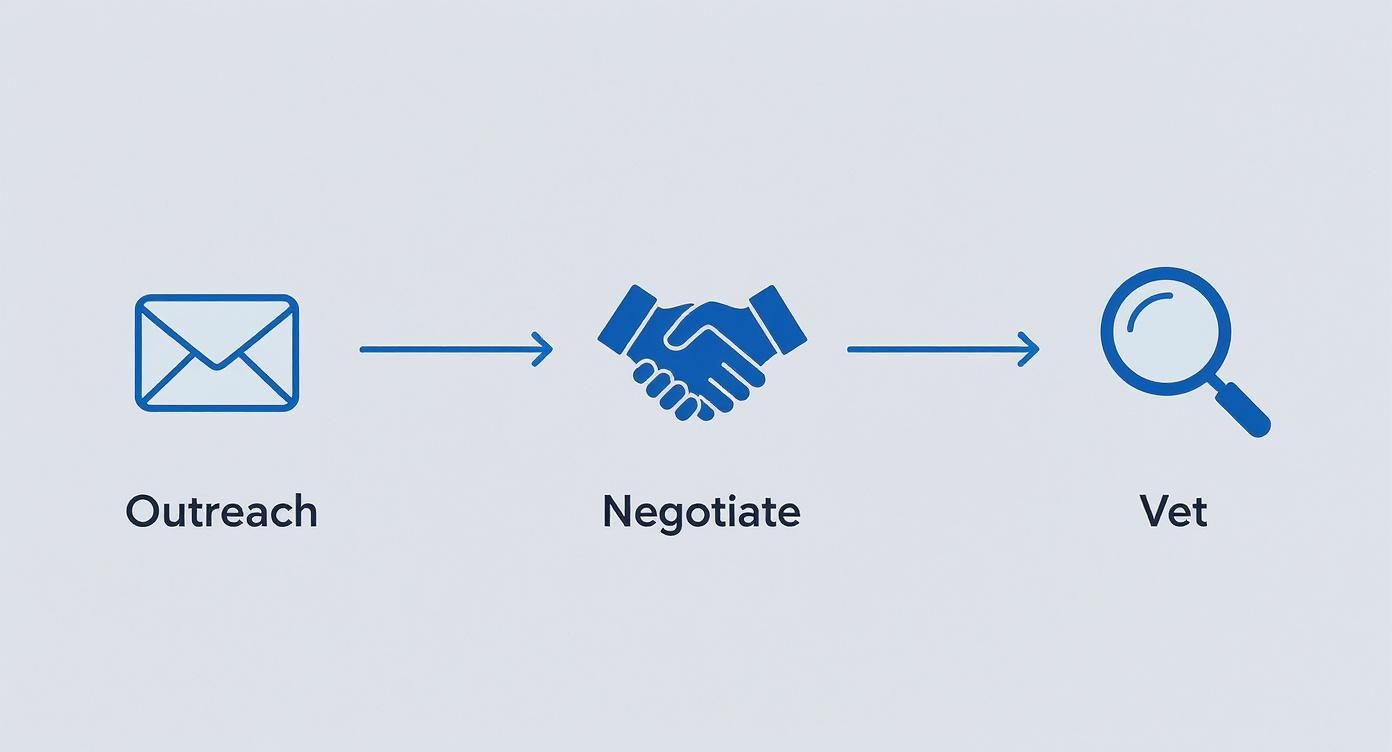
Following a systematic approach like this ensures you don't miss any critical details, moving from negotiation to verification with total confidence.
The Anonymous Test Order Strategy
Here's the key: never, ever tell a potential supplier you're placing a test order.
Act like a regular customer. Use a different name and ship to a friend's address if you have to. This is the only way to get a raw, unfiltered look at their actual performance. You're not getting the "special treatment" they might give a potential business partner; you're getting the real deal.
During this test, you're a detective. Keep a close eye on these specific things:
- Communication Speed: How fast do they send the order confirmation? What about the shipping notification? If communication is slow or vague now, it'll be a nightmare when you have a real customer issue.
- Shipping and Tracking: Clock the actual time it takes from the moment you click "buy" to when the package hits your doorstep. Does the tracking number work? Does it update reliably?
- Packaging Quality: This is huge. How does the product arrive? Is it protected? Does the packaging look professional, or is it something you'd be embarrassed for your customers to receive? The unboxing experience is a massive part of your brand.
This anonymous test gives you the ground-truth data you need. You see exactly what your customers will see, and that's the only thing that matters.
Assessing the Product Sample
Once the package arrives, it’s time to become your own harshest critic. Don't just give it a quick look. Put it under a microscope and compare every detail against the product brief you created. This is where the rubber meets the road.
Key Insight: A product sample is a direct reflection of a manufacturer's standards. If they send you something that's just "okay," they're telling you exactly what level of quality they think is acceptable. Believe them, and find someone else.
Grab your product brief and run through this checklist with every sample:
- Material and Build Quality: Does it feel solid? Are the materials what they promised? Look for weak seams, sloppy glue, or uneven finishes—the small stuff that screams "cheap."
- Color and Finish Accuracy: Hold it up against your specs. If you sent them specific Pantone codes, do they match? Is the matte finish actually matte?
- Functionality Test: Use it. Press all the buttons. Turn it on and off. Does it do what it's supposed to do, flawlessly?
- Branding and Details: If you requested a logo, is it centered? Is the color right? Is it printed clearly, or is it blurry and cheap-looking?
This hands-on inspection isn't optional. It’s your final defense against a partnership that could sink your brand before it even has a chance to swim. This is especially true when you're sourcing from massive marketplaces; many guides to starting your AliExpress dropshipping business rightly stress how vital this verification step is.
Ultimately, this whole vetting process is about one thing: confidence. You need to know, without a shadow of a doubt, that the manufacturer you choose will consistently deliver a great product and a positive experience on your behalf.
Answering the Tough Questions Before You Commit
Alright, you've done the legwork, narrowed down your list, and you're close to picking a partner. This is usually when a few nagging questions pop up—the kind that can make you second-guess everything. Let's walk through these common concerns, because getting them right is what separates a decent supplier relationship from a truly profitable one.
These are the nitty-gritty details that can make or break your business down the road.
"What If They Have a High Minimum Order Quantity?"
That dreaded acronym, MOQ (Minimum Order Quantity), has scared off plenty of aspiring dropshippers. You see a great product on Alibaba, but the supplier wants you to buy 500 units. Don't close the tab just yet.
The secret is in your approach. Instead of asking a blunt "Do you dropship?" (which often gets an immediate "no"), you need to reframe the conversation. Pitch it as a partnership. Explain that you'll handle the marketing and drive sales directly to customers if they can handle fulfilling individual orders. You're essentially offering them a risk-free entry into a new market. You'd be surprised how many manufacturers are open to this, even if their listing says otherwise.
My Go-To Tactic: If a supplier I really want to work with won't budge on their MOQ, I'll propose a small, prepaid inventory. I might offer to pay for 50 units upfront. They hold the stock for me in their warehouse and ship orders out as I get them. It shows I'm serious and gives them the production commitment they need.
"How Do I Deal with International Shipping?"
The thought of customs, duties, and month-long shipping times can be overwhelming. The good news is that your manufacturing partner will handle the heavy lifting. Your role is to understand the process so you can manage your customers' expectations.
Here’s what you absolutely need to nail down with any potential supplier:
- Real-World Delivery Times: Don't accept vague answers. Ask for their typical shipping times to your key markets, like the US, UK, or Australia. A supplier who can reliably offer 7-15 day premium shipping is worth their weight in gold.
- Rock-Solid Tracking: This is a deal-breaker. Confirm that every single package gets a reliable tracking number. Without it, you’re flying blind and setting yourself up for customer service nightmares.
- Who Pays Customs?: Get clarity on how they handle customs and duties. In most cases, the customer is responsible for any import fees. You just need to be crystal clear about this on your store’s shipping policy page to prevent any nasty surprises for your buyers.
A seasoned manufacturer will have clear, confident answers to all of these. If their responses are fuzzy or they seem unsure, that's a huge red flag.
"How Do I Make Sure Quality Stays High Over Time?"
The sample you ordered was flawless. But what about the 500th order you send them six months from now? Maintaining quality long-term is all about setting expectations upfront and staying vigilant.
First things first, ask for their quality control (QC) process in writing. A professional operation will have one. Find out what percentage of products they inspect from every batch.
Then, you have to do your own spot checks. Every so often, place a test order to a friend or family member's address without telling the supplier it's from you. This gives you a real-world look at what your customers are experiencing. If you ever spot a dip in quality, document it with photos and bring it to your supplier's attention immediately. A great partner will want to fix the problem, not make excuses. This is how you protect your brand and keep customers happy.
Tired of manually saving product photos? AliSave Pro is a lifesaver. It lets you download all the images, videos, and specs from an AliExpress listing with just one click. Grab AliSave Pro for free from the Chrome Web Store and get your product pages built in a fraction of the time.