
For a long time, the dropshipping game was all about one thing: finding the absolute cheapest product, usually from overseas. But the landscape has shifted. Working with US dropshipping suppliers isn't just a niche strategy anymore—it's become a cornerstone for building a serious, profitable ecommerce brand.
The focus has moved away from a pure cost-per-unit mindset to delivering a killer customer experience. That means faster shipping, products that don't feel cheap, and a return process that isn't a nightmare.
Why Partnering With US Suppliers Is a Power Move
Sure, the rock-bottom prices from international suppliers look tempting on a spreadsheet. I get it. But seasoned sellers know that the initial product cost is just one piece of a much larger puzzle. Choosing to work with domestic suppliers is about playing the long game and building a brand that lasts.
This is about more than just cutting down shipping times. It's a fundamental decision that builds trust. Think about it: when a customer gets their order in 3-5 days instead of waiting 3-5 weeks, their entire perception of your business changes. That speed alone leads to better reviews, fewer "where is my order?" emails clogging your inbox, and customers who actually come back to buy again.
The Real Perks Go Deeper Than Delivery Speed
If you only focus on shipping, you're missing the most powerful benefits. Partnering with US-based suppliers creates a ripple effect of advantages that make your whole business stronger.
- You Get Better Stuff: Domestic suppliers generally operate under stricter quality standards. This means fewer defective items, fewer disappointed customers, and a better reputation for your store.
- Returns Are Actually Manageable: Trying to process a return back to a warehouse overseas is a logistical headache. With a US supplier, it's simple. A happy customer who has an easy return experience is far more likely to shop with you again.
- Your Brand Looks More Legitimate: Sourcing domestically instantly boosts your credibility. Many shoppers actively look to support local businesses, and it just feels more trustworthy than a store with 30-day shipping times.
This isn't just happening in a vacuum. It's part of a much larger economic trend. You can see how this plays out on a macro level by reading up on the benefits of reshoring and nearshoring for the wider economy.
To give you a clearer picture, let's break down the key differences in a simple table.
US Suppliers vs. International Suppliers: A Quick Comparison
| Factor | US Dropshipping Suppliers | International Suppliers (e.g., AliExpress) |
|---|---|---|
| Shipping Time | 2-7 business days on average | 15-45+ days, often unpredictable |
| Product Cost | Generally higher unit prices | Significantly lower unit prices |
| Quality Control | Stricter standards, more consistent | Highly variable, risk of low-quality items |
| Return Process | Simple and fast domestic returns | Complex, slow, and often costly |
| Customer Support | Easier communication, same time zone | Potential language barriers, time zone delays |
| Brand Perception | Seen as more reliable and trustworthy | Often associated with long waits and cheap goods |
This table really highlights the trade-offs. While you might pay more per item upfront with a US supplier, you're buying speed, quality, and a better customer experience—all of which pay for themselves in the long run.
The Market Is Screaming for This Shift
This isn't just my opinion; the numbers back it up. The US dropshipping market is booming, hitting an estimated $95.28 billion in 2023, and it's projected to keep climbing. This massive growth is fueled by customers who now expect fast and reliable shipping. Local suppliers are the only ones who can consistently meet that demand.
The core question for store owners has evolved. It’s no longer, "How cheap can I get this?" It's now, "How quickly and reliably can I get a quality product to my customer?" This is where US suppliers give you a massive competitive advantage.
So yes, the initial cost from a US supplier might be higher. But when you subtract the money you save from fewer returns, fewer chargebacks, and way less time spent on frustrated customer service emails, the math starts to look very different. The total cost of doing business is often much lower.
If you're used to the international sourcing model, it's a big change in thinking, but a necessary one. To see a full breakdown of the old-school approach, you can check out our guide on dropshipping from China.
How to Actually Find High-Quality Domestic Suppliers
Let's be real—a quick Google search for "US dropshipping suppliers" is usually a waste of time. You'll end up sifting through a mountain of outdated blog posts, questionable middlemen, and lists that have been recycled a thousand times.
To find real, high-quality partners, you need to stop thinking like a dropshipper and start acting like a professional retailer. That means looking where actual B2B relationships happen, not just where the "dropshipping" keyword leads you.
The fastest way to get started is with a curated supplier directory. These platforms, like Worldwide Brands or DropCommerce, do the hard work for you. They vet suppliers to make sure they're legitimate, reliable, and actually based in the US. It's a solid investment that can save you dozens of hours of dead-end research.
Go Beyond the Obvious Search Terms
When you do use search engines, you have to dig deeper. Most established wholesalers and manufacturers don’t plaster "we dropship!" all over their homepages. Their main game is selling in bulk, so you need to speak their language.
Instead of generic searches, try using more specific, industry-focused terms. Think like a retailer trying to open a wholesale account.
"[your niche]" + wholesale program application"[your product]" + become a dealer"[brand name]" + authorized reseller form
Queries like these bypass the consumer-facing fluff and take you straight to the B2B side of a business. This is where you can start a real conversation about fulfillment, even if dropshipping isn't explicitly advertised. It's also the secret to uncovering unique product categories—for instance, learning how to find premium and luxury dropshipping suppliers can set you miles apart from the competition.
A supplier's website might look like it was built in 1999, and honestly, that’s often a good sign. It tells you they're probably focused on their warehouse and logistics, not on flashy web design. Don't let an old-school interface put you off a potentially amazing partner.
The Direct Outreach Method
One of the most effective strategies that people rarely use? Just contact the manufacturer directly.
If you know exactly what product you want to sell, find out who makes it. Then, shoot them a short, professional email. Don't ask them if they dropship; ask if they can provide a list of their authorized distributors who do.
Manufacturers are almost always happy to point you to their partners. This approach works wonders for two reasons: you get a warm introduction to a verified supplier, and you immediately establish yourself as a serious business owner who's done their research. For a more detailed walkthrough, our guide on how to find manufacturers that dropship breaks it all down.
Going direct cuts through all the noise. It connects you with the source or their most trusted partners, which is the foundation of a reliable supply chain. This is how you transition from being just another online seller to becoming a valued retail partner.
Your Practical Vetting Checklist for Potential Partners
So you’ve found a supplier that looks promising. Great. But that’s just the starting line. Now comes the real work: vetting. This is the part that separates the pros from the rookies, and skipping it is a mistake that can sink your business with angry customers and a trashed reputation.
You need a solid, repeatable system for checking out every potential partner before you even think about connecting them to your store. This isn't about a gut feeling; it’s a methodical process that puts their communication, tech, and actual performance under a microscope. A good vetting process catches red flags early, so you only end up working with US dropshipping suppliers who are built to help you grow, not hold you back.
Think of the journey in three main stages: finding them, talking to them, and then properly vetting them.
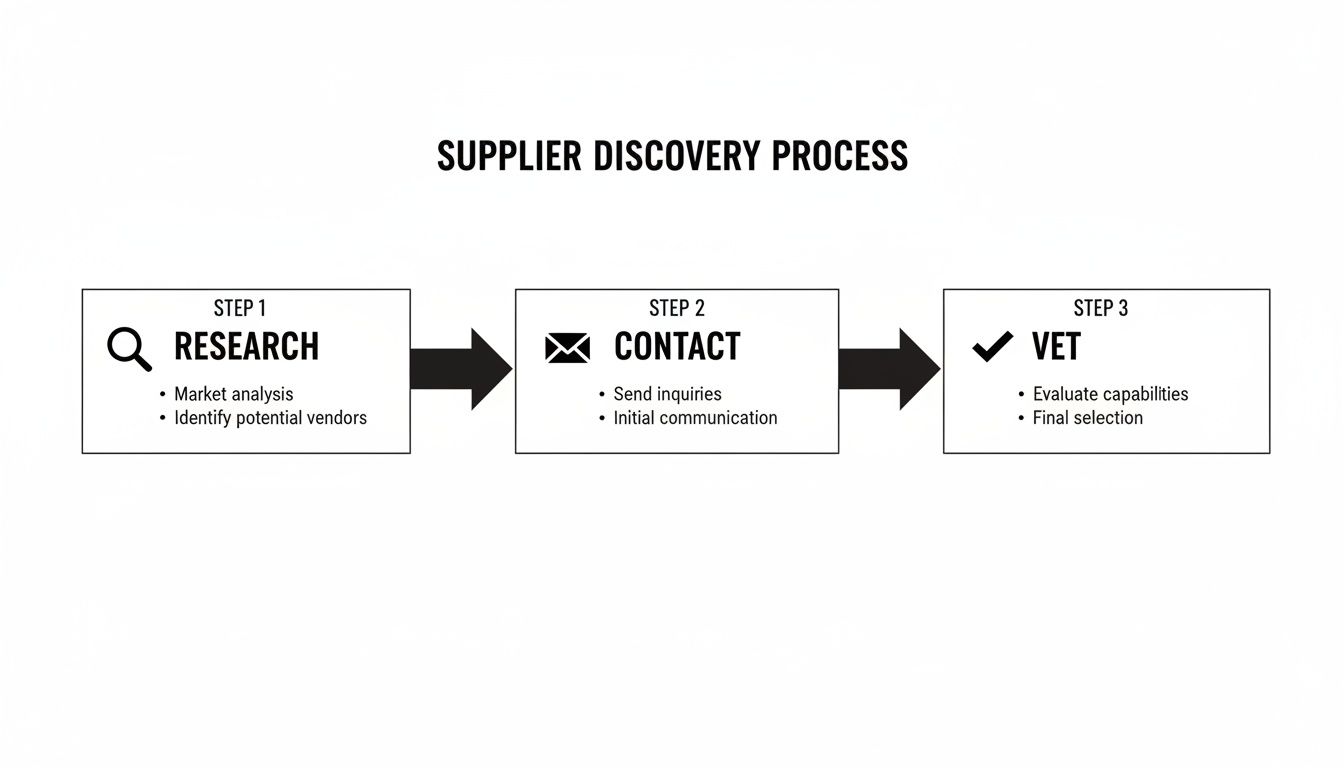
This simple flow—research, contact, vet—is your roadmap. We're zeroing in on that last, all-important step right now.
Assess Their Communication and Support
The first test has nothing to do with their products. It's all about how they handle communication. If a supplier is slow, vague, or just plain unhelpful before they have your money, imagine what it’ll be like when you have a real problem.
Kick things off by sending a few pre-sales questions via email. Here's what you're looking for:
- How fast do they reply? Anything within one business day is a good sign.
- Is the answer actually helpful, or did you get a generic, canned response?
- Do they have a support phone number? Even better, does a human actually answer it?
That first interaction tells you pretty much everything you need to know about what to expect when a customer's package goes missing.
Pro Tip: Don't ask something you can find on their FAQ page. Ask a slightly tricky question that requires them to do a little work. Something like, "Could you give me the exact packaged dimensions and weight for SKU #12345? I need it for my shipping calculator." How they handle that simple request reveals a ton about their internal processes and attitude.
Scrutinize Their Technology and Integration
A supplier's tech stack is the engine of your business. If it's clunky and outdated, you're the one who will be stuck doing manual work and fixing errors. You have to be sure their systems play nice with your store, whether you're on Shopify, WooCommerce, or something else.
Dig into their integration options:
- Dedicated Apps: Do they have an official app for your platform? If so, read the reviews. Real user feedback is gold for sniffing out sync issues or common bugs.
- API Access: For more complex needs, ask about API access and documentation. This is key for building out custom workflows later on.
- Inventory Sync: This is a big one. How often does their inventory data update? You need real-time or near-real-time updates to avoid the nightmare of selling out-of-stock products. A supplier who only syncs inventory once a day is a serious liability. If you want to learn more about protecting your store, our guide on ecommerce fraud prevention has some great related tips.
The Ultimate Test: Order Products
You can read all the reviews and ask all the questions you want, but you'll never truly know a supplier until you become their customer. Placing test orders is the single most important, non-negotiable step in this entire process.
Order a few different items and ship them to yourself or a friend. Be meticulous and document everything.
- Order Processing Time: Start the clock. How long does it take from the moment you place the order until you get a shipping confirmation with a tracking number? If it’s creeping over 48 hours, that's a red flag.
- Shipping Speed: Once it ships, how long does it actually take to arrive? Does it match what they promise on their website?
- Packaging Quality: How does the package look? You want a plain, unbranded box that's sturdy enough to protect the contents. Flimsy, beat-up packaging reflects poorly on your brand, not theirs.
- Product Accuracy and Quality: Open it up. Is it the exact item you ordered? More importantly, does the quality live up to the product photos and description?
This is where the rubber meets the road. It takes you beyond their marketing promises and gives you a clear, unfiltered look at the exact experience your future customers will have.
Negotiating Terms and Integrating with Your Store
Once you've found a supplier who looks like a great fit, it's time to make it official. This is where you move from a promising conversation to a real business relationship, building the foundation for a partnership that can actually last.
Think of this part as designing the engine for your business. Everything you decide here—from pricing to processing times—will directly impact your daily operations, your profit margins, and ultimately, your customers' happiness. Don't gloss over the details. A solid, clear agreement is your best insurance policy against future problems.
Locking in Favorable Terms
The first thing on everyone's mind is usually price, but a successful negotiation goes much deeper than the cost of the product. The small print and operational details are often what make or break your profitability in the long run.
When you sit down to talk numbers, make sure these topics are on the table:
- Tiered Pricing: A great question to ask is, "Do you offer discounts based on volume?" Many suppliers will lower their per-unit costs once you start sending them a certain number of orders, maybe at 50 or 100+ orders per month. It's a fantastic way to reward your own growth.
- Handling Fees: Get a clear breakdown of all per-order fees. It’s common for suppliers to charge a pick-and-pack fee, often somewhere in the $1.50 to $3.00 range. You need this number to be crystal clear so you can factor it into your retail pricing.
- Damage & Return Allowances: What happens when a product arrives damaged or is defective? A reliable partner will have a straightforward policy, often offering credit for items that can't be sold. Nail this down before it becomes a problem.
With the money talk out of the way, you need to lock in the operational promises.
The single most important document you can create is a Service Level Agreement (SLA). This isn't just for big corporations. It's your written proof of their commitment, clearly stating that all orders will be processed and shipped within 24-48 business hours.
This one simple clause is what lets you confidently promise fast shipping to your customers. It gives you a concrete standard to hold your supplier to. Without it, you're just crossing your fingers and hoping for the best, which is no way to run a business.
Integrating Your Store for Seamless Operations
Now for the technical side of things. How do orders from your Shopify or WooCommerce store actually get to your supplier's warehouse? Manually emailing spreadsheets every day is a recipe for disaster—it's slow, error-prone, and impossible to scale.
Your supplier needs to offer a reliable way to automate this process. Here are the most common ways this works:
- Direct App Integration: The dream scenario. Many modern suppliers have their own Shopify or WooCommerce apps that handle everything automatically: syncing inventory levels, sending orders, and pushing tracking numbers back to your store.
- CSV File Exchange: A classic method that still works well. Your store automatically exports new orders into a CSV file and sends it to the supplier. They process the orders and send a file back with the tracking information, which your store then imports.
- API Integration: This is the most powerful and direct connection, usually for higher-volume stores. An Application Programming Interface (API) lets your store's system "talk" directly to the supplier's system in real-time, ensuring instant order placement and inventory updates.
No matter the method, the goal is always automation. The less you have to touch an order, the fewer mistakes you'll make and the faster you can grow. This technical handshake is the final step in truly making your US dropshipping supplier a seamless extension of your own brand.
Building a Strong Supplier Relationship for Long-Term Success

Finding a great supplier is a huge win, but it’s just the starting line. Your long-term success really hinges on the partnership you build from that point forward. Think of it less like a simple transaction and more like bringing a key player onto your team.
This mindset pays off big time when—not if—things go sideways. A supplier who views you as a true partner is far more likely to hustle to fix a problem, whether that means hunting down a lost shipment or pushing your orders to the front of the line during a holiday rush.
Mastering Daily Operations and Communication
The secret to smooth day-to-day operations is simple: clear, consistent communication. Don't just reach out when there's a fire to put out. Regular, professional check-ins keep you top-of-mind and build the kind of goodwill that becomes invaluable when you actually need a favor.
For example, when a popular item suddenly goes out of stock, a good partner gives you a heads-up. That quick warning lets you pause your ad campaigns or hide the product listing, saving you from a flood of angry customer emails about oversold inventory. Make sure you know exactly who your point of contact is—be it a dedicated account manager or a specific support email—and keep that channel open.
A great supplier relationship is your hidden competitive advantage. It gives you the operational stability to create better customer experiences, which directly impacts your bottom line. Over time, it can even lead to perks like early access to new products or more flexible payment terms.
This operational stability is more important than you might think. Recent data shows that only about 10% of dropshippers turn a real profit in their first year, largely because of tight margins and customers who expect fast, domestic shipping. A reliable US supplier is your best defense. You can dig into more of these dropshipping statistics and trends to see the full picture.
Tracking Performance and Streamlining Processes
To keep the partnership healthy, you need to look at the data, not just go by gut feelings. I recommend tracking a few core metrics to make sure everything is running as it should.
- Order Accuracy Rate: What percentage of orders are shipped perfectly—no wrong items, no incorrect quantities? You should be aiming for 99% or higher.
- Fulfillment Speed: How long does it take from the moment an order is placed to when you get a tracking number? Hitting your 24-48 hour SLA consistently is non-negotiable.
- Return Processing Time: After a return arrives at their warehouse, how quickly do they process it and let you know?
If you see any of these numbers start to slide, bring it up early and constructively. Frame it as a team effort. Something like, "Hey, I noticed our average fulfillment time crept up to 52 hours last week. Anything we can do on our end to help get that back under 48?" This reinforces that you're in it together, working toward the same goal: keeping your customers happy.
Got Questions About Sourcing in the US? Let’s Clear Things Up.
Switching from international platforms like AliExpress to domestic suppliers is a big move, and it's bound to bring up some new questions. Even after you've found and vetted a great partner, you'll probably wonder about the day-to-day logistics.
Let's tackle some of the most common concerns I hear from store owners making this shift.
One of the first things everyone asks about is the cost. It’s true: the per-unit price from a US-based supplier is almost always higher. You're not just buying a widget; you're paying for reliability, quality control, and shipping that doesn't take a month.
Think of it as an investment in your brand's reputation. That slightly higher unit cost buys you drastically lower return rates and far fewer "Where is my order?" emails. When you look at the total cost—factoring in time saved on customer service and money saved on returns—it often comes out ahead.
What If a Supplier Wants a Minimum Order?
This one can feel like a curveball. The whole point of dropshipping is to avoid buying inventory upfront, right? But some established US wholesalers or manufacturers have Minimum Order Quantities (MOQs) baked into their business model.
Don't let this scare you off. It's often negotiable.
A great strategy I've seen work well is to propose a prepaid credit. You might offer to deposit $500 into an account with them, which they can then draw from as you send them individual customer orders. This proves you're a serious partner and gives them cash flow, all while you stick to the classic dropshipping model.
Finding this middle ground shows you're committed to a long-term partnership, not just a quick transactional relationship. That kind of flexibility is what builds strong supplier connections.
How Do Returns and Refunds Actually Work?
This is where US suppliers are a breath of fresh air. The process is so much cleaner than dealing with international returns.
Here’s the typical flow:
- Your customer requests a return, and you give them a shipping label that sends the item directly to your supplier's warehouse.
- The supplier gets the package and inspects it to make sure it can be resold.
- Once approved, they credit your account for the wholesale cost of that item.
- You then issue the full refund back to your customer.
The most important thing is to get their exact return policy in writing before you start. Ask about restocking fees and what happens if an item comes back damaged. A clear policy means no surprises for you and a smooth, professional experience for your customers.
Ready to build your next store with incredible product images? AliSave Pro is the fastest way to download high-resolution photos and videos from AliExpress in just one click. Download the free Chrome extension from AliSave Pro and start creating stunning product listings today.