
So, you're thinking about dropshipping from China. It's a classic e-commerce model for a reason: you sell products online that are sourced directly from Chinese manufacturers, who then handle shipping the items straight to your customers. The biggest draw? You get access to a mind-boggling variety of products at rock-bottom costs, which keeps your initial investment and risk incredibly low.
Your Blueprint for a Profitable China Dropshipping Venture
Look, succeeding with dropshipping from China isn't just about finding cheap stuff. The low product costs and endless selection are what get people in the door, but the real path to profitability is built on mastering three things: finding reliable suppliers, understanding global shipping, and creating product pages that actually convince people to buy. This is about building a real, sustainable business, not just flipping a few gadgets.
China's dominance in the dropshipping world is no secret. The market pulled in an incredible USD 41,756.5 million in 2023 and is on track to hit a staggering USD 253,710.6 million by 2030. That's a compound annual growth rate of 29.4%, which shows just how massive the opportunity is. If you're curious about the data, you can dig into the market's explosive growth on Grandview Research.
Choosing Your Sourcing Platform
Your first big move is deciding where you’re going to find your products. This isn't a one-size-fits-all situation. The right platform depends entirely on where you are in your business journey. If you're just starting out, your needs are completely different from someone who's already scaling up and needs to cut costs.
Think of it like this—your business stage points you to the best platform.
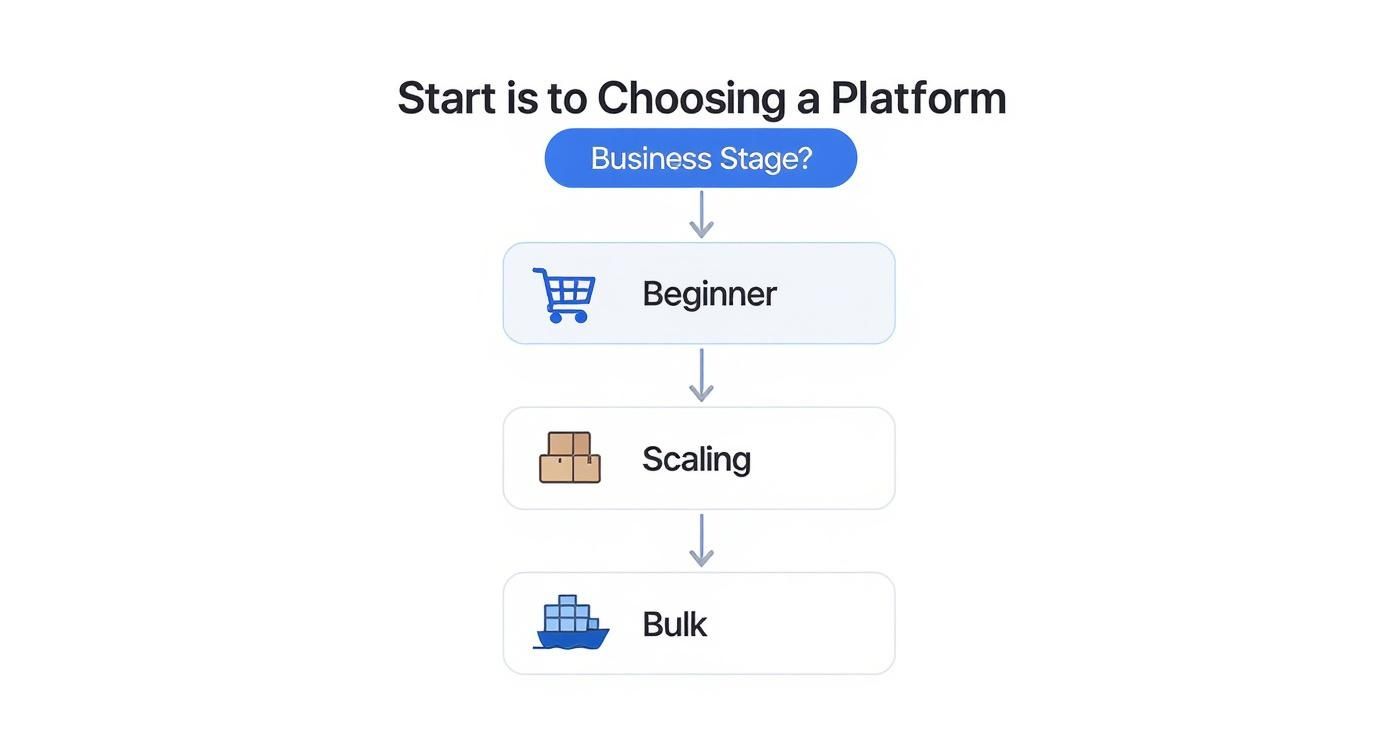
As you can see, where you start sourcing from should match your current scale to keep things efficient and profitable. Let's break down the big three players you'll be dealing with when dropshipping from China.
My Two Cents: Your sourcing platform is a strategic choice, not just a place to find products. What works when you're testing the waters is rarely the right fit when you're juggling hundreds of orders a day. Align your platform with your goals from day one.
To help you figure out where to start your product hunt, I've put together a quick comparison of the major players.
Comparing China's Top Sourcing Platforms
Here's a quick look at the major sourcing platforms to help you decide where to start your product search for your dropshipping business.
| Platform | Best For | Minimum Order Quantity (MOQ) | Pricing | Language Barrier |
|---|---|---|---|---|
| AliExpress | Beginners and testing new products | No MOQ | Retail-like | Minimal (English) |
| 1688.com | Scaling businesses looking for lower costs | Low MOQ (often 2-3 units) | Wholesale | High (Mandarin) |
| Alibaba | Bulk orders and private labeling | High MOQ | Wholesale/Custom | Moderate |
This table should make the choice a lot clearer. For example, 1688.com has much better prices than AliExpress, but you'll hit a major language barrier and will almost certainly need a sourcing agent to navigate it. Picking the right platform from the get-go saves you a ton of headaches down the road and builds a solid foundation for your business.
Finding Winning Products and Reliable Suppliers
Let's be honest: the success of your entire dropshipping business comes down to two things—the products you pick and the suppliers you trust. You can have the slickest marketing in the world, but it all falls apart if your product is junk or your supplier goes dark. This is where the real work begins.
The opportunity is massive. The dropshipping market in the Asia-Pacific region, powered by China, was valued at USD 100.14 billion in 2025 and is on track to explode to USD 621.37 billion by 2033. This incredible growth means there’s a ton of money to be made, but it also means more competition. That makes your choice of product and supplier more critical than ever. For a closer look at these numbers, check out this market analysis from FedEx.
Vetting Suppliers Like a Pro
Jumping onto AliExpress or Alibaba can feel like a free-for-all. You’ll see thousands of suppliers, often selling the exact same product. Your mission is to cut through that noise and find a real partner, not just a faceless vendor. Don't get fixated on the lowest price; a reliable partner who costs a few cents more per unit is worth their weight in gold.
Start by checking out their digital storefront. How long have they been in business? A supplier with a few years under their belt and a high feedback score—aim for 95% or higher—is a decent starting point. It shows they’ve managed to keep other merchants happy over time.
Next, see how they communicate. Fire off a few questions about the product, shipping options, or maybe even customization. Pay attention to a few things:
- Response Time: Do they get back to you within 24 hours? That’s a good benchmark.
- Clarity: Is their English clear enough to avoid major confusion? It doesn't need to be perfect, but you need to understand each other.
- Attitude: Are they genuinely helpful, or are their answers blunt and dismissive? That first interaction tells you a lot about the kind of support you’ll get when a customer’s order inevitably goes sideways.
Validating Your Product Idea
Finding a "winning product" isn't about some magical, undiscovered item. It’s about finding a solid product that connects with the right audience. Before you go all in, you need to make sure people actually want to buy it. Use a tool like Google Trends to see if interest is growing, flat, or dying off.
You also have to gauge the competition. If you search for your product and find a dozen huge stores with thousands of reviews and professional video ads, you’re in for a tough fight. I find it’s better to look for products that serve a passionate community or solve a very specific problem. If you want to go deeper on this, our guide on https://alisavepro.com/product-research-for-dropshipping/ has more advanced strategies.
Pro Tip: Don't just look at what's selling; figure out why it's selling. Go read the 1-star reviews on your competitors' product pages. Those complaints about poor quality, confusing instructions, or slow shipping? That's your roadmap for creating a much better offer.
The Non-Negotiable Sample Order
I’ll say it again for the people in the back: never, ever start selling a product you haven't held in your own hands. Ordering a sample is the most important step in this whole process. It’s a tiny investment that can save you from a mountain of refunds and a trashed brand reputation.
When the sample finally shows up, you’re doing more than just a quick quality check. You need to evaluate the entire experience from your customer’s point of view.
- Product Quality: Does it actually look and feel like the pictures? Get picky. Check the materials, the stitching, the overall finish. Is this something you'd be proud to put your name on?
- Packaging: How did it arrive? Thrown in a flimsy plastic mailer or packed in a decent box? Good packaging protects the product and makes your brand feel more professional, even if it's unbranded.
- Shipping Time: This is crucial. How long did it really take to get to you? Write down the date you ordered it and the day it hit your doorstep. This is your real-world data for setting honest shipping times on your store.
This one simple test tells you pretty much everything you need to know. For those focused on sourcing from Alibaba to sell on Amazon, this Dropshipping Alibaba to Amazon: Ultimate Guide to Success is an invaluable resource. By being meticulous with both your supplier and product validation, you build a foundation that can actually withstand the pressures of a real business.
Tackling International Shipping and Customs Head-On
Let's get real for a moment: long shipping times are the single biggest headache when you're dropshipping from China. If you don't get a handle on this, you'll drown in a sea of "Where's my order?" emails and refund demands. But here's the thing—what looks like a deal-breaker can actually be managed with the right strategy and a whole lot of transparency. Your job is to pull back the curtain on the journey from a warehouse in Shenzhen to a customer's mailbox in Ohio. Get this right, and you’ll build a business that lasts.
The first thing to wrap your head around is the constant tug-of-war between three things: speed, cost, and tracking. You're always trying to find the sweet spot. Leaning too far in any one direction can wreck your customer experience or sink your profit margins. It's a balancing act, and it’s one you need to master.
Picking the Right Shipping Method
When you’re browsing suppliers on a platform like AliExpress, you’ll be hit with a dropdown menu of shipping options. It's tempting to just pick the cheapest one. Don't. That rock-bottom price usually means no tracking and a delivery window so long and unpredictable you'll forget you even sold the item.
You’ll typically be choosing between two main tiers of service:
- The Go-To Options (ePacket/AliExpress Standard Shipping): Think of these as the workhorses of dropshipping. For anyone starting out, they offer the best middle ground between a reasonable price and decent tracking. You're still looking at a wait time, often 15 to 30 days to the US or Europe, but it's a reliable and affordable place to begin.
- The Premium Couriers (DHL, FedEx, UPS): This is your express lane. These guys can get a package across the world in as little as 5-10 days, but you'll pay a hefty price for it. That high cost can completely evaporate your profit on a $20 gadget, making these services really only practical for higher-ticket items where customers expect and are willing to pay for speedy delivery.
My Two Cents: Whatever you do, always choose a shipping method with end-to-end tracking. If you can't track it, you can't answer your customer's most important question. Replying with "I'm not sure" is a surefire way to kill any trust you've built.
Making Sense of Customs and Duties
The whole topic of "customs," "duties," and "taxes" sounds complicated, but for the kind of low-value goods most dropshippers sell, it's usually straightforward.
Most countries have something called a de minimis value—a threshold below which packages can enter the country without any extra fees. In the United States, this value is a very generous $800, meaning the vast majority of your individual orders will sail right through customs.
But don't get too comfortable. This isn't a global rule. Many countries in the EU and the UK have much lower thresholds, and they're serious about collecting VAT (Value Added Tax) on imported goods. As the seller, it's on you to know the basics of the regions you're selling to.
So, when a fee is charged, who foots the bill? The customer (as the official importer). Your job is to make sure they know this before they buy.
- Build a Clear Shipping Policy Page: Your site absolutely must have one. Spell out your estimated delivery times and plainly state that the customer is responsible for any local customs fees or import duties that may apply.
- Be Upfront and Honest: A simple sentence in your policy can save you from a world of pain. Something like, "Please be aware that international orders may be subject to customs duties or import taxes upon arrival, which are the customer's responsibility."
This kind of transparency prevents that awful moment when a customer is hit with an unexpected bill from their local post office. That’s a fast track to a chargeback or an angry review. For a deeper dive into the logistics, our guide on shipping from Alibaba has some great insights that apply no matter which platform you're using. Managing these expectations from the get-go isn't just good customer service—it's how you build a sustainable business.
Crafting Product Pages That Actually Convert
You can line up the perfect supplier and nail down the fastest shipping line, but none of it matters if your product page can't convince someone to click "Add to Cart." When you're dropshipping from China, your product page is everything—it's your digital storefront, your best salesperson, and your brand's first impression, all in one. This is where the sale is won or lost.
A winning product paired with a lazy, uninspired listing is a recipe for failure. Your goal isn't just to list specs; it's to make a potential customer feel the problem your product solves and imagine how their life will be better with it. This is your single biggest opportunity to cut through the noise.
The dropshipping market is absolutely exploding, hitting $301 billion in 2024 and on track to reach a staggering $1.254 trillion by 2030. With products from China fueling so much of this growth, a killer product page isn't just a "nice-to-have"—it's your ticket to grabbing a piece of that pie. You can dig into more of these impressive dropshipping statistics on AutoDS.com.
Write Descriptions That Resonate
First things first: stop copying and pasting those generic, feature-dump descriptions from the manufacturer. No one cares that the portable blender has a "2000mAh lithium-ion battery." What they do care about is that they can whip up a fresh smoothie at their desk, at the gym, or even on a hike, getting a healthy energy boost wherever life takes them.
You have to translate features into benefits. Connect the technical jargon to real-world value.
Instead of: "Water-resistant polyester fabric"
Try: "Never worry about getting caught in a sudden downpour again. Your laptop and valuables stay bone-dry, guaranteed."
Instead of: "Ergonomic handle design"
Try: "Carry it all day without the usual hand cramps. It's built for comfort on long commutes or while navigating a busy airport."
Break up your text into short, easy-to-read paragraphs. Use bullet points to make the key benefits pop. Your job is to tell a story about how this product seamlessly fits into your customer's life and solves a nagging problem they deal with every day.
High-Quality Visuals Are Non-Negotiable
Let's be honest, people shop with their eyes first. The single biggest hurdle in e-commerce is that customers can't physically touch or hold the product. It’s your job to bridge that gap with incredible, high-resolution photos and videos.
Supplier photos from platforms like AliExpress are a decent starting point, but they're often cluttered with Chinese characters, distracting watermarks, or just plain bad lighting. Worse yet, downloading them one-by-one is a mind-numbing task that will absolutely kill your workflow. This is where a smart tool becomes essential.
For instance, a browser extension like AliSave Pro lets you batch-download all the product media—we're talking main images, every single variant, and even the videos—with just one click.
This kind of tool saves you hours of tedious work and packages everything into a neat ZIP file. Once you have the high-res assets, you can clean them up: crop out any logos, adjust the brightness, and create a clean, professional gallery that builds immediate trust.
Key Takeaway: Your visual presentation is a direct reflection of your brand's quality. If your product photos look cheap or unprofessional, customers will assume your product is, too.
Leverage Social Proof and Smart Pricing
No matter how persuasive you are, shoppers will always trust other shoppers more. This is why social proof is one of the most powerful conversion tools in your arsenal.
- Import Reviews: Use a review app to pull real customer photos and reviews directly from the AliExpress listing. Seeing the product in the hands of real people is incredibly powerful.
- Display Trust Badges: Place familiar icons for secure payments (like Visa, Mastercard, and PayPal) right near your "Add to Cart" button. This small touch can instantly soothe any security concerns.
Finally, you need to price your product intelligently. Your price has to cover the cost of the item, shipping, marketing, and transaction fees, while still leaving you with a healthy profit margin—aim for at least 20-30% to start.
Don't fall into the trap of trying to be the cheapest. Instead, compete on value. A polished product page with compelling descriptions, professional visuals, and glowing reviews allows you to command a higher price because you’ve built trust and demonstrated value.
Automating Operations and Scaling Your Business
There’s a moment every dropshipper hits. The sales start rolling in, and the initial excitement quickly turns into the dreadful realization that you’re buried in manual order entry. Fulfilling a handful of orders a day is one thing, but as you grow, it becomes a time-sucking bottleneck.
If you’re serious about dropshipping from China, this is where you pivot from a hands-on hobby to a real, scalable business. The name of the game is automation. It's how you free yourself from the grind of repetitive tasks to focus on what actually moves the needle: marketing, finding new products, and building a brand.
Putting Order Fulfillment on Autopilot
The bedrock of any scalable dropshipping store is the seamless connection between your storefront and your supplier. This is where automation software becomes your most valuable employee. These tools are the digital glue that holds your operation together.
An app will link your Shopify or WooCommerce store directly to your supplier's system on a platform like AliExpress. When a customer clicks "buy," the software instantly shoots their order details and shipping information to your supplier. No more copy-pasting addresses and praying you didn’t make a typo.
Better yet, when the supplier ships the package, the app grabs the tracking number and syncs it back to your store, automatically triggering a shipping confirmation email to your customer. It’s a completely hands-off process. If you're wondering which apps to use, this guide breaks down the best dropshipping automation tools.
Professionalizing Your Customer Service
More orders mean more customer questions. You’ll quickly notice the same inquiries popping up again and again: "Where’s my package?" "How long is shipping?" "What’s your return policy?" Typing out a fresh response every time is a massive waste of energy.
This is where pre-written scripts and templates are a lifesaver. They ensure your support is fast, professional, and consistent.
Create a simple document with templates for your most common interactions:
- Order Confirmation: A warm "thank you" that also sets clear expectations for the shipping timeline.
- Shipping Update: A proactive message letting them know their tracking number is ready.
- "Where Is My Order?" Reply: A polite response that explains the shipping stages and gives them a direct tracking link.
- Return Request: A clear, step-by-step guide on how to proceed based on your return policy.
Using templates keeps your brand voice consistent and lets you handle customer service in minutes, not hours.
Pro Tip: Never overpromise. When a customer asks about shipping, be transparent. Stick to the realistic timelines you confirmed when you ordered samples. Managing expectations is 90% of good customer service in this business.
Advanced Strategies to Go from Seller to CEO
Once your day-to-day operations are running on their own, you can finally put on your CEO hat and think about long-term growth. The most successful dropshippers don’t just ride one winning product into the sunset—they constantly evolve.
Here are three moves that separate the pros from the amateurs.
Find a Private Sourcing Agent
AliExpress is the perfect training ground, but you'll eventually outgrow it. To get better pricing, faster processing, and more reliable service, you need a private sourcing agent. This is an individual or company on the ground in China who acts as your personal sourcing partner.
A good agent can often get you the exact same product for 10-30% less than the AliExpress price. They also become your single point of contact, can bundle orders from different factories, and will even perform quality control checks before anything leaves the warehouse. This is a game-changer.
Graduate to Private Labeling
Private labeling is how you turn a generic product into your brand. It involves working with a manufacturer to add your own logo and custom packaging to an existing product.
Suddenly, you’re not just another person selling "a portable blender." You’re selling the "BlendGo Portable Blender." This lets you build a real brand, foster customer loyalty, charge a premium, and create something your competitors can't easily copy. Most sourcing agents can help you arrange this with a manufacturer.
Diversify Your Traffic
Relying on a single source of traffic, like Facebook Ads, is like building your house on a cliff. One algorithm update or a surprise account ban, and your entire business can disappear overnight.
To build a resilient brand, you have to diversify.
- SEO: Start optimizing your product pages and writing blog content to capture free, organic traffic from Google.
- Email Marketing: Build your email list from day one. It's an asset you own and a direct line to your best customers for driving repeat sales.
- Other Platforms: Get creative. Depending on your product, your audience might be on TikTok, Pinterest, YouTube, or even Snapchat.
To truly scale and create a hands-off operation, it's essential to master e-commerce automation tools and strategies. By adopting these advanced tactics, you stop being just a dropshipper and start becoming the founder of a legitimate e-commerce brand.
Common Questions About Dropshipping from China
https://www.youtube.com/embed/cDpc-n41TyM
When you're first diving into dropshipping from China, a ton of questions pop up. It’s a well-trodden path, for sure, but the game is always changing. Let’s tackle some of the biggest questions I hear from entrepreneurs who are just starting out.
Is Dropshipping from China Still Profitable?
Yes, without a doubt. Every year, someone declares that dropshipping is "dead," but that's just not what I see on the ground. The market is definitely more crowded than it was a few years ago, but the core advantages of sourcing from China haven't gone anywhere. We're talking rock-bottom product costs and a mind-boggling variety of inventory.
What has changed is what it takes to be profitable. You can't just find a cheap gadget, throw up a few ads, and expect to make a killing anymore. Success today is built on smart branding, sharp marketing, and creating a customer experience that feels reliable. The stores that are really crushing it are the ones with a strong brand identity and top-notch service, not just the ones with the lowest prices.
What Are the Biggest Challenges?
Let's be real—no business model is without its headaches, and dropshipping is no different. Knowing the common pitfalls ahead of time is half the battle.
- Long Shipping Times: This is the big one. Your customers are used to Amazon Prime, so you have to be crystal clear about delivery estimates. Managing those expectations from the get-go is non-negotiable.
- Inconsistent Product Quality: You're putting your brand's reputation in your supplier's hands. This is precisely why ordering samples is a step you absolutely cannot skip. You need to see and feel the product before your customers do.
- Communication Gaps with Suppliers: Language barriers and cultural differences can occasionally trip you up. My advice? Keep your messages simple, direct, and unambiguous. It cuts down on a lot of potential confusion.
Finding a solid, trustworthy supplier is your best defense against all these issues. A great partner will be on your team, helping you solve problems before they blow up.
The Bottom Line: You can get ahead of these challenges. Be transparent about shipping, always vet your products with samples, and communicate clearly with your suppliers. It makes all the difference.
How Should I Handle Customer Returns?
Returns can feel tricky. Asking a customer to ship a $15 item back to a warehouse in China just isn't practical for anyone involved. Because of this, most experienced dropshippers build a more flexible return policy.
For low-cost products, it's almost always cheaper to just issue a full refund or send a replacement without getting the original item back. Seriously, the cost of a lost product is often far less than the damage a single angry customer review can cause.
What about pricier items? You can set up a local return address—even your own home address works when you're starting out. This lets you inspect the returned product, and if it's in good shape, you might even be able to resell it. The key is to have a simple, easy-to-find return policy spelled out clearly on your website to avoid any drama.
Ready to create stunning product pages without the hassle? With AliSave Pro, you can download all the high-resolution images and videos from any AliExpress product page in a single click. Save hours of manual work and build a professional-looking store faster. Get started for free at AliSavePro.com.