
Thinking about starting your own beauty brand? Dropshipping cosmetics is one of the smartest, lowest-risk ways to jump into e-commerce right now. It lets you sell products directly to your customers without ever having to buy or store inventory yourself. This is a game-changer because it slashes your initial investment and gets rid of a ton of operational headaches. You handle the fun part—the marketing—and a supplier takes care of all the packing and shipping.
Launching Your Beauty Brand with Dropshipping
The beauty industry is a powerhouse, and its massive shift online has created a huge opportunity for new entrepreneurs. Forget the old way of doing things, which meant sinking a ton of cash into inventory, warehouse space, and logistics. Dropshipping gives you a much more direct path to market. You can build a brand, hand-pick a product line, and start selling to customers worldwide with very little upfront money. This freedom lets you pour your energy into what really builds a successful beauty business: killer marketing, a strong brand identity, and amazing customer relationships.
This model works exceptionally well for cosmetics for a few key reasons:
- Passionate Niches: The beauty world is full of them. You can easily build a brand around a specific niche like vegan, cruelty-free, or organic makeup and attract a loyal following that’s actively searching for what you offer.
- Low Shipping Costs: Most makeup is small and light. This is a huge plus because it keeps your shipping costs down, which is a major advantage over stores selling bulkier items.
- Endless Trends: There's always something new. Fresh trends, colors, and formulas are constantly popping up, giving you a steady stream of new products to add and keeping your store feeling relevant and exciting.
Understanding the Market and Its Challenges
The potential here is massive. We're talking about a global cosmetics market projected to hit an incredible $758.4 billion by 2025. A huge chunk of that growth is being driven by e-commerce and models like dropshipping. You can dig into the numbers in this market analysis by Dropship Spy.
But let's be realistic—that kind of money attracts a lot of competition. Success isn't as simple as just listing a few products online. You’re going to be up against thousands of other stores, and many of them will be selling the exact same things you are.
The key to standing out isn't being the cheapest—it's building a brand that customers trust. Your success will depend on your ability to curate quality products, create a compelling brand story, and provide an exceptional customer experience.
You also have to accept that you’ll have less direct control over your supply chain. Since you're not physically handling the products, you're putting a ton of trust in your supplier for everything from product quality and packaging to how quickly orders get shipped. This is why vetting your suppliers is the single most important thing you'll do.
Once you get your footing, the natural next step is often moving toward a unique brand identity through private labeling. We've put together a guide that walks you through how to do this, which you can read here: private label drop shipping. This guide will help you set realistic expectations and navigate these challenges to build a business that actually lasts.
Finding and Vetting Your Cosmetics Suppliers
Let's be clear: your supplier isn't just a vendor. They are, without a doubt, the most critical partner in your cosmetics dropshipping business. Product quality, shipping times, customer happiness—it all flows directly from them. A fantastic supplier can build your brand, but a bad one will torpedo it before you even get started. This is one decision you absolutely cannot rush.
Choosing the right partner means you have to put on your detective hat and dig way deeper than a simple AliExpress search. You're looking for the tell-tale signs of professionalism and quality that separate the legitimate suppliers from the thousands of fly-by-night resellers.
This process map lays out the entire journey, from the low initial risk to the major hurdles you'll need to clear.
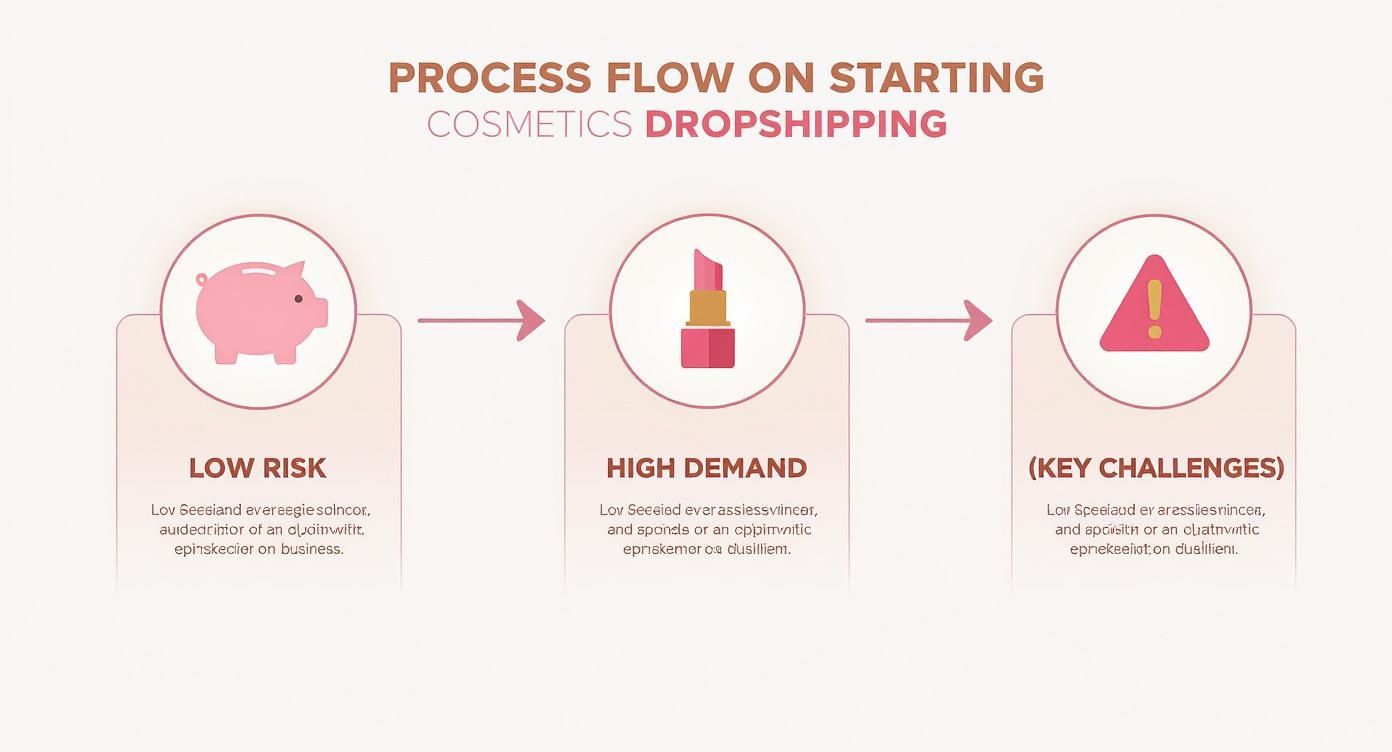
As you can see, the barrier to entry is low, but success hinges on navigating the challenges—and supplier quality is the biggest one of all.
Your Go-To Supplier Vetting Checklist
When you land on a platform like AliExpress, the sheer number of options can feel overwhelming. To cut through the noise, I’ve developed a specific checklist that helps me vet potential partners quickly. It's a system for spotting the good ones and immediately tossing out the suppliers who are likely to cause problems later.
First things first, check the store’s rating and its history. A high rating—I look for 95% or better—is a great start, but longevity matters just as much. A supplier who has been in business for 3+ years with a solid rating is a much safer bet than a brand-new shop, even if its score is perfect.
Next, you need to become a review connoisseur. Don't just glance at the star ratings. I specifically hunt for reviews that include customer-submitted photos. This is gold. It shows you what the product actually looks like when it arrives at someone's door, not just the glossy, perfect studio shots. Do the lipstick shades match the listing? Is the packaging crushed or pristine?
To help you get started, I’ve put my core criteria into a simple table. Use this as your guide when you’re scrolling through potential partners.
Supplier Vetting Checklist
| Vetting Criteria | What to Look For | Red Flag Example |
|---|---|---|
| Store History & Rating | 3+ years in business, 95%+ positive feedback. This shows consistency and reliability over time. | A 6-month-old store with a 100% rating but only 50 reviews. It's too new to trust. |
| Product-Specific Reviews | Look for detailed reviews with customer photos. Do the real-life products match the listing images? | A product with 1,000 five-star ratings but no photos and generic comments like "Good product." |
| Communication & Responsiveness | Send a test message. A quality supplier should respond clearly and helpfully within 24 hours. | A vague, automated response that doesn't answer your question, or complete silence for 48+ hours. |
| Shipping & Processing Times | Check the "Processing Time" on listings. Reliable suppliers usually ship within 1-3 days. | A stated processing time of 7-10 days before the item even ships. This will lead to unhappy customers. |
This checklist isn't foolproof, but it's an incredibly effective filter. It helps you focus your energy on the suppliers who are serious about their business, just like you are.
How to Talk to Potential Suppliers
Once you have a shortlist, it’s time to reach out. This isn’t just about asking, "Do you dropship?" You need to probe for the details that reveal their operational standards and, most importantly, their commitment to safety.
Here are the questions I always ask:
- On Product Origins: "Can you tell me where the ingredients for this eyeshadow palette are sourced?" A vague answer is a deal-breaker.
- On Safety Documentation: "Are you able to provide a Safety Data Sheet (SDS) or confirm your products are made in a GMP-certified facility?" For selling in the US or EU, this is non-negotiable.
- On Their Role: "Are you the direct manufacturer or a reseller?" Working directly with the source often means better prices, more consistency, and fewer headaches.
Your first conversation sets the tone for the entire partnership. If a supplier is vague, dismissive, or slow to respond before you've even given them any money, just imagine how they'll react when a real customer issue pops up. Always trust your gut.
As you grow, effectively managing product data from different suppliers is crucial for keeping your store's information accurate. This is where mastering supplier feed management becomes a vital skill. For a deeper look into the discovery process, don't miss our comprehensive guide on https://alisavepro.com/how-to-find-dropshipping-suppliers/.
The Final, Unskippable Step: Always Order Samples
I can't stress this enough. No matter how perfect a supplier seems on paper, you absolutely must order samples of the products you plan to sell. This is the only way to truly verify the quality and see exactly what your customers will be unboxing.
When the samples arrive, be ruthless in your evaluation:
- The Product Itself: What's the texture like? The scent? The pigmentation? Does the foundation apply smoothly or look cakey? Be your own toughest critic.
- The Packaging: Was the item bubble-wrapped and secure, or was it just tossed in a thin mailer? Did it arrive damaged? The unboxing experience is a huge part of your brand.
- The Shipping Time: Clock the delivery from the moment you placed the order. This real-world data is what you'll use to set honest, accurate shipping expectations on your website.
Testing the products yourself is a small investment that protects your reputation and prevents much bigger, more expensive problems down the line. It gives you the confidence to stand behind what you sell.
When you're dropshipping cosmetics, you're not just selling lipstick or skin cream—you're selling trust. Your customers are literally putting your products on their faces and bodies, trusting that they are safe, effective, and compliant with the law.
Breaking that trust isn't just a bad look for your brand. It can have devastating legal and financial blowback that could end your business before it even gets off the ground.
This is one part of the business where you absolutely cannot cut corners. We're not selling t-shirts or phone cases here; cosmetics is a heavily regulated industry for a reason. As the seller, you are responsible for the products you market, even if you never physically touch the inventory.
The global nature of dropshipping adds yet another wrinkle. The market has exploded, especially in the Asia Pacific region, which now holds a massive 35.2% share of the global market. Since many of the best suppliers are based there, you have to be ready to navigate international rules. You can find more eye-opening dropshipping statistics over at Printful.com.
Learning the Lingo of Compliance
To navigate cosmetic safety, you need to speak the language. Certain terms aren't just industry buzzwords; they represent crucial standards and documents that protect you, your business, and your customers. When you start talking to potential suppliers, you need to know exactly what to ask for.
Here are the absolute must-haves you need to understand:
- Good Manufacturing Practices (GMP): Think of this as a seal of quality for the production process. A GMP-certified factory adheres to strict protocols for everything from raw material handling and sanitation to staff training. It’s a huge green flag that a supplier is serious about quality control.
- Safety Data Sheet (SDS): Previously known as an MSDS, this document is a comprehensive breakdown of a product's chemical properties. It details any potential hazards, safe handling instructions, and what to do in an emergency. Your supplier must have an SDS for every single product. No excuses.
- Ingredient Transparency: You have to know exactly what's in the products you're selling. That means getting a full, accurate list of ingredients from your supplier, usually in the International Nomenclature of Cosmetic Ingredients (INCI) format.
Let me be crystal clear: if a supplier is vague, hesitant, or flat-out unable to provide you with GMP certification, an SDS, or a full ingredient list, you need to walk away immediately. It's a non-starter. The risk is just too high to partner with someone who can't verify the safety of their own products.
A Quick Look at Major Market Regulations
Rules and regulations change from country to country, but if you're serious about dropshipping, you'll likely be selling to customers in the United States and the European Union. These are two of the biggest markets, and you need to have a basic grasp of their rules.
Selling in the United States (FDA)
In the U.S., the Food and Drug Administration (FDA) is the agency in charge. While they don’t typically require pre-market approval for cosmetics, they demand that all products and ingredients be safe for consumers when used as directed.
- Labeling is Everything: The FDA has very specific rules for what goes on a label. Everything must be truthful and not misleading. This includes listing ingredients from most to least-used and displaying any required warnings.
- Banned & Restricted Ingredients: The FDA maintains a list of ingredients that are either completely banned or restricted for use in cosmetics. It is your responsibility to ensure the products you sell don't contain any of these substances.
Selling in the European Union (CPNP)
The EU has some of the most stringent cosmetic regulations on the planet. Before any cosmetic product can be sold there, it must be registered through the Cosmetic Products Notification Portal (CPNP).
- The "Responsible Person" (RP): A key EU requirement is having a designated "Responsible Person" located within the EU. This person or entity is legally responsible for ensuring a product's compliance. This can get tricky for dropshippers, and you may need to work with a third-party service to fill this role.
- Product Information File (PIF): For every product, you must maintain a detailed PIF. This file contains everything from the product's formula and safety assessments to its manufacturing methods.
Ignoring these rules can lead to your products being seized at the border, massive fines, and a swift ban from selling in these markets. Always be upfront with suppliers about where you plan to sell and get confirmation that they can meet the required standards.
Building Product Pages That Actually Convert
You've done the hard work of sourcing safe, high-quality cosmetics. Now comes the fun part: making people want them. In the beauty world, your product page is everything. It's your digital shelf, your brand's voice, and your 24/7 salesperson all in one. Just copying and pasting a supplier’s generic text is a one-way ticket to zero sales.
Your real job is to turn a simple listing into an experience. This means weaving together persuasive writing, stunning visuals, and some smart search engine optimization (SEO) so your ideal customers can actually find you.
Write Descriptions That Sell an Outcome, Not Just a Product
This is the number one mistake I see new store owners make. They list features, not benefits. Nobody is just buying a "long-wear lipstick." They're buying the confidence of a lipstick that survives coffee, lunch, and after-work drinks without a single smudge.
Instead of getting technical, focus on the feeling. Paint a picture of how this product solves a problem or makes their life better.
- Don't say: "Matte finish foundation."
- Do say: "Get that flawless, airbrushed look that keeps shine away for up to 12 hours. You'll have camera-ready confidence from your morning meeting to your evening out."
This approach taps into what the customer truly desires. To take it a step further, bring in sensory details. Talk about the "velvety texture" of a pressed powder or the "subtle, fresh scent" of a setting spray. Help them imagine what it's like to use it.
High-Quality Visuals Are Non-Negotiable
In beauty, people buy with their eyes first. They can't touch, smell, or swatch your products through a screen, so your images and videos have to do all the work. Using those grainy, watermarked, or inconsistent photos from your supplier instantly screams "amateur dropshipper" and destroys trust.
This is where a tool like AliSave Pro is a game-changer. It lets you download all of a supplier's high-res images and videos with a single click—even photos from customer reviews. Suddenly, you have a huge library of top-notch assets to work with.
Don't just stick to the boring studio shots. Your secret weapon is mixing it up. Use user-generated content (UGC), show swatches on a variety of skin tones, and include short video clips of the product in action. This builds massive social proof and helps customers see themselves using it.
Once your pages are looking sharp, the next step is to keep tweaking them to maximize sales. Take some time to learn how to improve your e-commerce conversion rate with proven, actionable strategies.
Optimize Your Pages So People Can Find You
A gorgeous product page is worthless if it's buried on page 10 of Google. Basic SEO for your product titles and descriptions is absolutely essential for pulling in free traffic.
Think like your customer. What would they type into the search bar?
- A bad title: "Lipstick #54"
- A great title: "Velvet Matte Lipstick – Rich Burgundy Red | Long-Lasting & Cruelty-Free"
In the description, sprinkle in related keywords that feel natural, like "smudge-proof lipstick," "hydrating matte formula," or "best lipstick for dry lips."
A fantastic product page is the heart of your store, but it needs to be part of a great overall site experience. For more on that, check out some of the best ecommerce website design principles that are all about turning browsers into buyers.
Smart Pricing and Modern Marketing Strategies
You’ve done the hard work of curating a fantastic collection of safe, high-quality products. Now it's time to focus on the engine that actually drives your business forward: pricing and marketing. Getting these two elements right is the difference between a side hobby and a genuinely profitable brand.
Simply slapping a standard markup on your products and hoping for the best just won't cut it in the hyper-competitive world of beauty e-commerce. You need a more thoughtful strategy—one that prices products based on their value, covers your costs, and still feels like a great deal to your customers. At the same time, your marketing needs to be sharp, authentic, and targeted directly at the communities who will fall in love with what you're selling.
Pricing Beyond the Basic Markup
So many newcomers to dropshipping fall into the same trap: they use a simple formula, like a 3x markup on the supplier's cost, and call it a day. While that’s a decent starting point, it ignores the most important factor—what a customer is actually willing to pay. Effective pricing is a blend of art and science.
Start by scoping out your competitors, but don't just look at their prices. Look at their branding. Is another store selling a similar eyeshadow palette for $25 by positioning it as a luxury item or a budget-friendly find? The perceived value of your brand plays a massive role. If you’ve built a brand around clean, vegan ingredients and stunning visuals, you can absolutely command a higher price than a store with generic product photos.
The goal isn't just to cover costs; it's to align your price with the value your brand delivers. A customer who trusts your curation and connects with your brand story is often willing to pay more than they would at a generic, faceless storefront.
Another powerful technique is to create product bundles. Instead of selling a single lipstick, try offering a "Complete Lip Kit" that includes a matching liner and gloss for a slightly discounted price. This not only makes the offer more tempting but also significantly boosts your average order value (AOV)—a critical metric for profitability.
Authentic Marketing for the Modern Beauty Buyer
Let's be real: today's beauty consumers are incredibly savvy. They can spot inauthentic marketing from a mile away and are drawn to brands that feel genuine and relatable. Your marketing efforts need to focus on community and connection, not just hard-selling.
The best places to do this are on highly visual, community-driven platforms. Think TikTok and Instagram Reels. You can create short, engaging videos showcasing product textures, quick application tutorials, or "get ready with me" style content that feels personal. You don't need a fancy studio; authentic, user-generated-style content often performs way better.
Here’s where you should focus your energy:
- Micro-Influencer Collaborations: Forget chasing mega-influencers with millions of followers. Partnering with micro-influencers (those with 10,000 to 50,000 followers) often delivers a much higher return on your investment. Their audiences are smaller but fiercely loyal and trust their recommendations implicitly. Simply sending them free products in exchange for an honest review can be a game-changer.
- Build a Community, Not Just an Audience: Use your social media to start real conversations. Ask your followers questions, run polls about what products they want to see next, and feature their photos (with permission, of course!). Make them feel like they're part of your brand's journey.
- Email and SMS for Repeat Business: Your email list is one of your most valuable assets. Don't just use it to blast out sales. Use it to build relationships. Share valuable content like beauty tips, behind-the-scenes stories, and exclusive early access to new drops. This is how you turn a one-time buyer into a loyal, repeat customer.
Setting Realistic Shipping Expectations
One of the fastest ways to destroy your brand's reputation is to be shady about shipping times. Since you're dropshipping, you don't have direct control over fulfillment speed, which makes transparency absolutely non-negotiable.
Be upfront and crystal clear about your estimated shipping times. Display them on your product pages, at checkout, and in your shipping policy. Use the real-world data you got from your sample orders to provide a realistic window (e.g., "Please allow 10-18 business days for delivery").
Proactive communication is also key. The moment an order ships, your customer should automatically get a tracking number. If you become aware of widespread delays, send out a friendly, apologetic email update. You'd be surprised how forgiving customers can be when they're kept in the loop.
Honesty builds the kind of trust that pays off for years, setting you up for sustainable success. The opportunity here is immense; the food and personal care goods market is projected to see a 30% CAGR between 2019 and 2025. You can explore the full global dropshipping market size research to get a better sense of the industry's growth trajectory.
Common Questions About Dropshipping Cosmetics
Jumping into the world of dropshipping cosmetics is exciting, but let's be real—it comes with a lot of questions. I get them all the time from new entrepreneurs. Below, I’ve broken down the most common ones I hear to help you sidestep the usual pitfalls and get your store on the right track from day one.
Is Dropshipping Cosmetics Still Profitable?
Yes, it absolutely is, but not in the way you might think. The beauty industry is massive, and you’re not going to win by trying to be the next Amazon or Sephora. Forget competing on price.
Profitability in 2024 comes from finding your niche and building a real brand around it. Think about curating a specific collection for a dedicated audience—maybe it’s vegan-friendly foundations, cruelty-free skincare for sensitive skin, or bold, experimental makeup. When you build a brand that genuinely connects with a community and its values, you can create a highly profitable business that isn't just about being the cheapest option.
How Should I Handle Returns for Makeup?
This is where cosmetics dropshipping gets tricky, and you need a rock-solid policy. For obvious hygiene reasons, you can’t just accept used products back. Most successful beauty stores have a strict "no returns" policy for any items that have been opened or used.
But that doesn't mean you leave your customers hanging. Your policy must be crystal clear about offering full refunds or replacements for legitimate issues like:
- Products damaged during shipping
- Receiving the wrong item
- Orders that get lost in transit
For any of these claims, make it standard practice to ask for a clear photo of the problem. This isn't just to protect you; it's the evidence you'll need to open a dispute with your supplier and get your own money back. A great pro-tip is to offer store credit as an alternative—it often keeps the customer happy and encourages them to place another order.
The golden rule for returns is clarity. Your policy needs to be dead simple to find and understand. Any confusion just leads to frustrated customers and painful chargebacks.
What Are the Biggest Mistakes to Avoid?
I’ve seen so many new store owners make the same few mistakes that sink their businesses before they even get started. If you can avoid these, you're already way ahead of the game.
- Not Personally Testing Your Products: This is the cardinal sin. You simply cannot sell a lipstick or foundation you've never touched yourself. Order samples. Check the quality, feel the texture, see the real-life pigmentation, and inspect the packaging. Your reputation is literally in that tiny bottle.
- Ignoring Safety and Compliance: This isn’t just a business risk; it's a legal nightmare waiting to happen. Selling cosmetics that aren't compliant with regulations or failing to get proof of certifications (like GMP) from your supplier can destroy your brand and get you into serious legal trouble. Always demand documentation.
- Competing Only on Price: I'll say it again: it's a race to the bottom you will always lose. There will always be someone willing to make a few cents less than you. Focus your energy on building a unique brand, offering an amazing customer experience, and creating content that your audience actually finds valuable. That's how you build loyalty.
Can I Use My Own Branding and Packaging?
Yes! This is the goal for any serious dropshipper and it’s called private label dropshipping. It’s how you transition from just a reseller to a genuine brand owner by putting your own logo on the products.
But, it's a step you take once you've got some traction. Most suppliers that offer private labeling, especially on a platform like Alibaba, will have a minimum order quantity (MOQ). This means you'll have to invest in a small batch of inventory upfront, which moves you slightly away from the zero-inventory model.
Here’s the smart way to do it: start with standard dropshipping to figure out your bestsellers. Once you have a few clear winners with consistent sales, you can confidently invest in a private label run for those specific items. It’s the perfect strategy for minimizing risk while building a powerful, long-term brand.
Ready to create stunning product pages with high-quality, watermark-free media? AliSave Pro is the essential tool for any serious cosmetics dropshipper. Download unlimited product images and videos from AliExpress in a single click, completely free. Get the extension and streamline your workflow.