
Most dropshipping advice you see online boils down to one simple, yet incredibly vague, command: "find a winning product." But honestly, that's where most new entrepreneurs get it wrong. Real product research for dropshipping isn't some mystical treasure hunt for a trendy gadget. It's a methodical process—a system for finding items with actual demand, healthy profit margins, and a marketing angle you can own.
Why Smart Product Research Is Your Unfair Advantage
Seeing a product go viral on TikTok and immediately trying to sell it feels like a fast track to cash, right? More often than not, it's a direct path to burning through your ad budget and dealing with angry customer emails. The hard truth is that the foundational work you do before you ever build a product page is what determines if your store thrives or nose-dives. It's about building a business based on data, not just chasing a 24-hour trend.
When you put in the time upfront, you stop being a reactive seller jumping on bandwagons and become a proactive business owner who creates them. This research phase sets the stage for everything else, from the ads you run to the brand you build.
Beyond Finding a 'Winning Product'
Let's kill the "winning product" lottery mindset right now. The real goal isn't to find that one magic item that makes you rich overnight. It's to build a repeatable system for spotting opportunities. A properly researched product has specific traits that make it fundamentally easier to sell and scale.
These advantages aren't trivial; they're game-changers:
- Lower Ad Costs: When a product genuinely solves a problem or taps into a passionate community, you don't have to work as hard to convince people. Your marketing is instantly more efficient because you're talking to an audience already searching for what you offer.
- Healthier Profit Margins: Deep research means you're calculating the true landed cost—the product price plus all the shipping and fees. This simple step keeps you from picking a product with paper-thin margins that vanish the second you start running ads.
- Real Brand Building: You can't build a memorable brand around the same generic junk everyone else is selling. Unique, quality products let you become a go-to source, a trusted name in a specific niche.
The difference between a six-figure dropshipping store and one that flames out in a month almost always comes down to the quality of the initial product research. It's the least sexy part of the business, but it delivers the biggest results.
The market data backs this up. The global dropshipping space was valued at a staggering USD 365.67 billion in 2024 and is still climbing. With over 27% of online retailers now using dropshipping to fulfill orders, the competition is absolutely brutal. In this environment, a casual "I'll just wing it" approach to product selection is a recipe for failure. If you want to understand the scale of this, you can read the full research about the growing dropshipping market to see what you're up against.
Common Mistakes That Sink New Stores
If you skip proper research, you're likely to make the same predictable mistakes that have sunk countless stores before you. Most aspiring dropshippers fall into these traps because they prioritize speed over a solid strategy. Learning what not to do is just as important as learning what to do.
Be on the lookout for these classic blunders:
- Chasing Saturated Trends: By the time a product is blowing up your social media feeds, it's already too late. Thousands of other people are selling it, driving ad costs through the roof and squeezing margins down to nothing.
- Ignoring Shipping and Logistics: A product might look great on paper, but what if it's huge, fragile, or ships from a warehouse with 30-day delivery times? Bad logistics create unhappy customers, chargebacks, and a support inbox you'll dread opening.
- Miscalculating Your Actual Profit: So many beginners just look at the supplier's cost and their selling price. They completely forget to factor in payment processing fees (like Stripe or PayPal's cut), ad spend, Shopify app subscriptions, and the inevitable cost of refunds.
Finding and Qualifying Your Next Best-Seller
Let’s be honest, the classic rookie mistake is getting lost for hours just scrolling through AliExpress. It’s a passive approach that leaves you at the mercy of whatever algorithm they’re pushing that day. The real winning products aren't found that way; they’re discovered by actively listening to what real people are talking about, complaining about, and asking for online.
When you shift your mindset like this, you start seeing opportunities everywhere. Instead of just chasing trendy gadgets, you begin hunting for unresolved problems. That’s the foundation of a successful dropshipping store.
Go Where Your Customers Are Talking
Believe it or not, your future customers are already telling you exactly what they want to buy. You just have to know where to listen. Niche communities are absolute goldmines because they’re packed with passionate people discussing their hobbies, frustrations, and needs.
Think beyond the usual suspects and start digging into these platforms:
- Reddit: Dive into subreddits related to specific hobbies or lifestyles. In
r/gardening, you might find dozens of posts from people struggling with a certain pest—that's a clear signal for a new organic solution. Or inr/onebag, travelers might be complaining about not having a compact, spill-proof way to carry toiletries, pointing you directly to a product gap. - TikTok: Don't just scroll—search. Use phrases like "#tiktokmademebuyit" or "Amazon finds" and pay close attention to the comments. Are people asking where to buy it? Are they saying it’s always sold out? That's direct, undeniable social proof of high demand.
- Niche Forums: Don’t sleep on old-school forums for specific interests like car detailing, knitting, or homebrewing. These places are incredible. Find a thread where members are sharing DIY workarounds for a common problem, and you've likely found a product that doesn't exist yet—or at least, not a good one.
The best product ideas rarely come from some guru's "winning product" list. They come from finding a specific group of people with a shared, frustrating problem and then sourcing a product that solves it for them. This hands you a built-in marketing angle and a ready-made audience.
To make this process a whole lot faster, many smart entrepreneurs use the best product research tools to pull data from these sources and analyze market trends. A good tool can literally save you countless hours of manual digging.
The Litmus Test: Fads Versus Real Trends
Okay, so you’ve got a list of potential products. The next crucial step is to separate the fleeting fads from the genuine, sustainable trends. A fad is something with a massive spike in interest followed by a spectacular crash—think fidget spinners. A real trend shows steady, sustained growth over time.
For this, Google Trends is your best friend. Just pop in a product keyword and you can see its search interest over the past five years. You're looking for a stable or upward-sloping line, which suggests lasting market demand.
This research phase is the bedrock of the entire operation, leading to both immediate profit and the potential for long-term brand building.
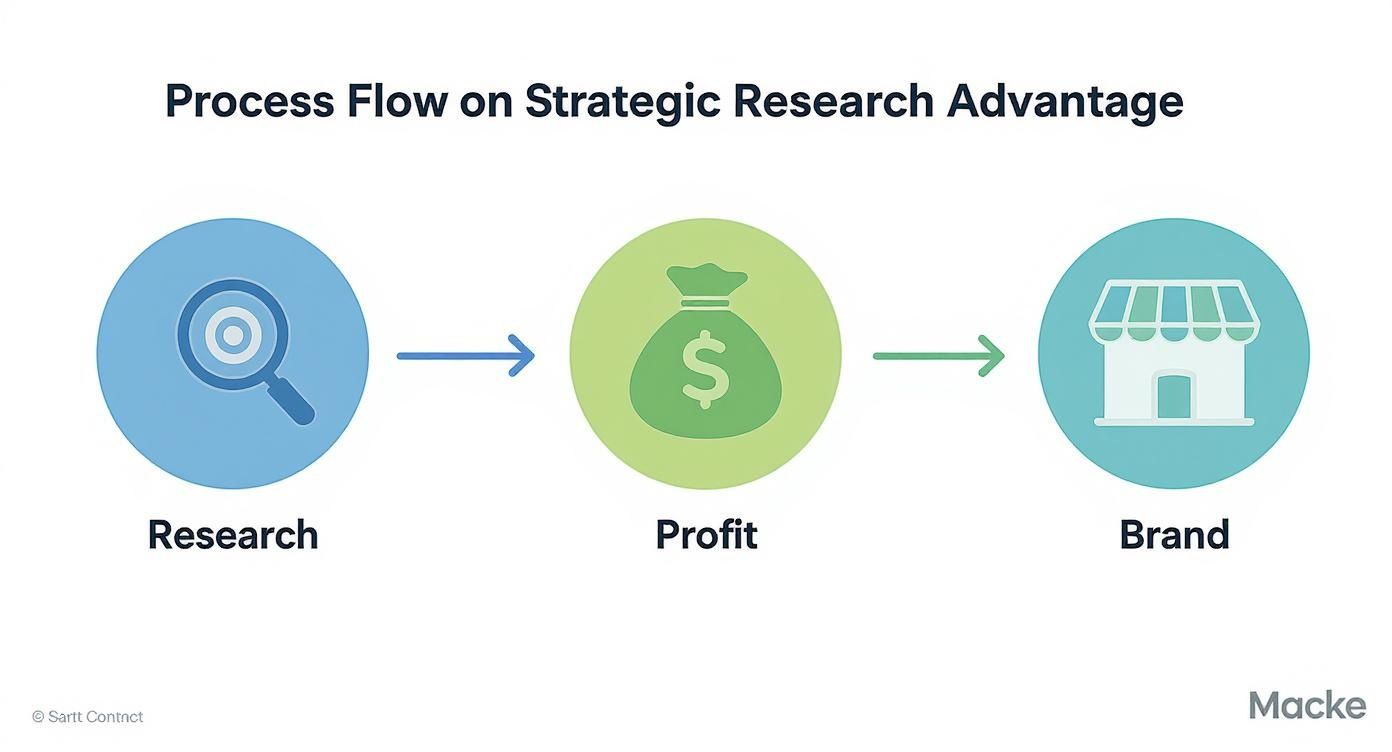
As you can see, solid research isn't just a one-off task; it's the engine that drives everything else forward.
Your Quick Qualification Checklist
Before you get too attached to an idea, you need to run it through a quick reality check. This isn't a deep financial analysis just yet; it's a high-level filter to weed out the obvious non-starters before you waste any more time. If you need some inspiration to get started, you can check out some currently https://alisavepro.com/trending-dropshipping-products/ to get your gears turning.
This checklist is a quick way to vet your ideas without getting bogged down in spreadsheets.
Product Idea Qualification Checklist
| Criteria | What to Look For | Red Flag Example |
|---|---|---|
| Problem/Passion | Does it solve a real pain point or cater to a passionate hobby? | A generic phone case with no unique features. |
| Local Availability | Is it hard to find in a typical brick-and-mortar store? | A standard brand of popular toothpaste or soap. |
| Shipping Profile | Is it small, lightweight, and durable? | A large, fragile glass mirror or a 50lb dumbbell set. |
| Price Point | Can you sell it for 3x the supplier cost? (e.g., $10 cost, $30 price) | A product that costs $40 but the market will only pay $50. |
| Marketing Angle | Is there an obvious "wow" factor or a clear story to tell? | A basic t-shirt with a common, uninspired design. |
| Legal/IP Risk | Is it free of patents and brand trademarks? | A keychain that looks exactly like a Disney character. |
Running your ideas through this table first will save you from sinking time and energy into products that were doomed from the start. It forces you to think critically about the business potential, not just how "cool" the product seems.
Validating Demand and Calculating Real Profit
An exciting product idea is a great starting point, but it's just a guess until you prove people are actually willing to pay for it. This is where your product research gets serious. The pivot from "I think this is cool" to "I know people are searching for this" is the single most important step you’ll take, and it's all about letting the data lead the way.

Before you drop a single dollar on a domain name or a Shopify theme, you absolutely have to validate that an active, hungry market exists for what you plan to sell. Honestly, guesswork is the fastest way to a failed store. Think of data-backed validation as your insurance policy against wasting precious time and money.
Using Keyword Research to Prove Demand
So, how do you find this proof? The most direct method is to see if people are typing your product idea into Google. Keyword research tools are your best friend here. Tools like Ahrefs or Semrush, and even free options like Google Keyword Planner, peel back the curtain and show you the search volume for specific terms. This data instantly tells you if you've stumbled upon a ghost town or a bustling city.
Let's walk through a real-world example: the portable dog water bottle. It’s a niche product that solves a very clear problem for pet owners who are out and about.
If you plug that into a keyword tool, you'll see some encouraging numbers:
- "portable dog water bottle": 25,000 monthly searches
- "dog travel water bottle": 15,000 monthly searches
- "dog water bottle for walking": 8,000 monthly searches
These aren't just numbers; they're a massive green light. They represent tens of thousands of potential customers actively looking for the exact solution you can offer. On the flip side, if a product has less than 1,000 total monthly searches across its main keywords, it might be too niche to get off the ground without a huge marketing spend.
A winning product isn't just clever or unique. It's one that perfectly aligns with existing search behavior. You want to place your store directly in the path of where customers are already looking, not try to create demand out of thin air.
Calculating Your True Profit Margin
Once you've confirmed there's an audience, it's time to run the numbers. A product can have all the demand in the world, but if the margins are paper-thin, it’s a terrible business. So many beginners make the fatal mistake of only looking at the supplier's cost versus their selling price. The real calculation is much, much deeper.
Your main goal here is to figure out the landed cost—the total expense to get one single unit into your customer's hands. This number is the bedrock of your store's finances.
To get it right, you have to account for every little expense:
- Supplier Product Cost: The baseline price you pay the supplier for the item.
- Shipping Cost: What the supplier charges to ship the product to your customer.
- Payment Processing Fees: Companies like Stripe and PayPal take a cut, typically around 2.9% + $0.30 per transaction.
- Estimated Ad Spend Per Sale: This is your Customer Acquisition Cost (CAC), and it's a critical piece of the puzzle.
A Practical Example: The Portable Dog Water Bottle
Let's break down the math for our dog water bottle to see if it’s actually profitable.
Financial Breakdown
| Metric | Amount | Description |
|---|---|---|
| Supplier Product Cost | $4.50 | The base price for one unit from an AliExpress supplier. |
| Supplier Shipping Cost | $3.50 | The cost for standard ePacket shipping to the United States. |
| Total Landed Cost | $8.00 | The combined cost of the product and shipping from your supplier. |
Now, we need a retail price. A good rule of thumb is the 3x markup, which gives you a healthy buffer for marketing and other hidden costs. Based on that, we’ll set our selling price at $24.99.
With that price point, we can figure out our profit before factoring in ads:
- Selling Price: $24.99
- Payment Processing Fee (Stripe): ($24.99 * 0.029) + $0.30 = $1.02
- Profit Before Ads: $24.99 – $8.00 (Landed Cost) – $1.02 (Fee) = $15.97
That $15.97 is your gross profit per sale. More importantly, it’s the absolute maximum you can afford to spend on ads to get one customer and still break even. For a more granular look at this, our guide on how to calculate cost per unit for your products offers an even more detailed framework.
Let's say your Facebook ads cost you $10 to make one sale (a solid target to aim for). Your net profit is now $5.97 per unit. This simple math instantly tells you if the product is viable. If your profit before ads was only $8, you'd have zero room for marketing, making the product a financial dead end. This step is completely non-negotiable.
Vetting Suppliers and Analyzing Your Competition
Alright, you've found a product with real demand and the numbers are starting to look good. That’s a huge step, but don't get ahead of yourself. Pairing a great product with a shoddy supplier is a recipe for disaster. It's the silent killer that leads to angry customer emails, shipping nightmares, and a brand reputation that’s trashed before it even gets off the ground.
At the same time, you can't just launch into a market without knowing who you're up against. That's like walking onto a battlefield blindfolded. You need to size up the competition, see what they're doing well, and, more importantly, find their weak spots. This part of the process is all about minimizing risk and carving out your unique space in the market.
How to Find and Vet a Reliable Supplier
Think of your supplier as your business partner—because that's exactly what they are. They're handling the entire backend of your operation. A bad partner can tank your business, so you absolutely cannot skip this vetting process. While platforms like CJdropshipping, Zendrop, or even AliExpress are full of options, you need a system to separate the pros from the amateurs.
Don't just sort by the lowest price. Treat this like you're hiring a key employee. You're looking for someone who is communicative, consistent, and obsessed with quality. Paying a little extra for a product from a top-tier supplier is a smart investment that will save you from chargebacks and customer service headaches down the road.
Here’s a practical checklist I run through when I’m sizing up a new supplier:
- Seller Ratings and Reviews: I don’t even look at anyone with less than a 4.7-star rating. And I always read the negative reviews first. Are people complaining about quality? Shipping? Communication? These details are gold.
- Order Volume: A supplier with thousands of orders has seen it all. They have their systems dialed in. A new supplier with only a handful of sales is a much bigger gamble.
- Communication Test: This is my go-to litmus test. I send them a message with a few specific questions about the product. How fast do they reply? Is the response clear and professional? If I get a slow, broken-English response, I'm out.
- Shipping Options and Times: Do they offer proven shipping lines like ePacket or YunExpress? Get realistic delivery estimates for your target countries. Be very skeptical of anyone promising delivery times that sound too good to be true.
- Order a Sample: This is non-negotiable. Ever. You have to get the product in your own hands. Feel the quality, check the packaging, and see if it actually matches the listing photos. You can’t sell something with confidence if you've never actually seen it yourself.
This might feel like a lot of work, but trust me, a few days spent on due diligence now will prevent months of chaos later. For an even more detailed breakdown, you can check out our complete guide on how to find dropship suppliers.
Your supplier’s performance is a direct reflection of your brand. Customers don’t know or care about dropshipping; when an order is late or the product is junk, they blame you, not the invisible supplier. Choose your partners wisely.
Analyzing Your Competitors to Find an Edge
Once you've got a solid supplier in your corner, it's time to put on your detective hat and scope out the competition. The goal here isn't to copy them—it's to find the gaps in their strategy that you can drive a truck through.
Start by identifying 3-5 other stores that are selling your product or something very similar. You can find them lurking in the Facebook Ad Library, through targeted Google searches, or by using various spy tools. Get your list together, and then it's time to dig in.
This analysis is absolutely critical. The global dropshipping market is expected to explode to USD 1.253 trillion by 2030, and North America already makes up a massive 35.8% of that pie. It's a crowded space. The top players know this—over 50% of successful dropshippers use tools to track their competitors' prices, which on average helps them boost sales by 20%. By doing this research, you're not just guessing; you're adopting a proven strategy.
What to Look for in Your Analysis
I recommend creating a simple spreadsheet to keep your notes organized. You're going to dissect every part of your competitors' operations, looking for clues.
Here are the key things to zero in on:
- The Product Page & Offer: What's their price point? Are they offering bundles, upsells, or the classic "free shipping" incentive? Scrutinize their product descriptions, photos, and especially their videos. Is there an opportunity for you to create much more compelling content?
- Their Marketing Angle: How are they selling it? Are they hitting a pain point, positioning it as a luxury item, or focusing on convenience? Go back to the Facebook Ad Library and study their ads. The copy and creative they use will tell you exactly who they think their customer is.
- Customer Reviews (The Gold Mine): Read their reviews—the good, the bad, and the ugly. The 5-star reviews tell you what customers absolutely love, which you should highlight in your own marketing. But the 1-star reviews? That's where you find your opening. "Shipping took forever." "Broke after one use." These are direct instructions on how you can be better.
- Brand & Social Proof: Does their website look like it was built in 2005? Is their Instagram a ghost town? A weak brand presence is a huge opportunity for you to build a slicker, more trustworthy store that customers will flock to.
After you've done this, you'll have a crystal-clear idea of how to stand out. Maybe you'll win on faster shipping. Maybe you'll create killer video ads that blow theirs out of the water. Or maybe you'll build a real brand in a sea of generic stores. This competitive analysis is what turns a simple product idea into a winning business plan.
Testing Your Product With a Small Budget
Alright, you've done the legwork. The research is done, you've found a promising supplier, and you're pretty sure you've got a winner. But before you go all-in, it's time for the moment of truth: will actual people spend their hard-earned money on it?
This is where so many new dropshippers get it wrong. They either burn through their savings on a huge ad budget for a product that flops, or they give up too soon on a potential gem because their initial tests were a mess.
The goal here isn't to get rich overnight. It's simply to gather data. We're looking for clear signals from the market that tell us whether to scale up or shut it down.
Setting Up Your Lean Testing Machine
First things first, you don't need some elaborate, multi-page website. A clean, simple, one-product Shopify store is perfect. This approach focuses all of your visitor's attention on the product you're testing, which keeps the data you collect much cleaner.
Make sure that your product page is compelling. Use the best photos and videos you got from your supplier or took from your own sample.
Next up, you need to create a few different ad creatives. Don't make the mistake of just running one ad and crossing your fingers. You should test at least 3-5 different variations on a platform like Meta (Facebook) or TikTok. This could be as simple as changing the first three seconds of a video, trying a different headline, or testing a new call to action. You'll quickly see what angle people respond to.
Think of this as a small-scale scientific experiment. Your hypothesis is, "People will buy this product at this price." Your ads are the experiment, and the data—clicks, add-to-carts, and purchases—will prove or disprove that hypothesis.
The Metrics That Truly Matter
Once your ads are live with a small daily budget—I'm talking just $10-$20 per day to start—it's easy to get lost in all the numbers. To avoid analysis paralysis, you really only need to watch three key metrics. Together, they tell a clear story about how interested customers really are.
Add-to-Carts (ATCs): This is your first real sign of interest. Someone didn't just click your ad; they were interested enough to take the next step. If you're seeing a lot of ATCs but no sales, it's often a red flag for your pricing or shipping costs being too high.
Initiated Checkouts (ICs): This is an even stronger signal. Someone was ready to buy and actually started typing in their payment details. A high number of ICs without a purchase could point to a lack of trust in your store or a technical issue with your checkout flow.
Purchases: The holy grail. A sale is the ultimate validation that your product, price, and marketing are all aligned. This is the number we're chasing.
Reading the Data and Making a Decision
As the results trickle in, you'll start to see a picture forming. The main thing you're looking for is a reasonable Cost Per Purchase (CPP). During this initial testing phase, a "good" CPP is basically anything at or below your break-even point.
For example, if you sell a product for $40 and it costs you $20 (including the product cost and shipping), your break-even CPP is $20. Any cost per purchase under that means you're on the right track.
Don't panic if you aren't profitable on day one. Let your ads run for at least 3-4 days to give the platform's algorithm time to find the right people.
After that period, you can make a clear 'go' or 'no-go' decision. If you've spent $50-$100 and have zero purchases or, even worse, zero add-to-carts, that's a pretty strong signal this product isn't the one. It's time to cut it loose and move on.
For a deeper dive into this part of the process, it's worth learning about setting up a creative testing campaign on Meta, as this will help you get clear answers much faster. This whole lean-testing approach gives you a data-backed way to know for certain whether to hit the gas or start researching your next winner.
Got Questions? Let's Get Them Answered
Even with the best playbook, you're bound to hit a few snags during product research. It's a messy process, and honestly, that's normal. Let's walk through some of the questions I hear all the time from people just starting out.
These aren't just hypotheticals; they're the real sticking points that can grind your progress to a halt. Getting these sorted out is the key to moving forward with confidence instead of getting stuck in "analysis paralysis."
"How Much Competition Is Too Much?"
This is the classic question, and the answer isn't as simple as a specific number. Seeing a handful of other stores selling your product is actually a good thing—it's instant proof that there's a market for it. The real trouble starts when that market becomes completely saturated.
So, how can you tell? You'll start seeing some obvious warning signs:
- Identical Ads: You see the exact same video creative being run by dozens of different stores. That's a huge red flag.
- A Race to the Bottom: Competitors are constantly slashing prices, trying to undercut each other. This means profit margins are probably non-existent.
- The "Guru" Effect: The product is being plastered all over YouTube in every "Top 10 Winning Products" video. By the time that happens, the party's over.
Ideally, you want to see a market with maybe 3-5 serious competitors, but not 50. That signals there’s money on the table, but you still have a real chance to come in with a better brand, a unique angle, and superior marketing. If you see signs of total saturation, your time is almost always better spent finding a new product.
Don’t be afraid of a little competition—be terrified of a market where you can’t possibly stand out. The goal isn't to be the only one, but to be the best one.
"What if My Product Has Zero Search Volume?"
Seeing a flat line on tools like Google Trends or Ahrefs can feel like a dead end, but it doesn't automatically kill the idea. This is super common for new, trendy products that people don’t even know exist yet.
Think about it for a second. Nobody was typing "sunset lamp" into Google before it went viral on TikTok. That demand was created through eye-catching, scroll-stopping videos on social media. It was an impulse buy, not a solution to a problem someone was actively searching for.
When you have low search volume, your entire game plan has to change. You're not capturing existing demand; you're creating it from scratch. This puts all the pressure on your creative. Can you make a video ad for TikTok or Meta that's so compelling it makes someone stop scrolling and think, "I need that"? It's a higher-risk play, for sure, but the reward can be massive if you nail the creative.
Tired of the soul-crushing process of right-clicking and saving every single product image? AliSave Pro is a lifesaver. It’s a one-click Chrome extension that grabs all the high-res images, videos, and even customer review photos from an AliExpress listing instantly. Build your store faster, create better ads, and get a leg up on the competition. Download AliSave Pro for free from the Chrome Web Store and start working smarter, not harder.