
Finding a trending dropshipping product isn't some magic trick; it's a calculated strategy. Your success truly depends on picking items that actually solve a problem for someone, tap into what people are passionate about right now, and still leave you with a decent profit margin. The right product is the engine of your business—it powers your marketing and keeps customers happy.
Why Finding the Right Products Is Everything in Dropshipping
Before we get into the nitty-gritty of product research, let's zoom out and look at just how big this market has become. Dropshipping isn't a niche side hustle anymore; it has exploded into a mainstream ecommerce powerhouse. This growth is a double-edged sword: it creates massive opportunities but also ramps up the competition, making your product choice more critical than ever.
The numbers are staggering. Projections show the global dropshipping market is expected to hit $418.2 billion in 2025 and an incredible $3,314.6 billion by 2035. This isn't just random growth; it’s driven by real consumer demand for unique products and massive improvements in supply chain technology. If you want to dig deeper, you can explore more data on the dropshipping market's rapid expansion and see what it means for sellers like you.
The sheer scale of this market means there's plenty of room for new players, but only if they're smart about what they sell. Understanding what's driving this growth can give you a serious edge.
Here's a quick look at the major forces pushing the dropshipping model forward.
Key Dropshipping Market Growth Drivers
| Growth Driver | Impact on Your Business |
|---|---|
| Low Barrier to Entry | It's easier and cheaper than ever to launch a store, meaning more competition. A unique product is your best advantage. |
| Rise of Social Commerce | Platforms like TikTok and Instagram make it simple to showcase products and drive impulse buys, perfect for trending items. |
| Global Ecommerce Adoption | More people are shopping online worldwide, opening up new customer markets for you to target. |
| Supplier Technology | Better integration and faster shipping from suppliers mean a better experience for your customers and less hassle for you. |
Ultimately, these drivers create a landscape where a well-chosen product can find its audience quickly and profitably.
The Foundation of Your Business
Think of your product as the foundation of a house. If you build on a weak foundation—a product with no real demand, razor-thin margins, or flaky suppliers—the whole thing will eventually collapse, no matter how fancy your marketing is. On the flip side, a fantastic, in-demand product can almost sell itself once you get it in front of the right people.
Here’s why getting the product right is so fundamental:
- Your Marketing Angle: A trending product already has a story. You can create ads that plug directly into existing conversations, trends, and desires.
- Real Profitability: A good product has enough margin built-in to cover your ad spend and other costs, with plenty left over for you.
- Your Brand Identity: The products you sell become your brand. Choosing items that fit a clear niche helps you attract and keep a loyal community of customers.
Choosing a product is choosing your customer, your marketing strategy, and your daily challenges. Get this step right, and everything that follows becomes significantly easier and more profitable.
Uncovering Winning Ideas with Data-Driven Research
If you’re still mindlessly scrolling through AliExpress hoping a winning product will just jump out at you, it’s time for a new approach. The pros don't guess; they use data to spot what people are actively looking for before it becomes mainstream. This is how you build a business on solid ground, not just a gut feeling.
Think of a tool like Google Trends as your new best friend. It’s a completely free way to see how a search term’s popularity has changed over time. For instance, you could plug in "portable blenders" and "smart water bottles" to compare their search interest over the last year. A nice, steady upward trend often points to a sustainable product, while a massive, sudden spike might just be a flash in the pan.
Using Social Platforms for Real-Time Insight
Search data is fantastic, but social media is where you can see products in action. The TikTok Creative Center is an absolute goldmine for this. It literally shows you which products, sounds, and hashtags are blowing up right now.
Let's say you notice a ton of videos featuring "walking pads" for under-desk use. That’s a crystal-clear signal that demand is surging. You're not just looking at a viral video; you're seeing a product that solves a real problem for the work-from-home crowd.
This workflow breaks down how you can go from that first spark of an idea all the way to a validated product choice.
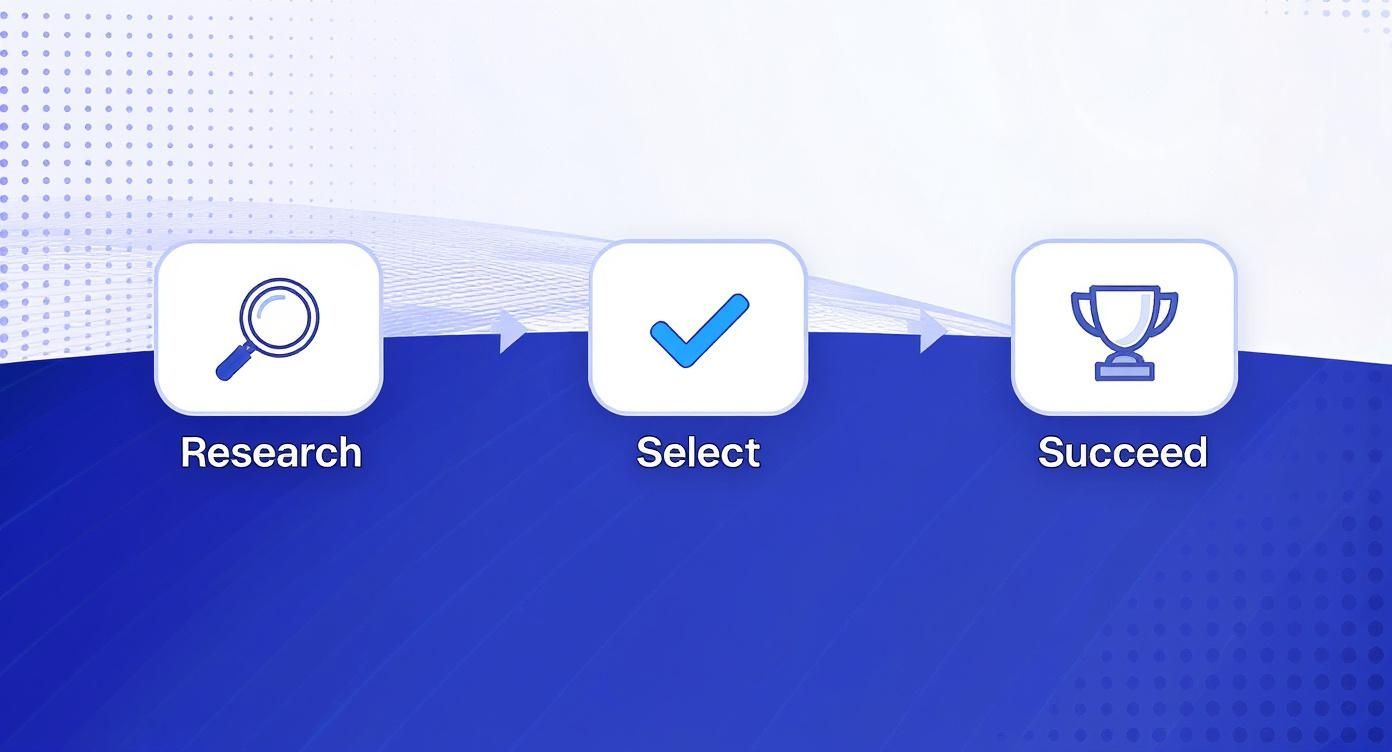
As you can see, success isn't just one lucky break. It's the result of putting in the work upfront with smart research and deliberate choices.
The real magic happens when you start layering these data sources. Imagine you see "portable home office gadgets" trending on Google. At the same time, you're seeing TikToks of people raving about their new lap desks and portable monitors. Now you have powerful validation from two completely different angles, which is a very strong sign.
Key Takeaway: You’re not just looking for a product. You're looking for a product that sits at the intersection of converging trends. When you find that sweet spot where search interest, social media buzz, and a genuine problem-solving purpose all line up, you've likely found a winner.
How to Validate Your Product Ideas and Avoid Costly Fails
Look, having a cool product idea is one thing. Knowing for sure that people will actually buy it is something else entirely. This next step—validation—is where you stop gambling and start building a real business. It's the critical process that separates a profitable online store from a money pit.
We're not just trying to figure out if people like the product. We need to know if we can sell it profitably. A product could be going viral on TikTok, but if your profit margins evaporate after you pay for ads and shipping, you're just running a very expensive hobby.

This means you have to get honest with the numbers. You need to scope out what your competitors are charging on places like Amazon, get a handle on what it will cost you to get a customer, and figure out what your real-world profit margins will be.
Analyzing Demand and Profitability
I find it helps to run every potential product through a simple checklist. This keeps the process objective and stops you from falling in love with a bad idea. You're essentially grading each product on its core business viability.
Here’s what I look at:
- Real Market Demand: Fire up a keyword research tool and see how many people are actually searching for this thing each month. You want to see at least a few thousand searches to confirm there's an active audience.
- The Competitive Landscape: Head over to the big online marketplaces and search for the product. Is it completely flooded with sellers, or do you see an opening where a fresh brand could make some noise?
- Potential for Profit: This is the big one. Can you realistically charge a 2.5x to 3x markup on what your supplier charges and still have a competitive price? You absolutely need that buffer to cover marketing, fees, and, you know, actually make money.
Running the numbers this way takes the emotion out of the decision. For instance, the fashion niche made up over 34% of the entire dropshipping market in 2024. That's a massive pie, but it also means the competition is absolutely brutal. You can dig into more dropshipping statistics to see how different markets stack up, but this validation process is non-negotiable for any of them.
Remember, the best trending dropshipping products aren't always the flashiest or most viral. They're the ones that hit the sweet spot: solid demand, manageable competition, and healthy profit margins. That’s what builds a sustainable business.
Finding and Vetting Reliable Dropshipping Suppliers
You've got a validated product idea—awesome. Now for the make-or-break part: finding a supplier who can actually deliver. Think of your supplier as the engine of your business. A good one keeps everything running smoothly, ensuring happy customers and repeat business. A bad one? They can single-handedly tank your store’s reputation before you even get going.
Most people start their search on massive platforms like AliExpress, CJdropshipping, or Zendrop. While these are great resources, just picking a supplier with a high star rating is a rookie mistake. A 4.8-star rating is a good sign, but it doesn't reveal how they'll react when a package goes missing or a customer complains.
What to Look for Beyond Star Ratings
You need to get a little more investigative. I treat this stage like I'm hiring a key employee, because that's essentially what a supplier is. Don't just pick the first one you see; reach out to a handful of potential partners and see how they stack up.
Here's my personal checklist for digging deeper:
- Communication Speed and Quality: Send them a few questions. How fast do they reply? Is their English clear and professional? If it takes them three days to give you a one-word answer, imagine how they'll handle a real customer issue.
- Realistic Shipping Times: Get specific. Ask them for their average delivery times to your primary markets, like the US, UK, or Australia. Then, do some sleuthing in their latest customer reviews to see if those timelines are legit.
- Product Quality Confirmation: This is the one step you absolutely cannot skip. Always order a sample. A product can look amazing in photos and be complete junk in person. This is the only real way to know what your customers will receive.
- Return and Refund Policies: Ask them directly: "What is your process if a product arrives broken or gets lost?" A reliable supplier will have a clear, straightforward policy. If their answer is vague, walk away.
A supplier's true colors show when things go wrong, not when everything is perfect. You want a partner who is transparent, communicates clearly, and works with you to solve problems. That’s how you build a business that can scale.
For a more detailed breakdown of what to look for, our guide on AliExpress dropshipping covers supplier communication templates and red flags to watch out for. This approach ensures you’re not just finding a vendor for your trending dropshipping products, but a true partner for growth.
Sourcing High-Quality Product Media to Drive Sales

Let's be blunt: in dropshipping, your product photos and videos are your sales pitch. Your customers can't pick up the item, feel its weight, or see it with their own eyes. The media on your product page has to do all that work for them.
Grainy, watermarked, or blurry images are an immediate turn-off. It screams "cheap" and erodes trust in a split second, making even the best trending dropshipping products feel like a risky purchase. This isn’t just about making things look nice; it's about making them look legitimate.
So, getting your hands on high-quality, clean media isn't just a "nice-to-have"—it's an absolute must. Sure, you could try to right-click and save images one by one, but that’s a frustrating, time-consuming mess that often leaves you with low-res files. There’s a much smarter way to handle this.
Using AliSave Pro to Get the Good Stuff
This is where a purpose-built tool like AliSave Pro completely changes the game. It’s a simple browser extension that lets you grab every single product image, variant photo, and even the marketing videos from an AliExpress listing with just one click.
Instead of wrestling with watermarks or dealing with a bunch of oddly sized files, you get a perfectly organized ZIP file delivered straight to your computer. All the high-resolution assets are there, ready to be uploaded to your store.
This simple step instantly gives you a professional media library to build out your product pages and create ads that actually stop people from scrolling. Think about it—that crisp, clean visual is often the one thing that pushes a potential customer to click "Add to Cart" instead of just closing the tab.
Professional product presentation isn't a luxury; it's a fundamental requirement. By using the right tools to source your media, you elevate your brand's perceived value and give your products the best possible chance to sell.
If you want a full walkthrough, this guide on how to download images and videos from AliExpress breaks it down step-by-step. Adopting this approach will save you countless hours and ensure your store looks polished and trustworthy right from the start.
Building a Winning Launch Strategy for Your New Product
Finding one of the best trending dropshipping products feels like a massive victory, but the real work is just beginning. Even the greatest product on earth will fail to take off without a smart launch strategy. It's all about creating that crucial initial momentum.
Your first stop? The product page. This is your virtual salesperson, and it needs to be convincing. Focus your copy on the benefits—how the product solves a problem or improves the customer's life—not just a dry list of features. This is where all that high-resolution media you sourced comes into play, helping shoppers visualize the product as part of their own story.
With a killer product page ready, it's time to get some eyeballs on it. A targeted ad campaign on a platform like TikTok or Facebook is usually the best way to start. But don't just set one ad live and hope for the best. You need to test everything: different video clips, various images, and a handful of headlines to see what actually connects with people.
Kicking Off Your Sales
Getting that first wave of traffic is great, but you need to convert those clicks into customers. The most effective way to do this is by creating a bit of urgency right out of the gate. An introductory offer can work wonders.
Here are a few simple but incredibly effective tactics to get those first sales rolling in:
- Launch Discount: Offer a compelling, time-sensitive deal. Something like "20% off for the first 72 hours" works well.
- Scarcity Angle: Use simple phrases like "Limited stock available at this launch price" to nudge people off the fence.
- Bundle Deals: Get a higher average order value from the start by offering a slight discount when customers buy more than one.
The goal of a launch isn't perfection; it's data. Your initial ad campaigns are really just a big experiment to see what your audience responds to. Once you know what works, you can kill the losers and pour your budget into the winners.
This "test, learn, and refine" cycle is the engine that will scale your business. As those sales start to pick up, you'll also want to think about streamlining your backend operations. To get ahead of the curve, check out our guide on dropshipping automation tools that can handle things like order fulfillment and inventory tracking for you.
Got Questions? We've Got Answers
If you're new to the world of dropshipping, you've probably got a few questions swirling around your head. It's totally normal. Getting these sorted out early on is the key to building confidence and dodging those rookie mistakes. Let's dig into some of the most common questions I hear from new sellers.
How Can I Tell a Real Trend From a Passing Fad?
This is the big one. How do you spot a product with real staying power versus something that's just a flash in the pan, like a fidget spinner? The best tool for the job is Google Trends.
Crank the timeline back to 5 years and look at the interest graph. A fad looks like a massive, sharp mountain peak that falls off a cliff. A genuine trend, on the other hand, shows a slower, steadier climb, maybe with some seasonal dips, but the overall direction is up. Ask yourself: does this thing solve a real, ongoing problem, or is it just a novelty? Solutions sell for years; novelties sell for a few months.
What Are the Biggest Red Flags With Suppliers?
You're right to be cautious here, as a bad supplier can sink your store before it even gets going. There are a few warning signs that scream "stay away."
The biggest red flags are always poor communication (if they take days to reply, imagine how they'll handle a customer issue), a complete lack of real-world customer photos in the reviews, and a string of recent negative feedback mentioning shipping delays or quality problems. A brand-new store with just a handful of orders is also a gamble.
Should I Sell Cheap Stuff or Expensive Stuff?
Ah, the classic debate: low-ticket vs. high-ticket products. Honestly, both can work, but they're completely different ball games.
Low-ticket items (under $50) are fantastic for sparking impulse buys, but your profit margins will be razor-thin. High-ticket products (over $200) promise juicy profits per sale, but convincing a customer to spend that much requires a lot more trust and a much bigger ad budget.
For most people starting out, the sweet spot is right in the middle. I usually recommend products in the $40-$80 range. This gives you healthy enough margins to run ads profitably without needing the world-class branding of a high-ticket store.
Ready to make your product pages look absolutely incredible? AliSave Pro is a free tool that lets you grab all the high-resolution images and videos from any AliExpress page with just one click. It's the secret weapon used by over 20,000 dropshippers to create stunning storefronts.
Get AliSave Pro for free and start building better product pages today.