
Choosing the best Shopify app for dropshipping really boils down to what you value most. You'll likely find yourself looking at one of three heavyweights: DSers for its unparalleled access to AliExpress, Spocket for its network of fast-shipping US and EU suppliers, or Zendrop for its powerful branding and automation features. Your decision will hinge on whether you need massive product variety, lightning-fast shipping, or the tools to build a memorable brand from day one.
Your Guide to Top Shopify Dropshipping Apps
Picking a dropshipping app for your Shopify store isn't just a small technical choice; it's the operational backbone of your entire business. This app is the bridge between your online storefront and a world of suppliers, handling the nitty-gritty of product sourcing, inventory updates, and order fulfillment. Think of it as the engine that keeps your business running smoothly and allows you to scale.
Instead of just running through a list of features, I want to give you a strategic way to think about this decision. Getting a handle on the subtle but critical differences between these apps is a game-changer, especially for anyone just learning how to start dropshipping and wanting to do it right.
Key Evaluation Criteria
As we dig into the top contenders, I'll be comparing them based on what actually impacts your store's performance and, most importantly, your bottom line. These are the core pillars we’ll focus on:
- Supplier Access & Quality: Who are you really working with? We'll look at the variety and, critically, the reliability of the suppliers on each platform.
- Automation Capabilities: How much of the busywork does the app take off your plate? This includes order processing, inventory syncs, and tracking updates.
- Pricing & Value: What’s the real cost? We'll analyze the pricing tiers and what you get for your money as your business grows.
- Branding Features: Can you make the products your own? This covers things like custom packaging, branded invoices, and private labeling options.
Many seasoned dropshippers also use the best Shopify spy tools to get a leg up on the competition. These tools are fantastic for uncovering winning products and seeing what other successful stores are doing, which perfectly complements the functions of your main dropshipping app.
The right app does more than just import products. It should mesh perfectly with your business model, whether you're building a massive general store for bargain hunters or a niche brand that promises premium quality and fast shipping.
My goal here is to give you the practical insights you need to confidently choose the best Shopify app for your specific dropshipping goals.
A Look Inside the Dropshipping App Ecosystem
Before diving into a feature-by-feature comparison, it's helpful to understand where the best Shopify app for dropshipping really fits into your business. Think of these apps less as simple software and more as the central hub connecting your Shopify store to a huge global network of manufacturers, wholesalers, and suppliers. They're the engine of your entire operation.
At its most basic level, a dropshipping app takes an order from your customer and instantly turns it into a fulfillment request sent straight to your supplier. This one function is what makes the whole model work. It means you don't have to buy inventory, rent a warehouse, or deal with packing and shipping. Everything is managed digitally, creating a smooth, hands-off process.
Two Core App Models
You'll quickly notice that not all dropshipping apps work the same way. They generally fall into two camps based on how they handle their supplier networks. Grasping this distinction is the first real step in choosing the right tool for your store.
- Marketplace Aggregators: These are apps like the popular DSers, which plug you directly into a massive, open marketplace—most often AliExpress. The big draw here is an almost unbelievable selection of products at very competitive prices. The trade-off? You have to do the legwork to vet each supplier for quality and reliability yourself.
- Curated Supplier Networks: On the other side, you have apps like Zendrop and Spocket. They build their own private, pre-vetted network of suppliers. This approach usually gives you access to faster shipping times (often from warehouses in the US or EU), more reliable product quality, and sometimes even custom branding options. The product catalog, however, is naturally more limited.
The right choice really boils down to your business priorities. Are you after endless product variety, or do you value speed and consistency above all else? Keep in mind that running a smooth operation involves more than just picking products; understanding dropshipping chargebacks is a critical piece of the puzzle for long-term health.
What Makes a Dropshipping App Powerful?
Beyond the supplier model, the apps that truly stand out share a common set of features designed to make your life easier and help you scale. These are the non-negotiables that separate a simple tool from a genuine business asset.
The real power of a great dropshipping app lies in its ability to automate the repetitive, time-consuming tasks. This frees you up to focus on what actually grows your business: marketing, customer service, and brand building.
Solid dropshipping automation tools are the bedrock of any store that plans to grow. Trying to manage hundreds of orders manually is a recipe for disaster. Here are the core features you should look for:
- One-Click Product Importing: The ability to pull product photos, descriptions, and variants from a supplier directly into your Shopify store in seconds.
- Real-Time Inventory Sync: Automatically updates stock levels in your store so you never accidentally sell an item that's out of stock.
- Automated Order Fulfillment: Forwards customer orders and shipping details to your supplier with a single click, or even with zero clicks.
- Dynamic Pricing Rules: Lets you set global rules to automatically mark up product prices, keeping your profit margins consistent across your entire catalog.
This business model continues to be one of the fastest-growing in e-commerce, and platforms like Shopify—powering over 4.8 million active stores globally—are at the center of it. It's an interconnected world; for instance, over 35% of dropshipping stores now use the TikTok Pixel for advertising, showing just how vital it is to have an app stack that works together to find and convert customers.
A Deep Dive into the Top Shopify Dropshipping Apps
Stepping into the Shopify App Store can feel a bit like walking into a massive, noisy marketplace. As of January 2025, it’s home to over 12,320 apps—a staggering jump from just 5,649 back in 2021. If you want to dig into the numbers, these detailed Shopify statistics paint a clear picture of this explosive growth. In a space this crowded, finding the best Shopify app for dropshipping requires looking beyond the flashy feature lists to see how these tools actually perform day-to-day.
This isn't just about features. We're going to break down how DSers, Zendrop, Spocket, and AutoDS handle the real work of dropshipping—from finding products to getting them into your customers' hands automatically.
Product Sourcing and Supplier Networks
The heart of your dropshipping business is your product catalog. Where you get your products from and who supplies them will define everything from your shipping times to your profit margins. Each of these apps takes a completely different road to connect you with suppliers.
DSers: The AliExpress Powerhouse
Let’s be clear: DSers was built to do one thing exceptionally well—act as the ultimate bridge to AliExpress. It doesn't have its own curated supplier list. Instead, it gives you supercharged, direct access to the millions of products on the world's biggest B2C platform. This is both its greatest strength and its biggest catch.
You get a nearly infinite selection of products, which is fantastic for hunting down the latest trends or testing out niche ideas without much risk. But the responsibility for vetting suppliers lands squarely on you. You’ll be the one checking seller ratings, combing through reviews, and probably ordering a few samples to make sure the quality is up to snuff.
The proof is in its reputation. Just look at its standing in the Shopify App Store.
That perfect 5.0 rating from over 21,000 reviews tells a powerful story. For merchants who are all-in on the AliExpress model, DSers is reliable, effective, and gets the job done.
Spocket: Curated for Speed
Spocket flips the script entirely. It focuses on a hand-picked network of suppliers, most of whom are based in the United States and Europe. This is a deliberate strategy aimed at solving one of the biggest headaches in dropshipping: painfully long shipping times.
With Spocket, you can confidently tell your customers their order will arrive in 3-7 days. That’s a massive competitive edge. The trade-off? The product catalog is smaller and more focused than what you'll find through DSers. You might not discover every quirky gadget, but you will find high-quality items from vetted suppliers, which is huge for building customer trust and cutting down on support emails.
Zendrop: The Hybrid Solution
Zendrop lands somewhere in the middle, blending the massive marketplace feel of DSers with the curated approach of Spocket. It was born from the frustrations of dropshippers who were fed up with unreliable AliExpress suppliers. So, they built their own network of vetted partners, mostly in China but with a growing number of US-based options.
This setup gives you access to a huge range of popular dropshipping products, but with a crucial layer of quality control. The Zendrop team already has relationships with these suppliers, which usually means better communication and more dependable fulfillment than if you were flying solo on AliExpress.
The Real Difference: Your choice here boils down to a classic trade-off: variety versus reliability. DSers gives you unmatched selection. Spocket delivers speed and quality assurance. Zendrop tries to give you a bit of both by vetting suppliers for popular product types.
Automation and Order Fulfillment
After a customer clicks "buy," the real test of your app begins. How it handles processing, syncing, and tracking is what separates a smooth, scalable operation from a logistical nightmare.
DSers: Built for Bulk Orders
This is where DSers really flexes its muscles, especially when the orders start piling up. Its crown jewel is the ability to place up to 100 orders on AliExpress with a single click. If your store is pushing hundreds of sales a day, this isn't a nice-to-have feature; it's an absolute necessity that will save you hours of mind-numbing work.
Its automation is solid, pulling tracking numbers and order statuses back into Shopify without you having to lift a finger. The entire platform is engineered for efficiency at scale, making it the go-to for stores that have found their winning products and are ready to hit the accelerator.
Zendrop: Full-Service, Hands-Off Fulfillment
Zendrop's big promise is "auto-fulfillment." Once configured, orders can be processed and shipped without you ever touching a button. This is a major leap from the semi-automated workflows of other tools.
This hands-off approach is a dream for entrepreneurs who want to pour all their energy into marketing and brand building. Zendrop quietly handles the logistics in the background, creating an almost completely passive operational flow after the sale is made.
AutoDS: The All-in-One Automator
AutoDS aims to be more than just an ordering tool; it's a full-blown dropshipping command center. Its automation goes beyond just fulfilling orders. It includes features like automated product importing, price and stock monitoring across multiple suppliers at once, and even automated ordering from the instant a purchase is confirmed.
It also plays nice with a wider variety of suppliers than just AliExpress, integrating with platforms like Amazon and Walmart. This makes it an incredibly powerful—though admittedly more complex—option for seasoned dropshippers juggling diverse product catalogs from several different sources.
Feature Comparison of Top Shopify Dropshipping Apps
To make sense of it all, here's a side-by-side look at how these apps stack up. This table breaks down their core features, supplier networks, and where they truly shine.
| Feature | DSers | Zendrop | Spocket | AutoDS |
|---|---|---|---|---|
| Primary Supplier Network | AliExpress | Vetted Chinese & US Suppliers | Vetted US & EU Suppliers | Multiple (AliExpress, Amazon, etc.) |
| Product Sourcing | Direct access to millions of products | Curated catalog of popular items | Curated catalog of quality goods | Multi-source importing |
| Order Fulfillment | Bulk processing (up to 100 at a time) | Fully-automated fulfillment | Semi-automated (one-click) | Fully-automated from purchase |
| Shipping Times | Variable (7-30+ days) | Standard (7-15 days), some express | Fast (3-7 days) | Variable, depends on supplier |
| Key Automation Feature | Bulk order placement | "Auto-Fulfillment" | Branded invoicing | Price/stock monitoring |
| Best For | High-volume AliExpress sellers | Beginners wanting reliability | Brand-focused stores | Multi-supplier management |
Choosing the right app is about matching its strengths to your business model. This table should give you a clear starting point for deciding which tool aligns with your goals.
Pricing and the True Cost of Running Your Store
Understanding the pricing is about more than just the monthly fee; it's about calculating your real profit margins. Each app structures its plans differently, unlocking critical features as you grow.
| App | Free Plan Offering | Starting Paid Plan (Approx.) | Key Feature at Paid Tier |
|---|---|---|---|
| DSers | Very generous free plan with a 3,000 product limit and full automation. | $19.90/month | Removes bulk ordering limits and adds advanced features. |
| Zendrop | Free, but limited to 25 orders per month. | $49/month | Unlocks unlimited orders and the signature auto-fulfillment. |
| Spocket | Lets you browse the catalog and import up to 25 unique products. | $39.99/month | Enables full order processing for all your imported products. |
| AutoDS | No free plan, but offers a trial period. | $26.90/month | Unlocks product importing and order automation. |
How to Think About Value at Different Stages
- For Beginners: DSers has the most functional free plan, hands down. You can run a real business without paying a dime until you're making consistent sales, making it the most budget-friendly way to get started.
- For High-Volume Sellers: As your order count climbs, the math changes. Zendrop's $49/month plan might seem steep, but its full auto-fulfillment could easily save you hours of work every single day. Likewise, the sheer efficiency of DSers' bulk ordering on its paid plans is a no-brainer for a store doing serious volume.
- For Brand Builders: Spocket's price tag reflects the premium value of its curated US/EU supplier network. You're not just paying for a tool; you're investing in faster shipping and higher-quality products—two cornerstones of a great brand reputation.
At the end of the day, the best Shopify app for dropshipping is the one that fits your strategy. Are you chasing endless product variety with DSers? Prioritizing lightning-fast shipping with Spocket? Craving hands-off automation with Zendrop? Or managing a complex, multi-supplier empire with AutoDS? Align the app's strengths with your goals, and you'll be building your business on a solid foundation.
Choosing Your App Based on Business Use Cases
Let's be honest: there's no single "best" Shopify dropshipping app. Anyone who tells you there is isn't telling you the whole story. The right tool for you depends entirely on your business model, your budget, and where you want to take your store. What's a must-have feature for a high-volume seller could be completely useless for a startup trying to build a niche brand.
This section cuts through the noise. We'll look at three common dropshipping scenarios to help you match your specific needs to the right app. Think of it as a guide to help you choose a partner for your business, not just today, but as you scale.
This flowchart breaks down the decision-making process based on what matters most to your business right now.
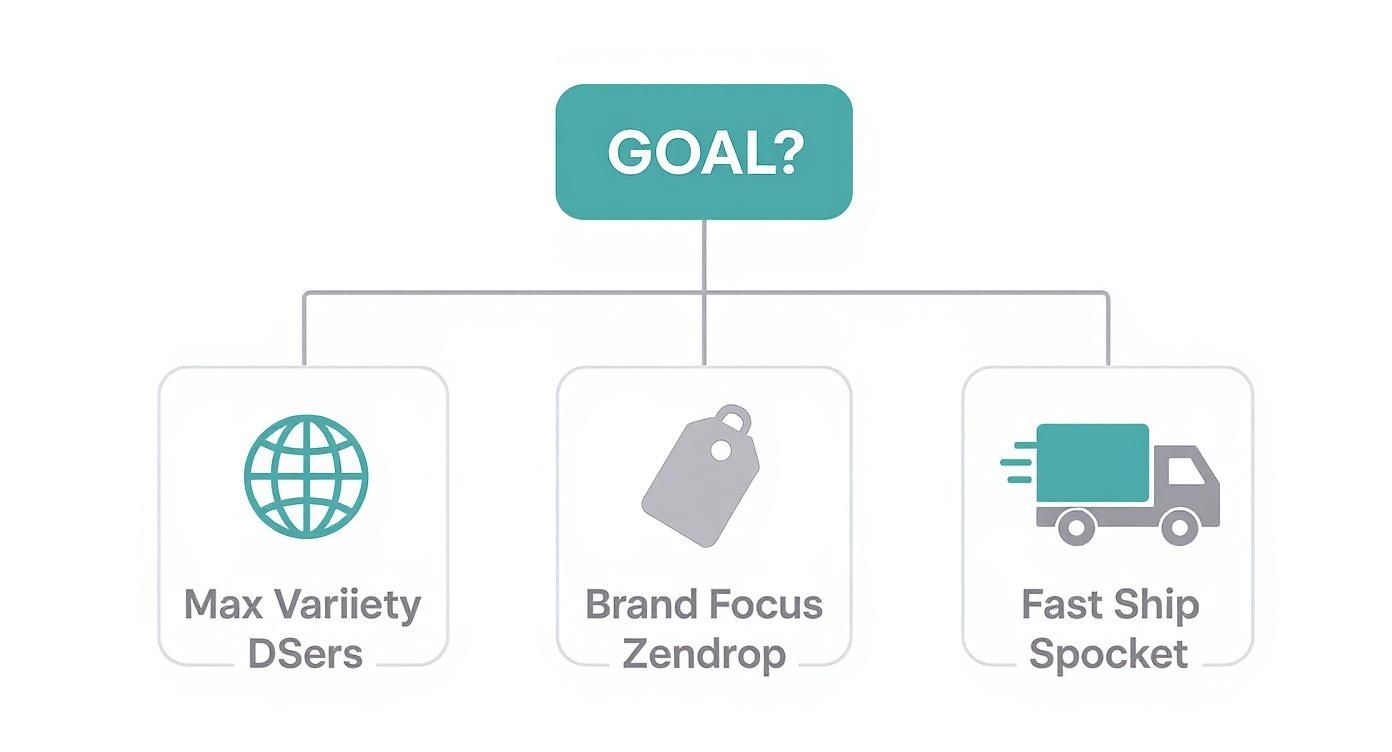
As you can see, the quickest way to find the right fit is to align your choice with your main goal—whether that's offering a massive product selection, building a memorable brand, or delivering products as fast as possible.
For the Budget-Conscious Beginner
When you're just starting, your main goal is to test product ideas without burning through cash. You need a platform that lets you build a store, import products, and handle your first few orders without a big monthly bill. Every dollar you save on software is a dollar you can put into marketing.
For this situation, DSers is the clear standout. Its free plan is incredibly generous, letting you import up to 3,000 products and giving you access to all the core automation features. You can actually run a real, money-making store on the free tier and only upgrade once your sales justify the cost. This gives you a fantastic runway to find winning products before committing to a monthly expense.
Key Insight: A great free plan isn't just about saving a few bucks. It’s a strategic advantage that lowers the barrier to entry, so you can learn the ropes of dropshipping without financial stress.
For the Brand-Focused Entrepreneur
For you, dropshipping is more than just a transaction; it's about creating a brand people love and come back to. Your top priorities are product quality, speedy shipping, and a customized customer experience. Plain packaging and month-long shipping times from overseas just aren't going to work.
You’ll want an app that offers features like custom packaging, branded invoices, and access to faster, more reliable suppliers.
- Top Recommendation: Zendrop shines here. It offers excellent branding options, including custom-designed thank you cards that can be slipped into every package. It's a small touch, but it makes a huge difference in how customers perceive your brand.
- Strong Contender: Spocket is another fantastic choice. Its network of pre-vetted US and EU suppliers is its main draw, guaranteeing faster shipping times—a critical part of a positive brand experience.
Deciding between them comes down to what's more important for your brand right now: the unboxing experience (Zendrop) or the promise of speed (Spocket). Of course, a great brand starts with great partners. If you want to go deeper, our guide on how to find dropship suppliers walks you through vetting partners who can actually support your brand's vision.
For the Growth-Oriented Scaler
You've found your winning products and your store has real momentum. Your biggest headache isn't finding what to sell—it's managing the flood of orders. Manual tasks are killing your productivity, and you need serious automation to handle hundreds (or thousands) of orders without your workflow breaking down.
At this stage, efficiency is the name of the game. You need to process orders in bulk, manage multiple stores from a single dashboard, and automate every step you possibly can.
The Clear Winner: DSers was built for this. Its killer feature is the ability to place up to 100 AliExpress orders with a single click. For any high-volume store, this is an absolute game-changer. It can literally save you hours of tedious work every single day, freeing you up to focus on what really matters: scaling your marketing and growing your business. While other apps have automation, nothing beats the bulk-processing power of DSers for an AliExpress-based operation.
A Practical Checklist for Your Final Decision

Choosing a dropshipping app for your Shopify store is a big deal. It’s not just another tool; it's the operational backbone of your business. The right app feels like a partner, helping you scale smoothly. The wrong one? It can turn into a daily source of frustration and operational headaches.
Let’s cut through the noise of endless feature lists. This checklist is designed to help you think critically about your specific business needs and match them to the right platform.
Evaluating Your Business Priorities
Your business model should be the number one factor guiding this decision. An app that works wonders for a high-volume, low-margin store could be a disaster for a curated, brand-focused boutique.
1. Who am I selling to, and where do they live?
This is the most important question you can ask. If you're targeting customers in the US or Europe, an app like Spocket with its roster of local suppliers gives you a serious leg up. Getting products to customers in 3-7 days is a huge competitive advantage and drastically cuts down on those "Where's my order?" emails.
2. What's my real monthly budget for apps?
Be honest with yourself here. If you're bootstrapping with minimal capital, DSers has the most capable free plan on the market. You can run a legitimate business without paying a monthly fee at the start. On the flip side, apps like Zendrop and Spocket really need a paid plan to unlock their core order processing features.
3. How important is building a unique brand?
If your goal is to create a brand that people remember, you need to look past basic fulfillment. This is where Zendrop shines. Its custom thank you cards and private labeling options give you the tools to create a memorable unboxing experience that fosters real customer loyalty.
Your choice of app directly influences your customer's perception of your brand. An app offering branded invoicing and fast shipping will always create a more professional and trustworthy impression than one that doesn't.
4. How much time can I spend on manual tasks?
Think about where you want to focus your energy. If you plan to pour all your time into marketing and growth, the hands-off, auto-fulfillment from an app like Zendrop is a smart investment. But if your strategy involves processing hundreds of AliExpress orders a day, the bulk-processing muscle of DSers is absolutely essential to stay efficient.
Dropshipping App Decision Scorecard
To pull everything together, I've created a simple scorecard rating each app on the key factors we just discussed. After thinking through your priorities, use this as a final check to see which app truly aligns with your goals.
| Criteria | DSers | Zendrop | Spocket | AutoDS |
|---|---|---|---|---|
| Shipping Speed | 2/5 | 3/5 | 5/5 | 2/5 |
| Product Variety | 5/5 | 4/5 | 3/5 | 5/5 |
| Automation Power | 5/5 | 5/5 | 3/5 | 5/5 |
| Branding Features | 1/5 | 5/5 | 4/5 | 1/5 |
| Pricing Value | 5/5 | 3/5 | 3/5 | 4/5 |
| Beginner Friendliness | 4/5 | 5/5 | 4/5 | 2/5 |
By cross-referencing your own answers with these ratings, you can move forward with confidence. You’ll be choosing an app that not only works for your business today but is also built to support your growth down the road.
Frequently Asked Questions
When you're trying to pick the right dropshipping app, a lot of questions come up. It's the engine of your Shopify store, after all. Whether you're a seasoned seller or just building your first store, getting straight answers is the only way to make a good decision. Let's tackle the questions I hear most often.
Getting this choice right from the start saves you from a world of logistical nightmares later and gives your business a real shot at growing.
Can I Use Multiple Dropshipping Apps on One Store?
The short answer is yes, you technically can. Some advanced sellers do this to pull products from different supplier networks. For example, you could use DSers for its massive AliExpress catalog and pair it with Spocket to offer a few key products with faster US-based shipping.
But I have to warn you, this approach gets complicated fast. You’ll be juggling products, orders, and inventory from different dashboards. It’s a recipe for fulfillment errors and customer service headaches if you're not extremely organized.
My advice for beginners: Stick with one primary app. Master its workflow, get your store profitable, and then consider adding another app to the mix if you have a specific strategic reason.
Sourcing from AliExpress Versus Curated Networks
This is a big one. It really boils down to a classic trade-off: variety and price versus speed and quality. Understanding where you want your business to sit on that spectrum is everything.
AliExpress (via apps like DSers): This route gives you a practically endless ocean of products at rock-bottom prices. The catch? The responsibility is 100% on you to vet every single supplier. Shipping times are also a known challenge—they can be long and unpredictable, something you have to be crystal clear about with your customers.
Curated Networks (via apps like Zendrop and Spocket): These platforms do the heavy lifting by pre-vetting their suppliers, often finding ones located in the US or EU. The result is much faster, more reliable shipping and a higher baseline for product quality. The trade-off is a smaller product catalog and sometimes slightly higher costs.
So, what’s your play? Are you building a trend-chasing store with a massive catalog, or a brand that competes on reliability and speedy delivery? Your answer points to the right app.
Do I Need to Pay for an App Right Away?
Nope, and that’s one of the best parts about getting started. Most of the top-tier apps, including DSers and Zendrop, have incredibly useful free plans. They're not just stripped-down demos; they give you enough features to import a decent number of products and handle your first batch of orders.
These free plans are perfect for testing the waters. You can find products, build out your store, and actually start making sales with zero upfront cost for the app. Once your order volume picks up and you need features like full automation or custom branding, you can upgrade with confidence because you've already validated your business idea.
How Do These Apps Handle Returns and Refunds?
This is a critical detail that too many new dropshippers ignore. The app itself doesn't set the return policy—the end supplier does. The app is just the go-between.
When a customer wants a return, you'll have to open a line of communication with your supplier, usually through the app’s dashboard. Every supplier, particularly on a massive marketplace like AliExpress, has their own rules. One of the quiet advantages of curated networks like Zendrop is that they sometimes offer more standardized, less painful return processes.
You absolutely must have a clear return policy on your own Shopify store. Make sure it mirrors the policies of the suppliers you’re working with. This isn't just about avoiding customer disputes; it's about protecting your brand's reputation by managing expectations from day one.
No matter which dropshipping app you choose, one thing is certain: your products need to look incredible. AliSave Pro cuts out the tedious work by letting you download all product images, variant photos, and videos from any AliExpress page in a single click. You can speed up your store setup and create killer ads with pristine media, all for free.
Download the AliSave Pro Chrome extension today and see just how easy sourcing product media can be.