
Solid dropshipping product research is what separates the stores that take off from the ones that never get off the ground. It’s not about luck or stumbling upon a magic product; it’s a repeatable, data-backed system. This whole process is designed to systematically find products people are already hungry for, check if the market is viable, and make sure you can actually source them for a decent profit.
Think of it less as a treasure hunt for one "perfect" item and more as building a reliable engine for spotting new opportunities.
Where to Find Product Ideas That Don't Suck
Before you even think about building a store, you need a product idea. Forget the generic advice. Let's get into the practical, boots-on-the-ground methods for digging up ideas that have a real shot at succeeding. The secret is to go where your potential customers are already hanging out and talking—or, more importantly, complaining.
This means you need to get good at social listening. Platforms like TikTok and Pinterest aren't just for scrolling; they're live-fire focus groups. Dive into the comments of viral videos in niches like home organization, pet care, or DIY projects. What tools are people asking about? What common frustrations keep popping up? That's your starting point.
Uncovering Those Hidden Gems
Don't just stick to the big social platforms. Niche forums and specific Reddit communities are absolute goldmines. I once found a thread in a coffee-lover's subreddit where dozens of people were griping about how messy their coffee grinders were. That single, widespread complaint sparked the idea for a six-figure product: a custom-designed cleaning brush and tamping mat set.
You're looking for patterns—repeated complaints, wishes, or hacks. These conversations are raw, unfiltered market research, handed to you on a silver platter. To get the most out of this, try to match these pain points with profitable dropshipping niches.
The best product ideas rarely come from a flash of genius. They come from paying close attention to a specific group of people and finding a problem you can solve for them just a little bit better than anyone else.
The urgency to get this right is real. The global dropshipping market is on a tear, growing from $128.6 billion in 2020 to a projected $372.47 billion by 2025. That explosive growth isn't random; it's driven by sellers who are masters at product research. Just look at the data: in April 2021 alone, Shopify stores dropshipped over half a million clothing items. This is why a solid research process is non-negotiable.
This simple workflow shows how to turn a raw idea into a validated opportunity you can actually build a business on.
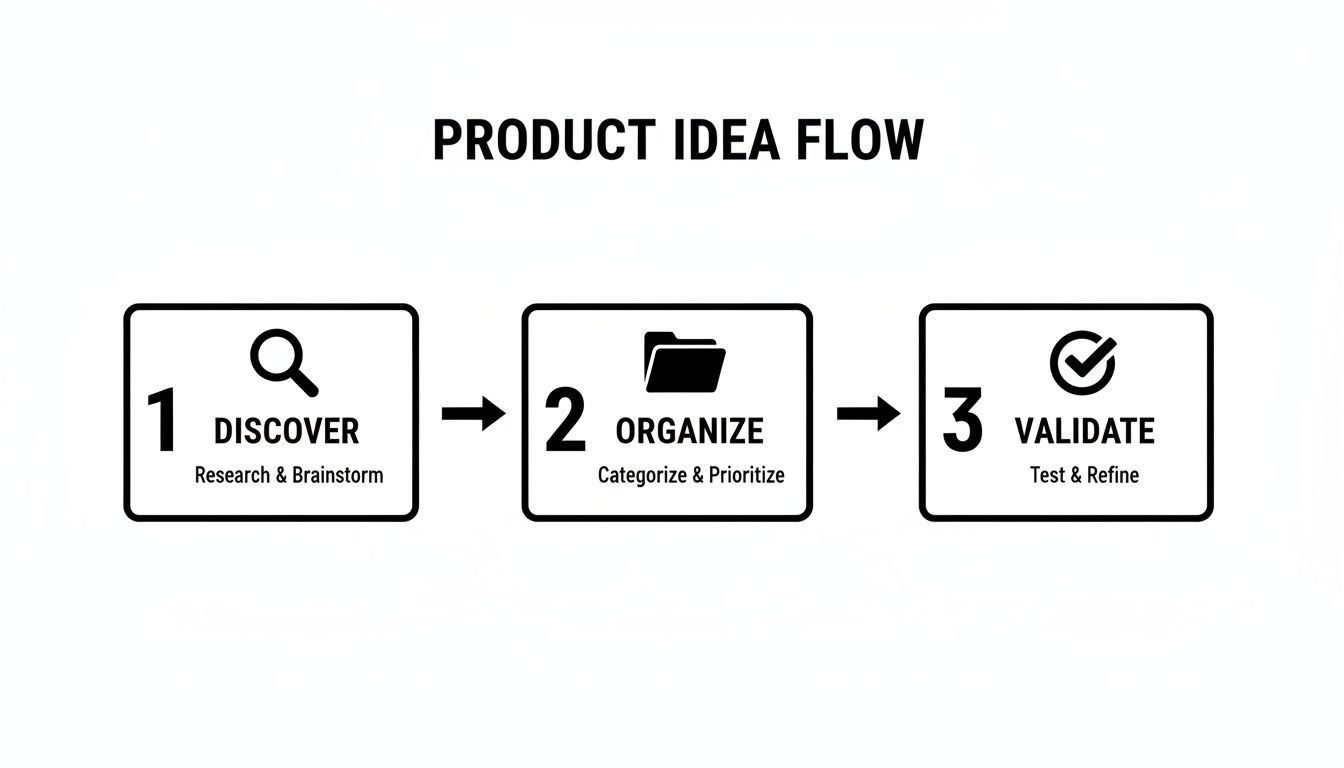
As you can see, finding the idea is just the first step. The real work happens when you organize your thoughts and start validating them against real-world data.
Don't Just Collect Ideas, Systematize Them
A random list of ideas on a notepad isn't a strategy. You need a system. A simple spreadsheet or a Trello board works perfectly. For every single idea you find, log it. Note where you found it (e.g., the specific Reddit thread), the core problem it solves, and some initial notes on who you think the customer is.
To get you started, here's a quick rundown of the most common methods I use and see other successful dropshippers rely on.
Product Idea Generation Methods Comparison
| Method | Best For | Pros | Cons |
|---|---|---|---|
| Social Media Listening (TikTok, Pinterest, IG) | Finding viral trends and impulse-buy items. | Quick to spot emerging demand; great visual validation. | Trends can be short-lived; high competition. |
| Niche Forums & Reddit | Uncovering deep, unsolved problems for passionate hobbyists. | Low competition; authentic demand; loyal communities. | Slower process; requires genuine interest in the niche. |
| Competitor Store Spying | Analyzing what's already working for others. | Proven demand; can see pricing and marketing angles. | Can lead to "me-too" products; hard to stand out. |
| Marketplace Trend Reports (Amazon, Etsy) | Identifying broad category shifts and best-sellers. | Data-backed; shows sustained interest. | Very competitive; often saturated product categories. |
Each method has its place. Your best bet is to use a combination of these to build a robust pipeline of potential products.
At this stage, your goal is quantity over quality. You're building a big list of potential winners that you'll later put through a much tougher validation process. If you need a little inspiration to get the ball rolling, check out our updated guide on https://alisavepro.com/trending-dropshipping-products/.
Validating Demand and Sizing Up Your Competition

A great idea is just an idea until you prove people will actually pay for it. This phase of your dropshipping product research is all about turning that brainstorming list into a data-backed shortlist of genuine contenders. It’s where gut feelings finally meet hard numbers.
Your first move is to figure out if anyone is even looking for this stuff. Keyword research isn't just for SEO; it's a raw signal of market demand. Fire up a tool like Ahrefs, Semrush, or even the free Google Keyword Planner to see how many people are searching for terms related to your product each month.
A healthy search volume—let's say over 1,000 monthly searches for your main product keyword—is a fantastic sign. It tells you an audience already exists. You’re tapping into an existing stream of interest, not trying to dig a new river from scratch, which is a much harder and more expensive game to play.
Using Trends to Spot Opportunity
Okay, so people are searching for it. But when? This is where Google Trends becomes your secret weapon. It shows you the rhythm of search interest over time, revealing patterns that can make or break your marketing budget.
Is interest for "inflatable pools" steady all year? Of course not. It spikes massively in the summer, which tells you exactly when to ramp up your ads. On the flip side, a product showing a long, slow decline in interest is a huge red flag. You don't want to jump on a sinking ship.
You can also use it to pit ideas against each other. For instance, comparing search interest for "air fryer" versus "instant pot" shows you which kitchen gadget is currently winning the popularity contest. It’s about catching a wave, not paddling against the current.
Pro Tip: Look for products with a steady, upward-trending interest line on Google Trends. This signifies a growing market with long-term potential, not just a fleeting fad that will die out in a few months.
This data-driven approach is absolutely critical. Global e-commerce sales are projected to hit $4.9 trillion in 2025, and an incredible 27% of online stores are dropshipping. Finding products with verifiable metrics is how you claim a piece of that pie. For example, data on Dropship.me shows that wireless Bluetooth earbuds have a staggering 6,454% sell-through rate. Analytics can point you straight to the winners before you invest a single dollar.
Sizing Up the Competition
Knowing there's demand is only half the battle. Now you need to find out who you’re up against.
Start with a simple Google search for your product keywords. Your goal here isn't to be intimidated by Amazon or Walmart, but to find other dropshipping stores. Look for Shopify-based sites running social media ads and with a similar vibe to what you want to build. These are your real competitors.
Once you’ve found a few, it’s time to play detective. This is where you can get a serious edge by using competitor analysis tools (often called "spy tools") to gather intelligence. These tools can give you solid estimates on:
- Monthly Traffic: How many eyeballs are they getting?
- Top-Selling Products: What are their actual home runs?
- Ad Creatives: What ads are they running on Facebook, TikTok, or Instagram?
- Store Technology: What apps and plugins are they using to power their store?
This information is pure gold. By seeing their winning ads, you learn what angles and customer pain points are working right now. By reading their customer reviews—especially the bad ones—you can spot weaknesses to exploit. Is their shipping slow? Is the quality inconsistent? Every complaint is an opportunity for you to do it better.
This level of recon helps you understand if a market is too crowded and, more importantly, find your unique angle to stand out from the noise.
Running the Numbers: Profitability and Sourcing on AliExpress
Finding a hot product is a great start, but it's only half the battle in your dropshipping product research. A viral gadget that loses you money on every sale isn't a winning product—it's just a quick way to burn through your budget. Now, we get into the numbers and logistics that actually build a profitable business.
It’s tempting to see a $5 product on AliExpress, imagine selling it for $20, and get excited about a $15 profit. But that napkin math can be dangerously misleading. Your real profit margin is almost always thinner once you factor in all the costs nibbling away at your revenue.
You have to nail down your Cost of Goods Sold (COGS) with total clarity. This goes way beyond the price on the product listing.
- Product Cost: The base price you pay the supplier.
- Shipping Fees: The cost to ship the item to your customer's front door.
- Transaction Fees: Payment gateways like Shopify Payments or PayPal take a cut, usually around 2.9% + $0.30 per order.
- Advertising Spend: Your estimated cost per acquisition (CPA) from running ads on platforms like Facebook or TikTok.
Missing even one of these can flip a "profitable" product into a money pit. You need a complete picture, and our guide can help you calculate your true cost per unit so your pricing is built on a solid foundation.
Finding the Pricing Sweet Spot
Once you know your total costs, you can figure out a retail price. The goal is to land on a number that gives you a healthy profit margin but still feels competitive and fair to the customer. For dropshipping, a net margin of 20-40% is a great target.
For lower-priced items (under $30), you really want to be on the higher end of that range to make each sale worthwhile. On the other hand, for high-ticket products (over $100), you can often get by with a smaller percentage because the total dollar profit is still substantial.
Let’s walk through a quick example. You find a slick portable blender for $12 on AliExpress, and shipping adds another $3. After factoring in ad costs and payment fees, your actual COGS might be closer to $20. Pricing it at $39.99 gives you a great margin, feels like a good deal to shoppers (thanks to that ".99" magic), and comfortably covers all your expenses. This is the kind of detailed math your research requires.
Smart Sourcing on AliExpress
With your financial plan taking shape, it's time to get serious about sourcing on AliExpress. This isn't just a product catalog; it's a goldmine of data for confirming your ideas. The AliExpress Dropshipping Center is a powerful, free tool that a surprising number of sellers completely ignore.
Inside this dashboard, you can get insights straight from the source. You can see a product's sales volume over time, check which countries it's popular in, and see its overall sales performance rating. A product with a high, steady stream of orders is a much safer bet than one with random, unpredictable sales spikes.
A supplier’s rating and communication are just as important as the product itself. A fantastic product from an unreliable supplier who ships late and ignores messages will destroy your store's reputation faster than anything else.
When you're vetting suppliers, don't just glance at the main store rating. Dive deeper into their scores for "Item as Described," "Communication," and "Shipping Speed." Personally, I won't even consider a supplier unless they have 4.7 or higher across all three categories.
Before you commit, reach out to them directly. Send a quick message asking about their processing times, which shipping carriers they use for your target country, or if they can send you any real, unedited photos of the product. Their response time and the quality of their answer will tell you everything you need to know about working with them when customer orders are on the line.
How to Vet Suppliers and Avoid Logistical Nightmares
You can find the most incredible, in-demand product on the planet, but if you partner with an unreliable supplier, your business is doomed before it even starts. It's a hard lesson many dropshippers learn too late. A bad supplier can single-handedly tank your store’s reputation with late shipments, shoddy products, and ghost-like communication.
Think of your supplier as the most critical employee you'll never actually meet. They're in charge of the entire physical experience your customer has with your brand—from product quality and packaging to getting it delivered on time. A fantastic product from a terrible supplier always equals a bad customer experience. There are no exceptions.
Look Beyond the Overall Store Rating
Jumping on a supplier with a high overall store rating on AliExpress seems like a safe bet, but it doesn't even begin to tell the whole story. You have to dig deeper. From my own experience, I never even consider a supplier unless they have a rating of 4.7 or higher across these three specific metrics:
- Item as Described: This score tells you if the product you see in the pictures is the product your customer will actually get. A low score here is a massive red flag for future headaches and customer disputes.
- Communication: How quickly and professionally do they respond to questions? A high score here is a good sign they'll be helpful when—not if—an order issue pops up.
- Shipping Speed: This isn't just about transit time. It reflects their entire fulfillment operation, from how fast they pack the order (processing time) to how long it spends in transit.
Ignoring these individual scores is a classic rookie mistake. A supplier might have a decent overall rating because they move a ton of cheap trinkets, but if their communication score is in the basement, good luck getting help when a customer's package vanishes. For a more detailed breakdown of what to look for, our guide on how to find dropship suppliers is a great resource.
The Communication Test and Red Flags
Before you place a single order, you need to test the waters. Send the supplier a direct message with a few pointed questions to see how they handle themselves.
Here's what I usually ask:
- What’s your typical order processing time? (How long does it take you to ship after I place an order?)
- Which carriers do you use for shipping to the United States/UK/Australia?
- Do you support blind dropshipping and ship without any of your own invoices or branding?
A professional supplier will get back to you with clear answers within 24 hours. If you get vague replies, broken English that's hard to decipher, or just radio silence, they're out. It’s an immediate disqualification. Another red flag? Seeing the exact same generic stock photos on dozens of other listings. It often means the supplier doesn't even have the product in their own warehouse.
Navigating Shipping and Sourcing Realities
Let's be honest: logistics are getting trickier. With potential tariffs and shipping delays on small parcels from overseas, the game is changing. This pressure is pushing many entrepreneurs to look for domestic suppliers, but it also highlights just how crucial good product research is. You have to find products with enough margin to absorb these costs and suppliers who can still deliver reliably.
The AliExpress Dropshipping Center is a free tool you absolutely should be using. Its "Product Analysis" feature gives you a behind-the-scenes look at a product's sales volume and, more importantly, its logistics performance. This is the hard data you need to back up your choice.
Key Takeaway: A supplier's shipping performance is just as important as the product's price. Slow shipping and customs headaches will drown you in angry customer emails and chargebacks, no matter how cool your product is.
Finally, always order a sample for yourself. This is the only way to truly see the product quality, check out the packaging, and get a real-world feel for the actual shipping time. It's a small investment that can save you from a complete logistical nightmare.
Getting Your Product to Market Before Anyone Else

You’ve done the hard work. All the dropshipping product research, the validation, the supplier vetting—it's all led you to a product that feels like a winner. Right now, your biggest advantage is speed. While other sellers are still buried in spreadsheets, you need to be getting your product in front of actual customers.
The single biggest holdup at this point? It’s almost always the same thing: creating great-looking product pages and eye-catching ads. You absolutely need professional visuals to build trust and get sales, but saving every single photo, variant image, and video from an AliExpress listing is a brutal time-waster.
Honestly, this tedious, manual process can easily tack on hours, if not days, to your launch. That's precious time you're giving competitors to beat you to the punch. Think about it—a product with ten color options and a few lifestyle shots means dozens of right-clicks and saves. It’s mind-numbing. This is where a smarter workflow isn't just nice to have; it's a competitive weapon.
Stop Wasting Time on Media Gathering
You need to shift your mindset. Collecting media isn't just a chore to get through; it's a critical part of your launch strategy. The quicker you can grab all your assets, the faster you can get your Shopify listing live, start testing ad creatives, and actually make some money. This is where tools built for this specific problem become essential.
A simple Chrome extension like AliSave Pro completely changes the game here. Instead of saving files one by one, you can download every single piece of media from a product page with just one click.
The hours you save on manual grunt work like downloading images can be put back into things that actually make you money—writing better ad copy, talking to customers, or finding your next winning product. Speed to market isn't a luxury; it's a core business strategy.
This small tweak to your process means you can go from finding a product to having a folder full of high-res assets in less than a minute. It’s a tiny change that has a massive ripple effect on your efficiency.
A Complete Creative Library, Instantly
The real magic of a one-click tool is how it organizes everything for you. When you use something like AliSave Pro, you get a clean ZIP file that’s already sorted into folders. No more messy downloads folder. You get:
- Main Product Photos: All the key shots showing the product from different angles.
- Variant Images: Every single photo for each color, size, or style. This is a huge time-saver.
- Review Media: Customer photos and videos. This stuff is absolute gold for building social proof in your ads.
- Promotional Videos: The supplier’s own video, which you can often use for a quick, initial ad creative.
Suddenly, you have a complete, organized media library for your new product. It’s all ready to go for your store, your ads, and your social media posts. This is what moving like a professional dropshipper looks like.
Building High-Converting Pages on Shopify
With your assets neatly organized, putting together a slick product page on Shopify becomes a breeze. You can bulk upload the main photos and then quickly assign the right images to each variant without having to hunt for file names.
A well-made product page with crisp images and clear variant photos can make a huge difference in your conversion rate. It gives people the confidence that they know exactly what they’re buying.
This workflow lets you get from product validation to a live, customer-ready listing in a fraction of the time. While your competition is still right-clicking, you’re already mapping out your first ad campaign. For some great inspiration on what's working right now, check out these successful ecommerce ad examples to see how the top brands do it.
The speed you create here directly impacts your bank account. The faster you launch, the faster you get data, optimize your campaigns, and scale up while the product is still hot. It’s all about turning your research into revenue as quickly as humanly possible.
Common Sticking Points in Product Research (And How to Solve Them)
Let's dig into some of the most common questions that trip people up during the product research phase. These are the practical, in-the-weeds issues I wish someone had laid out for me when I was starting out. Nailing these details helps you sidestep costly mistakes and build a much smarter strategy from the get-go.
You've got a promising list of products. Now what? The big question is, how many do you actually try to launch?
How Many Products Should I Test at Once?
When you're new to the game, it's so tempting to throw a dozen products at the wall to see what sticks. Don't do it. My advice is to keep your testing batch incredibly small—think one to three products at a time.
This isn't about limiting your chances; it's about giving each product a real chance.
Trying to run ads for ten different items is a fast track to burning through your budget with nothing to show for it. Your money and focus get spread so thin that the data you collect is murky and unreliable. You'll never know for sure which ad, audience, or product was the actual driver of any sales you might get.
Instead, pour your resources into that tiny batch. This focus allows you to gather clean, meaningful data on your click-through rates, conversion rates, and ad performance for each one. Once a clear winner emerges, you can double down and scale it profitably before you even think about starting the research process over. It’s a far more sustainable and capital-efficient way to build a business.
What’s a Good Profit Margin for a Dropshipping Product?
At the end of the day, a product is only as good as the profit it generates. The benchmark I always aim for is a net profit margin between 20% and 40%. And I mean net—that's after factoring in the product cost, shipping, and ad spend.
But this isn't a one-size-fits-all rule. The sweet spot really depends on the price of what you're selling.
- Low-Ticket Items (Under $30): For cheaper products, you need to be on the higher end of that range, pushing for 40%. The raw profit per sale is smaller, so you need that higher percentage to make each transaction count.
- High-Ticket Items (Over $100): With more expensive goods, you have more breathing room. A 20% margin on a $150 product nets you a solid $30 profit, which is often more than enough to build a scalable business.
The single most important number to know is your break-even point. You have to understand your customer acquisition cost inside and out to make sure your pricing leaves enough room to pay for ads, cover costs, and actually put money in your pocket.
How Do I Avoid Products with Copyright or Trademark Issues?
Navigating intellectual property is a minefield, but getting it right will save you from legal headaches that can shut down your store overnight. The simplest rule I live by is this: if you have to ask yourself if it might be a problem, just walk away.
Immediately steer clear of anything featuring famous brands, logos, or characters. That means no Disney, no Nike, no popular movie franchises, and definitely no luxury brand knock-offs. Also, be really careful with products that are clear replicas of a patented design, even if they don't have a logo on them.
If you're unsure, you can do a quick check with tools like Google's Patent Search or the USPTO's database. But honestly, the best defense is a good offense.
Stick to generic, problem-solving products. You want items that sell because they're useful, not because they're riding on the coattails of another company's creative work. Sourcing from reputable AliExpress suppliers who can vouch for their products adds another critical layer of protection.
What’s the Best Way to Use Customer Reviews in Product Research?
Customer reviews on AliExpress and competitor sites are an absolute goldmine of market intelligence. You have to go deeper than just looking at the star rating. Think of yourself as a detective.
I always start by reading the 1-star to 3-star reviews. This is where you find the raw, unfiltered truth. Look for patterns. Are people constantly complaining about cheap materials, long shipping times, or the product not matching the photos? Those are massive red flags.
Then, I'll jump over to the glowing 4-star and 5-star reviews. I'm not just looking for praise; I'm looking for the specific words people use. The exact features they love and the benefits they mention are pure gold for your ad copy and product descriptions.
And here’s a pro tip: pay close attention to reviews that include photos or videos submitted by customers. This is invaluable user-generated content that shows the product in a real-world setting. It provides incredible social proof and gives you authentic creative you can potentially use in your marketing to build trust.
Ready to turn that winning product into a high-converting store listing in minutes? Stop wasting time manually saving images one by one. With AliSave Pro, you can download all product photos, variant images, and review media from any AliExpress page with a single click—and it's free. Join over 20,000 sellers who launch faster and build better stores. Download the AliSave Pro Chrome extension now.