
The real secret to making money on eBay isn't just jumping on the latest trend; it's about building a system to find profitable products you can get your hands on reliably. The best items to sell on eBay are always a sweet spot between high demand and competition you can actually beat.
This guide is all about ditching the guesswork. I’m going to walk you through a repeatable process for spotting those opportunities, checking if they’re viable before you spend a dime, and then sourcing them in a way that protects your profit margins.
The goal here isn't a one-hit wonder. It's about developing a solid workflow that helps you find winner after winner.
Finding Your Niche in the eBay Marketplace
First things first, you need a starting point. While broad categories like electronics and fashion are always popular, the real money is often made in smaller, more focused niches. Think less about "selling video games" and more about "selling tested, retro Nintendo consoles." Instead of just "used tools," you might focus on a specific brand of cordless drills that you know holds its value.
This entire process can be boiled down to a simple, three-stage workflow that every seasoned seller I know follows.
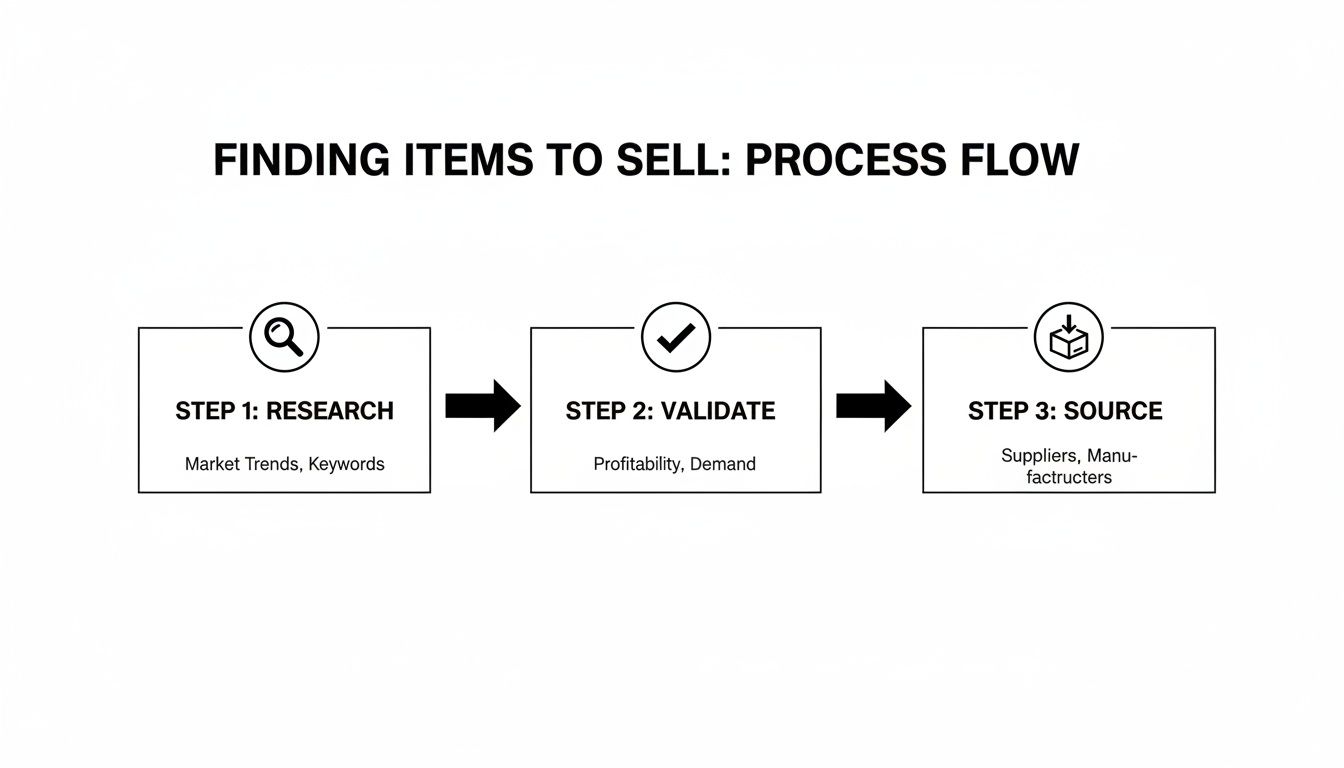
It’s that straightforward: Research, Validate, and Source. Following this order is your best defense against wasting time and money on a product that won't sell.
High-Potential eBay Categories at a Glance
To get your gears turning, let's look at a few popular product areas. The table below breaks down some of the biggest categories on eBay, giving you a quick snapshot of what to expect in terms of demand, competition, and how sellers typically find their inventory.
| Category | Market Demand | Competition Level | Common Sourcing Methods |
|---|---|---|---|
| Electronics | Very High | High | Refurbishers, Wholesale, Liquidation |
| Collectibles | Medium-High | Medium | Estate Sales, Flea Markets, Auctions |
| Home & Garden | High | High | Retail Arbitrage, Wholesale, Dropshipping |
| Fashion (Used/Vintage) | Very High | Very High | Thrift Stores, Consignment, Buyouts |
| Sporting Goods | High | Medium-High | Retail Arbitrage, Used Marketplaces |
| Auto Parts (Used) | High | Medium | Junkyards, Online Forums, Part-outs |
Remember, this is just a starting point. A "high competition" category isn't a dead end—it's a signal to niche down further.
Key Categories with High Potential
Picking the right sandbox to play in is your first major decision. While the platform is massive, a few categories consistently deliver results because of their built-in demand and solid resale value.
Here are some of my go-to starting points:
- Electronics: This is a classic for a reason. From refurbished iPhones to vintage stereo receivers, the appetite for tech is endless. The high average selling price is a huge plus.
- Collectibles: This is a broad one, covering everything from Pokémon cards and comic books to old coins and action figures. Your personal knowledge is your biggest advantage here, allowing you to spot things others miss.
- Home & Garden: Think small kitchen gadgets, unique home decor, or reliable power tools. People are always looking for a deal to upgrade their home, making this a very stable market.
- Fashion: Gently used designer clothing, vintage band tees, and sought-after sneakers are on fire right now. The whole "recommerce" trend is massive, and eBay is its original home.
The trick isn't to find the "perfect" category. It's to find a small, defensible niche within a category where you can become the go-to expert. Don't just sell "clothes"—sell "vintage 90s band t-shirts."
This laser-focused approach is how you carve out your space and build a base of repeat customers. If you're looking for more inspiration, our guide on the best niches for drop shipping has a ton of ideas that apply just as well to traditional eBay selling.
Using Data to Uncover Winning Products
Guesswork is the fastest way to lose money selling online. Instead of scrolling endlessly through categories hoping for a spark of inspiration, let's talk about how the pros find profitable items to sell on eBay. It all comes down to digging into the data.
Your best friend here is eBay's own set of tools, which are designed to show you what’s actually moving off the virtual shelves. This isn't about finding a single "hot" product; it's about building a repeatable system for market research. The goal is to make smart decisions based on what has actually sold, not just what’s currently listed.
Mastering Terapeak for Market Research
Terapeak is where the magic happens. It's eBay’s built-in research tool, and it’s your window into the platform's sales history for the past year. It’s what separates speculation from a real strategy.
To get started, just pop a keyword for a product idea into Terapeak Sourcing Insights. Let's say you're curious about "vintage audio equipment." The first results you see will give you a quick health check on the category as a whole.
Drill down and look for these key indicators:
- Sell-Through Rate: This is the big one. It’s the percentage of listed items that actually sold. You're looking for strong buyer demand, so a rate above 50% is a great sign.
- Average Sold Price: This tells you what people are really willing to pay. It’s a quick gut check to see if the potential profit is worth your time.
- Total Number of Sellers: This shows you who you’re up against. A high number isn't a dealbreaker, but it means you'll need a unique angle or a more specific niche to stand out.
A Real-World Research Scenario
Let's stick with our "vintage audio equipment" example. A broad search is fine for a starting point, but the real money is in the specifics. Instead of a general category search, try looking for a particular brand and model, like a "Pioneer PL-518 turntable."
Now you’re getting somewhere. You might find this specific turntable has a 75% sell-through rate and an average sold price of $250. That’s a fantastic signal. From there, click into the actual sold listings. What condition were they in? Did they come with the original box? These details tell you exactly what buyers value and are willing to pay a premium for.
Your goal isn't just to find items that sell, but to understand why they sell. Dissect successful listings to see how top sellers use keywords, photos, and descriptions to attract buyers and command higher prices.
To stay ahead of the curve, you can also use external hot trend trackers to see what consumers are searching for across the web. This gives you a broader view of market demand and helps you spot opportunities before they land on eBay and become oversaturated.
Finding Underserved Niches
Data can also shine a light on gaps in the market. On Terapeak, look for keywords that have a high search volume but a surprisingly low number of active listings. This is a classic sign of an underserved niche where demand is higher than the current supply. For instance, you might discover that "replacement knobs for vintage receivers" gets hundreds of searches but only a handful of sellers are catering to that need.
Electronics is a massive category with endless opportunities for this kind of deep-dive research. In fact, it's the undisputed king of eBay sales, accounting for a huge 16.4% of all product listings. Buyers flock to eBay for everything from the latest gadgets to refurbished tech and the kind of vintage audio gear we've been exploring.
Instead of trying to compete on brand-new iPhones, you can carve out a profitable space by digging into the data for specific components, accessories, or parts. These research tactics are fundamental to long-term success, and many of the same principles apply across different selling models. You can explore more strategies in our guide to product research for dropshipping, as the core concepts are universal.
How to Calculate Profit Before You Invest
Finding what you think is a winning product is a rush, but that initial excitement is only half the story. Before you ever spend a dime on inventory, you need to be absolutely certain it's going to make you money. It’s a classic rookie mistake to get dazzled by potential revenue, only to watch your profits get chewed up by fees and costs you never saw coming.
Running the numbers first is your single best defense against a bad buy. This isn’t about complicated accounting—it’s just a simple exercise in subtracting your costs from your expected sale price. Doing this protects your cash and makes sure you're building a real business, not just a time-consuming hobby.

Uncovering All the Hidden Costs
The most common trap new sellers fall into is underestimating what it actually costs to sell something. The price you pay for your item is just the starting line. To get a true picture of your profitability, you have to account for every single expense, from the obvious to the easily overlooked.
These costs will shift depending on what you sell, but here are the non-negotiables you must factor in:
- Final Value Fees: Think of this as eBay's commission. It’s taken from the total amount the buyer pays—that includes the item price, shipping, and any sales tax. For most categories, you’re looking at around 13.25%, though it can be more for things like high-end handbags or less for athletic shoes over $150.
- Insertion Fees: You get 250 free listings a month, which is plenty for most beginners. But once you go past that, you'll pay a small fee (usually $0.35) for every new listing. It sounds small, but if you're listing hundreds of items, it adds up.
- Promoted Listing Fees: If you decide to use eBay's advertising to get more eyes on your stuff, you’ll pay an extra percentage of the final sale price. You get to set this rate yourself, but it comes directly out of your bottom line.
- Shipping Costs: This is more than just postage. It's the box, the bubble mailer, the packing tape, and the shipping labels. These little things can easily add another $1-$2 per package to your overhead.
- Sourcing Costs: This is what you paid for the product itself. Getting this number right is critical, and our guide on how to calculate your cost per unit is a huge help, especially when you start buying in larger quantities.
Miss just one of these, and a product you thought was a winner could end up costing you money. I always recommend building a small buffer into your math just in case.
A Simple Formula for Net Profit
Once you've got a handle on all your costs, figuring out your potential profit is straightforward. Using a simple formula keeps you organized and lets you apply the same logic to every product idea, taking the emotion out of your decisions.
Here's the basic math:
Net Profit = [Final Sale Price] – [Item Cost] – [eBay Fees] – [Shipping & Supply Costs]
Let's walk through a real-world example. Say you snag a cool vintage camera at a flea market for $20. After checking sold listings, you’re confident it will sell for $100, and the buyer will pay $15 for shipping.
Here’s how the numbers shake out:
| Line Item | Amount | Notes |
|---|---|---|
| Total Sale Amount | $115.00 | $100 item price + $15 shipping |
| Item Sourcing Cost | -$20.00 | Your initial investment |
| Final Value Fee | -$15.26 | Roughly 13.25% of the $115 total |
| Shipping & Supplies | -$17.00 | $15 postage + $2 for a box/filler |
| Net Profit | $62.74 | Your final take-home amount |
Boom. You just turned a $20 bill into $62.74 of pure profit. That's a fantastic margin, and it tells you this item is a green light.
The Power of Small-Scale Testing
The great thing about eBay is that you don't need to go all-in by buying 50 units of something to see if it’s a hit. You can test the market with just one. Find a single item, run the profit calculation, list it, and see what happens.
This small-scale testing approach is your best risk-mitigation strategy. It allows you to gather real market data—clicks, views, and hopefully a sale—without committing significant capital.
If it sells quickly for your asking price, you've got a proven winner and can confidently source more. If it just sits there for weeks, you've only risked the cost of one item, not a garage full of inventory nobody wants. This test-and-invest method is how you systematically find profitable items to sell on eBay while keeping costly mistakes to a minimum.
Smart Sourcing Strategies for Any Budget
Once you’ve locked down a product idea that you know has legs, it’s time to roll up your sleeves and get to the most hands-on part of the whole process: sourcing. Let's be honest, finding profitable items to sell on eBay is a skill. The real secret that separates the casual hobbyists from the full-time sellers is building a reliable pipeline of inventory.
The great news? You absolutely don’t need a mountain of cash to get started.
There are a few different roads you can take to stock your virtual shelves. Each one comes with its own unique blend of pros, cons, and elbow grease. The best fit for you really boils down to your starting budget, how much risk you're comfortable with, and how much time you can realistically dedicate to the hunt.
The Thrill of Retail and Online Arbitrage
Arbitrage is the classic game of "buy low, sell high." In its purest form, you're finding an underpriced gem in one place—like a dusty clearance aisle—and flipping it for a tidy profit on eBay. For anyone just getting their feet wet, this is probably the most accessible way to start.
Retail arbitrage means you’re physically in stores like Walmart or Target, scanning clearance racks for hidden gold. Online arbitrage is the exact same idea, but you’re doing your bargain hunting on other websites. Both demand a sharp eye and the ability to make a call on the spot.
Your smartphone is your secret weapon here. Fire up the eBay app and use its barcode scanner to instantly pull up an item’s recent sold prices and how many others are for sale. That real-time data is the difference between finding a goldmine and bringing home a dud.
A few pointers that have worked for me:
- Hunt for Discontinued Gold: When a brand stops making a popular shampoo scent or a limited-edition mug, loyal fans will often pay a premium.
- Master the Seasonal Cycles: Big box stores slash prices at the end of every season. Buying up winter coats in March or pool toys in September can lead to fantastic margins just a few months down the line.
- Check the Grocery Aisle: You’d be surprised what sells. Limited-edition Oreos, regional hot sauces, or special-release sodas that aren't sold nationwide can be shockingly hot items.
Uncovering Hidden Gems at Thrift Stores and Estate Sales
This is, without a doubt, my personal favorite way to source. It feels less like work and more like a treasure hunt where your knowledge is the map. Thrift stores, garage sales, and estate sales are absolutely overflowing with unique, vintage, and collectible pieces you can snag for next to nothing.
The trick is to specialize. Don’t just wander around hoping to get lucky. Pick a few niches that you're genuinely interested in—maybe vintage band tees, mid-century glassware, or 90s electronics—and become the go-to expert. That expertise helps you spot the valuable stuff everyone else walks right past.
I once bought a box of old slide projector carousels at an estate sale for $5. I almost passed on it, but decided to take a look inside. Tucked away in one was a full set of original NASA press slides from the Apollo missions. That set sold for over $400. That’s the kind of return you get from knowing what to look for.
Buying Wholesale and Building Supplier Relationships
When you’re ready to stop hunting and start scaling, wholesale is the next logical move. This is where you purchase inventory in bulk, straight from a manufacturer or distributor, at a deep discount. The biggest advantage is a consistent, repeatable source of products—something arbitrage and thrifting just can't guarantee.
Reaching out to suppliers can feel a little intimidating at first. Many will ask for a business license or resale certificate, so it’s a good idea to get your business officially registered.
When you make that first contact, keep it professional and straight to the point. Introduce your business (an online retailer specializing in X), tell them you're interested in their products, and ask for their wholesale catalog and terms. Try to project confidence; you've done your homework on their brand and see a fit.
The Low-Risk World of Dropshipping
Dropshipping is a fascinating model where you can sell products without ever touching the inventory yourself. Here’s how it works: a customer buys from your eBay store, you then place that order with a third-party supplier (like a vendor on AliExpress), and that supplier ships the item directly to your customer.
This is an incredible way to test a ton of different items to sell on eBay with almost zero financial risk. Your job shifts from packing boxes to mastering marketing, listing optimization, and top-notch customer service.
Of course, it’s not without its own set of hurdles:
- Thinner Profit Margins: You aren't buying in bulk, so your cost per item is naturally higher.
- Inventory Headaches: You have to keep a close eye on your supplier’s stock levels. Selling an item that just went out of stock is a recipe for a bad review.
- Supplier Dependency: Your reputation is in their hands. Product quality and shipping speed are a direct reflection on you, for better or worse.
In the end, the most successful sellers I know often use a hybrid approach. They might start with arbitrage to build up some cash, then reinvest those profits into their first small wholesale order. By getting comfortable with these different methods, you build a resilient and flexible inventory pipeline that can fuel your eBay business for the long haul.
Creating Listings That Convert Shoppers into Buyers
You’ve done the hard work. You’ve researched, validated, and sourced your inventory. Now for the final piece of the puzzle: building an eBay listing that actually convinces someone to hit that "Buy It Now" button. You could have the most sought-after items to sell on eBay, but a lazy or confusing listing will kill a sale before it even starts.
Think of your listing as your best salesperson, working around the clock. Every single element—from the title to the photos to the description—has to work together to build trust and make the purchase feel like a no-brainer.
Crafting Titles That Attract High-Intent Buyers
Let's be blunt: your title is the most important part of your listing. It’s what eBay's search algorithm latches onto, and it’s the very first thing a potential buyer sees. A weak title makes you invisible.
The trick is to get inside your customer's head. What words are they actually typing into the search bar? Don't get creative; get specific.
A battle-tested title formula almost always includes these key ingredients:
- Brand Name: Lead with it if it's a known brand (e.g., Nike, Sony, Pyrex).
- Product Name: Be precise. Not just "running shoes," but "Air Max 90."
- Key Identifiers: These are the details people search for—model numbers, sizes, colors, and other unique features.
- Condition: Clearly state if it's "New with Tags (NWT)," "Used," or "For Parts."
For instance, a terrible title is "Blue Shoes." A killer title that gets clicks is: "Nike Air Max 90 Men's Size 11 Blue White Running Shoes DM0029-100 Used." See the difference? It's packed with searchable keywords and instantly answers a buyer's core questions.
Taking Photos That Sell Your Product
Online, your photos are the product. Buyers can’t pick it up or inspect it, so your images have to do all the heavy lifting. The good news is you don't need a fancy studio. Your smartphone is more than capable.
First, focus on lighting. Natural, indirect daylight is your best friend. Find a spot near a bright window, but keep the item out of harsh, direct sunlight that creates deep shadows. A simple white poster board makes a fantastic, clean background.
Next, show them everything. Take pictures from every possible angle—front, back, top, bottom, and close-ups of any important details. If you're selling a used item, be brutally honest. Photograph every single scratch, scuff, or flaw. This builds massive trust and drastically cuts down on returns.
Your goal with photography is to answer a buyer's questions before they even think to ask them. A comprehensive set of clear, well-lit photos tells a story of quality and transparency that words alone can't match.
Writing Descriptions That Build Trust
Once your title and photos have grabbed their attention, the description is where you seal the deal. This is your chance to fill in the gaps, answer questions, and reinforce why your item is the right choice.
Start with a quick, simple summary of the item and its condition. Then, use bullet points to break out the key features so they're easy to scan. Be honest and descriptive. Selling a used shirt? Give the measurements, mention the material, and describe any signs of wear.
The words you choose are just as important as the images; you can learn how to write product descriptions that convert and turn casual interest into a firm sale. This is especially true in categories like apparel, where the small details can make or break a decision.
Speaking of apparel, clothing and accessories are a powerhouse on eBay, making up 13.8% of all listings. This category offers a massive opportunity, from trendy fast fashion to rare vintage finds. With a huge built-in base of buyers, it's a fantastic market for new and experienced sellers alike.
A great listing is a complete package. When you optimize your title for search, take photos that build confidence, and write a description that leaves no questions unanswered, you create an experience that turns browsers into buyers.
Common Questions About Selling on eBay
Jumping into eBay can feel a bit overwhelming at first. You've got the ambition, maybe even a few product ideas, but a handful of common questions often trip up newcomers. Let's clear up some of those early hurdles so you can get started with confidence.

One of the first things people wonder is how "official" they need to be. Do you need a registered business from day one? The short answer is no. You can absolutely start as a casual seller just to get a feel for the platform.
Do I Need a Business License to Start Selling?
For most people just dipping their toes in, a business license is not a requirement. You can sell personal items you no longer need or try your hand at retail arbitrage as an individual. It’s the easiest way to see if eBay is for you without getting bogged down in paperwork.
Now, once you shift from a hobby to a full-fledged business—where you're consistently buying products just to resell them—it's a good idea to check your local regulations. Setting up an LLC or a sole proprietorship can provide liability protection and tax advantages later on. But don't let that initial step hold you back from making your first sale.
How Much Money Do I Need to Begin?
This is one of the best things about selling on eBay: your initial investment can be practically zero. Seriously. You can start by listing things from around your house—clearing out closets, the garage, or the attic. This approach costs you nothing in inventory.
When you're ready to actually buy products to sell, you can start small. I'm talking $20-$50. Head to a local thrift store or garage sale and look for a few items you know you can flip. The key is to reinvest the profits from those first few sales back into buying more inventory. That's how you build a self-sustaining business.
The most successful sellers don't start with a massive loan; they start small, prove their process, and scale organically. Your initial investment is more about time and effort than it is about cash.
What Are the Most Common Seller Mistakes?
Knowing where others have gone wrong is a shortcut to getting things right. I see new sellers make the same few mistakes over and over, and they are all completely avoidable.
- Bad Photography: Dark, blurry, or just plain unappealing photos are the quickest way to kill a sale. Your pictures are all a buyer has to go on.
- Vague or Dishonest Descriptions: You have to be 100% honest about an item's condition. If there's a scratch, a stain, or a missing button, disclose it. Trying to hide flaws only leads to returns and bad feedback.
- Guessing Shipping Costs: This one is huge. New sellers often forget to weigh and measure items after they're packed up. Miscalculating shipping can completely wipe out your profit margin.
If you can just avoid these three things, you'll be way ahead of the game. It all comes back to building trust with buyers through clear, accurate listings. That's the bedrock of a good reputation on eBay.
Finding and listing profitable items is a skill, but capturing all the necessary high-quality media for those listings can be a major time sink. For sellers sourcing from AliExpress, AliSave Pro eliminates this bottleneck. You can download all product images, variant photos, and videos in a single click, perfectly organized and ready for your eBay listings. Speed up your workflow and create more compelling listings by trying the free AliSave Pro Chrome extension today.