

Ever wondered what separates a side-hustle seller from a full-blown reselling business? It really boils down to one thing: knowing what to sell. The best items to flip for a profit are always a mix of high demand, low cost to you, and maybe even a little brand hype. Think limited-edition sneakers, the right electronics, or timeless vintage clothing.
From Hobby to High-Profit Business
Reselling isn't just about flipping garage sale finds anymore. It’s evolved into a serious, scalable business. Where it used to be about stumbling upon a hidden gem at a thrift store, today's game is a sophisticated mix of market research, smart sourcing, and building your own brand. The opportunity is massive, with online marketplaces giving you direct access to millions of potential buyers.
Of course, that growth means more competition. You can't just find something to sell anymore; you have to find the right thing. This means you need to get good at spotting trends, picking product categories with healthy margins, and developing an eye for value that other people miss.
If you're just starting out and want to build a solid foundation, this guide on how to start a reselling business from scratch is a great resource. It walks you through the essential first steps in a clear, structured way.
Adopting a Pro Reseller's Mindset
Thinking like a top-tier reseller is all about strategy. It's not about getting lucky; it's about having a repeatable process. Successful sellers are always asking themselves a few critical questions before they ever spend a dime on inventory:
- Is anyone actually looking for this? A product is worthless if nobody wants to buy it. You need consistent demand.
- Can I get it cheap enough? Your entire business exists in the gap between what you pay and what you sell it for.
- How crowded is the field? A super popular item might be a terrible choice if the market is saturated with other sellers.
- Is this a pain to ship? Big, bulky, or fragile items can destroy your profits with high shipping and handling costs.
This guide is built to help you develop that exact mindset. We're going to skip the generic advice and get right into the specific categories, sourcing tactics, and listing methods that truly profitable resellers use. You won't just learn what to sell—you'll learn how to look at any product and see its real potential.
The core of a successful reselling business isn’t just finding products; it’s about consistently identifying opportunities where perceived value is lower than market value.
To give you a head start, here’s a quick look at some of the most lucrative categories people are making money in right now. Each one is its own little world with unique buyers, challenges, and big opportunities.
Top Reselling Categories at a Glance
This table breaks down the big-picture details for a few of the most popular reselling markets. Use it to get a feel for where the opportunities might align with your interests and resources.
| Product Category | Typical Profit Margin | Sourcing Difficulty | Average Selling Speed |
|---|---|---|---|
| Electronics | 25% – 50% | Medium | Fast |
| Sneakers & Apparel | 40% – 200%+ | High | Very Fast |
| Vintage & Collectibles | 50% – 500%+ | High | Slow to Medium |
| Furniture & Home Goods | 30% – 100% | Low to Medium | Medium |
As you can see, the higher the potential profit, the harder it often is to source the items and the more knowledge you need. But with the right strategy, any of these categories can become your goldmine.
Finding Your Goldmine: The Most Profitable Product Categories
To find the best items to resell for a profit, you need to think less like a general store and more like a specialist. It’s not enough to just have a vague idea; you have to drill down into specific, high-potential niches. Certain categories just work better than others, consistently delivering strong returns because they tap into powerful market drivers like brand hype, scarcity, nostalgia, and simple everyday need.
Think of it like investing in stocks. You wouldn't throw your money at a random company, right? You'd research its performance, market position, and potential for growth. The exact same logic applies here. Let's break down the most lucrative product areas and look at real-world examples to see what makes them tick.
The infographic below really nails down the key factors that make any reselling niche a winner.
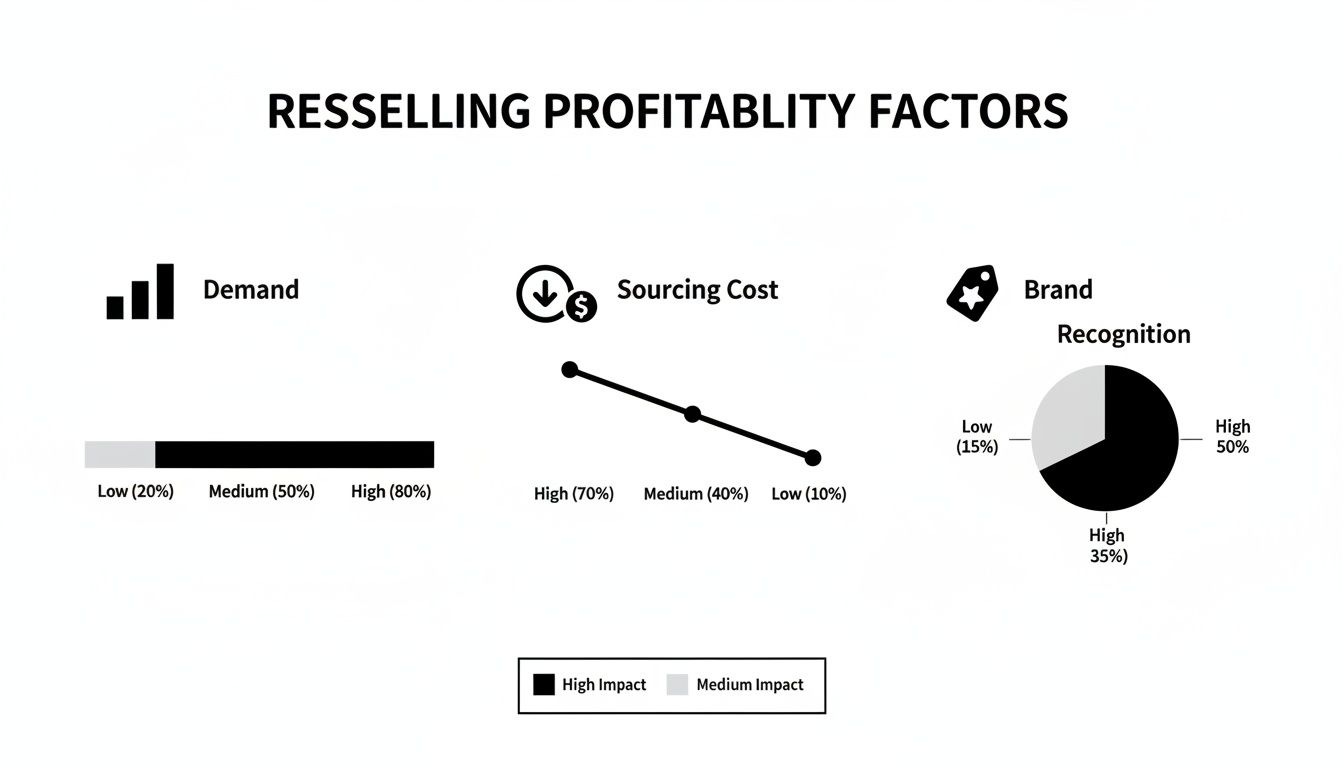
As you can see, the sweet spot for reselling is right at the intersection of high consumer demand, manageable sourcing costs, and strong brand recognition.
High-End Sneakers and Streetwear
This is, without a doubt, one of the most explosive and well-known reselling markets today. Limited-edition sneaker drops from giants like Nike, Adidas, and New Balance instantly create a massive gap between supply and demand. This scarcity is the engine that drives profitability, turning a $200 retail shoe into a $600+ asset, sometimes literally overnight.
Over the past decade, it’s been common to see margins of 30% to 300% on these limited releases. Special collaborations and retro drops often sell for two to four times their retail price within days on platforms that specialize in authenticated footwear. Some incredibly hyped-up releases have even hit five times their original price. The turnover is incredibly fast, too—popular sneakers often fly off resale listings within 24 to 72 hours.
The key takeaway here is that you're not just selling a product; you're selling access. The profit comes from the cultural value and status attached to that exclusive item.
Consumer Electronics
There's always a demand for consumer electronics, which makes them a perennially solid choice for reselling. I'm talking about smartphones, gaming consoles, laptops, and headphones. While you can make money on brand-new items, the real opportunity is often in the refurbished or gently used market.
So many people want the latest tech but just can't stomach the full retail price. This opens up a huge market for sellers who can source items in excellent condition and offer them at a discount.
- Smartphones: A used iPhone in great shape can still fetch hundreds of dollars, offering a fantastic margin if you can source it on the cheap.
- Gaming Consoles: When new consoles like the PlayStation or Xbox launch, the demand goes through the roof, creating massive resale opportunities. But even older consoles hold their value with collectors and casual gamers.
- Laptops & Tablets: Devices from brands like Apple and Microsoft hold their value exceptionally well, making them a relatively safe bet for reselling.
The trick here is to be meticulous. You have to verify that everything works perfectly and be brutally honest about the cosmetic condition. A tiny scratch can affect the price, so total transparency is essential for keeping your seller ratings high.
Vintage Clothing and Designer Accessories
Fashion is a wheel that never stops turning, and what was old inevitably becomes new again. Vintage clothing—from 90s band t-shirts to 80s denim jackets—has a huge appeal for people looking for unique, sustainable style. The profit margins here can be wild. A t-shirt you find for $2 at a thrift store could easily sell for $50 or more online if it hits the right note of nostalgia.
In the same vein, designer accessories like handbags, belts, and sunglasses from luxury brands (think Gucci, Louis Vuitton, Prada) are timeless assets that hold their value.
With this category, authentication is everything. Buyers need to be 100% confident they're getting the real deal, so using platforms with built-in verification services is a must for building trust and commanding top dollar. To stay ahead, it's a good idea to keep an eye on what's hot right now. You can get a sense of this by checking out our guide on trending dropshipping products.
Collectibles and Niche Hobbies
This category runs on pure passion and nostalgia. It’s a massive field that covers everything from trading cards and action figures to rare books and vinyl records. An item's value here is determined by its rarity, its condition, and the deep emotional connection it has with a dedicated fanbase.
- Trading Cards: Pokémon and sports cards have seen a massive comeback. A single rare card can be worth thousands.
- LEGO Sets: Believe it or not, retired or sealed LEGO sets can appreciate in value better than some stocks, as collectors are desperate to complete their collections.
- Action Figures & Toys: Vintage Star Wars or comic book figures, especially in their original packaging, are holy grails for die-hard collectors.
To succeed here, you have to be one of them—or at least think like one. You need deep niche knowledge to understand what makes an item valuable to a specific community. That's how you'll spot those undervalued gems that everyone else overlooks.
Mastering the Art of Sourcing Profitable Items

So, you know what you want to sell. The next big question is, where do you find it? Finding the best items to resell for profit isn't about blind luck; it's about building a smart, repeatable sourcing system. Your ability to consistently find undervalued goods is the engine that will power your entire business.
Think of yourself as a modern-day treasure hunter. The treasure—profitable inventory—is everywhere, from dusty thrift store shelves to the digital clearance racks of massive online retailers. Your job is to know where to look and how to spot a killer deal when you see one.
This process blends old-school, in-person hunting with modern digital strategies. Each approach has its own rhythm, its own set of challenges, and its own potential rewards. The trick is to find the channels that actually fit your niche, your budget, and the time you have to commit.
Traditional Sourcing: The Physical Treasure Hunt
For a lot of resellers, nothing beats the thrill of the hunt—the feeling of unearthing a hidden gem in the real world. This hands-on method requires a good eye, a ton of patience, and maybe a little negotiation savvy. It’s perfect for finding those unique, one-of-a-kind items that can deliver huge profit margins.
Some classic hunting grounds include:
- Thrift Stores: Places like Goodwill and local charity shops are legendary for a reason. They're goldmines for vintage clothing, rare books, and unique home decor.
- Garage and Estate Sales: This is where you find everything from furniture and electronics to niche collectibles, often at rock-bottom prices.
- Retail Arbitrage: This just means buying discounted items from retail stores—think clearance aisles at Target or Walmart—and flipping them online for a higher price.
The biggest draw here is the potential for incredible margins. An item you snag for $5 at an estate sale could easily sell for $100 online. The downside? This method can be a huge time-sink and isn't always scalable. Your inventory is totally dependent on what you happen to find on any given day.
Digital Sourcing: Finding Deals From Your Desk
Beyond brick-and-mortar, the internet offers a massive landscape for sourcing profitable items right from your computer. Digital sourcing is often far more scalable and can be done from anywhere, making it a powerful strategy for growing your business.
A few popular online methods are:
- Online Marketplaces: Scouring platforms like Facebook Marketplace or Craigslist for undervalued local listings that you can flip for a quick profit.
- Wholesale Suppliers: When you're ready to scale up, buying directly from wholesalers lets you https://alisavepro.com/buy-in-bulk-for-resale/ and secure a consistent flow of inventory. It takes more cash upfront but brings your per-item cost way down.
- Liquidation and Overstock Sites: These websites sell entire pallets of returned or overstocked goods from major retailers. It can be a treasure trove for a huge variety of products if you're willing to buy in volume.
Sourcing is a skill of recognizing future value where others see past use. Whether it's a vintage jacket at a thrift store or an overstocked item online, the principle remains the same: identify undervalued assets.
For anyone looking to source internationally and cut through the complexity, finding reliable sourcing agents can be a fantastic move. They act as your boots on the ground, helping with everything from negotiation to quality control.
Comparison of Product Sourcing Methods
So which path is right for you? It really depends on your business goals, how much capital you have, and the time you can invest. There's no single "best" method—in fact, the most successful resellers often use a mix of several approaches. This table breaks down the key differences to help you figure out where to focus your energy.
| Sourcing Method | Initial Cost | Potential Margin | Scalability | Time Investment |
|---|---|---|---|---|
| Thrift & Garage Sales | Very Low | Very High | Low | High |
| Retail Arbitrage | Low | Medium | Medium | High |
| Online Marketplaces | Low | Medium-High | Medium | Medium |
| Wholesale & Liquidation | High | Low-Medium | Very High | Low |
Ultimately, successful sourcing comes down to building a reliable and repeatable system. Start with one or two methods that fit your budget, really learn the ropes, and then gradually expand as your business grows. The more avenues you have for finding profitable inventory, the more resilient your reselling venture will be.
Calculating Your True Profit Margin
Finding the right products to resell is only half the job. The other, arguably more important half, is knowing your numbers cold. It’s so easy to fall into the trap of thinking your profit is just what the customer paid minus what you paid for the item. But the real profit is often buried under a pile of small, sneaky costs that can quietly eat away at your earnings.
To build a business that lasts, you have to look deeper than that simple math. Think of it this way: your profit margin is like the hull of a ship. It might look solid from a distance, but tiny, unseen leaks—like marketplace fees, payment processing charges, and even the cost of packing tape—can slowly sink your whole operation if you ignore them. A 10% marketplace fee or a 3% payment processing charge might not sound like much on one sale, but trust me, they add up fast.
Calculating your true net profit requires a bit of detective work. You have to account for every single penny it takes to get that product from your inventory into the customer's hands. This is the only way to know for sure if an item is actually worth your time.
Beyond the Basics: Uncovering the Hidden Costs
To get a real, honest look at your business's health, you need to list out every possible cost. These are the expenses that separate what you think you made from what’s actually in your bank account. Without tracking them, you're flying blind, making sourcing decisions with only half the story.
Here are the usual suspects you absolutely have to factor in:
- Marketplace Fees: This is the cut the platform—like eBay or Amazon—takes for letting you sell there. It can be anywhere from 8% to over 15%, depending on the product category.
- Payment Processing Fees: Services like PayPal or Stripe don't work for free. They typically charge a percentage of the total transaction plus a small flat fee, often around 2.9% + $0.30.
- Shipping and Handling: This isn't just the postage. It’s the boxes, bubble wrap, packing tape, and printer labels. It all adds up.
- Initial Sourcing Costs: Did you drive to a thrift store? Factor in your gas. Did you buy something online to flip? Don't forget the shipping you paid to get it to you.
Miss any of these, and a "winner" of a product can quickly turn into a waste of money.
Building Your Financial Model: A Practical Example
Let’s walk through a real-world scenario to see how this all plays out. Imagine you score a cool vintage jacket at a thrift store.
- Item Sourcing Cost: You buy the jacket for $10.00.
- Listing and Sale Price: After doing your research, you list it and it sells for $60.00.
On the surface, that looks like a clean $50.00 profit. Awesome! But now, let's pull back the curtain and look at the real costs.
| Expense Category | Description | Cost |
|---|---|---|
| Marketplace Fee | 13% commission on the total sale price | $7.80 |
| Payment Processing | 2.9% + $0.30 fee on the total sale | $2.04 |
| Shipping Supplies | Box, tape, and label | $1.50 |
| Postage Cost | The actual cost to ship the item to the buyer | $8.50 |
| Total Expenses | The sum of all associated costs | $19.84 |
Let's do the math again. Your true profit isn’t $50. It's $60 (Sale Price) – $10 (Item Cost) – $19.84 (Total Expenses) = $30.16. That's still a fantastic return, but it's vital to work with the real number. The first step to mastering this is understanding your core costs, and our guide on how to calculate cost per unit provides a great framework for doing just that.
True profitability isn't found in the sale; it's confirmed in the spreadsheet. Diligent tracking of every small expense protects your margins and empowers smarter sourcing decisions.
By creating a simple financial breakdown like this for every single item, you give yourself the power to make smart, data-driven decisions. It ensures you're only investing your time and money in products that actually hit your profit goals.
Choosing the Right Marketplace to Sell Your Products
You've done the hard work of sourcing great products, but that's only half the battle. Where you decide to list those items is just as critical to your success. Think of it like this: you wouldn't set up a high-end vintage clothing stall in the middle of a discount hardware store. The right location—or in this case, the right digital marketplace—is everything.
Each platform has its own vibe, fee structure, and most importantly, its own customer base. A rare band t-shirt that gets zero traction on Amazon could literally sell in minutes on a platform like Depop. Picking the wrong digital storefront is one of the fastest ways to end up with slow sales and thin profits.
The Big Players: General Marketplaces
If you're after sheer volume and the largest possible audience, the big general marketplaces are your go-to. These are the mega-malls of the internet, with billions of people actively searching for just about anything you can imagine.
- eBay: The granddaddy of them all. eBay has grown from a quirky auction site into a massive platform that's still one of the best places for used, vintage, and collectible items. The auction and "Best Offer" options give you real flexibility, but you need to get good at creating detailed listings and handling your own shipping.
- Amazon: The undisputed king of e-commerce. Amazon's reach is staggering, especially if you use their Fulfillment by Amazon (FBA) service. But be warned: it's a fiercely competitive arena with high fees, strict rules, and a heavy focus on new products. It’s built for sellers who can scale, not so much for one-off vintage treasures.
- Facebook Marketplace: With over a billion users, this platform has become a juggernaut for local sales, which completely sidesteps the headache of shipping. It’s brilliant for bulky items like furniture or electronics, and because it's tied to user profiles, there's a built-in layer of trust.
Niche Platforms: The Specialist Shops
Sometimes, a smaller, more focused audience is way more profitable than trying to appeal to everyone. Niche platforms are like specialty boutiques; they cater to specific passions and attract buyers who are ready to pay a premium for exactly what they're looking for. These aren't just shoppers—they're enthusiasts and collectors.
When you choose a niche marketplace, you're trading raw traffic for qualified buyers. You'll reach fewer people, but the ones you do reach are far more likely to be your perfect customer.
This focused approach gets your products in front of people who already get it. You don't have to convince them of the item's value—they already know.
Here’s a quick look at some of the best niche platforms out there:
| Platform | Specialization | Target Audience | Key Advantage |
|---|---|---|---|
| Poshmark | New & Used Fashion | Style-conscious shoppers | Built-in social selling tools |
| Depop | Vintage & Streetwear | Gen Z & Millennials | Strong community culture |
| StockX | Sneakers & Collectibles | Hype-focused collectors | Third-party authentication |
| Etsy | Handmade & Vintage | Seekers of unique goods | Creative and craft-focused |
Matching Your Product to the Platform
Okay, this is where you put it all together. The final step is to think like a strategist and match your inventory to the right marketplace. A luxury designer handbag might be completely overlooked on Facebook Marketplace but could fetch a premium on a consignment site like The RealReal. On the flip side, a heavy used treadmill is a perfect fit for a local Facebook sale but would be a shipping and cost nightmare on eBay.
Before you list anything, ask yourself these three questions:
- The Audience: Who is my ideal customer for this specific item? Where do they spend their time online?
- The Fees: After the platform takes its cut (commission, listing fees, payment processing), is there enough profit left to make it worthwhile?
- The Logistics: How much of a pain will this be to pack and ship? Is a local-pickup platform the smarter play?
Answering these questions moves you from being a passive seller to a strategic one. You're not just throwing products at a wall to see what sticks—you're placing them exactly where they have the best chance to sell fast and for the most money.
Creating Product Listings That Convert

Finding a profitable product is only half the battle. If that amazing item is buried under a sloppy, uninspired listing, it’s just going to sit there. Think of your product listing as your digital salesperson—it has to grab attention, build trust, and close the deal all on its own.
A weak listing makes a great product look cheap, but a fantastic one can make a simple item feel like an absolute must-have. It’s the difference between a quick flip and dead stock. To get this right, you need to nail three things: a title people can find, a description that tells the whole story, and visuals that sell the product for you.
Writing Titles and Descriptions That Sell
Your title is your first, and sometimes only, chance to catch a buyer's eye. It has to be clear, descriptive, and loaded with the exact keywords your target customer is searching for. Put yourself in their shoes: what words would you type into that search bar? Be specific.
When it comes to the description, honesty and detail are non-negotiable. Don’t just list what it is; sell what it does. Instead of "used jacket," try something like, "Gently used vintage denim jacket, no visible wear. Perfect for a classic retro look." See the difference?
Here are a few things you absolutely must include:
- Condition: Be upfront about everything—scuffs, dings, flaws. Honesty prevents headaches later.
- Measurements: Give exact dimensions for clothing, furniture, or anything where size matters.
- Authenticity: If you're selling a brand name, mention any proof you have that it's the real deal.
- Functionality: Does it work? Say so. Confirm that any electronics or gadgets are fully operational.
This kind of transparency builds instant trust with buyers. It also dramatically cuts down on your risk of returns and bad reviews, which are killers for any reseller.
A great product description doesn't just describe the item—it answers the customer's questions before they even think to ask them. This preemptive clarity is the foundation of a high-conversion listing.
The Power of High-Quality Visuals
In the world of online sales, your photos and videos are the product. A customer can't pick it up, feel the texture, or test it out, so your visuals have to bridge that gap. Grainy, dark, or blurry photos look unprofessional and can make a potential buyer think twice about your credibility.
If you’re sourcing from a platform like AliExpress, your supplier has likely already invested in professional photography and videography. You should be using it. This is where a tool like AliSave Pro becomes indispensable, letting you download all the high-quality media from a supplier's page with a single click.
This simple step can save you hours of work. More importantly, using professional assets makes your listings look more legitimate and boosts the perceived value of your products. Better photos often mean you can ask for—and get—a better price.
Your Top Reselling Questions, Answered
Jumping into reselling is exciting, but it's natural to have a ton of questions swirling around. Let's tackle some of the most common ones I hear from new sellers. Getting these answers straight from the start will help you dodge a few rookie mistakes and build momentum faster.
How Much Money Do I Really Need to Start?
Honestly, you can get this off the ground with less than you think. Many people start with a budget of under $100. The secret isn't a huge bankroll; it's being clever about where you find your first few items.
Think small to win big at the start. Hit up local thrift stores for unique clothing, or keep an eye out for free items on neighborhood marketplaces that just need a little polish. Once you make a few sales, you simply reinvest that money into more (and better) inventory. Your startup cost is what you make it—I know plenty of successful sellers who started by just selling things they no longer needed from their own closets.
What Are the Biggest Mistakes Newbies Make?
Every new reseller stumbles, but you can save yourself a lot of headaches by knowing what to watch out for. A few classic blunders pop up time and time again.
These are the most common tripwires:
- Buying blind: You find something that looks cool but don't check its actual selling price online before you buy it.
- Ignoring the "hidden" costs: Forgetting to factor in marketplace fees and shipping costs can wipe out your entire profit on a sale.
- Bad photos: Using dark, blurry, or unappealing pictures is the fastest way to make a buyer scroll right past your listing.
- Lazy descriptions: Writing a one-line description that leaves out key details is just asking for confused customers and, eventually, returns.
If I could give only one piece of advice, it would be this: don't go all-in at once. Start with just a handful of items in a niche you're curious about. Treat each sale as a lesson, see what works, and only scale up after you've found a winning formula.
How Do I Handle Shipping and Returns Without Losing My Mind?
Getting logistics right is where you separate the hobbyists from the pros. It's the key to happy customers and healthy profits. For shipping, all you really need to start is a small digital scale and a tape measure. Use the shipping calculators built into platforms like eBay or check out other shipping services to compare rates and find the best deal.
Now, for returns. It might feel safer to have a "no returns" policy, but that can scare away potential buyers. Offering a simple 14 or 30-day return window (where the buyer pays for return shipping) often boosts confidence and leads to more sales. But the best way to handle returns is to prevent them in the first place—pack your items well with plenty of padding so they arrive safely. Damaged goods are the #1 cause of returns you can easily avoid.
Ready to make your product listings look incredible without all the manual work? AliSave Pro is a free Chrome extension that lets you grab all the high-quality photos and videos from an AliExpress page in just one click. It’s a game-changer for creating listings that sell. Visit https://alisavepro.com to get started.