
Figuring out whether to sell on eBay or Facebook Marketplace really boils down to two things: what you're selling and who you're selling it to.
To put it simply, Facebook Marketplace is king for local, cash-in-hand sales, especially for bulky stuff like furniture. It’s straightforward and generally free. On the flip side, eBay is the undisputed champion for reaching a worldwide audience with niche collectibles, specialized electronics, or anything that needs secure shipping and solid seller protection.
Choosing Your Best Online Selling Platform

When you’re ready to turn some extra stuff into cash or even start a serious reselling business, picking the right platform is your first critical move. eBay and Facebook Marketplace offer two very different ways to sell online. It helps to think of them as a global auction house versus a neighborhood bulletin board—each has its own unique strengths.
eBay, a veteran in the game since 1995, is a structured e-commerce powerhouse built for dedicated sellers and serious buyers. It offers a complete system with detailed listings, built-in shipping tools, and formal protections for sellers. This makes it the go-to place if you're looking to build a brand, sell specialty items, and connect with customers across the globe.
Facebook Marketplace, however, taps into the power of social networks for local selling. Launched in 2016, it quickly became a major player, now used by over 1.1 billion people in 70 countries and holding a massive 51% share of the social commerce market. It’s designed for quick, informal deals within your community, which is perfect for beginners or anyone selling large items that are a pain to ship.
The real secret is matching what you’re selling to the platform that serves it best. Trying to ship a vintage sofa on eBay is a logistical nightmare, just like selling a rare comic book only on Facebook Marketplace means you’re missing out on a huge audience of collectors.
For a more detailed breakdown of what to consider, this article on how to choose the right marketplace for your business offers some great insights. Getting this right from the beginning will save you a ton of headaches and help you make more money, faster.
Quick Comparison eBay vs Facebook Marketplace
For a quick summary, here’s an at-a-glance look at how the two platforms stack up for sellers.
| Feature | eBay | Facebook Marketplace |
|---|---|---|
| Primary Audience | Global buyers, collectors, enthusiasts | Local community, bargain hunters |
| Best For | Niche collectibles, electronics, shippable goods | Furniture, large items, quick local sales |
| Seller Fees | Final value fees (~13.25%) + optional fees | Free for local pickup; fee for shipped items |
| Seller Protection | Formal policies, dispute resolution system | Limited; relies on user reporting |
| Shipping | Integrated global shipping solutions | Primarily local pickup; some shipping options |
This table highlights the core differences, but as you can see, the best choice really depends on your specific needs as a seller.
Comparing Fees, Payments, and Seller Profitability
The price tag on your item is just the beginning. The real measure of your success is how much cash you actually pocket after all the fees are paid. This is where eBay and Facebook Marketplace take dramatically different paths, and understanding the nuances is key to protecting your profit margins.
Facebook Marketplace's biggest draw has always been its fee structure for local deals: there isn't one. If you sell a bike for $100 to someone down the street who pays you in cash, you keep the full $100. It's clean, simple, and unbeatable for local flipping.
But things change the moment you decide to ship. For items sold and shipped through the platform, Facebook takes a selling fee of 10%. The fee is deducted right from your payout, so it’s straightforward, but that "free" platform suddenly comes with a cost.
Deconstructing eBay’s Fee Structure
eBay’s fee system is definitely more layered, but it’s built to support a massive, global operation. We're talking about a platform with 134 million active buyers worldwide as of early 2025. The fees you pay fund that global reach, seller protections, and customer support infrastructure. The average seller fee lands around 13%, which is a bit steeper than Facebook's shipping fee, but you're paying for a much more comprehensive service.
On eBay, you'll mainly encounter two types of fees:
- Insertion Fees: You get a generous number of free listings each month (currently 250), but if you're a high-volume seller, you’ll pay a small fee for each listing beyond that limit.
- Final Value Fees: This is the big one. It's a percentage of the total amount the buyer pays, which includes the item price, shipping, and sales tax. For most categories, this fee is 13.25%.
Key Takeaway: For local cash sales, Facebook Marketplace is the undisputed champion—it's completely free. For shipped goods, you're looking at a trade-off: eBay's slightly higher fees grant you access to a huge, dedicated buyer base and a structured ecosystem that Facebook simply doesn't offer.
Profitability in Action: A Real-World Scenario
Let's break down what this means with a real example. Imagine you're selling a used digital camera for $150. Here's how your take-home pay would look on each platform.
Scenario 1: Selling Locally on Facebook Marketplace
- Sale Price: $150
- Platform Fees: $0 (local cash sale)
- Net Profit: $150
Scenario 2: Shipping on Facebook Marketplace
- Sale Price: $150
- Platform Fees: $15 (10% of the sale)
- Net Profit: $135 (before shipping costs)
Scenario 3: Selling on eBay
- Sale Price: $150
- Platform Fees: ~$19.88 (based on a 13.25% final value fee)
- Net Profit: ~$130.12 (before shipping costs)
As you can see, for a quick local flip, nothing beats Facebook. Once shipping enters the picture, however, the gap in profitability shrinks. While eBay takes a bigger slice of the pie, its vast audience might mean you find a buyer willing to pay more for your camera, which could easily cover the higher fees and then some. Planning for these costs is non-negotiable, and you might find our guide to https://alisavepro.com/calculate-sales-margin/ helpful for setting the right prices.
Audience Reach and Finding the Right Buyers
Getting your product in front of the right person is everything. When you’re weighing eBay vs. Facebook Marketplace, you’re really looking at two completely different types of buyers. One platform is your neighborhood garage sale, and the other is a global auction house. Knowing the difference is the key to making a sale.
Facebook Marketplace is all about local convenience. The average buyer here is looking for a decent deal on something they can grab today. Think of someone searching for a "used bookshelf near me" or a "toddler bike in my city." They value speed, proximity, and the chance to haggle a bit in person.
eBay, on the other hand, is a destination for shoppers on a mission. People go to eBay with something specific in mind. They’re collectors looking for a rare vinyl record, mechanics who need a very particular car part, or fashion lovers hunting for a vintage designer bag. These aren't impulse buys; they're very targeted searches.
The Local Hunter vs. The Global Collector
At its core, the difference is all about buyer intent. A Facebook Marketplace user is usually solving an immediate problem or just browsing for a local bargain. An eBay user is actively trying to find a specific item, often one they can't get anywhere else.
This changes everything about what sells best on each platform. That bulky dining room set you’re finally getting rid of? It's a perfect match for Facebook Marketplace. A local buyer can swing by with a truck, and you avoid the headache of shipping. You’ll probably have it sold in a few days.
But what if you're selling a signed first-edition book? Listing that on Facebook Marketplace is a huge mistake. Sure, you might find a local book lover, but you're completely missing out on thousands of dedicated collectors across the globe who would fight over it on eBay, driving the price way up.
Key Insight: Facebook Marketplace connects you with a ton of people who live nearby. eBay connects you with a smaller, but much more motivated and specific, global audience.
Matching Your Product to the Right Crowd
The platform you pick needs to align with what you're selling. This isn’t just about avoiding shipping hassles; it’s about finding the biggest pool of buyers who actually get what your item is worth. And the power of social commerce is real—a recent study found that 51.2% of social media shoppers made their last purchase on Facebook, showing just how dominant it is for quick, local deals. For a closer look at the numbers, you can find in-depth Facebook Marketplace statistics here.
That data proves Facebook has a massive, ready-to-buy audience for everyday stuff. But that convenience-focused mindset can hurt you if you're selling something specialized.
Let's break it down with a few real-world examples:
- A Standard Microwave: This is classic Facebook Marketplace material. It’s a common appliance, a pain to ship, and its value is easy for any local buyer to understand.
- A Vintage Star Wars Action Figure: This belongs on eBay, hands down. Its value is tied to its rarity and condition, things only collectors truly appreciate. An eBay auction can spark a bidding war between enthusiasts from different countries—a scenario you could never replicate locally.
- A Used Laptop: This could go either way, but you'll get different results. On Facebook, you’ll probably make a fast cash sale. On eBay, you'll reach a much wider pool of tech-savvy buyers, but you’ll need a killer listing to compete. Great photos and a detailed description are non-negotiable, and mastering the basics of eBay listing optimization can seriously boost your final sale price.
Ultimately, choosing the right platform comes down to understanding the buyer's mindset. Are they scrolling for a deal on their lunch break, or are they actively searching for the exact thing you have? Answering that question will tell you exactly where your product will sell best.
Comparing Logistics, Shipping, and Seller Protections
This is where the rubber meets the road. Beyond the fees and potential audience, how you actually get your item sold, shipped, and protected is what defines your day-to-day experience as a seller. These details are where eBay and Facebook Marketplace really part ways, directly impacting your workflow and peace of mind.
The listing process alone shows two completely different philosophies. Facebook Marketplace is all about speed. Its mobile-friendly design lets you snap a few pictures on your phone, dash off a quick description, and have your item live in just a couple of minutes. It’s tailor-made for casual sellers who just want to get something posted without a big fuss.
eBay, on the other hand, is built for the serious seller. It’s a much more detailed and feature-heavy environment, pushing you to add multiple high-quality photos, fill out tons of item specifics, and write detailed, keyword-rich descriptions. It definitely takes more work upfront, but that investment pays off by attracting committed buyers from all over the world.
Navigating Logistics: Local vs. Global Shipping
Shipping is probably the single biggest operational difference between these two platforms. Facebook Marketplace grew out of the idea of connecting with your neighbors, and that local-first approach is still its greatest strength. For big, bulky, or fragile items like furniture, appliances, or exercise equipment, it's the undisputed champ because you can arrange for a simple in-person pickup.
While Facebook has added shipping for some items, the system is pretty basic. You can get prepaid labels and tracking, but it doesn't have the sophisticated tools a growing business needs. There are no deep integrations with different carriers, no international options, and no way to set up complex shipping rules.
eBay, by contrast, is a global logistics machine. It was built from the ground up for shipping, offering:
- Calculated Shipping: Automatically figures out the shipping cost based on the buyer's location and your package's size and weight.
- Deep Carrier Integration: Gives you access to discounted rates and lets you print labels seamlessly for major carriers like USPS, UPS, and FedEx.
- Global Shipping Program (GSP): Takes the headache out of selling internationally by handling customs, import fees, and international postage for you.
- Flexible Options: Lets you offer everything from cheap economy shipping to speedy overnight delivery.
This robust setup makes eBay the go-to choice if you plan on shipping products regularly. If you want to really get into the weeds of logistics, checking out a guide on the best shipping for small business can give you some great strategies for keeping costs down.
Key Difference: Facebook Marketplace shines when you want to avoid shipping altogether with local pickups. eBay excels at making complex, worldwide shipping not just possible, but actually manageable and affordable.
Understanding Seller Protection and How Disputes Are Handled
This is a critical one. When things go wrong—and they sometimes do—your seller protection is the safety net that stands between you and a fraudulent buyer or an unfair claim.
Facebook Marketplace largely leaves it up to you. Disputes are handled directly between the buyer and seller through Messenger, with Facebook taking a very hands-off approach. Their involvement is usually limited to a basic review if someone is reported. This puts a lot of risk on you as the seller; if a buyer is dishonest or just ghosts you, there’s not much you can do.
eBay’s system is far more structured and offers genuine protection. They have a formal Resolution Center to mediate disputes and clear policies for sellers. If a buyer files a false "Item Not as Described" claim, you're protected as long as you can provide evidence to back up your listing. eBay also actively looks for and cracks down on fraudulent buyer behavior, giving you a sense of security that's missing on Facebook Marketplace.
Knowing how to protect your brand and products is crucial on any platform. Learning your rights and the proper channels for reporting issues, as detailed in A practical guide on how to report counterfeit products, is a key part of running a smart business. When it comes down to it, eBay’s established protections make it the much safer choice for selling valuable items where the risk of fraud is higher.
Tools for Scaling Your Reselling Business
When you move past just clearing out your closet and start thinking about building a real reselling business, your platform choice becomes your most crucial partner. The tools, data, and marketing options at your disposal will either accelerate your growth or hold you back. This is a defining moment in the ebay vs facebook marketplace comparison, where the two platforms show their true colors.
eBay is, without a doubt, built for commerce. Its entire system is engineered to help sellers scale, manage inventory like a pro, and market their products to a global audience. The heart of this operation is the eBay Seller Hub.
Think of the Seller Hub as the command center for your business. It’s a powerful dashboard that puts everything you need in one place:
- Performance Analytics: You can see exactly how your sales are trending, where your traffic is coming from, and what your conversion rates look like.
- Inventory Management: Keep a close eye on all your active, sold, and unsold listings without juggling spreadsheets.
- Marketing Tools: This is where you launch ad campaigns with Promoted Listings, create store-wide sales, or send special offers to potential buyers.
Having this kind of data is a game-changer. It’s the difference between guessing what works and knowing for sure which products are your winners and which marketing efforts are actually making you money.
Marketing and Promotion Opportunities
eBay gives you a whole toolkit to actively push your listings in front of more buyers. The biggest tool in that box is Promoted Listings. You can essentially pay a small percentage of the final sale to boost your item’s visibility, getting it seen in prime locations across the site. For serious sellers trying to get an edge, this feature is indispensable.
Beyond that, you can run your own sales events, send custom offers directly to people who have shown interest in your items, and create unique coupon codes. These features allow you to take control of your sales strategy instead of just listing an item and hoping for the best.
Key Takeaway: eBay offers a structured, data-rich environment tailor-made for professional growth. Its analytics and marketing features are mission-critical for anyone serious about turning a reselling hustle into a legitimate business.
Facebook Marketplace, on the other hand, is a whole different beast. It operates on a simple, direct model that’s perfect for quick local flips, not for building an e-commerce empire. Its main “tool” is its massive built-in audience and the sheer speed at which you can post an item.
There's no central seller hub, no deep analytics to pour over, and your marketing options are pretty much limited to paying to "boost" a listing to show it to more people in your area.
This simplicity is great for getting started, but it creates major roadblocks when you try to scale. Managing more than a handful of items becomes a manual chore, and you have no real way to analyze your sales data to spot trends or opportunities. You also can’t build a brand or reputation through a robust feedback system like you can on eBay.
This doesn't mean you can't make serious money on Facebook Marketplace. Plenty of sellers have built entire businesses around its core strengths: zero fees for local cash deals and the ability to quickly sell in-demand items like furniture, tools, or electronics. Their business scales through sheer volume and speed—not brand loyalty or clever marketing. It’s a fantastic engine for individual transactions, but it's not designed to help you build a lasting, scalable brand.
So, Which One Is It? eBay or Facebook Marketplace?
The truth is, there's no single "best" platform. The whole eBay vs Facebook Marketplace debate really comes down to one thing: picking the right tool for the right job. It's about figuring out what you're selling, who you're selling to, and what your long-term goals are.
To make it easier, let's look at a few common selling scenarios. Find the one that sounds most like you, and the right choice should become pretty clear.
H3: The Side-Hustle Declutterer
Are you just trying to clear out some closet space? Selling off old electronics, unused furniture, or kids' clothes they've outgrown? Your main goal is probably to get some quick cash with the least amount of fuss and no upfront investment.
- Your Platform: Go with Facebook Marketplace.
- Why: For local cash deals, it's completely free. You keep 100% of the money. The listing process is ridiculously simple—you can have an item up for sale from your phone in under a minute. Plus, sorting out a pickup time is as easy as sending a quick message.
H3: The Niche Collectibles Specialist
If you're dealing in rare comic books, vintage vinyl, autographed memorabilia, or hard-to-find car parts, your customers aren't just down the street; they're all over the world. You need a way to reach a dedicated, passionate audience.
- Your Platform: This is eBay's home turf, no question.
- Why: You're tapping into a global audience of 134 million active buyers who are specifically searching for items like yours. The auction format is perfect for rare finds, often sparking bidding wars that push the final price way up. When you're shipping valuable goods, eBay’s seller protection is a must-have.
This decision tree gives you a good visual on how to think about scaling, whether you're focusing on local saturation or chasing a global audience.
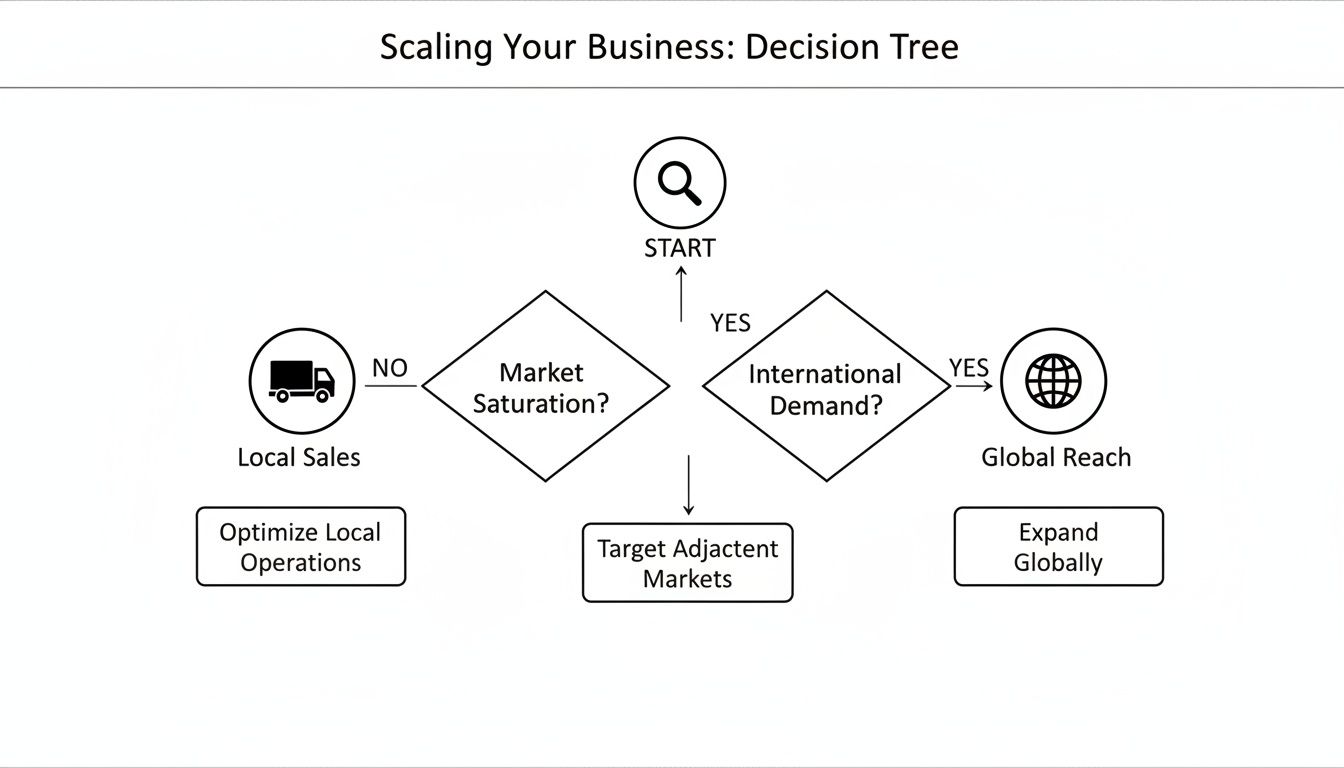
As you can see, the path you take really depends on whether you want to own your local market or find dedicated buyers internationally.
H3: The Local Furniture Flipper
Do you specialize in items that are a pain to ship? Think big, bulky things like refurbished dressers, home appliances, or exercise equipment. For you, logistics aren't just a detail—they're the whole game.
- Your Platform: Facebook Marketplace was practically built for this.
- Why: It's designed from the ground up for local, face-to-face exchanges. You completely sidestep the headache and high costs of shipping something heavy, which makes your entire business model simpler and more profitable.
H3: The Global eCommerce Brand
Are you building a serious, scalable reselling business? If you're managing a wide range of products and focusing on building a professional brand reputation, you need a platform with a serious set of tools.
- Your Platform: eBay offers the robust infrastructure you need.
- Why: Features like the eBay Seller Hub, marketing tools like Promoted Listings, and deep performance analytics are essential for managing and growing a real business. The structured feedback system is also crucial for building the kind of trust that keeps customers coming back.
To boil it all down, here’s a quick-reference guide to help you make the final call.
Decision Matrix Which Platform Is Right For You?
| Selling Scenario | Primary Platform Recommendation | Key Reason |
|---|---|---|
| Quickly selling personal items locally | Facebook Marketplace | No fees for local pickup, simple listing, direct buyer communication. |
| Selling rare, niche, or collectible items | eBay | Global reach to 134M buyers, auction format drives up prices, seller protection. |
| Flipping large, bulky items (e.g., furniture) | Facebook Marketplace | Avoids shipping costs entirely, built for in-person transactions. |
| Building a professional reselling business | eBay | Advanced seller tools, marketing options, and brand-building features. |
| Testing products with a new audience | Both (Start with FBM) | FBM for zero-cost market validation, then scale to eBay for wider reach. |
Ultimately, many successful sellers use both platforms strategically. You might use Facebook Marketplace to quickly move local inventory and test new product ideas, while relying on eBay as the backbone of your scalable, global operation. The key is to match the platform’s strengths to your specific product and business goals.
Frequently Asked Questions
When you're weighing your options between eBay and Facebook Marketplace, a few common questions always seem to pop up. Let's tackle them head-on to clear up any confusion and help you make the right call for your business.
Can I List the Same Item on eBay and Facebook Marketplace?
Absolutely. This is called cross-posting, and it’s a great way to get more eyes on your products. But—and this is a big but—you have to be on top of your inventory.
The second an item sells on one platform, you need to pull the listing from the other one immediately. If you don't, you risk selling the same item twice. That leads to a cancelled order, an unhappy customer, and a potential hit to your seller rating, especially on eBay.
Cross-posting can seriously boost your sales, but it requires discipline. A double sale is the biggest pitfall, as it can quickly damage the reputation you’ve worked hard to build.
Which Platform is Better for Selling Expensive Electronics?
For high-ticket items like laptops, cameras, or the latest smartphone, eBay is hands-down the safer bet. It’s built with protections for sellers baked right into the system.
eBay’s formal payment processing, integrated shipment tracking, and official dispute resolution process create a safety net that just doesn't exist on Facebook Marketplace. If a buyer tries to pull a fast one, you have a structured system to back you up.
Facebook Marketplace, on the other hand, is much more of a Wild West. It’s on you to vet the buyer and handle the transaction, leaving you far more exposed if something goes wrong.
How Do Returns and Disputes Work on Each Platform?
The way each platform handles problems couldn't be more different, and it really gets to the heart of what they are.
eBay's Approach: It’s all formal and structured. A buyer initiates a return or dispute through eBay's Resolution Center. From there, eBay steps in as a mediator, making a decision based on its official policies. As long as you followed the rules and your listing was accurate, eBay's seller protection has your back.
Facebook's Approach: It's all on you. Any issues are sorted out directly between you and the buyer through Messenger. There’s no official process, no mediation, and Facebook almost never gets involved. It’s a "seller beware" situation where your only real protection is the buyer's goodwill.
Knowing this fundamental difference is key. It helps you decide how much risk you're willing to take on and which system fits your selling style best.
Ready to create stunning listings for eBay or Facebook Marketplace in seconds? AliSave Pro is a free Chrome extension that lets you download all AliExpress product images and videos in a single click. Streamline your workflow and build better listings today by downloading it from the official Chrome Web Store.