
If you're a dropshipper, you've probably realized that finding cheap alternatives to Shein is about more than just a price tag. It’s about building a real business with better profit margins, a unique product catalog, and actual control over your brand. Shein might have the trendy, low-cost stuff, but platforms like AliExpress and Temu often get you closer to the source for even better pricing and offer direct e-commerce integrations. That’s a serious competitive advantage.
Why Dropshippers Are Looking Beyond Shein
Shein is a giant in fast fashion, no doubt about it. But for an e-commerce entrepreneur, it’s a tricky partner. When you source directly from Shein, you're not just a seller—you're a direct competitor to the platform itself. That means you're stuck with slim margins and absolutely no say in branding. This reality has pushed smart dropshippers to find more strategic suppliers who can help them grow for the long haul.
The biggest driver here is profitability. Shein’s prices are great for shoppers, but they aren't true wholesale prices. The best alternatives connect you directly with manufacturers, which means lower costs per item and much healthier margins for your business. To really grasp why this shift is happening, it’s worth understanding Shein's unique shipping and logistics model and seeing why it leads sellers to look elsewhere.
Core Challenges with Shein Sourcing
Dropshippers who try to build a business on Shein’s back run into the same roadblocks again and again. These aren't minor inconveniences; they're major hurdles that stop a business from scaling and building a loyal customer base.
- Limited Branding: Every package shows up with Shein’s logo all over it. It’s impossible to build your own brand identity when someone else’s is on the box.
- Saturated Market: You’re selling the exact same products as thousands of other people. The only way to compete is to drop your price, which kills your profits.
- No Direct Integration: Shein has no official dropshipping program. That means you're stuck placing every single order by hand, a nightmare that only gets worse as you grow.
A dropshipper's real challenge isn't just finding a cheap product. It's finding one that you can brand, that stands out from the competition, and that comes with a reliable, scalable way to get it to your customers. Shein stumbles on all three of these critical points.
This guide will walk you through how to find, evaluate, and partner with suppliers who offer what Shein can't. We’ll dive into everything from massive online marketplaces to dedicated wholesale distributors, giving you practical tips to succeed. A big part of that success comes down to how you present your products, so we'll also cover how to efficiently manage product photos and videos to lock in those sales.
How to Properly Evaluate Shein Alternatives
Finding a solid alternative to Shein isn't just about chasing the lowest price tag. If you want to build a real business, you need a disciplined approach that balances cost with quality and reliability. Before you even start browsing platforms, it's smart to have a clear set of criteria to measure potential suppliers against your specific needs.
Think of it as creating a scorecard. This helps you move beyond a gut feeling and make a data-driven decision that benefits your profitability, customer happiness, and the long-term health of your brand. I've found that a solid evaluation rests on four key pillars.
Sourcing Costs and Profit Margins
First up, Sourcing Cost. This is more than the price you see on the product page. You have to factor in shipping fees, any potential customs duties, and even transaction costs. A T-shirt might look like a bargain at $3, but if shipping adds another $7, your entire profit margin could vanish. Always calculate the total landed cost to see what you'll actually make on each sale.
A low unit cost doesn't mean much if it comes with month-long shipping delays that trigger a flood of customer complaints and refund requests. The real win is finding that sweet spot: a supplier that offers affordable products without sacrificing reliability.
Product Catalog and Niche Potential
Next, take a hard look at the Product Catalog. A supplier boasting millions of items is impressive, but it's useless if none of it fits your niche. Instead of getting distracted by sheer volume, dig into the categories that matter to you. Do they offer unique pieces that help you stand out, or is it the same generic inventory everyone else is selling?
The goal is to find a supplier whose catalog helps you build a distinct brand. For anyone serious about expanding their sourcing options, it's worth exploring various websites like AliExpress to uncover new product ideas and different types of suppliers.
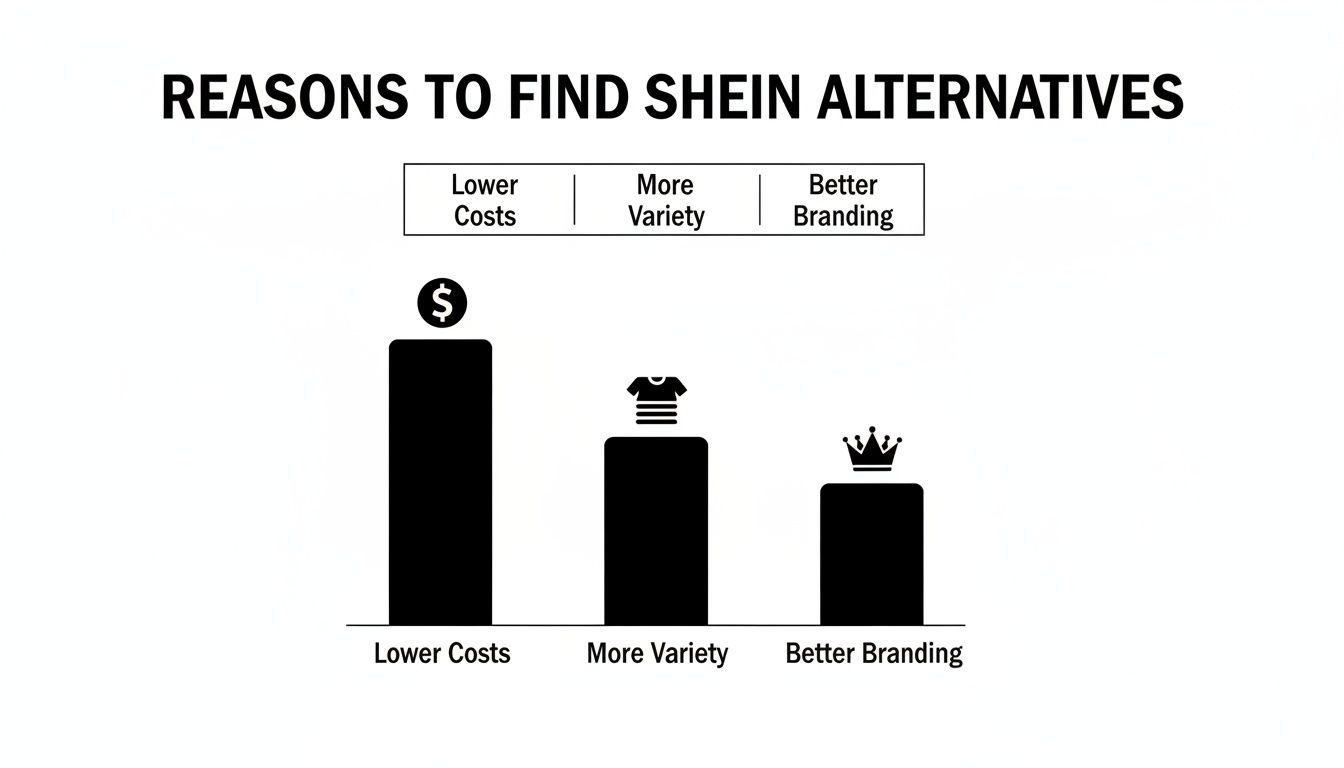
This chart really nails why sellers look for alternatives. Sure, lower costs are a big piece of the puzzle, but building a unique brand and offering a better product mix are just as critical for sustainable growth.
Shipping Reliability and Media Quality
The last two pillars are all about logistics and marketing. Shipping Reliability is non-negotiable. Happy customers are repeat customers, and that starts with getting their orders on time. Look for suppliers who provide clear tracking information, offer different shipping tiers, and have a proven record of hitting their delivery estimates. A supplier with local warehouses is a huge plus, as it can slash shipping times.
Finally, you have to assess the Quality of Product Media. This is a big one. High-resolution photos, images for every color variant, and product videos are your sales team. Terrible, blurry visuals will sink your conversion rate, no matter how great the product is. Finding a supplier with a library of professional, ready-to-use media saves you an incredible amount of time and helps you get your marketing campaigns live that much faster.
A supplier's product media is your product media. Great photos and videos directly impact your store's conversion rate, save you countless hours on content creation, and let you launch new products in a fraction of the time.
Supplier Evaluation Scorecard
To put this all into practice, use a simple scorecard to compare your options head-to-head. This framework helps you move from theory to a clear, actionable comparison based on what matters most for your store.
| Evaluation Criteria | AliExpress | Temu | Wholesale Platforms |
|---|---|---|---|
| Sourcing Cost & Margin | Extremely competitive, but watch shipping fees. Strong margins possible. | Very low prices, often with free shipping. High potential for good margins. | Higher upfront cost per unit, but best per-unit pricing. Highest margins. |
| Product Variety & Niche | Massive catalog. Good for testing many niches. Can be saturated. | Growing catalog, trendy items. Good for broad consumer niches. | Specialized catalogs. Best for building a deep, niche-specific brand. |
| Shipping Reliability | Varies widely by seller. Requires careful vetting of each supplier. | Generally reliable and tracked, often faster than standard AliExpress. | Very reliable. Often offers faster, domestic shipping options. |
| Product Media Quality | Inconsistent. Ranges from professional to very poor. Often requires editing. | Generally good quality, consistent style. Suitable for immediate use. | Typically high-quality, professional media provided for marketing. |
By scoring each potential partner against these criteria, you'll quickly see which platform aligns best with your business model, whether you're focused on testing trends quickly or building a premium niche brand.
Comparing Marketplace Giants: AliExpress vs. Temu
If you're hunting for Shein alternatives, two names inevitably pop up: AliExpress and its aggressive new competitor, Temu. On the surface, they both offer a dizzying array of products at rock-bottom prices. But peel back the curtain, and you'll find they run on completely different engines, which creates real pros and cons for sellers and dropshippers. You have to look beyond the price tag to see which one actually fits your business.
AliExpress is the old guard in this space—a massive B2C marketplace that’s been connecting individual sellers with global buyers for years. Its biggest advantage is its sheer size. The competition between millions of sellers naturally pushes prices down, which is fantastic for sourcing products with a healthy margin. For dropshippers, its long track record also means there's a mature ecosystem of tools and integrations ready to plug into your workflow.
Product Catalog and Seller Diversity
The fundamental difference comes down to how they're structured. AliExpress is a true open marketplace, giving you direct access to millions of independent storefronts. This means you can find just about anything, letting you curate a truly unique product catalog and tap into obscure niches. The flip side? Quality, shipping times, and even basic customer service can be all over the map. You have to put in the work to vet your suppliers carefully.
Temu, in contrast, acts more like one gigantic retailer. It sources from countless manufacturers, but it manages the logistics and the entire customer experience itself. This gives you more consistent shipping and a uniform look and feel, but you sacrifice the incredible product depth you'd find on AliExpress. If you want to dive deeper into how these marketplace models differ, our guide on AliExpress vs DHGate breaks it down even further.
The numbers don't lie about AliExpress's dominance. It pulled in an eye-watering $51.849 billion in Gross Merchandise Value (GMV), and its international orders recently shot up by 60%, partly driven by its AliExpress Choice program. A solid 10% of global shoppers made their last cross-border purchase there, putting it just ahead of Shein at 9%. You can dig into more of these shopping application statistics to see the full picture.
Strategic Use Cases for Dropshippers
So, which platform should you build your store on? Honestly, it depends entirely on your game plan.
AliExpress is the clear winner for anyone trying to build a long-term, specialized brand. The enormous catalog and direct-from-manufacturer access let you hand-pick a unique collection of products. It’s perfect for dropshippers who are willing to invest the time to find and build relationships with reliable sellers, ensuring consistent quality for their customers.
Temu shines in a totally different light. It’s a machine built for viral, trend-chasing products that you can blast all over social media. Its whole model is based on sparking impulse buys with unbelievably low prices and a constant barrage of ads. If your strategy is to jump on trending items, sell high volume at low margins, and move on to the next big thing, Temu is practically made for you.
Key Takeaway: Use AliExpress to build a stable, niche store with a deep, curated product line. Turn to Temu for sourcing cheap, viral products that are perfect for high-speed social media campaigns and testing new trends without much risk.
Ultimately, the smartest dropshippers often use both. You can use AliExpress for your core, evergreen products and then dip into Temu to source promotional giveaways or test the market's reaction to a new, flashy trend.
Sourcing and Presenting Products Like a Pro
Finding a cheap product is just the first step. Turning it into a sale? That all comes down to how you present it. Mastering this process is what separates the thriving stores from the ones that fizzle out. It all starts with a sharp eye for detail when you're evaluating listings on platforms like AliExpress—long before you ever think about adding an item to your own shop. This is how you build a brand that people trust over Shein.
Think of every potential product as an investment. Don't get distracted by a low price tag; your first move should always be to vet the seller. A seller with a rating north of 95% and a few years of business under their belt is a much safer bet than a brand-new shop with suspiciously good deals. Consistent, positive feedback is your first green light.

Beyond Seller Ratings: What to Look For
Once you've found a seller who seems reliable, it's time to dig into the product itself, and the best way to do that is through the eyes of people who've already bought it. Customer reviews are your goldmine of unfiltered truth.
- Filter for Reviews with Photos: This is a non-negotiable step. Customer photos show you what the product really looks like—the true color, the actual fit, the texture of the fabric—in a way polished studio shots never can.
- Read the Bad Reviews: Skip the generic complaints about shipping times. You're looking for patterns. Do you see multiple people saying "the fabric is see-through," "the zipper broke immediately," or "it faded after one wash"? Those are serious red flags.
- Cross-Check Material Claims: If a listing claims an item is "100% Cotton" but the reviews mention a shiny, synthetic feel, believe the reviews. This simple check saves you a world of headaches from unhappy customers and returns down the line.
As you start sourcing, remember that a professional operation also needs to handle logistics smoothly. Knowing how to track international packages is just as critical as vetting products, as it keeps your customers informed and happy.
Customer review photos are your secret weapon. They not only confirm the quality for you but also give you authentic social proof to use in your own marketing. Nothing builds trust faster than seeing a real person wearing and loving your product.
Your Media Management Workflow
Let’s be honest: manually saving every single product photo and video is a mind-numbing task that absolutely kills your momentum. If you're serious about finding Shein alternatives and actually scaling your business, you need a streamlined media workflow. The goal is to get from finding a product to having a beautiful, live listing as quickly as possible.
A dedicated tool like AliSave Pro was built for exactly this. Forget right-clicking and saving dozens of images one by one. You can grab all the high-resolution product photos, variant images, videos, and even those incredibly valuable customer review pictures with a single click.
Everything downloads into a neat, organized ZIP file, ready to go. You can upload the assets directly to Shopify or WooCommerce, create ads for social media, and build a visually compelling product page that actually converts. By cutting out the tedious manual labor, you get your time back to focus on what really matters: finding great products and marketing them well.
Thinking Beyond Marketplaces for Better Sourcing
While big marketplaces are fantastic for dipping your toes in the water and testing out new trends, relying on them alone is a recipe for getting lost in the crowd. A truly resilient sourcing strategy is your best defense against market saturation and paper-thin profit margins.
To get a real competitive edge, you have to explore models that offer unique products and, frankly, better financial returns. This means looking past the usual suspects to find suppliers that actually align with a long-term vision for your brand.
One of the most effective cheap alternatives to Shein is making the leap from single-item dropshipping to small-batch wholesale. Platforms like Alibaba open up a whole new world of direct-from-factory pricing that can seriously boost your bottom line. It does require a bigger upfront investment, but the per-unit savings are often massive.
The Wholesale Advantage
So, when does wholesale make sense? It's the perfect move for sellers who've already validated a product and are ready to scale up. Instead of ordering one piece at a time, you might commit to a minimum order quantity (MOQ) of 50 or 100 units.
This approach immediately gives you more control over your inventory. It can also lead to much faster shipping times, especially if you store the products locally or use a third-party logistics (3PL) provider. On top of that, buying in bulk often opens the door to customization, letting you add your own branding and create a private-label product that’s truly yours. If this is new territory for you, it’s worth digging into guides on how to find manufacturers that dropship to get the lay of the land.
The real power of wholesale isn't just the lower cost per item. It's the ability to build a unique brand that competitors can't just copy and paste. When you own your inventory, you can offer exclusive products and a much better customer experience.
Finding Hidden Gems in Resale and Niche Retail
Another powerful strategy is to hunt for inventory on resale platforms and in curated niche shops. Believe it or not, sites like Poshmark and Depop, or even specialized fast-fashion stores, can be goldmines for one-of-a-kind items that help you carve out a distinct brand aesthetic. This model is ideal for creating that boutique feel that mass-market dropshippers simply can't replicate.
- Resale Platforms (Poshmark, Depop): These are excellent for sourcing vintage or unique pre-owned fashion. You're also tapping into the growing consumer demand for sustainable, circular fashion.
- Niche Fast-Fashion Retailers (Zaful, ROMWE): While still in the fast-fashion orbit, these sites often have more curated collections than the giant marketplaces. This can help you target a very specific, well-defined audience.
This approach definitely requires more curation effort, but the payoff is attracting customers who are actively looking for something special. You’re not just selling a product anymore; you’re selling a carefully selected style.
In this fast-moving space, new players are always popping up. Take Temu, for example, which has become a fierce challenger to Shein with its rock-bottom pricing. After launching in the US in September 2022, it hit a staggering $16.5 billion in gross merchandise value in its first full year.
By early 2025, an incredible 44% of US adults had shopped on the platform, blowing past Shein's 31%. It just goes to show how quickly the landscape can shift. By keeping an eye on both established wholesale channels and nimble new retailers, you can build a sourcing strategy that's not just profitable, but built to last.
Answering Your Top Questions About Shein Alternatives
When you're building a dropshipping business, the questions come fast and furious. It's smart to get a handle on the common issues before they become real problems for your store. Let's dig into some of the most frequent questions I hear from sellers looking for reliable, cheap alternatives to Shein.
Is AliExpress Actually Cheaper Than Shein for Dropshipping?
Most of the time, yes, it is. Think of AliExpress as a massive online bazaar filled with thousands of individual sellers all competing for your business. That intense competition naturally pushes product prices down, often lower than what you'll find on Shein. For a dropshipper, that can mean a much healthier profit margin on every sale.
But "cheaper" isn't just about the sticker price. You have to consider the total landed cost—that's the product cost plus shipping. This is where it gets tricky. Shipping fees on AliExpress can be all over the map depending on the supplier. Shein, on the other hand, often bundles shipping costs or offers free shipping on larger orders, which makes its final price very straightforward.
What Are the Biggest Risks of Sourcing from Alternatives?
The two things that will keep you up at night are inconsistent product quality and unpredictable shipping times. It's the wild west out there. Because platforms like AliExpress or Temu are just marketplaces for millions of independent sellers, there’s no universal quality control. You can order a great product from one store and a flimsy, poorly-made knockoff of the same item from another.
The only way to protect yourself is through serious supplier vetting. I can't stress this enough. Stick to sellers with high ratings, thousands of orders under their belt, and tons of customer reviews—especially those with real photos. That's the social proof you need to feel confident in your source.
Shipping is the other major headache. Long, unreliable delivery windows can absolutely kill your brand's reputation, leading to a flood of angry customer emails and chargebacks. You have to be crystal clear and upfront about your shipping estimates.
How Do I Make My Store Stand Out from Competitors?
When everyone has access to the same pool of products, branding is everything. Don't try to be another generic "general store" that sells a little bit of everything. Your first move should be to carve out a specific, well-defined niche and curate a unique collection of products for that audience. It makes your store memorable.
Next, you need to build a real brand identity. This means creating your own compelling product descriptions—never just copy and paste what the supplier wrote. Your visuals need to look professional and trustworthy. Use tools to download the supplier’s high-quality media and, more importantly, the photos from customer reviews. Real-world images build incredible trust.
Finally, fantastic customer service is your secret weapon. Responding quickly and helpfully to customer inquiries builds loyalty like nothing else. That's how you get the repeat business you need to survive long-term.
Ready to create stunning product listings in a fraction of the time? AliSave Pro lets you download all the high-resolution images, videos, and review photos from any AliExpress page with a single click. Streamline your workflow and build a better brand at https://alisavepro.com.