
The real difference boils down to one simple thing: AliExpress is built for individual buyers and new dropshippers, while DHgate is a wholesale platform for businesses.
If you're just starting out and want to test products one by one with no minimum order, AliExpress is your playground. But if you’re ready to buy in small bulk to get better per-unit pricing, DHgate is where you should be looking. Your choice hinges entirely on your business model—are you testing the waters or are you ready to scale?
Comparing AliExpress vs DHgate At a Glance
Before we get into the nitty-gritty of shipping times, product quality, and seller reputations, it helps to understand what makes these two platforms fundamentally different. They both connect you with Chinese suppliers, but who they're for and how they operate creates two very distinct experiences for an ecommerce entrepreneur.
AliExpress, a powerhouse from the Alibaba Group, is mostly a business-to-consumer (B2C) marketplace. Think of it as a sprawling global mall where you can buy just one of anything. This makes it a perfect, low-risk launchpad for dropshipping. With over 100 million items and an interface designed for simple, individual purchases, it’s incredibly beginner-friendly.
DHgate, on the other hand, was built from the ground up with a business-to-business (B2B) focus. It serves small and medium-sized businesses that need to source products in small wholesale batches. You’ll see tiered pricing everywhere—the more you buy, the cheaper each unit gets. It’s the logical next step once you’ve found a winning product and want to boost your profit margins by buying in volume.
The core decision in the AliExpress vs DHgate debate is about your business stage. Choose AliExpress for flexibility and product testing; turn to DHgate for profitability through scaled purchasing.
To put it all into perspective, here’s a quick summary of the key differences between the two platforms.
Key Differences Between AliExpress and DHgate
This table breaks down the core distinctions at a glance, helping you see where each marketplace shines.
| Attribute | AliExpress | DHgate |
|---|---|---|
| Business Model | B2C (Business-to-Consumer) | B2B (Business-to-Business) |
| Best For | New dropshippers, product testing, single-item orders | Scaling businesses, small bulk orders, resellers |
| Pricing Structure | Fixed retail price per item | Tiered pricing (price drops with higher quantity) |
| Minimum Order | Almost never (No MOQ) | Often (Low to moderate MOQs) |
| Product Selection | Extremely vast (over 100 million products) | Large, but more focused on specific niches |
Ultimately, this table highlights the core trade-off: AliExpress offers unparalleled flexibility for starting out, while DHgate provides a clear path to better margins once you're ready to commit to inventory.
What Is AliExpress? The Dropshipper's Starting Point
AliExpress is a massive global retail marketplace, essentially the business-to-consumer (B2C) side of the massive Alibaba Group. The easiest way to think of it is a sprawling digital mall where anyone—from individual shoppers to small businesses—can buy single items directly from millions of Chinese manufacturers and resellers.
This direct-to-consumer model is the core difference when you stack it up against DHgate. Unlike wholesale-focused platforms, AliExpress was built from the ground up for individual sales. This means you’ll almost never run into a Minimum Order Quantity (MOQ). You can buy just one of anything, which is precisely what makes it the undisputed launchpad for new dropshippers.
The Ideal Platform for Product Testing
For entrepreneurs just starting out, this structure is a game-changer. It completely removes the financial risk of buying inventory upfront. You can list hundreds of different products in your store to see what resonates with your audience. When a customer places an order, you just turn around and buy that single item from the AliExpress seller, who ships it directly to your customer. This frictionless process is why it’s so popular for validating product ideas with minimal investment.
AliExpress is fundamentally a low-risk testing ground. Its model allows you to fail fast and cheap, iterating through products until you find a proven winner without ever touching inventory.
The sheer scale of the platform is another huge plus. With over 500 million monthly visits and a presence in more than 200 countries, AliExpress is a giant in global e-commerce. This immense traffic and an almost endless catalog mean you can find products for virtually any niche imaginable. Interestingly, about 60% of its traffic is direct, which points to strong brand recognition and a loyal customer base. You can dig into more stats about AliExpress's market share on techjury.net.
Finally, AliExpress plays nice with a whole ecosystem of dropshipping automation tools. This integration simplifies everything from importing products to fulfilling orders, freeing you up to focus on marketing and growing your business instead of getting bogged down in manual data entry. Add in a user-friendly interface and solid buyer protection, and it's clear why it's the go-to starting point for so many people entering the world of e-commerce.
What Is DHgate? The Scalable Sourcing Hub
While AliExpress is the undisputed king of single-item dropshipping, DHgate carves out its own territory as a powerful business-to-business (B2B) hub. It's built for that next stage of growth, connecting you directly with Chinese manufacturers and established wholesalers.
Launched back in 2004, DHgate was designed from the ground up for bulk purchasing and better profit margins.
This B2B focus is what really sets it apart from AliExpress. Instead of a simple retail price for one item, DHgate is all about its tiered pricing structure. The more you buy, the less you pay per piece. It's a system that directly rewards entrepreneurs who are ready to move beyond testing and start investing in small-batch inventory.
From Testing to Profitable Scaling
You don't go to DHgate to test a hundred different products one at a time. Think of it as the logical next step for a dropshipper or small retailer who's found a winner and is ready to scale.
Sellers on this platform are used to dealing with business clients, which often means you'll find more consistent quality and a greater focus on building long-term relationships.
Here’s what defines the DHgate experience:
- Low Minimum Order Quantities (MOQs): Even though it’s a wholesale platform, you'll find plenty of sellers with MOQs as low as 10-20 units. This keeps it accessible even for smaller operations.
- Volume-Based Discounts: This is the main draw. Buying in small bulk is how you dramatically increase your profit margin on every sale.
- Direct Manufacturer Access: Many sellers are the actual manufacturers. This opens the door for things like minor product customizations or even private labeling as you grow.
The platform is a massive ecosystem, connecting over 31 million registered buyers with 2.2 million sellers in more than 220 countries. Its entire network is geared toward helping small and medium-sized businesses find reliable suppliers. You can find more details on DHgate's business model on slashdot.org.
DHgate bridges the gap between single-order dropshipping and large-scale wholesale. It’s the platform where you transition from validating ideas to building a profitable, inventory-backed brand.
Plus, its escrow payment system holds your money until you confirm you've received your order and are happy with it. For the larger transactions common in B2B, that layer of protection is absolutely essential.
Comparing Pricing Models: From Single Items to Bulk Orders
Let's get straight to what matters most for your bottom line: pricing. When it comes to the AliExpress vs. DHgate debate, their entire pricing philosophies are built for different types of sellers. Understanding this distinction is the key to protecting your profit margins.
AliExpress is essentially a massive online retail market. The price you see is the price you get for one item, plain and simple. This makes it a perfect testing ground for dropshippers who need to fulfill single orders without touching any inventory. It’s clean, predictable, and removes the risk of buying stock that might not sell.
DHgate, on the other hand, is a wholesale machine. Its pricing is built around one simple concept: the more you buy, the less you pay per item. This tiered system is a godsend for businesses that have already found a winning product and are ready to increase their margins by purchasing in small batches.
A Real-World Price Comparison
To really see the difference, let’s run the numbers on a popular dropshipping product: a portable mini blender.
Scenario 1: Testing a New Product (1 Unit)
- AliExpress: You’ll likely find a single blender for $12.50, including standard shipping.
- DHgate: The same blender might be listed closer to $16.00 for just one piece, since the platform isn't really set up for single-item sales.
For a single dropshipping order, AliExpress is the clear winner. You get a better price right out of the gate with no strings attached.
Scenario 2: Small Batch Order (10 Units)
- AliExpress: The price is static. Your total would be $125.00 (10 x $12.50).
- DHgate: This is where things get interesting. The tiered pricing kicks in, dropping the per-unit cost to maybe $10.50. Your new total? $105.00.
Suddenly, DHgate starts to pull ahead, showing you how a little volume can lead to real savings.
Scenario 3: Scaling Your Inventory (50 Units)
- AliExpress: The cost remains fixed, bringing your total to $625.00 (50 x $12.50).
- DHgate: At this volume, the price per unit could plummet to just $8.50, making the total $425.00. That’s a massive $200 in savings.
This breakdown shows it’s not about which platform is "cheaper," but which one is smarter for your current business stage.
The Takeaway for Entrepreneurs: Use AliExpress for low-risk product testing and validation. Shift to DHgate when you're ready to scale and unlock higher profit margins with bulk orders.
Your business model should dictate your sourcing platform. Start lean with AliExpress to prove your concept. Once the sales are rolling in, make the strategic switch to DHgate for small bulk orders—it’s the logical next step toward greater profitability.
Evaluating Product Quality and Seller Reliability
Beyond the sticker price, the real foundation of your dropshipping business is built on reliable products from trustworthy suppliers. When you're weighing AliExpress vs DHgate, you'll find that both platforms are a mixed bag—you can find absolute gems and complete duds. The secret to success isn't picking the "better" platform, but becoming a pro at vetting sellers on either one.
Because AliExpress is a massive B2C marketplace, you’re dealing with a huge range of sellers, from small-time hobbyists to legitimate, large-scale businesses. This sheer volume means you absolutely cannot skip your homework. Reading every review and scrutinizing seller ratings is just part of the game.
DHgate leans more toward B2B, so you’re more likely to find actual manufacturers or established wholesalers. This can sometimes translate to more consistent product quality, especially if you're buying in bulk. These sellers are used to dealing with business buyers and understand that maintaining quality is key to getting repeat orders. Still, this is a general tendency, not a hard-and-fast rule.
Interpreting Seller Metrics and Reviews
Both sites throw a lot of data at you, but the key is knowing what to look for. A high overall score is nice, but the real story is always in the details.
On both AliExpress and DHgate, zero in on these specifics:
- Positive Feedback Score: Don't even consider sellers below 95%. Aim higher.
- Store “Age”: A shop that's been around for a few years has a track record. A store that opened last week? That's a gamble.
- Detailed Seller Ratings: Pay attention to the individual scores for "Item as Described," "Communication," and "Shipping Speed." A low score in one area can be a major red flag.
- Photo Reviews: This is where you find the unvarnished truth. Customer photos show what the product looks like in a real-world setting, not under perfect studio lighting.
When comparing AliExpress vs DHgate, remember that DHgate sellers often have more experience with bulk fulfillment, potentially offering better consistency. However, diligent vetting is mandatory on both platforms to avoid quality issues.
Actionable Strategies for Minimizing Risk
Finding a great supplier is more than just reading reviews—it requires a proactive, hands-on approach. Before you stake your store's reputation on a new supplier, you need to take a few crucial steps to protect yourself and your customers.
First, always order samples. I can't stress this enough. There is absolutely no substitute for getting the product in your own hands. You need to feel the materials, check the construction, and see the packaging for yourself. This small upfront cost can save you from a world of headaches, refunds, and reputation damage later on.
Next, test their communication. Before you buy anything, send the seller a question about the product or shipping. A quick, professional, and clear answer is a great sign. If you get a vague, broken-English reply (or no reply at all), that's a huge warning sign about the kind of customer service you can expect when something goes wrong.
For anyone new to this, learning how to navigate these supplier relationships is critical. You can get a better sense of this by checking out guides on if AliExpress can be trusted for your business needs. Ultimately, building a supply chain you can count on means combining the data the platform gives you with your own real-world verification.
Navigating Shipping Times and Logistics
Let's be honest: shipping is where most dropshipping businesses either shine or fail. It’s the last mile of your entire operation, and it directly shapes how your customers feel about your brand. Both AliExpress and DHgate give you plenty of shipping options, but they play the game a little differently. Your job is to find the right balance between what you pay, how fast it gets there, and how reliable it is.
With AliExpress, you're looking at a massive menu of shipping methods. This is because every seller on the platform can offer their own set of carriers. That flexibility is a huge plus. You can go for the super-cheap (and super-slow) options like Cainiao or stick with the tried-and-true ePacket. If you need something there fast, you can almost always find a seller offering premium carriers like DHL or FedEx, though you'll definitely pay for it.
DHgate also gives you choices like ePacket and DHL, but its real secret weapon is a growing network of local warehouses. If you can find a supplier who stocks your product in a DHgate warehouse in, say, the US or Europe, you're in a completely different league. Suddenly, shipping times drop from weeks to just a handful of days. For any business trying to compete on delivery speed, this is a massive advantage over the old long-haul shipping model.
Balancing Cost and Customer Patience
The real trick is managing what your customers expect. Touting "free shipping" is a great way to get sales, but a 30-45 day waiting period is also a great way to get angry emails and chargebacks. For a deeper dive into what typical wait times look like, our guide on how long AliExpress takes to deliver breaks it all down.
Here’s how to think about your options in the real world:
- Standard Shipping (e.g., AliExpress Standard, ePacket): This is the go-to for most dropshippers, and for good reason. It hits that sweet spot between cost and speed, usually getting packages to customers within 15-30 days with decent tracking. It’s cheap enough that you can often absorb the cost and offer free shipping without killing your profit margins.
- Premium Shipping (e.g., DHL, FedEx): Save this for your high-value items where customers are paying a premium and expect premium service. It's also a great tool to have in your back pocket for fixing a shipping problem or sending a replacement out fast. The cost is much higher, but you can get delivery in as little as 3-7 days.
- Local Warehouses (Primarily DHgate): If you can source your product from a local warehouse, do it. This is the holy grail. You get shipping times that feel domestic, often for just a small price bump, and the customer experience is worlds better.
Key Insight: The cheapest shipping option is rarely the best one. Think hard about who you're selling to. Customers in one country might be perfectly fine waiting a few weeks, while those in another expect their package by the weekend. Your shipping strategy needs to be built around their expectations, not just your bottom line.
The Final Verdict: When to Choose AliExpress or DHgate
So, which platform should you use? The truth is, there's no single "best" choice between AliExpress and DHgate. The right answer depends entirely on where your business is right now and what you're trying to achieve.
For anyone just starting out, testing new products, or running a classic dropshipping model, AliExpress is the hands-down winner. Its no-minimum-order-quantity (MOQ) approach is built for flexibility. You can test a dozen different products without risking a dime on inventory, fulfilling orders one by one as they come in. It’s the perfect sandbox.
When to Make the Jump to DHgate
But what happens when one of those test products takes off? When you have a proven seller and consistent sales, your focus naturally shifts from testing to maximizing profit. This is where DHgate shines.
DHgate is fundamentally a B2B platform, and its tiered pricing reflects that. Buying just 10 or 20 units at a time can slash your cost-per-item, directly boosting your profit margins. It's the logical next step for scaling a winning product.
This decision tree gives you a great visual for navigating the shipping options on both platforms, which is always a balancing act between cost and speed.
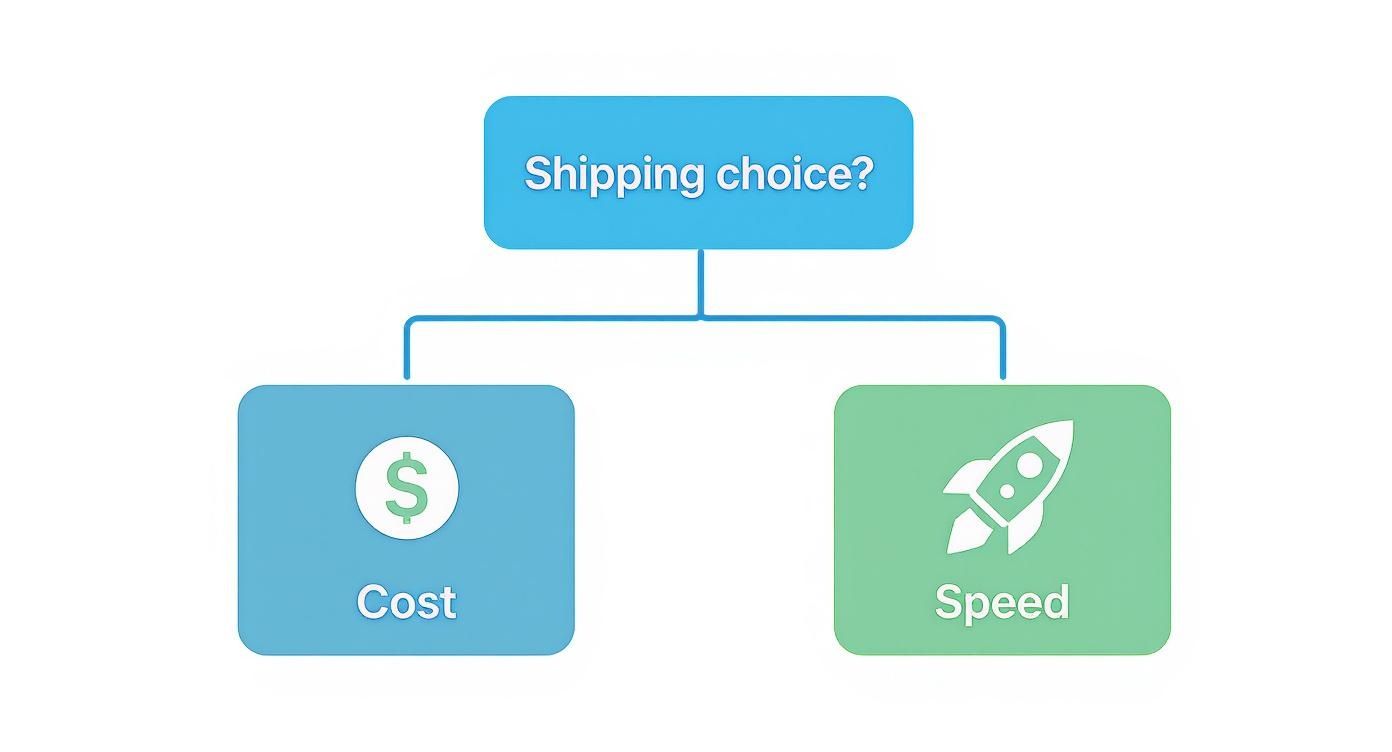
This constant trade-off is central to the dropshipping game: keeping your costs down while still getting products to your customers in a reasonable timeframe.
The global dropshipping market is massive—valued at around $365.7 billion and expected to grow to $464.4 billion next year. That's a staggering 27% jump. Platforms like these are the engine room of that growth, each playing a vital role. You can dive deeper into these dropshipping market trends on thunderbit.com.
Final Recommendation: Start your journey with AliExpress. Use it to find your winning products with zero inventory risk. Once you’ve got a steady stream of orders for a specific item, move that product over to DHgate. Buy in small bulk, improve your unit economics, and watch your profits grow.
Got Questions? We've Got Answers
When you're deciding between AliExpress and DHgate, a few common questions always pop up. Let's tackle them head-on so you can choose the right sourcing partner for your store.
Is DHgate Safer Than AliExpress?
This is a big one, but the answer isn't as simple as one platform being safer than the other. Both AliExpress and DHgate have solid buyer protection in place. They use an escrow system, which means your money is held securely until you confirm that you’ve received your order and are happy with it.
The real key to safety isn't the platform itself, but rather vetting individual sellers. Your security truly comes down to doing your homework. Before you buy anything, dig into the seller's ratings, check how long their store has been open, and—most importantly—read the reviews from other buyers. A little due diligence on either site goes a long way.
Which Platform Has Better Return Policies?
Here's where we see a clearer difference. For single-item purchases, AliExpress often has the edge with a more straightforward, buyer-friendly return process. You’ll frequently find "free returns" offered, which is a huge plus.
DHgate, on the other hand, can be a bit more complicated, especially since it's geared toward bulk orders. Return policies can vary more widely between sellers, and you might find yourself on the hook for return shipping costs. Sending a large batch of items back to China can get expensive fast, so it's something to factor in.
Ready to streamline your product sourcing? AliSave Pro lets you download all AliExpress product images and videos in a single click, saving you hours of manual work. Get the free Chrome extension and build your store faster.