
Staring at a blank page, trying to conjure up a legal policy from scratch? It's a common feeling. Honestly, the best way to tackle this is to start with a solid cancellation policy sample and tailor it to your business. This approach saves you a ton of headaches and makes sure you don't miss crucial details like refund windows, potential fees, or any special conditions.
Why Your Business Needs a Clear Cancellation Policy

A lot of online sellers see writing a cancellation policy as just another tedious task on the to-do list. I get it. But it's so much more than that—it's a fundamental tool for building customer trust and protecting your business.
Think of it as your first line of defense. A clear, easy-to-find policy heads off misunderstandings at the pass, saving you from endless email threads and frustrating disputes. This isn't just about protecting you, either. It gives your customers the confidence to make an informed purchase. When they know the rules of the game upfront, that "what if?" anxiety disappears, making it easier for them to click "buy."
Setting Clear Expectations and Reducing Disputes
Vague policies are a recipe for customer service nightmares. Picture this: a customer orders a custom-engraved necklace and then tries to cancel a week later, well after you've already paid for the engraving. Without a policy clearly stating that custom items are non-refundable after production begins, you're stuck. You're likely facing lost revenue and, almost certainly, a bad review.
A well-crafted policy does the heavy lifting for you by managing expectations from the very beginning. It answers all the "what if" questions so you don't have to.
Key Takeaway: A cancellation policy isn't about punishing customers. It's about creating a fair and predictable framework that works for everyone. It turns potential conflicts into simple, process-driven conversations.
This proactive stance also dramatically cuts down on your customer service workload. Instead of your team answering the same cancellation questions over and over, they can focus their energy on helping customers with more complex problems.
Protecting Your Bottom Line and Brand Reputation
Let's talk about chargebacks. They're a painful, time-consuming reality for any e-commerce store. Having a detailed cancellation policy—that customers agree to at checkout—is one of your strongest pieces of evidence if a dispute lands on your desk. Payment processors and banks always look for clear proof that the customer was aware of your terms before they paid.
Beyond the financial shield, your policy is a direct reflection of your brand's professionalism. A weak or non-existent policy can make your business look disorganized, or worse, untrustworthy. On the flip side, a fair and clearly written policy signals that you're a serious, customer-centric company. It shows you've thought through the entire customer experience, even when things don't go as planned.
This has a huge impact on your reputation. When policies are transparent and simple to understand, customers see your brand as honest. That foundational trust is what turns one-time buyers into loyal, repeat customers.
The Building Blocks of an Effective Cancellation Policy
Crafting a policy that actually works—one that protects your store while keeping customers happy—boils down to getting a few core components right. Think of it like a recipe. Miss a key ingredient, and the whole thing falls flat. A solid cancellation policy will always have a few non-negotiable elements that leave no room for guesswork.
This isn’t about burying your rules in fine print; it's about being upfront and creating a predictable, fair experience for everyone. When a customer knows exactly what to expect from the get-go, they feel much more confident hitting that "buy" button. This holds true everywhere, even in massive industries like travel, where customer demand for clarity is reshaping the market.
Just look at the numbers. The global travel cancellation insurance market was valued at around USD 1,765 million in 2023. It’s expected to grow by 6.5% annually for the next decade, which tells you just how much people value having a clear safety net. Your policy does the same job on a smaller scale—it's a promise of transparency.
Defining Your Cancellation Window
First things first: the cancellation window. This is the specific amount of time a customer has to change their mind and cancel an order. You have to be crystal clear here. "Within 24 hours of purchase" is good. "Shortly after ordering" is a recipe for disaster.
The right timeframe really depends on how you run your business and fulfill orders.
- For Dropshippers: Your window will likely be tight—maybe just a couple of hours. Once your supplier gets the order and starts processing it, the train has often left the station.
- For Custom Products: The window should slam shut the moment production starts. Spell this out explicitly (e.g., "Cancellations are only accepted within 6 hours of placing your order, as our team begins crafting your item immediately.").
- For Standard eCommerce: If you stock your own inventory, you can probably afford a more generous window, like any time before the shipping label is printed.
Whatever you decide, state it plainly. Any ambiguity here is a one-way ticket to customer service headaches and chargebacks. It's also smart to explain what happens after an item ships. At that point, it’s no longer a cancellation; it's a return. That's a crucial distinction. You can check out our guide on finding the best shipping for small business to see how different carriers manage packages already in their network.
Specifying Refund Types and Eligibility
Next up is the money. You need to explain exactly what happens to the customer's payment. A cancellation doesn't always mean a full, immediate refund to their credit card, and being transparent about that is vital for building trust.
Lay out all the possible outcomes so there are no surprises:
- Full Refund: The most straightforward option. The customer gets the entire purchase amount back to their original payment method. This is the standard for any cancellation made comfortably within your stated window.
- Partial Refund: This might come into play if cancelling the order has already cost you money, like for a non-refundable deposit on a custom piece or a small payment processing fee that you can't recoup.
- Store Credit: This is a fantastic middle-ground. It keeps the cash in your business and encourages the customer to come back and find something else they love. It's a great compromise for those borderline, "gray area" cancellations.
A great policy clearly connects the timing of the cancellation to the type of refund. For example: "Cancellations made within 12 hours of purchase will receive a full refund. Cancellations made after 12 hours but before shipment are eligible for store credit only."
This kind of structure takes all the guesswork out of the equation.
Outlining Fees and Special Conditions
Finally, you have to cover any fees or exceptions. Nobody likes a surprise fee. If you charge for restocking or processing a cancellation, it needs to be stated clearly and upfront. It also helps to explain why the fee exists (e.g., "A 15% restocking fee applies to cover the costs of unboxing, inspecting, and returning the item to our inventory.").
You also need to rope off any special product categories that play by different rules.
- Final Sale Items: Make it unmistakable that these products cannot be canceled or returned. Period.
- Digital Downloads: The standard policy here is that all sales are final once the download link has been clicked or sent.
- Custom-Made Products: As we touched on earlier, these items often have extremely short cancellation windows or are completely non-cancellable once the work has begun.
By laying out these core building blocks, you create a cancellation policy that’s comprehensive, fair, and easy to understand. It’s a framework that not only protects your bottom line but also establishes you as a professional, trustworthy seller from the very beginning.
3 Ready-to-Use Cancellation Policy Templates
Alright, let's get practical. Theory is great, but what you really need is a solid starting point. Instead of staring at a blank page and wondering where to begin, the best move is to adapt a template that’s already been battle-tested. It saves a ton of time and helps ensure you don’t miss any crucial details.
We’ve put together three distinct, copy-and-paste templates designed for the most common types of online businesses. These aren't just generic legal documents; they're built with the real-world operational challenges of each business model in mind.
Think of it like this: your policy really boils down to three core decisions.
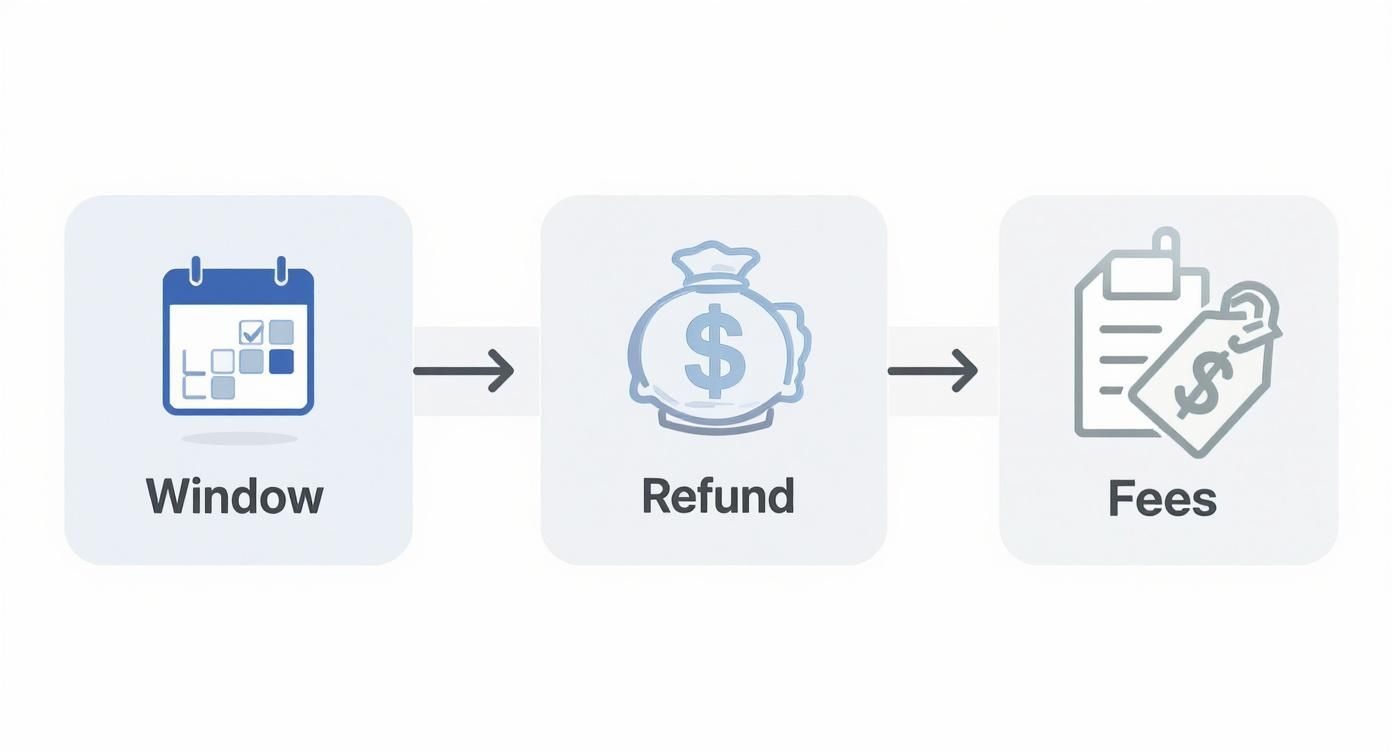
Each element—the timeframe, the refund method, and any fees—builds on the last to create a policy that’s easy for you to manage and simple for your customers to understand.
Choosing The Right Template For Your Store
Not sure which template is the right fit? This table breaks down the key differences to help you decide. It highlights the special clauses and considerations we’ve baked into each one, so you can pick the best foundation for your specific business.
Which Cancellation Policy Template Should You Use?
| Feature / Clause | General eCommerce (Shopify/WooCommerce) | Dropshipping Business | Service-Based Business |
|---|---|---|---|
| Cancellation Window | Before order has shipped | Within a short, fixed window (e.g., 2 hours) | A set number of hours before appointment (e.g., 48 hours) |
| Key Condition | Based on fulfillment status (unshipped vs. shipped) | Based on time passed since order was placed | Based on advance notice given |
| Supplier Clause | N/A | Yes, addresses supplier processing and delays | N/A |
| Special Fees | No cancellation fees; handled under return policy | No cancellation fees, but strict time limit | Yes, includes fees for late cancellations and no-shows |
| Ideal For | Stores managing their own inventory | Stores using third-party suppliers for fulfillment | Coaches, consultants, digital service providers |
Once you've pinpointed the best starting point, you can grab the corresponding template below and begin tailoring it to your brand.
General eCommerce Policy Template (Shopify/WooCommerce)
This is your go-to template if you're running a standard online store on a platform like Shopify or WooCommerce and handle your own inventory. It strikes a great balance between being fair to your customers and protecting your operations. The line in the sand is clear: they can cancel right up until you’ve shipped the order.
Cancellation Policy
You may cancel your order for a full refund at any time before your order has shipped.
To cancel your order, please contact our customer support team at [Your Email Address] with your order number. We will process your cancellation and issue a full refund to your original payment method within 3-5 business days.
Once an order has been shipped, it is no longer eligible for cancellation. At that point, it falls under our Return Policy. You may return the item once you receive it by following the instructions on our Returns & Exchanges page.
Please Note: Custom-made items and "Final Sale" products cannot be canceled once the order is placed.
What works so well here is its simplicity. It's direct, easy for customers to grasp, and cuts down on the back-and-forth that can lead to disputes.
Dropshipping Business Policy Template
Dropshipping is a different beast entirely. Your biggest variable is the supplier. Once you send an order their way, you often lose control. This template is intentionally more restrictive to reflect that reality, protecting you from situations where you physically can’t stop a package from going out the door.
Cancellation Policy
We offer a brief window to cancel your order before it is processed by our supplier. You may request a cancellation within 2 hours of placing your order.
To request a cancellation, please contact us immediately at [Your Email Address] with "URGENT CANCELLATION" and your order number in the subject line. While we will do our best to accommodate your request, we cannot guarantee cancellation after this 2-hour window, as the order may have already been forwarded to our supplier for fulfillment.
If we are unable to cancel your order, you will need to wait for the item to be delivered and then proceed with a return according to our Return Policy.
Supplier Delays: Please be aware that we are not responsible for order processing delays caused by our suppliers.
This language is all about managing expectations. It clearly communicates the urgency and explains why the window is so short. If you're looking for more inspiration, it can be helpful to review a real-world cancellation and refund policy to see how other companies navigate these specific challenges.
Service-Based Business Policy Template
If you're selling your time or expertise—think coaching, consulting, or digital workshops—your policy needs to focus on protecting your schedule. This template is built to address the most common headaches for service providers: last-minute cancellations, rescheduling requests, and no-shows.
Cancellation & Rescheduling Policy
We understand that plans can change. To cancel or reschedule your appointment, please provide at least 48 hours' notice before your scheduled session.
- Cancellations with 48+ hours' notice: You will receive a full refund or may apply the credit to a future session.
- Cancellations with less than 48 hours' notice: You will be charged 50% of the session fee.
- No-Shows: If you miss your appointment without prior notice, you will be charged the full session fee.
To reschedule, please use the link in your confirmation email or contact us at [Your Email Address]. We allow one complimentary reschedule per booking, provided it is made at least 48 hours in advance.
This structure creates a fair system that respects both your time and your client’s. More importantly, it establishes clear financial consequences for no-shows and late changes, which is one of the biggest pain points for anyone selling a service.
How to Adapt Your Policy for Real-World Scenarios
A good cancellation policy sample is the perfect foundation, but the real world is messy. Customers will find exceptions and scenarios you never dreamed of, from trying to cancel an order minutes after it ships to dealing with situations completely out of your control. This is where a rigid, copy-paste policy can fail you.
The secret is to build a framework that’s both firm and flexible. Your policy needs to be a living document, not something you set and forget. It should anticipate common headaches and give you clear guidelines, protecting your business while showing customers that you're reasonable and fair—a huge factor in building loyalty.
Handling Cancellations After an Item Has Shipped
This is probably one of the most common—and frustrating—scenarios you'll face. A customer places an order, you quickly pack and ship it, and then the cancellation request hits your inbox. At this point, the order status has moved past a simple cancellation. Our guide on what pending fulfillment means explains this transition in detail, but it can be a confusing moment for the customer.
It’s absolutely crucial that your policy makes a sharp distinction between a cancellation (before shipment) and a return (after shipment).
Use clear, direct language. No jargon.
"Once an order has been shipped and a tracking number has been issued, it is no longer eligible for cancellation. If you have changed your mind, you will need to follow our standard return process once the item is delivered."
This single sentence reframes the situation for the customer. It's not a refusal; it's a redirection to the correct procedure. This simple clarification can prevent countless disputes and chargebacks by setting a clear, logical boundary.
Setting Fair and Transparent Restocking Fees
Let's be honest: restocking fees can be a sensitive topic. If handled poorly, they feel punitive and can tick off customers. But they serve a legitimate purpose by helping you recoup real costs from a return, like labor for inspection, new packaging materials, and payment processing fees that you don't get back.
The key to implementing them successfully is transparency and justification. Don't just slap a fee on and call it a day.
- Be Specific About the Cost: State the fee clearly, either as a flat rate or a percentage (e.g., 15% of the item's price). No surprises.
- Explain the 'Why': Briefly explain what the fee covers. For example: "A restocking fee helps us cover the costs of processing returns, including inspecting the item, repackaging, and returning it to our inventory."
- Define When It Applies: Clearly state which returns are subject to the fee, like non-defective items or opened products.
This approach turns a potentially negative policy into a reasonable business practice that most customers will understand.
Managing Pre-Orders and Custom Items
Pre-orders and custom-made products are a different beast entirely. They operate on unique timelines and often involve upfront costs on your end. Your standard cancellation policy just won't cut it here. You need a specific clause that addresses their unique nature.
For pre-orders, you might offer a full refund up to a certain date before the expected ship date. After that, you could switch to store credit only. For custom items, the window for a full refund is often extremely short—sometimes just a few hours—before production begins.
Example Wording: "For all custom-engraved orders, cancellations are only accepted within 6 hours of purchase. After this period, the order is sent to production and cannot be reversed or refunded."
This kind of specific language protects you from losing money on materials and labor for an order a customer decides they no longer want.
Addressing Force Majeure and External Events
Sometimes, things happen that are entirely outside of anyone's control. These "force majeure" events can include natural disasters, postal strikes, or widespread transportation meltdowns. The global aviation industry, for example, saw major disruptions in the first half of 2025, affecting nearly 25% of passengers worldwide. One study noted Europe alone had 80.4 million travelers impacted by flight issues, creating a massive ripple effect on deliveries.
Your policy should include a clause that addresses these situations. It doesn't need to be filled with legalese. Something simple like this works well:
"We are not liable for delays or cancellations due to circumstances beyond our control, such as natural disasters, severe weather, or carrier-related disruptions. We will, however, work with you to find a reasonable solution."
This manages your liability while still showing customers that you're on their side. When a policy needs to be enforced or an agreement terminated due to such issues, the legal framework becomes important. For a deeper understanding of the legal processes involved, this guide to contract dissolution is a valuable resource.
Building these real-world scenarios into your policy transforms it from a generic document into a practical tool for running your business smoothly.
Making Sure Your Cancellation Policy Is Seen—And That It Sticks

You’ve put in the work to craft a solid cancellation policy. That’s great, but it’s only half the job. If your customers can't easily find it, it might as well not exist. A policy buried in the depths of your website won't do you any good in a dispute and is a surefire way to create frustrated customers.
The key is to be transparent and direct. And no, you don't need a law degree. In fact, you should do the opposite—strip out all the dense, confusing legal jargon. Your policy needs to be written in plain English that anyone can understand in a minute or less. When it comes to preventing misunderstandings, clarity is your best friend.
Where to Post Your Policy for Everyone to See
Where you put your cancellation policy matters just as much as what's in it. You have to place it in the high-traffic spots where customers naturally look for information. Hiding it away is a fast track to losing a chargeback dispute.
Here are the absolute must-have locations for your policy link:
- Your Website Footer: This one's a no-brainer. Shoppers are trained to scroll to the bottom of a site for key links like "About Us," "Contact," and, yes, your policies.
- Product Pages: This is a smart, proactive move. Placing a link right next to the "Add to Cart" button gives people a chance to review your terms before they even think about buying.
- FAQ Page: Simply add a question like, "What's your cancellation policy?" and provide a straightforward answer with a link to the full document.
By putting the policy in multiple, logical places, you make it almost impossible for a customer to argue they "never saw it."
Making It Legally Binding
Visibility is one thing, but getting customers to actually agree to your terms is what makes the policy enforceable. This is where your checkout process becomes your most critical line of defense. You need undeniable proof that the shopper saw and accepted your rules before handing over their money.
The best way to do this? A simple clickwrap agreement. This is just a fancy term for an unticked checkbox next to a statement like, "I have read and agree to the Terms of Service and Cancellation Policy."
My Two Cents: Don't pre-check the box. Requiring customers to physically click it themselves before the "Pay Now" button works creates a concrete, legally recognized record of their consent. I've seen this tiny detail be the deciding factor that wins a payment dispute.
Keep in mind that business conditions change, and your policies might have to change, too. For example, a 2025 Global Business Travel Association survey revealed that nearly 29% of travel pros expect a major decline in business travel, partly due to new government rules. You can read the full GBTA poll analysis for more on that. These kinds of external shifts can affect your suppliers and force you to update your terms.
Finally, consistency is everything. Your customer service team needs to know the policy inside and out and apply it evenly to every situation. If you make an exception, document the reason why. Your fulfillment process also ties directly into your cancellation rules, so it's worth taking a look at streamlining your ecommerce order fulfillment to ensure everything aligns. By making your policy visible, clear, and consistently applied, you build a fair and predictable experience that protects your business and earns customer trust.
Got Questions About Your Cancellation Policy?
Even with a rock-solid policy in place, you're bound to run into some tricky situations. Customers have unique circumstances, and sometimes the "right" answer isn't immediately obvious. Let's walk through some of the most common questions we see from store owners.
Think of this as your go-to guide for handling those gray areas. Getting these details straight will give you the confidence to not only post your policy but to enforce it fairly and consistently.
Can I Change My Policy After a Customer Has Ordered?
In a word: no. The policy that matters is the one that was live on your site at the moment the customer clicked "buy." You can't go back and apply a new, stricter rule to an order that's already in the system.
Let's say you currently give customers a full 24 hours to cancel. Someone places an order, and a few hours later you decide to tighten things up and change your policy to a 2-hour window. That new rule doesn't apply to the existing order—the customer still has the full 24 hours they agreed to when they checked out.
My Advice: Always save dated versions of your policies. If a dispute ever comes up, you'll have a clear record of what rules were in effect on a specific date. It’s a simple step that can save you a massive headache.
What if a Customer Abuses the Policy?
This is a tough one, but it happens. You might notice a customer who constantly orders and cancels, which can cost you real money in payment processing fees and wasted time. While you have to honor your policy for each transaction they make, you are not obligated to do business with them forever.
If you spot a clear pattern of abuse, you have the right to refuse service. You can simply cancel any future orders they place, issue an immediate refund, and move on. It’s a good idea to send them a polite but firm email explaining that due to their history of cancellations, you can no longer fulfill their orders. This protects your business from getting stuck in a costly loop.
How Should I Handle Exceptions?
Life happens. Sometimes a customer will have a legitimate, heartbreaking reason for needing to cancel late—a sudden family emergency or a medical issue. In those moments, sticking rigidly to your 24-hour rule can feel cold and do more harm than good.
This is where a little human compassion can make all the difference. Decide ahead of time what your absolute non-negotiables are, but give yourself (or your customer service team) the power to bend the rules. Waiving a restocking fee or offering store credit when your policy technically says "no refund" can turn a bad situation into a story of incredible customer service. That kind of goodwill is priceless and often creates a customer for life.
Is It Better to Offer Store Credit or a Refund?
This really comes down to your business model, cash flow, and what you’re trying to achieve.
- Refunds: This is the gold standard and what most customers expect. Offering a clean, no-fuss refund for cancellations that follow your rules is the simplest way to build trust.
- Store Credit: This is a brilliant option for those "just-missed-the-window" cancellations. It keeps the money in your business and gives the customer a great reason to come back and buy something else. You essentially get a second chance to make that sale.
A popular strategy is to use a tiered approach. Offer full refunds for quick cancellations, but switch to store credit for requests that come in a little later. It’s a fair compromise that protects your bottom line while still giving the customer a good outcome.
When you're sourcing from AliExpress, every minute counts. Manually saving product photos and videos is a slow, frustrating process that kills your momentum. With AliSave Pro, you can download all high-resolution product media—including variant images and video—in a single click. Stop wasting time and start building your store faster. Get the free Chrome extension at https://alisavepro.com.