
Your email list is one of the only marketing channels you truly own. It’s a direct line to your customers, free from the whims of social media algorithms. But to make it a real asset for your store, you need to build it on a solid foundation.
This isn't just about picking a tool and slapping a signup form on your site. It’s about making smart choices from the get-go that will pay off for years to come. Think of it like this: you wouldn't build a house on shaky ground, right? The same logic applies here.
We'll break down the two most important parts of that foundation: choosing the right email platform for your specific needs and making sure you're playing by the rules legally. Get these right, and you're setting yourself up for sustainable growth and a list full of engaged, happy customers.
Choose Your Email Service Provider (ESP) Wisely
Your Email Service Provider (ESP) is the command center for your entire email operation. It's tempting to grab the cheapest or most well-known option and call it a day, but that's a classic rookie mistake. The best ESP for you depends entirely on what you're selling and where you want to go.
For instance, a platform like Mailchimp is fantastic when you're just starting out. It's user-friendly and gets the job done for simple newsletters. But a growing ecommerce or dropshipping store will hit its limits fast.
That's where a more specialized tool like Klaviyo comes in. It's built from the ground up for ecommerce, integrating deeply with platforms like Shopify. This allows for incredibly powerful segmentation based on actual customer behavior—think "people who bought this specific sneaker but haven't bought the matching socks yet." That kind of targeting is pure gold and a major factor in driving up your store's sales over time, which you can learn more about at https://alisavepro.com/how-to-improve-ecommerce-conversion-rates/.
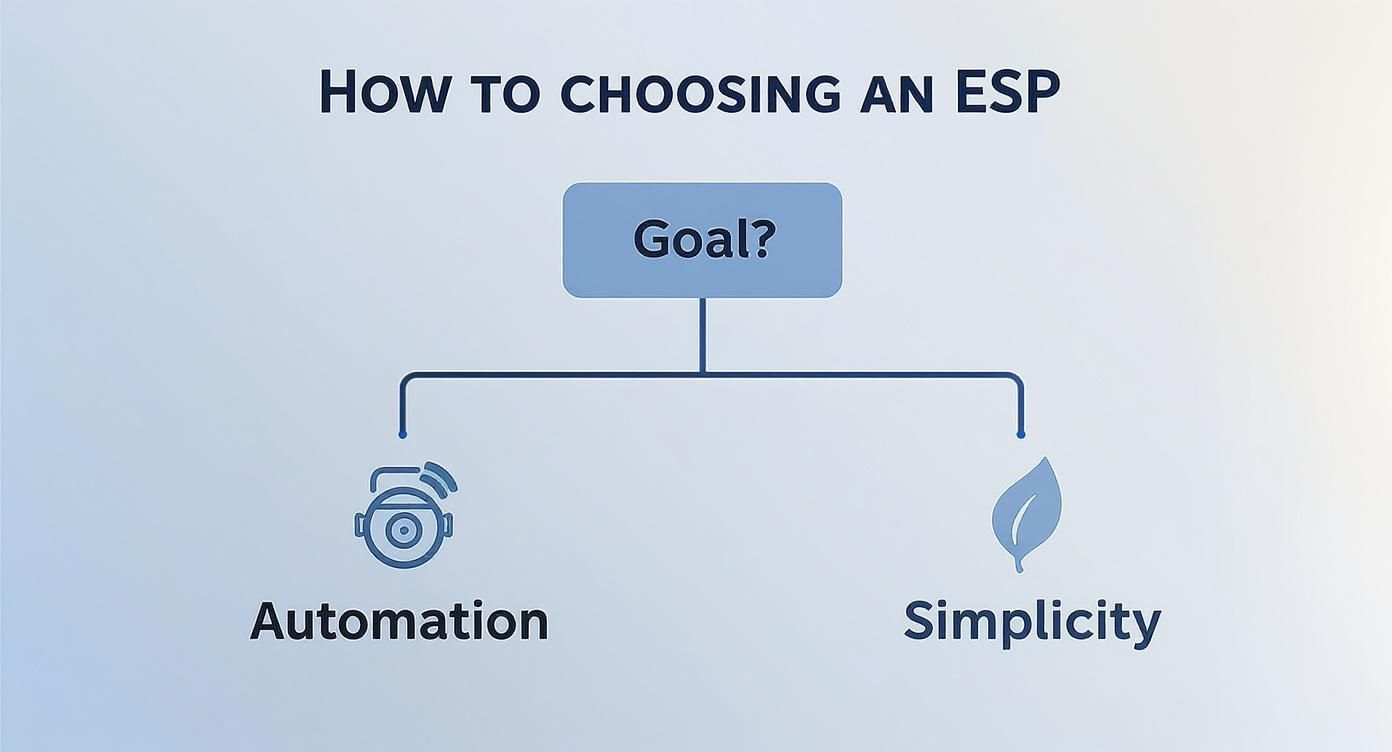
The infographic above really simplifies it. If your game plan involves sophisticated, behavior-based campaigns, you need a platform built for automation. If you're keeping it simple for now, a more straightforward tool will do just fine. For a deeper dive into these strategic choices, this comprehensive email marketing and lead generation guide is a fantastic resource.
Comparing Popular Email Service Providers for Ecommerce
To help you decide, here’s a quick-glance comparison of top ESPs to help you choose the best fit based on key features, pricing models, and primary use cases for dropshipping and ecommerce stores.
| ESP Name | Best For | Key Ecommerce Features | Pricing Model |
|---|---|---|---|
| Klaviyo | Data-driven ecommerce stores and serious dropshippers. | Advanced segmentation, predictive analytics, deep Shopify/BigCommerce integration. | Based on contact/profile count. |
| Omnisend | Ecommerce brands that want powerful automation without the complexity. | Visual automation builder, SMS & push notifications, pre-built workflows. | Tiers based on features and contacts. |
| Mailchimp | Beginners and content-focused businesses just starting out. | Simple interface, good for basic newsletters, some basic ecommerce features. | Freemium, then tiers by contacts. |
| Brevo | All-in-one solution for businesses needing more than just email. | Email, SMS, live chat, CRM, landing pages, all in one platform. | Tiers based on email volume. |
Each of these platforms can get the job done, but the right one will feel like a natural extension of your business, not a tool you have to fight with.
Understand Your Legal and Compliance Duties
This part might sound boring, but I promise you, it's critical. Getting a handle on laws like GDPR (for the EU) and the CAN-SPAM Act (for the US) is absolutely non-negotiable. These aren't just annoying rules; they're about protecting people's privacy and creating a more trustworthy online space.
Ignoring them can lead to massive fines, but even worse, it can completely tank your brand's reputation.
Key Takeaway: Compliance isn't about avoiding a penalty. It's about building a brand that people actually trust. An email list built on clear, enthusiastic consent will always crush one built on sneaky tactics.
So, what does this look like in the real world?
- Explicit Consent is King: You need someone to actively say "yes" to your marketing. No more pre-checked boxes or tricky language. They have to know what they're signing up for.
- Make Unsubscribing Easy: Every single marketing email must have a clear, one-click way to opt out. Don't hide the link or make them jump through hoops.
- Say Who You Are: Your emails need to clearly identify your business and include a valid physical address. It’s about transparency.
With an estimated 4.6 billion email users worldwide by 2025, the opportunity is huge. We also know that automated emails can see open rates as high as 42.1%. But that scale means inboxes are more crowded and regulated than ever. You have to earn your place there by being honest and valuable.
Create Lead Magnets People Actually Want
Let’s be real for a second. Another generic "10% off your first order" popup just isn't going to cut it if you want to build an email list full of genuinely enthusiastic fans. Sure, discounts have their place, but relying on them alone tends to attract one-time bargain hunters, not the loyal customers who will champion your brand.
The real secret to building a killer email list is creating genuine value. You need to offer something that makes a visitor excited to give you their email address. We're talking about moving beyond simple discounts and into the realm of actually solving your customers' problems. Your goal is to provide something so useful, insightful, or exclusive that a visitor feels like they're getting an absolute steal. This simple shift changes the whole dynamic—you're no longer just a store, you're a trusted expert.
Thinking Beyond the Coupon
The most powerful lead magnets feel like they were made specifically for your audience and the products you sell. They show off your expertise in your niche and help guide a customer along their buying journey before they've even spent a dime. This is your chance to really stand out.
Instead of another tired discount, think about high-value alternatives like these:
- Exclusive Buyer's Guides: Selling specialty coffee gear? Offer a downloadable PDF on "The Ultimate Guide to Brewing the Perfect Pour-Over." It instantly positions you as an authority and provides huge value.
- Style Guides or Lookbooks: If you're in fashion or home decor, a "Seasonal Lookbook" showing how to style your new arrivals is incredibly powerful. It sparks inspiration and helps customers see your products in their own lives.
- Interactive Quizzes: A quiz like "What's Your Perfect Skincare Routine?" is a fun, engaging way to get an email. Plus, you get valuable data to personalize your marketing later on.
- Checklists and Planners: For a store selling travel accessories, a "Printable Ultimate Packing Checklist" is a practical tool your audience will actually use again and again, keeping your brand front and center.
This is where your product media becomes a secret weapon. When you use a tool like AliSave Pro to download crisp, clean product photos and videos from AliExpress, you can fill these guides and lookbooks with stunning visuals. It's what makes your offer truly irresistible.
A Real-World Dropshipping Example
I worked with a dropshipping store that sold unique, bohemian-style jewelry. Their first attempt at a lead magnet was the classic 10% off coupon, and their signup rate was stuck at a dismal 1.5%. They had traffic, but no one was biting.
We decided to ditch the discount and create a "Boho Chic Summer Style Guide." Using the best lifestyle and product photos they could get their hands on, we designed a beautiful, 10-page PDF that showed customers how to layer their necklaces, pair bracelets, and match earrings with different summer outfits. It wasn't just a catalog; it was pure inspiration.
The results were immediate and frankly, staggering.
We pushed the style guide live in an exit-intent popup and a banner on the homepage. Within the first month, their email signup rate shot up to over 6%—that's a 300% increase. But here's the kicker: the subscribers who came from the guide had a 25% higher open rate on the welcome emails than the old discount-seekers ever did.
This story proves a crucial point: when you solve a customer's problem (in this case, "how do I style this?"), you attract a much more engaged and valuable subscriber from day one.
How to Create Your Own High-Converting Lead Magnet
Ready to build your own? The process is a lot more straightforward than you might think. You're not writing a novel; you're providing a quick, valuable solution.
- Pinpoint a Core Customer Problem: What's the biggest question or challenge your customers face that relates to your products? Do they struggle with picking the right size, using the product correctly, or matching it with other items?
- Pick the Right Format: Based on the problem, what's the best way to solve it? A visual guide (like a PDF lookbook)? A step-by-step checklist? An exclusive video tutorial? Maybe even early access to a new product drop?
- Gather Your Best Visuals: For an ecommerce store, this is non-negotiable. Use high-resolution product photos, user-generated content, or even short video clips. You want your lead magnet to look professional and appealing. Don't let bad images sink a great idea.
- Write Clear, Punchy Copy: Focus on the benefits. Instead of "Download Our Guide," try "Get Your Free Guide to Flawless Summer Style." Keep your language simple, benefit-driven, and straight to the point.
Creating a lead magnet that people actually want is your first and best chance to prove your emails are worth reading. It sets the tone for your entire relationship with a new subscriber, turning a passive browser into an engaged fan who sees you as a go-to resource, not just another online store.
Design Opt-In Forms That Actually Convert Visitors
So you’ve created an amazing lead magnet. That's a huge win, but it's completely useless if nobody sees the offer or if signing up feels like a chore. This is where your signup forms come in—they are the bridge between your website visitors and your valuable content.
The goal here is to design and place these forms so they feel like a natural, helpful part of the shopping experience, not an annoying interruption.
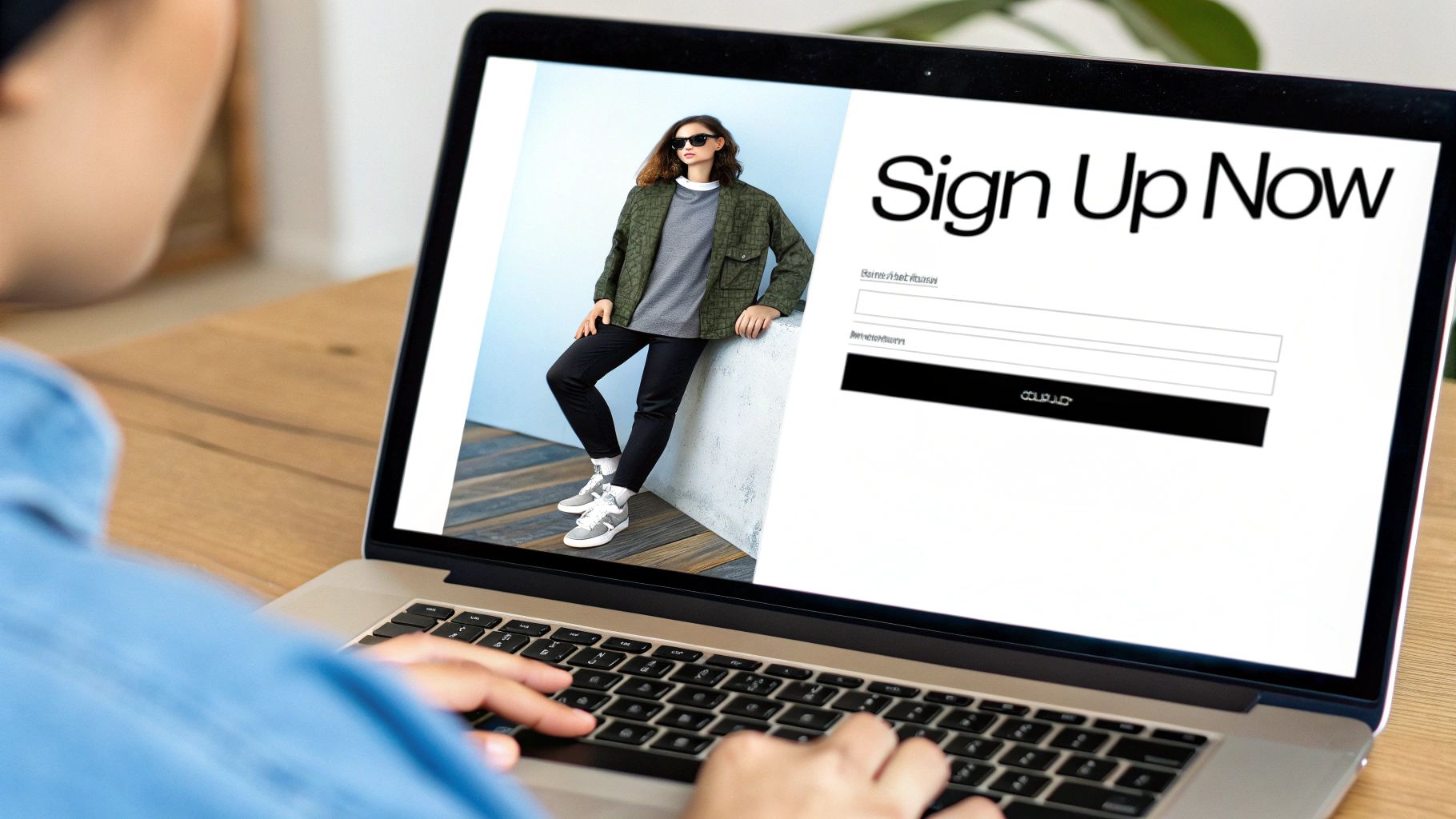
You need to remove every single ounce of friction. Make signing up such an effortless and obvious decision that visitors don't even have to think twice. This means being smart about where you place your forms and what you ask of potential subscribers.
Choosing the Right Form Type
Not all opt-in forms are created equal. The right one depends entirely on the user’s context and what you’re trying to achieve. Honestly, the most effective approach is to mix and match different types across your site to capture emails without wrecking the user's journey.
- Exit-Intent Popups: These are the MVPs for catching visitors who are about to leave. They only trigger when a user’s cursor moves toward the top of the browser, signaling they're heading for the exit. This makes them far less intrusive than an immediate popup and gives you one last shot to make an irresistible offer.
- Embedded Forms: Placing a simple, clean form right inside a blog post or at the bottom of your homepage is a fantastic, low-pressure way to capture engaged readers. If someone is already deep into your content, they’re clearly interested in what you have to say.
- Slide-In Boxes: A slide-in that appears in the bottom corner after a user has scrolled down a bit is a great middle ground. It gets noticed without taking over the entire screen.
The key is to think about the user’s mindset at each point. An exit-intent popup can be more direct with its offer, while an embedded form should feel like a natural extension of the content it's sitting in.
My Experience: One of the biggest wins I've seen came from a simple A/B test on an exit-intent popup. We tested "Get 15% Off" versus "Get Our Free Style Guide." The style guide popup converted 40% better because it offered genuine value and expertise, not just a discount.
Principles of High-Converting Form Design
Once you’ve picked the right types of forms, the design itself is the next hurdle. A clunky, poorly designed form can absolutely kill your conversions, even with a killer offer. The same principles that make for good ecommerce website design apply here—clarity and focus are everything.
Your form needs a single, clear purpose. Don't clutter it with social media links, multiple offers, or a dozen unnecessary fields. Every single element should guide the user toward one simple action: signing up.
Here are the core components you have to nail:
- A Compelling Headline: Don't just say "Subscribe to Our Newsletter." That's boring. Focus on the benefit. Use action-oriented language like "Unlock Your Exclusive Style Guide" or "Get VIP Access to New Arrivals."
- Minimal Form Fields: Every extra field you ask for is another reason for someone to give up. For most lead magnets, an email address is all you truly need. You can ask for a first name if you're serious about personalizing your emails, but anything more will cause a significant drop-off.
- A Striking Call-to-Action (CTA): Your button copy needs to be specific and exciting. Ditch the generic "Submit" and go for something that reinforces the value, like "Send My Guide!" or "I Want In!" Make the button a contrasting color so it pops off the page.
- Stunning Product Imagery: This is a total game-changer for ecommerce stores. Include a high-quality lifestyle photo or a crisp product shot that visually represents your brand or the lead magnet itself. If you’re offering a lookbook, show a sneak peek of the cover. This grabs attention and makes your offer feel more tangible and real.
When your strategy is on point, achieving a 10% conversion rate on your signup forms is an entirely realistic goal. This is also why you should never, ever purchase an email list—blasting unsolicited contacts will destroy your sender reputation and get you blacklisted.
Ultimately, designing effective opt-in forms is an exercise in empathy. Figure out what your visitor wants, make your offer crystal clear, and then make it incredibly easy for them to say "yes."
Automate Your Welcome and Nurture Funnels
The moment someone trusts you with their email address is your single biggest opportunity to make a lasting impression. Their interest is at its absolute peak, and if you don't act on it immediately, you're leaving money on the table. This is where automation becomes your secret weapon, turning a fresh signup into a loyal customer while you're busy running the rest of your business.
A well-crafted automated sequence does way more than just send out the lead magnet they signed up for. It’s a strategic conversation—a series of messages designed to introduce your brand, build real trust, and gently guide that subscriber toward their first purchase. After getting a visitor to sign up, it’s critical to have effective strategies for following up with new sign-ups in place, which is the very foundation of these welcome and nurture funnels.
The Anatomy of a High-Impact Welcome Series
Your welcome series is, without a doubt, the most important automation you will ever build. Think about it: subscribers are actively expecting to hear from you, which is why these emails see sky-high engagement rates. Your job is to meet that expectation with value, personality, and a clear path forward.
A solid welcome series for an e-commerce store isn't a one-and-done email; it's a conversation that unfolds over several days.
Here’s a proven framework you can steal and adapt for your own store:
- Email 1 (Sent Immediately): Deliver the Goods. This first email has one job: deliver what you promised. Make the discount code or download link big, bold, and impossible to miss. Follow it up with a quick, warm welcome and a hint of what they can expect from you next.
- Email 2 (Day 2): Tell Your Brand Story. People connect with stories, not just products. This is your chance to share your "why." Why did you start this store? What problem are you solving? This is how you build a human connection that the faceless retail giants can't touch.
- Email 3 (Day 4): Showcase Social Proof and Best-Sellers. Now it’s time to build confidence. Feature your top-rated products right alongside glowing customer reviews or user-generated photos. Seeing that other people love your stuff is often the final nudge someone needs to make their first purchase.
This carefully paced sequence is designed to move a subscriber from casual interest to genuine trust, making them far more likely to click "buy." It’s the engine that turns an email list into a revenue-generating machine.
Sample 5-Day Ecommerce Welcome Sequence
To give you a clearer picture, here’s a template outlining the goal, content, and timing for a high-impact welcome automation.
| Day | Email Goal | Content Focus | Call to Action |
|---|---|---|---|
| 1 | Deliver & Welcome | Deliver lead magnet, quick brand welcome, set expectations. | Download Your Guide |
| 2 | Build Connection | Share the founder's story or the brand's mission. | Read Our Story |
| 3 | Drive First Purchase | Offer a special "new subscriber" discount on best-sellers. | Shop Best-Sellers |
| 4 | Establish Authority | Share valuable content (blog post, how-to guide, video). | Learn More |
| 5 | Create Urgency | Send a final reminder that their welcome offer is expiring. | Claim Your Offer |
This is a great starting point you can tweak based on your brand and audience.
Pro Tip: Inject high-quality product media into every single email. Use crisp photos and even short GIFs you've downloaded with a tool like AliSave Pro to make your products look irresistible. In a crowded inbox, great visuals sell far better than text alone.
Beyond the Welcome: Nurturing Your List for the Long Haul
So, the welcome series is over. Now what? Your job isn't done. You need a plan to keep your list engaged so they don’t forget you exist. This is where simpler, ongoing nurture automations take over. These aren't complex sales funnels; they're relationship-builders.
Consider setting up a few of these key automations to run in the background:
- Post-Purchase Follow-Up: After someone's first purchase, automatically send an email asking for a review or offering tips on how to get the most out of their new product. It shows you care about their experience, not just the sale.
- Happy Birthday Email: If you collect birth dates during signup, a simple automated email with a small discount is a fantastic personal touch that drives easy repeat business.
- Abandoned Cart Sequence: This is non-negotiable for any e-commerce store. An automated series of emails reminding customers about items left in their cart can recover a huge amount of otherwise lost revenue. If you're stuck, these abandoned cart email examples are a great source of inspiration.
By automating these key touchpoints, you create a system that builds relationships and drives sales 24/7. It’s the engine that turns your email list from a simple collection of contacts into a predictable, hands-off revenue stream for your store.
Track Your Growth and Maintain List Health
Getting that email list built is a huge win, but let's be real—the work has just begun. A massive list full of people who ignore your emails is nothing more than a vanity metric. What you're actually after is a smaller, highly engaged list, because that is a profitable asset.
The difference between successful stores and those just shouting into the void comes down to the ongoing work of tracking your data and keeping your list healthy.
This isn't just about spring cleaning. It’s about protecting one of your most valuable marketing channels. Internet Service Providers (ISPs) like Gmail and Outlook are always watching how people interact with your emails. If you consistently send to subscribers who never open them, you’re slowly eroding your sender reputation. Before you know it, your emails start landing directly in the spam folder, even for the people who want to see them.
Key Metrics You Must Monitor
To get a real feel for what's going on, you have to look past the total subscriber count. Your Email Service Provider's dashboard is a goldmine of data, but you can get the full story by focusing on just a few key metrics.
Here's what I always keep my eye on:
- Open Rate: This is the percentage of people who actually opened a specific email. It's your first and best indicator of whether your subject lines are working and if people recognize your brand in a crowded inbox.
- Click-Through Rate (CTR): Of the people who opened your email, what percentage clicked on a link? Your CTR tells you if your offer and call-to-action were strong enough to get someone to take the next step.
- Bounce Rate: This tracks the emails that never even made it to the inbox. A hard bounce is a permanent failure (like a fake or deleted email address), while a soft bounce is usually a temporary problem, like a full inbox.
- Unsubscribe Rate: The percentage of people who opt out after getting an email. A few unsubscribes are perfectly normal, but a sudden spike is a massive red flag that something's off with your content or sending frequency.
Watching these numbers over time helps you spot trends. Is your open rate slipping? Maybe it's time to freshen up your subject lines. CTR in the basement? Your offers probably aren't hitting the mark. This data isn't just for show; it's direct feedback from your audience.
The Power of Proactive List Hygiene
List hygiene is just a fancy term for cleaning your email list by getting rid of inactive subscribers and invalid addresses. I know, it feels completely backward to shrink the list you worked so hard to grow, but trust me, it's one of the most critical things you can do for long-term success.
A clean list means:
- Better deliverability and a much stronger sender reputation.
- More accurate data on how your engaged subscribers are behaving.
- Lower costs, since most ESPs charge you based on how many contacts you have.
Don't forget why this matters so much—email marketing is a beast. For every £1 you put in, the return can be as high as £42. And when you use segmentation and personalization, you can see open rates jump by 29% and click-throughs by 41%. A clean, engaged list is your ticket to unlocking that kind of ROI. You can discover more insights about these email marketing statistics and how they translate to real-world results.
Running a Re-Engagement Campaign
Before you hit delete on a subscriber, it's always worth trying to win them back with a re-engagement campaign (sometimes called a "win-back campaign"). This is just a short, automated sequence of emails you send to people who haven't opened or clicked anything in a while—say, 90 or 120 days.
The goal isn't just to say, "Hey, we miss you!" It’s to give them a compelling reason to stick around.
A simple, effective re-engagement flow might look like this:
- Email 1: The Gentle Nudge. Start with a subject line like, "Still interested in [Your Niche]?" In the email, remind them what they're missing and maybe link to some of your most popular content or a best-selling product category.
- Email 2: The Can't-Miss Offer. If they don't bite, hit them with your best shot a few days later. This is where you pull out the big guns—a deep discount, a free gift with their next purchase, or early access to a new drop. Frame it as a special offer just for them.
- Email 3: The Last Call. For anyone who still hasn't responded, it's time for the goodbye email. Be upfront. "We're cleaning up our mailing list and noticed you haven't opened an email in a while. To avoid cluttering your inbox, we'll be removing you soon unless you click here to stay."
If a subscriber ignores all three of those emails, you can remove them with confidence. You gave them a fair chance. This proactive culling process ensures your list is packed with people who actually want to hear from you, which makes every single campaign you send that much more powerful.
Common Questions About Ecommerce List Building
As you dive into building your email list, it's natural for questions to pop up. It’s easy to get bogged down in the "what ifs" instead of just getting started. Let's cut through the noise and give you some clear, practical answers to the most common hang-ups I see ecommerce owners face.

This isn't about getting everything perfect from the jump. It's about making consistent progress. Let's tackle those questions that keep you from moving forward.
How Many Emails Do I Need Before Sending Campaigns?
You should start the second you get your first subscriber. Seriously. Don't wait for some arbitrary number.
The single most important thing to have ready is your automated welcome series. This automation should fire off the moment someone signs up, delivering whatever you promised them and starting the conversation while your brand is fresh in their mind.
For one-off campaigns like weekly newsletters or a holiday sale, a good benchmark to aim for is 50-100 subscribers. At that point, you have a small but real audience to talk to. The goal is to build the habit of sending consistently, not to wait for a massive list.
What Is the Best Lead Magnet for a Dropshipping Store?
The best lead magnets solve a problem that's directly tied to what you sell. Discounts are the easy way out, but they tend to attract bargain hunters who will buy once and unsubscribe immediately.
Instead, think about how you can offer genuine expertise. This positions you as an authority and pulls in customers who care about more than just the price tag.
Key Insight: Value-based lead magnets attract higher-quality subscribers. A customer who downloads a "Buyer's Guide" is showing far more interest in your niche than someone who just grabs a 10% off code.
Try some of these more powerful ideas:
- A "First-Time Buyer's Guide" to help new customers feel confident choosing the right product in your category.
- A "Top 10 Bestsellers Lookbook" showcasing your most popular items with stunning, high-quality product photos in real-world settings.
- A printable checklist that helps a customer pick the right size, model, or accessory for their specific need.
How Often Should I Email My Ecommerce List?
For most online stores, sending one to two emails per week hits the sweet spot. It's frequent enough to keep your brand top-of-mind but not so often that people start getting annoyed and hitting unsubscribe.
A good mix is usually best. Maybe you send one promotional email each week—announcing a sale or a new arrival—and one that's pure value, like a new blog post, styling tips, or a behind-the-scenes story.
Ultimately, your audience will give you the answer. Keep a close eye on your open rates and unsubscribe numbers. If engagement starts to dip, you might be sending a little too often. If sales are strong and unsubscribes are low, you’ve found your rhythm.
Ready to create stunning visuals for your lead magnets, ads, and product pages? AliSave Pro is the go-to tool for dropshippers, letting you download high-resolution AliExpress product images and videos in just one click. Clean up your workflow and build a more beautiful brand today—you can download it for free from alisavepro.com.