
It's a story I hear all the time. Your ad dashboard is glowing with a positive ROAS, but when you check your bank account, the numbers just don't add up. You're left wondering where the money is going. The answer lies in a single, critical metric: your break-even ROAS.
This isn't just another piece of data; it's the specific point where your ad-generated revenue perfectly covers both the cost of the ad and the cost of the product you just sold. Anything above this number is profit. Anything below is a loss.
Why Your ROAS Looks Good But Your Bank Account Doesn't
It’s easy to get caught up in the numbers staring back at you from your Facebook or Google Ads dashboard. Seeing a 2.5x ROAS feels like a win, right? It looks like you're making $2.50 for every $1.00 you spend on ads. But here's the catch: that platform metric is incredibly simplistic. It only compares ad spend to total revenue, ignoring a huge chunk of your actual costs.
This is exactly where profit disappears into thin air. That seemingly healthy 2.5x ROAS doesn't account for the real-world expenses that hit your bottom line on every single order.
Think about it. The platform ignores:
- The actual cost of the product you sold (your COGS)
- Shipping and handling fees you have to pay
- Payment processing fees from Stripe or PayPal
- Any taxes or import duties involved
Once you start subtracting these unavoidable costs, that "profitable" campaign can suddenly reveal itself as a money pit.
The True Measure of Ad Profitability
This is precisely why knowing your break-even ROAS is non-negotiable. It forces you to look past the vanity metrics and focus on the number that actually determines your profitability. This isn't some generic benchmark you find online; it's a unique figure you have to calculate for each product, based on its specific costs and selling price.
Understanding this number is the difference between guessing and knowing. It transforms your ad spend from a mysterious expense into a predictable growth engine, ensuring every dollar you invest has a clear path to profitability.
Flying blind without this calculation is a massive financial risk. One analysis of over 5,000 e-commerce campaigns found that brands who didn't track their break-even points wasted up to 27% of their ad budgets on unprofitable campaigns. To truly understand your financial health, you need complete cash flow clarity, which means getting a handle on both your payables and receivables. This fundamental awareness helps explain why dashboard metrics so often fail to match your bank balance. By taking the time to calculate your break-even ROAS, you build a solid foundation for every advertising decision you make.
Uncovering the Hidden Costs in Your Dropshipping Business

If you want an accurate break-even ROAS, you need to think like a detective. That price you see on AliExpress? It’s just the starting point—the tip of the iceberg. Your real profitability is buried under a pile of small, sneaky expenses that eat away at your margins with every single sale.
So many dropshippers fall into the trap of only using the product cost in their calculations. This is a huge mistake. It gives you a dangerously optimistic break-even number and fools you into thinking your ad campaigns are making money when they're actually bleeding cash. We need to build a rock-solid financial foundation for our ROAS calculation, leaving no room for nasty surprises.
Beyond the Product Sticker Price
The costs that sink most businesses aren't the big, obvious ones. They're the little fees that feel insignificant on their own but add up fast when you're processing hundreds of orders.
Let's spotlight the usual suspects you absolutely have to factor into your cost of goods sold (COGS). These are the non-negotiable costs tied to getting one single order out the door:
- Supplier Shipping Fees: This is what your supplier charges to ship the product directly to your customer. It’s a totally separate cost from the item price and can vary dramatically.
- Payment Processing Fees: Services like Stripe and PayPal take a slice of every transaction. Their fees are typically a percentage plus a fixed amount (like 2.9% + $0.30), which comes directly out of your revenue.
- Currency Conversion Charges: Are you paying your supplier in USD but selling in EUR or AUD? You’re probably losing a small percentage on the currency exchange. Dig into your payment gateway’s reports to find the exact rate.
Don't brush these off as minor details. A $4 shipping fee and a $1 processing fee on a $25 product instantly hike your costs by 20%. That dramatically changes the ROAS you need just to break even.
A Practical Dropshipping Cost Example
Let's walk through a real-world scenario. Imagine you're selling a trendy gadget on your store for $49.99. On the surface, the math seems simple, but the reality is much more complex.
Here’s how quickly those "hidden" costs stack up:
- Advertised Product Cost: $15.00
- Supplier Shipping to Customer: $4.50
- Payment Processing (2.9% + $0.30 on $49.99): $1.75
- Currency Conversion (estimated 1%): $0.15
Suddenly, your cost isn't $15.00. Your true cost per unit is actually $21.40. That $6.40 difference is pure profit erosion. If you're finding these numbers tricky to pin down, it's worth taking a moment to learn more about how to calculate cost per unit properly.
If you ignore these expenses, every decision you make based on your break-even ROAS will be fundamentally flawed. By meticulously tracking these details, you can be confident your calculator is giving you a number you can actually trust to make smart, profitable ad-spending decisions.
Putting The Break-Even ROAS Calculator To Work With Real Examples
Theory is great, but the real magic happens when you start plugging your own numbers into a break-even ROAS calculator. This is where you take back control of your ad spend. It’s time to see how this plays out in the wild with a couple of real-world dropshipping products.
The formula itself is pretty straightforward: Selling Price / (Selling Price – Total COGS). This little equation tells you the exact ROAS you need for an ad to pay for itself and the product it just sold. If you're not already familiar with the basics of how to calculate ROAS, it's worth a quick look, as it's the foundation for what we're doing here.
Let's jump into two very different scenarios to see just how much your costs and margins can swing this number.
Example 1: The Low-Ticket Gadget
First up, let's imagine you're selling a trendy phone accessory. These little gadgets are classic dropshipping fare—low product cost, but the shipping fees can really eat into your margins.
You’re selling this one for $29.99.
Here’s what it costs you to get one to your customer:
- Product Cost: $6.00
- Shipping Fee from Supplier: $5.50
- Payment Processing (2.9% + $0.30): $1.17
First, we need to find your Total COGS (Cost of Goods Sold). Just add up all those per-sale costs: $6.00 + $5.50 + $1.17 = $12.67.
That means your profit before you even think about ad spend is: $29.99 – $12.67 = $17.32.
Now for the main event. Let's plug it all into the formula:
$29.99 / $17.32 = 1.73
For every $1 you put into ads for this gadget, you have to make $1.73 back just to break even. If your Facebook or TikTok ad dashboard shows a ROAS below 1.73x for this campaign, you are officially losing money on every sale.
Example 2: The Higher-Priced Home Decor Item
Let's switch gears to a completely different product: a stylish decorative vase. This item has a higher price tag and, as you'll see, a much healthier profit margin. The advertising math here is a whole different ballgame.
You’ve priced this vase at $79.99.
And here are your costs:
- Product Cost: $22.00
- Shipping Fee from Supplier: $8.00
- Payment Processing (2.9% + $0.30): $2.62
Your Total COGS for the vase comes out to: $22.00 + $8.00 + $2.62 = $32.62.
The profit per sale looks much better here: $79.99 – $32.62 = $47.37.
So, what's the break-even ROAS for this item?
$79.99 / $47.37 = 1.69
Here’s what’s so interesting: even though the vase is way more expensive, its break-even ROAS is actually lower at 1.69x. Why? The profit margin is much stronger. You have a lot more wiggle room with your ad spend on this product compared to the low-ticket gadget.
These examples drive home a critical point: a "good" ROAS is never a universal number. A 1.7x ROAS could be a money-loser for one product but the break-even point for another. You have to run the numbers for every single product you advertise.
Comparing Break-Even ROAS for Different Products
Seeing the numbers side-by-side really highlights how a product's unique costs and selling price dictate its advertising strategy. A one-size-fits-all approach just doesn't work.
| Variable | Product A (Low-Ticket Gadget) | Product B (High-Ticket Decor) |
|---|---|---|
| Selling Price | $29.99 | $79.99 |
| Total COGS | $12.67 | $32.62 |
| Profit Per Sale (Pre-Ad Spend) | $17.32 | $47.37 |
| Profit Margin | 57.7% | 59.2% |
| Break-Even ROAS | 1.73x | 1.69x |
As you can see, even a small difference in profit margin can change your target ROAS. The high-ticket item, despite higher absolute costs, gives you more flexibility because its margin is stronger.
This simple, repeatable process is your best defense against guessing. By plugging your own numbers into a break-even ROAS calculator, you get an instant, clear benchmark for every campaign you run. No more flying blind.
Turning Your Break-Even Number into Smarter Ad Decisions
Figuring out your break-even ROAS is one thing, but actually using it to make money is where the real work begins. This number isn't just a metric; it's your North Star for every decision inside your ad accounts. It moves you from guesswork to a place of confidence, backed by hard data.
With this single figure, you can instantly triage your campaigns. Are they thriving, just surviving, or actively losing you money? Each of these situations requires a totally different game plan.
Responding to Profitable Campaigns
So, what happens when a campaign's actual ROAS is flying high above your break-even point? This is the green light you've been waiting for. It’s a powerful signal that your offer, creative, and targeting are all hitting the mark.
The obvious move here is to scale your budget. This isn't the time to be shy. A campaign that’s comfortably profitable is telling you there’s more room to grow. I've seen too many sellers hesitate here. The right response is to start increasing the campaign's daily spend to capture as much of that momentum as possible. For instance, if your break-even is 1.7x and you're consistently hitting 3.5x, it's time to fuel that fire.
A profitable campaign is a genuine asset. Your job is to make the most of it before ad fatigue kicks in or a competitor figures out what you're doing.
This decision-making process is really a simple fork in the road, and your break-even ROAS is the signpost telling you which path to take.
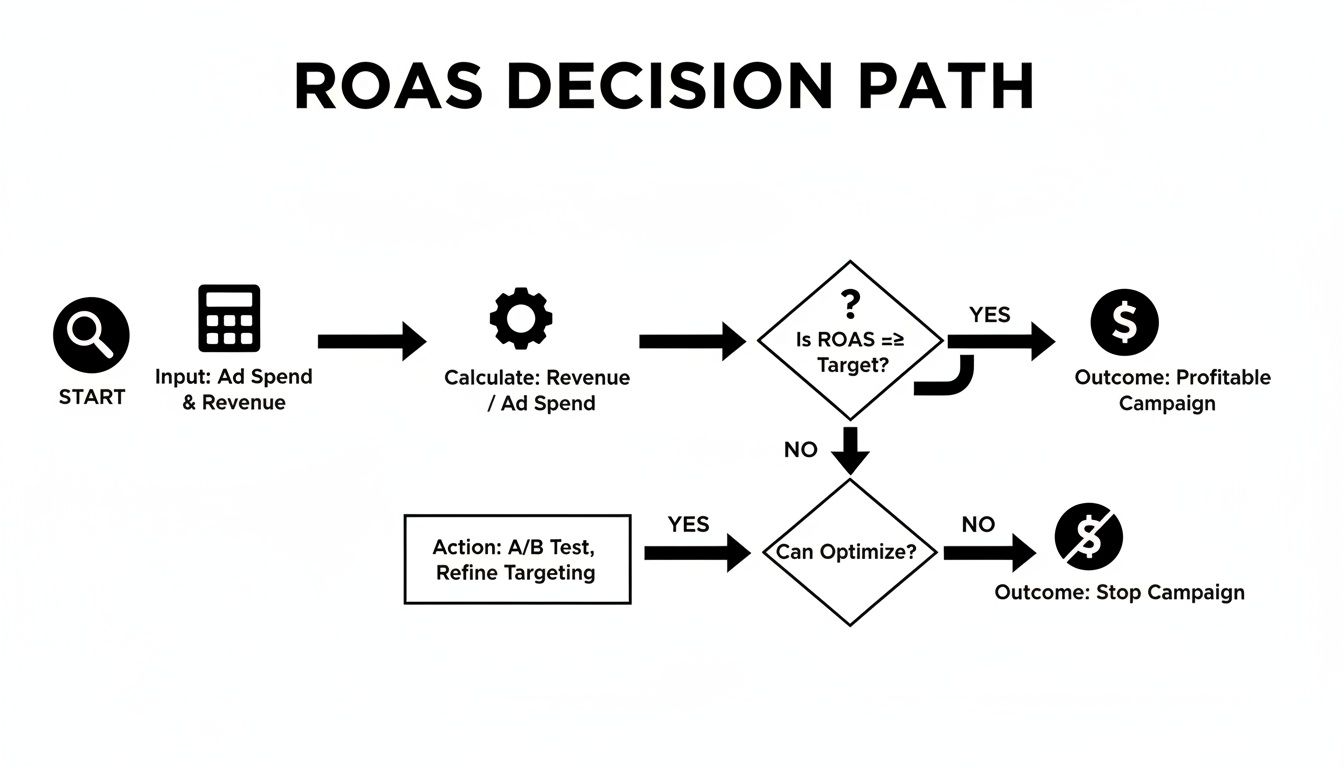
The flowchart above nails it down: your campaign's performance dictates whether you scale, optimize, or kill it. It’s that straightforward.
Handling Campaigns on the Brink
This is the most common place to be. You have a campaign that's just kind of… there. It's hovering right around your break-even point, paying for itself but not adding a dime to your bottom line. It's a critical moment, but it's definitely not a dead end.
Don't panic and hit the pause button just yet. This is a call for optimization. Before you give up, it’s time to get your hands dirty and start tweaking things:
- Refresh Your Ad Creative: Is your audience getting bored? Ad fatigue is real. Test out new images, videos, or headlines to see if you can spark some new interest.
- Tweak Your Audience Targeting: Get more specific. Try narrowing down your audience to a more focused demographic, or maybe build a lookalike audience from your best customers to find more people like them.
- Adjust Your Bidding Strategy: The platform's default bidding strategy isn't always the best. Experiment with a different model to see if you can acquire customers more cheaply.
If your ROAS is stuck right at your break-even point, you might also consider lowering your keyword bids or looking for ways to trim your COGS. Dive deeper into these kinds of strategies in our full guide to running Facebook ads for dropshipping.
When to Cut Your Losses
And then, there are the campaigns that are clearly sinking. Their ROAS is consistently below your break-even number, meaning every single sale is actually costing you money. These are the budget killers.
The decision here is painfully simple: pause the campaign immediately. There's absolutely no reason to let a failing ad bleed your budget dry. Once it's paused, you can perform a post-mortem to figure out what went wrong. Was it a bad offer? The wrong audience? A terrible creative? Learn from the mistake and apply those lessons to the next one.
Setting a Target ROAS for Real Profitability
Knowing your break-even ROAS is a huge milestone. Seriously, pat yourself on the back. But that number is just the starting line. When you hit your break-even point, you’re simply not losing money on your ads. It's the financial equivalent of treading water—you’re surviving, but you’re not moving forward.
The real goal is to turn those ad dollars into strategic, profitable growth. To do that, you need to set a Target ROAS.
Think of your Target ROAS as your break-even number with your desired profit margin layered on top. This is the metric that ensures every sale from an ad doesn't just cover its own immediate costs, but also contributes to your business's fixed overhead. We're talking about things like software subscriptions, virtual assistant fees, and, most importantly, your own salary.
From Breaking Even to Building a Brand
Let's break it down. Your break-even ROAS keeps the lights on for one specific product's ad campaign. Your Target ROAS is what actually builds the entire business. This is where you make a conscious decision about how much profit you want to bank from each sale.
For instance, say your break-even ROAS is 1.7x. That’s your zero point. If you decide you want to achieve a 25% profit margin on top of covering all your costs, your new target isn't just a tiny bump—it's a much more ambitious goal. You’re no longer just trying to recoup the cost of goods and the ad spend; you're aiming to generate real, take-home profit.
If you're still getting the hang of how margins impact your final numbers, our guide on how to properly calculate retail margin can be a lifesaver.
A 2.5 ROAS might cover your direct costs, but a 4.0 ROAS is what funds your next product launch, pays for better creative assets, and actually grows your brand’s value over time.
Why You Should Ignore Generic Benchmarks
You'll see articles and "gurus" throwing around industry averages, often quoting a ROAS around 2.87:1. For most dropshippers, this benchmark is dangerously misleading. Many sellers, especially those sourcing from platforms like AliExpress, operate on razor-thin margins where a 2.87 ROAS would put them deep in the red.
As a rule of thumb, a truly healthy ROAS for online retail often needs to be closer to a 4:1 ratio to be sustainable. If you're curious about industry standards, you can find more e-commerce advertising benchmarks on opensend.com, but always take them with a grain of salt.
This is exactly why you must use a break even roas calculator tailored to your specific products before you even think about setting goals. Your target has to be grounded in your unique cost structure, not what works for some other company with a totally different business model.
By setting a realistic Target ROAS, you shift your advertising strategy from a defensive game of "don't lose money" to an offensive plan for building a profitable, long-lasting e-commerce business. It gives every single campaign a clear, powerful purpose that goes far beyond just breaking even.
Your Top ROAS Questions, Answered
Once you get the hang of calculating your break-even ROAS, a few real-world questions always pop up. It’s one thing to understand the formula, but it’s another to apply it day-in, day-out to your own business.
Let's dig into the nitty-gritty details that I see trip people up the most. Getting these right is what separates a fuzzy guess from a number you can confidently use to scale your ads.
Should I Factor in My Salary or VA Costs?
This is a big one. The short answer is no—keep your personal salary, VA costs, software subscriptions, and other fixed overhead out of your break-even ROAS calculation.
Think of it this way: the break-even formula is built to answer a very specific question: "For this one sale, did my ad revenue cover the direct costs of selling this one product?" It’s all about per-sale profitability.
Your general business overhead gets covered later. First, you confirm an ad is profitable on its own with your break-even ROAS. Then, you set a much higher target ROAS that’s designed to cover all those other fixed costs and, most importantly, leave you with actual profit in your pocket.
How Often Should I Recalculate This?
You'll want to recalculate your break-even ROAS anytime one of your key variable costs changes. This isn't something you just set and forget.
The most common triggers are supplier price hikes or sudden changes in shipping fees—something every dropshipper has experienced. It's also smart to re-run the numbers if your payment processor, like Stripe or PayPal, updates its fee structure.
For your core, actively advertised products, I'd recommend making it a habit to review these costs quarterly. But here's the most critical rule: always recalculate before you decide to pump serious money into scaling a campaign. The last thing you want is to scale an ad that just became unprofitable without you realizing it.
What if I Sell Product Variants with Different Costs?
Fantastic question, and super common for anyone selling apparel or items with premium add-ons. If the cost difference between your variants is significant—say, a deluxe version costs $10 more to source than the standard one—you absolutely need to calculate a separate break-even ROAS for each.
On the other hand, if the cost differences are tiny (just a few cents) and they all sell at the same price, you can make your life easier. Just calculate an average Cost of Goods Sold (COGS) across all variants and use that to find a single, blended break-even number. It’ll be close enough.
For maximum accuracy, though, I always lean towards being more specific. If one of your more expensive variants is a massive bestseller, calculating its ROAS individually is the only way to go. This stops a popular but lower-margin item from secretly tanking your overall profitability.
Streamline your entire product media workflow with AliSave Pro. Download all AliExpress product images and videos in one click, and get back to what really matters—building profitable ad campaigns. Get AliSave Pro for free on the Chrome Web Store and start saving time today.