
To figure out your cost per unit, you need to tally up every single expense that goes into production—both the fixed costs and the variable ones—and then divide that grand total by the number of units you made. It's a simple formula, but the result is powerful. This one number tells you exactly what it costs to produce a single item before you even think about marking it up for profit. For any ecommerce business, getting this right is the absolute first step toward smart pricing and long-term profitability.
Why Your Unit Cost Is More Than Just a Number

Nailing down your cost per unit is the foundation of a healthy ecommerce brand. This isn't just a boring accounting task; it’s the secret to setting prices that actually make you money, growing sustainably, and knowing your real bottom line on every sale. This single figure directly impacts your profit margins, tells you how much you can afford to spend on marketing, and fundamentally shapes your entire business strategy.
Think of it as your financial north star. It guides every decision you make, from which supplier to choose to how you run a flash sale. If you don't have a precise handle on your unit cost, you're essentially flying blind. It's entirely possible to sell thousands of products and still be losing money on every single one without even realizing it.
The Real-World Impact of Unit Costs
When you have a crystal-clear understanding of your unit cost, you can start making strategic moves that genuinely boost your profits. For example, knowing this number helps you:
- Set Profitable Prices: You can confidently set a retail price that covers all your expenses and builds in a healthy profit margin. No more guesswork.
- Spot Inefficiencies: By tracking your cost per unit over time, you can see when things are getting more expensive. A rising unit cost could be a red flag that it's time to renegotiate with a supplier or find ways to streamline your production.
- Make Smarter Sourcing Decisions: It lets you accurately compare suppliers and manufacturing partners, looking past the obvious sticker price to understand the true "landed cost" of each option.
Knowing your cost per unit is the difference between hoping you're profitable and knowing you are. It turns your pricing strategy from a shot in the dark into a data-backed plan for success.
Keep in mind that the components of this cost can change due to bigger economic forces. Labor costs, for instance, are a massive part of manufacturing expenses. In the U.S. manufacturing sector, unit labor costs recently hit an index of 133.035 (using 2017 as a baseline of 100), which is up from 131.381 the previous year. This shows a clear trend of rising production costs that you need to account for. You can dig deeper into these trends on the Bureau of Labor Statistics website.
In the rest of this guide, I'll walk you through how to identify every single expense that adds up to your total cost per unit.
Getting to the True Cost of Your Product
If you want to know if you're actually making money, you have to look beyond the price on your supplier's invoice. So many sellers get this wrong. They just look at the purchase price, and that gives them a dangerously incomplete picture of their real expenses. Your true cost is the sum of every single penny it takes to get one product into your customer's hands.
These costs really break down into two buckets: direct costs and indirect costs. Think of direct costs as the obvious, tangible expenses tied right to getting your product. Indirect costs are the sneakier ones—the expenses that are just as critical but are more about facilitating the sale and getting it delivered.
Identifying Your Direct Costs
Direct costs are the most straightforward part of the equation. These are the expenses you can point to and say, "This cost is for this specific unit." But even here, people miss things, and that can really throw off your numbers.
The main direct costs you'll always have are:
- Product Cost: This is the simple one—the base price you pay your supplier for one item.
- Inbound Shipping: Don't forget what it costs to get the products from your supplier to you. You can learn more about finding the best shipping for small business to keep this number as low as possible.
- Import Duties and Tariffs: If you're sourcing from overseas, these government taxes are a non-negotiable part of your landed cost.
- Customization Fees: Did you add a logo? Get special branding? Any modifications you pay for before the product is ready to sell fall right into this category.
Let's say you order 500 custom-branded water bottles at $4 a pop. Your initial product cost is $2,000. But then you add $300 for freight and get hit with $150 in import duties. Suddenly, your total direct cost is $2,450 before that inventory even lands on your shelves.
Unearthing Your Indirect Costs
Indirect costs are the silent killers of your profit margin. These are the expenses that aren't tied to a single unit but are absolutely necessary to sell and deliver your products. To get your true cost per unit, you have to assign a small slice of these costs to every item you sell.
I’ve seen so many businesses fail because they ignored the small, recurring costs that seemed insignificant. But when you sell thousands of units, those "small" fees can add up to thousands of dollars in lost profit.
To help you get a handle on this, here’s a quick breakdown of what you need to be tracking.
Direct vs Indirect Cost Components Per Unit
| Cost Category | Type | Example |
|---|---|---|
| Packaging Materials | Indirect | Mailer bags, boxes, branded tissue paper, tape, and void fill. |
| Payment Processing | Indirect | Fees from Shopify Payments, Stripe, or PayPal (e.g., 2.9% + $0.30). |
| Returns & Refunds | Indirect | The average cost of processing a return, including shipping and damaged goods. |
| Fulfillment Center Fees | Indirect | Pick and pack fees, storage fees, or order handling charges from a 3PL. |
| Software Subscriptions | Indirect | A small fraction of your Shopify plan or other essential app costs. |
It's easy to see how these add up in the real world.
Imagine you spend $250 on branded mailers and thank-you cards for that same 500-unit order. That's an extra $0.50 per unit just in packaging. Once you factor in payment processing fees and the average cost of returns, you start to see how quickly these indirect costs inflate your true unit cost, turning what looked like a home-run product into a breakeven one.
The Simple Formula for Unit Cost Calculation
Once you've tracked down and categorized all your costs, it's time for the fun part: the math. Calculating your cost per unit is surprisingly straightforward, but the real power comes from the quality of the numbers you feed into the formula. It all boils down to one core equation that every ecommerce seller should have memorized.
The fundamental formula is:
Cost Per Unit = (Total Fixed Costs + Total Variable Costs) / Total Number of Units
This calculation gives you the true, all-in cost for producing a single item. Let's break down what each part of this puzzle means so you can start applying it to your own business right away.
Defining the Formula's Components
The terms "fixed" and "variable" costs might sound like dry accounting jargon, but they're really just common-sense concepts.
- Total Fixed Costs: These are your consistent, predictable expenses that stay the same whether you make 100 units or 1,000. Think of your monthly Shopify subscription, warehouse rent, or annual insurance premiums. They're the cost of keeping the lights on.
- Total Variable Costs: These expenses are directly tied to your production volume. The more you make, the higher these costs climb. This bucket includes things like raw materials, per-unit manufacturing fees, and the cost of shipping labels.
- Total Number of Units: This is simply the total quantity of items you produced over a specific period, whether that's a month, a quarter, or a single manufacturing run.
This infographic does a great job of showing how the final cost is built up from the product itself, incorporating both the obvious direct costs and the easily forgotten indirect ones.
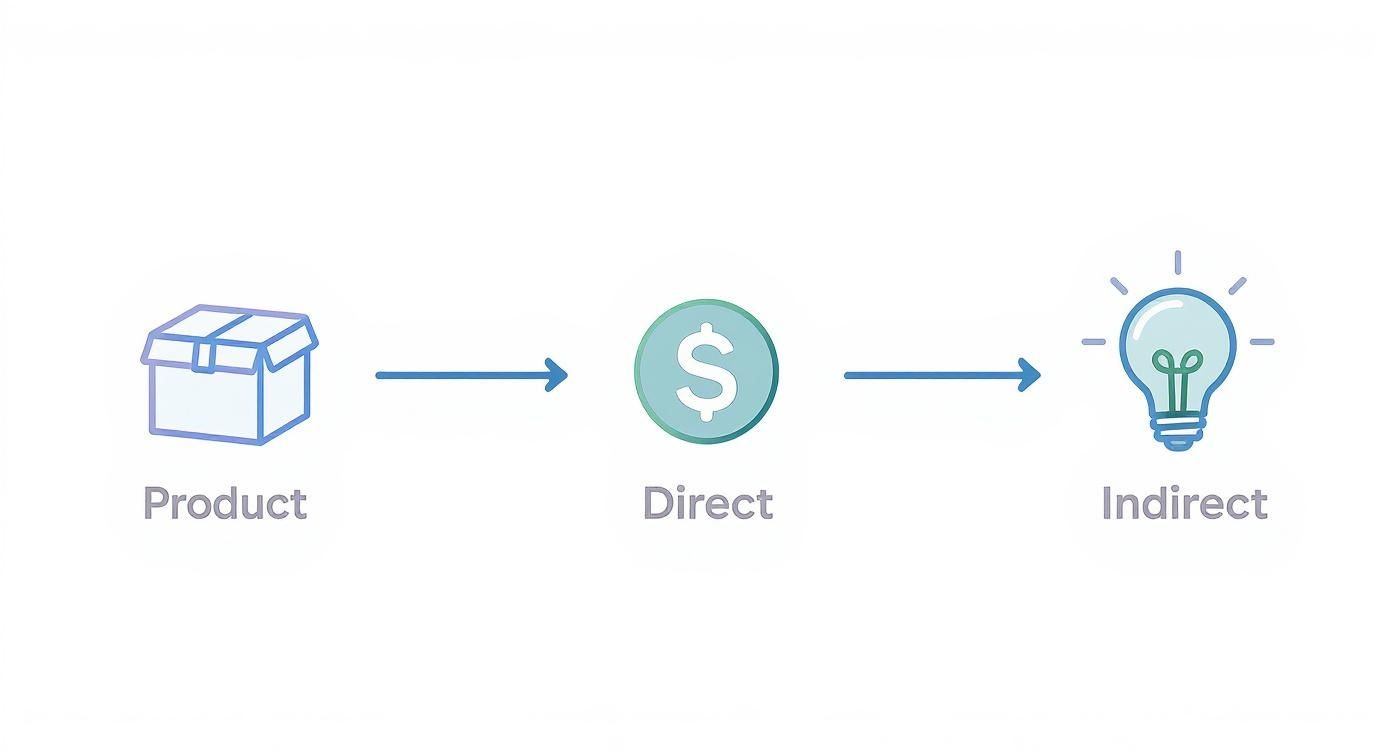
As you can see, the final cost is so much more than what you paid your supplier. It's a sum of many parts, and missing even one can throw off your entire pricing strategy.
Putting the Formula Into Practice
Let's make this concrete with a real-world example. Imagine you run a small business selling handmade candles and decide to produce a batch of 500 candles in one month.
Here’s a breakdown of your costs for that month:
Fixed Costs:
- Workshop Rent: $600
- Shopify Plan: $39
- Insurance: $50
- Total Fixed Costs = $689
Variable Costs (for 500 candles):
- Wax, Wicks, and Fragrance Oil: $750
- Glass Jars: $500
- Labels & Packaging: $250
- Total Variable Costs = $1,500
Now, we just need to plug these numbers into our formula.
First, let's get the total cost for the batch:
Total Costs = $689 (Fixed) + $1,500 (Variable) = $2,189
Next, divide that total cost by the number of candles you made:
Cost Per Unit = $2,189 / 500 units = $4.38
So, your actual, all-in cost to produce one candle is $4.38. This is the most important number you need before you can even think about setting a retail price. If you want to get more comfortable with this and other key business calculations, it’s worth spending some time mastering financial formulas in Excel.
By allocating a small piece of your fixed costs to every single unit, you ensure your pricing covers more than just materials—it covers the essential overhead required to run your business. Skipping this step is a classic mistake that creates "phantom profits," where sales look great on paper but you're not actually making enough to cover your core operational expenses.
Navigating Global Sourcing and Manufacturing Costs
Sourcing products from overseas suppliers throws a whole new set of financial curveballs into your cost calculations. When you're trying to pin down your cost per unit, the price your factory quotes is really just the tip of the iceberg. You also have to contend with shifting labor wages, local taxes, energy costs, and the wild ride of currency exchange rates.
Many sellers get lured in by the seemingly low per-unit prices from manufacturing hubs abroad, thinking it's a direct path to higher profits. What they often miss is the complex web of costs hidden just beneath the surface—costs that can vary wildly from one country to the next. A product made in China will have a fundamentally different cost structure than one from Vietnam or the United States, even if the initial quotes look close.
Beyond the Factory Invoice
The real metric you need to watch is the total landed cost, not just what you pay the manufacturer. This number includes all the expenses that crop up the moment you move goods across a border. Getting these wrong can absolutely tank your profitability.
Here's what you need to keep a close eye on:
- Labor Wages: This is a huge piece of the puzzle, but it's not the whole story. Cheaper wages in one country might be canceled out by lower productivity or the need for more extensive training.
- Structural Costs: Think of these as the "hidden" expenses—corporate taxes, the cost of regulatory compliance, and energy prices. They can quickly eat away at any savings you thought you were getting from lower labor costs.
- Currency Fluctuation: The exchange rate between your home currency and your supplier's can change in the blink of an eye, directly hitting your bottom line. An unfavorable shift can turn a profitable order into a losing one overnight.
If you're sourcing through big platforms, it's also vital to know if you're dealing with a trading company or a direct manufacturer. We break this down in our guide on the difference between Alibaba and AliExpress to help you source smarter.
A Tale of Two Costs: Labor vs. Structure
A recent analysis really drives home how misleading raw labor costs can be. Research found that while U.S. manufacturers had 'raw costs' (mostly wages) that were about 9% lower than their top nine trading partners, this advantage was completely wiped out by higher structural costs like taxes and regulations.
In the end, this pushed overall U.S. manufacturing costs to be about 9% higher. For example, the wage cost per unit might be $1.20 in the U.S. versus $0.80 in Vietnam. But after you factor in all the structural costs, the total could be $1.50 in the U.S. compared to just $1.35 in Vietnam. You can see the full breakdown in the research on global manufacturing operations.
This data proves a critical point: a lower factory price in one country does not guarantee a lower final cost per unit. You must account for the entire financial ecosystem your supplier operates in to make truly profitable sourcing decisions.
Turning Your Unit Cost Into Profitable Prices

Knowing how to calculate cost per unit is one thing, but the real skill lies in turning that number into a smart, sustainable price. Think of your unit cost as the financial bedrock of your business. It’s the starting point that helps you find your break-even point and, more importantly, layer on the profit margin that will actually let your business grow.
With your true unit cost figured out, you can stop guessing. Instead of picking a price that just "feels right," you're making data-backed decisions. This is the moment your diligent cost tracking transforms into tangible profit, ensuring every single sale adds to your bottom line.
Choosing Your Pricing Model
Once you have your unit cost nailed down, understanding effective pricing strategies is the next logical step. For most ecommerce stores, a couple of common models tend to work best, each with its own pros and cons.
Cost-Plus Pricing: This is the most straightforward approach. You take your unit cost and simply add a fixed percentage or dollar amount—your markup. If your cost per unit is $10 and you want a 50% markup, you sell it for $15. It’s simple, predictable, and guarantees you cover your costs on every sale.
Value-Based Pricing: This model flips the script and focuses on the customer. Instead of starting with your costs, you price your product based on the value it provides to your buyers. This often opens the door to much higher margins, especially for unique or in-demand items, but it demands a deep understanding of your target audience.
Many savvy brands actually use a hybrid model. They’ll start with a cost-plus calculation to set a baseline, then adjust the price upward based on what the market will bear, what competitors are doing, and the product's perceived value. This way, you guarantee profitability while still pushing for maximum revenue.
Your cost per unit is your price floor—the absolute minimum you can charge without losing money. Any price below this number means you are literally paying customers to take your product.
Factoring in the Finer Details
A truly solid pricing strategy also has to account for expenses that fall outside your initial unit cost calculation, like marketing. If you plan to run sales or offer discount codes, your starting price needs to be high enough to absorb those promotions without wiping out your profit. This is especially critical for dropshippers who often operate on thinner margins and need to stay competitive.
Labor is another piece of the puzzle, and its impact can shift depending on global trends. Back in 2018, for example, manufacturing labor costs in Germany jumped by 4.2 percent, while the U.S. saw a 3.5 percent increase. Because Germany's productivity growth didn't keep pace, its final cost per unit of output rose more sharply than in the U.S. It’s a great example of how big-picture economic factors can quietly influence your baseline costs.
Ultimately, pricing is both an art and a science. It’s about blending your hard cost data with a sharp intuition for your market. Finding that balance is the key to setting prices that not only attract customers but also build a resilient, profitable business. If sales aren't where you want them to be, check out our guide on https://alisavepro.com/how-to-improve-ecommerce-conversion-rates/.
Common Questions About Calculating Unit Cost
Even with a solid formula, the real world of ecommerce can throw you a few curveballs. When you're trying to nail down your cost per unit, you'll inevitably run into fluctuating expenses, big one-off costs, and the age-old question of where marketing fits in. Let's tackle some of the most common sticking points I see sellers struggle with.
How Do I Handle Costs That Fluctuate?
Shipping is a classic example. One month you might ship 100 orders, the next 500. Carrier rates change, package weights vary, and destinations are all over the map. So, how do you assign a stable cost to a single unit?
The best way to handle this is to work with averages over a longer period. Don't just look at last week's numbers. Instead, calculate your total shipping spend over a full quarter or even six months. Then, divide that total by the number of units you shipped in that same window.
This simple move smooths out all those jarring peaks and valleys, giving you a much more reliable average shipping cost per unit for your calculations.
Should I Allocate Marketing Costs?
This question comes up all the time: "Should my Facebook ad budget be part of my cost per unit?"
The short answer is no, not directly. Marketing and advertising are almost always treated as operating expenses (OpEx), not as part of your Cost of Goods Sold (COGS). Think of it this way: COGS is the cost to get the product, while marketing is the cost to sell the product.
That doesn't mean you ignore it, though. You absolutely need to factor it into your overall profitability. The best metric for this is Customer Acquisition Cost (CAC).
To find your CAC, just divide your total marketing spend over a period by the number of new customers you brought in. Knowing your CAC and your profit margin per unit tells you instantly whether your ad campaigns are actually making you money.
Keeping these costs separate gives you a "pure" unit cost while still providing a clear picture of your bottom line.
What About Big One-Time Expenses?
Okay, so what happens when you have a big, one-time purchase? Maybe you bought new warehouse equipment or paid for a professional product photoshoot. If you load that entire cost onto a single batch of inventory, it will completely blow up your unit cost and make your pricing look insane.
The right way to handle these is to spread them out over their useful life, a process known as amortization or depreciation. It’s simpler than it sounds.
- New Equipment: Let's say a packing machine costs you $5,000 and you expect it to last for five years. You'd account for that as a $1,000 expense per year.
- Product Photoshoot: A $1,200 photoshoot will probably give you great marketing assets for at least a year. So, you can think of that as a $100 monthly expense.
By spreading these costs out, you maintain a realistic and stable cost per unit over time. This helps you avoid making terrible pricing decisions based on temporarily skewed data. At the end of the day, consistent and accurate tracking is what separates the businesses that thrive from those that are quietly bleeding money.
Ready to streamline your product media workflow? With AliSave Pro, you can download all AliExpress product images and videos in a single click, perfectly organized for your store. Stop wasting time on manual downloads and start building beautiful product pages faster.