
Your dropshipping business is only as good as the suppliers you work with. It's a simple truth that a lot of new entrepreneurs overlook. Finding the right partner means everything—they handle your inventory, ensure product quality, and get orders to your customers on time. This relationship is the absolute bedrock of your store's reputation and success.
Your Business Is Only as Strong as Your Suppliers
Think about it: a great supplier leads to happy customers, glowing reviews, and people coming back to buy more. A bad one? You're looking at a nightmare of shipping delays, shoddy products, and a brand reputation that's dead on arrival. Your business truly is a direct reflection of the partners you choose to fulfill your orders.
The Make-or-Break Challenge for Entrepreneurs
It's no surprise that finding a trustworthy partner is a huge hurdle. In fact, over 84% of online sellers say that sourcing reliable dropshipping suppliers is their single biggest obstacle. Most new store owners end up testing four to six different suppliers before they find one they can stick with for the long haul.
This guide will walk you through how to turn that challenge into a real competitive advantage. We're going to ditch the old advice and focus on what actually works today:
- Reliability Over Rock-Bottom Prices: It's tempting to go for the cheapest option, but that's a classic rookie mistake. We'll show you how to find partners who are consistent and dependable.
- Fast Shipping is Non-Negotiable: Customers expect their stuff to arrive quickly. Slow shipping is a business killer, so we’ll focus on finding suppliers who can keep up.
- Building a Resilient Supply Chain: Relying on one supplier is risky. You'll learn how to create a small network of trusted partners to protect your store from stockouts and other surprises.
The goal isn't just to find a supplier. It's to find a partner who cares about your customers' experience just as much as you do. Getting that mindset right is the first real step toward building a dropshipping business that lasts.
To get a complete picture of the process, from digging through B2B marketplaces to cleverly analyzing your competitors, check out a comprehensive guide to finding dropshipping suppliers. It provides a clear roadmap to transform your sourcing from a guessing game into a powerful asset.
Finding Your Suppliers in Directories and Marketplaces
Think of supplier directories and online marketplaces as the Grand Central Station of the dropshipping world. These are the massive, bustling hubs where you can find thousands of potential partners, compare their products, and make first contact—all from one dashboard. For most people starting out, this is ground zero for sourcing.
These platforms are essentially digital matchmakers. You have open marketplaces like AliExpress, where just about anyone can list a product, and then you have curated directories like SaleHoo, which charge a fee to access a pre-vetted list of suppliers. Knowing the difference is crucial; it helps you focus your energy where it’ll count the most.
Getting to Know the Major Players
Every platform has its own vibe and attracts different kinds of suppliers. If you know where to look, you can save yourself from scrolling through thousands of listings that just aren't a good fit.
Here are the heavyweights you'll run into most often:
- AliExpress: This is usually the first stop for anyone new to dropshipping. It's a gigantic B2C marketplace loaded with individual sellers who are happy to sell you one item at a time at a low cost. It's fantastic for testing products without buying a truckload of inventory. If you're heading this route, our guide on AliExpress dropshipping has some great strategies.
- Alibaba: Think of this as AliExpress's B2B older sibling. Alibaba is built for bulk orders straight from manufacturers. While it’s not for standard, one-off dropshipping, it becomes a goldmine when you're ready to scale up, create a private label, and start managing your own stock.
- SaleHoo: This is a paid directory that does the initial legwork for you by vetting its list of over 8,000 suppliers. The annual fee buys you peace of mind and access to a cleaner, more reliable database. It's a solid choice if you'd rather invest a little money upfront to avoid scams.
- Worldwide Brands: Another premium, paid directory, but this one comes with a lifetime access fee. They're famous for a super strict certification process, so every supplier you find there is a legitimate, wholesale-focused business. This platform is really for people who are in it for the long haul.
To help you choose, here's a quick breakdown of where to start your search.
Comparing Leading Supplier Platforms
| Platform | Supplier Type | Pricing Model | Key Feature |
|---|---|---|---|
| AliExpress | B2C Sellers | Free to Use | Huge product variety, no minimum order quantity (MOQ) |
| Alibaba | B2B Manufacturers | Free to Use | Ideal for bulk orders and private labeling |
| SaleHoo | Vetted Wholesalers | Annual Fee | Curated directory reduces risk of bad suppliers |
| Worldwide Brands | Certified Wholesalers | One-Time Fee | Lifetime access to a highly vetted supplier list |
Each platform serves a different need, from testing new ideas on AliExpress to building a long-term brand with suppliers from Worldwide Brands.
How to Actually Find Good Suppliers on These Sites
Just hopping on and browsing is a recipe for frustration. You need a game plan to cut through the noise and spot the real winners. It all comes down to knowing how to filter, what to look for, and how to read the signals.
First off, get comfortable with the advanced filters. Don't just type "blue widget" into the search bar. Filter your results by top-rated sellers, the total number of orders, and how long the supplier has been active. A seller with a 95% or higher positive feedback score and a few years of history is always a safer bet than a brand-new shop with zero track record.
Take a look at this screenshot from Alibaba. Right away, you can see trust signals like the "Verified" supplier status and their years in business.
Things like the "Trade Assurance" badge and the supplier's tenure are right there. These are instant clues that the supplier has met the platform's standards, which gives you a bit of a safety net.
Pro Tip: When you're just starting, zero in on suppliers who explicitly say they support dropshipping. Search their store pages for terms like "dropshipping friendly" or "blind shipping." Some platforms, like the AliExpress Dropshipping Center, even have tools built specifically to help you find partners who get your business model.
Beyond these dedicated sourcing sites, don't forget the big players. Marketplaces like eBay, with its 17.6 million sellers, and Amazon, with 9.7 million sellers worldwide, can be unconventional but useful spots to research product trends or even find smaller-scale suppliers. You can dive deeper into these numbers with these dropshipping statistics from AutoDS.
Spotting the Signs of a Trustworthy Partner
On any of these platforms, your most important job is to be a detective. You need to gather evidence that a supplier is the real deal before you even think about sending them a message.
Here's a quick checklist of positive signs to look for:
- A Professional Storefront: Their digital shop should look clean and professional. That means high-quality product photos and descriptions that are detailed and written in clear English.
- They Actually Respond: Before committing, send them a simple question about a product. A fast, helpful, and clear reply is a huge green flag for good customer service.
- Clear, Fair Policies: Can you easily find their shipping and return policies? If they're buried, confusing, or nonexistent, run the other way.
- Detailed Positive Reviews: Don't just glance at the star rating. Dig into the actual reviews. Look for comments that mention product quality and shipping speed, especially those that include photos from other customers.
In the end, finding great suppliers on these platforms all comes down to doing your homework. With a bit of strategic digging, you can move past aimless scrolling and start building a shortlist of genuinely reliable partners.
The Art of Vetting Potential Partners
So, you've got a list of potential suppliers. That’s a great start, but it's just the beginning. The real work is about to kick in as you shift from simply finding names to actually scrutinizing them. This is where you separate the true partners from the future headaches, turning that long list into a reliable shortlist. It's a critical process that demands a sharp eye.
This flow chart breaks down the basic path from your initial search to your final, vetted list.
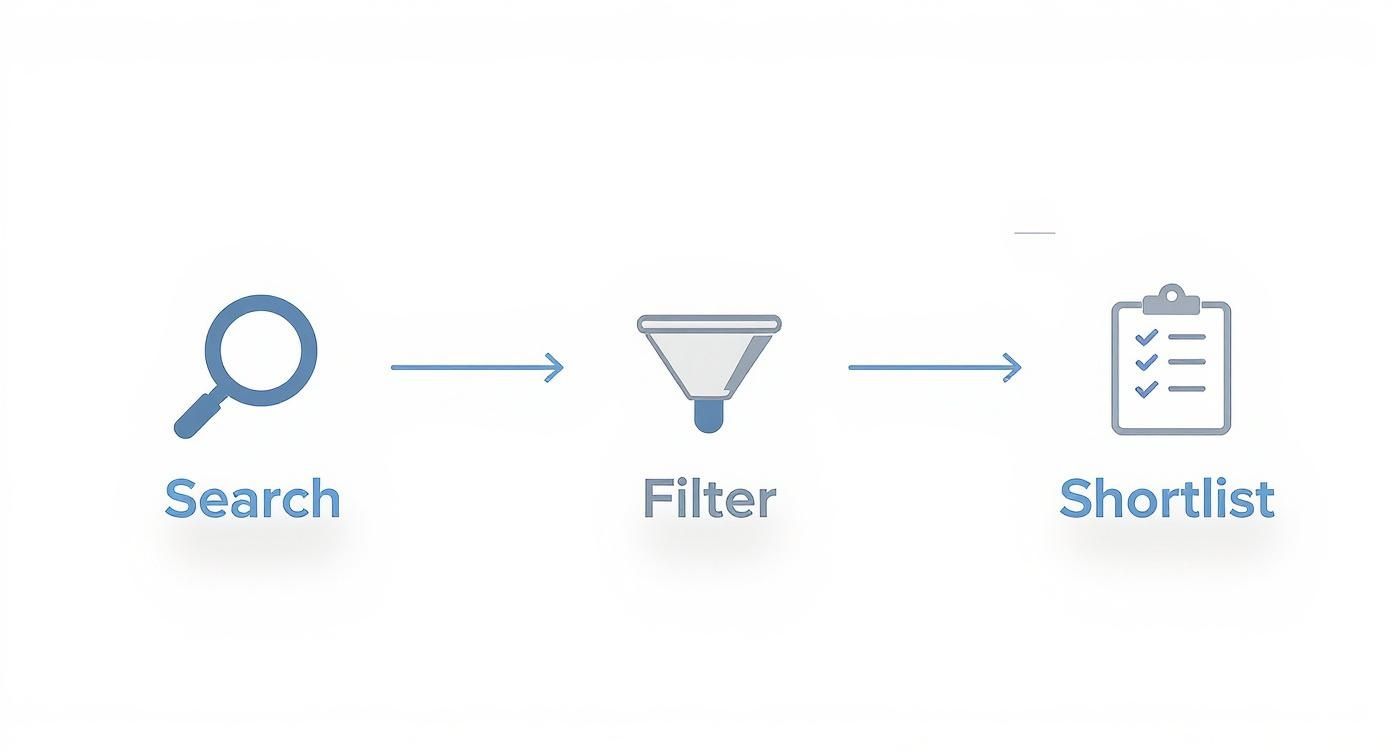
Following these steps helps you methodically weed out the weak links, making sure you only invest serious time in the most promising candidates.
Communication Is Everything
Before you even think about placing a sample order, test their communication. How a supplier responds to a simple question now is a dead giveaway for how they'll handle a real problem later.
Shoot them an email with a few specific questions about their products or how their dropshipping process works. Are their replies quick, clear, and professional? Or are you getting slow, vague answers full of typos? If a supplier takes 48 hours to answer a basic question now, imagine trying to reach them when a customer's package is lost.
A supplier who can’t communicate effectively isn't a partner; they're a liability. Your business and your brand's reputation will eventually pay the price for their poor service. Make this your first and most important test.
The Sample Order Litmus Test
Whatever you do, never skip ordering samples. A product can look incredible in professionally shot photos but feel cheap and flimsy in your hands. This is your one and only chance to physically check the quality your customers will actually receive.
When that sample arrives, put on your detective hat. You're not just looking at the product—you're evaluating the entire customer experience.
- Packaging Quality: Did it show up in a sturdy box, or was it a flimsy, crushed mailer? Good packaging prevents damage and shows they actually care.
- Product Integrity: Is the item exactly as it was described online? Look for defects, off-colors, or cheap materials that didn't show up in the pictures.
- Shipping Speed: How long did it really take to get to you from the day you clicked "buy"? Compare this to their advertised shipping times. Consistent delays are a huge red flag.
I learned this the hard way. I once tested a supplier for a line of minimalist watches. The photos were gorgeous. But when the sample arrived, one of the hands was loose and the strap felt like cheap plastic. If I'd skipped that sample order, I would have sent defective products to my first customers, killing my brand before it even had a chance.
Digging into Policies and Production
A supplier's true operational strength is hidden in their policies. You need to know exactly how they handle the messy side of ecommerce before an angry customer is blowing up your inbox.
Find and read their return policy. Is it easy to understand? Who pays for return shipping? Do they offer refunds, or are customers stuck with replacements? Your store’s return policy has to align with theirs, otherwise you'll be eating the cost of every return. If their policy is buried or confusing, it's a sign they don't have their act together.
Also, ask them about their production capacity and how they manage stock. A great question is, "How do you notify dropshippers about low stock levels for popular items?" A reliable supplier will have a clear system, whether it’s an automated inventory feed or a dedicated account manager who keeps you in the loop.
Technical Integration and Automation
In today's dropshipping game, manually fulfilling orders is a recipe for burnout and mistakes. A top-tier supplier should offer some kind of technical integration to automate the conversation between your store and their warehouse.
Look for partners who can provide:
- API Integration: This is what lets your store automatically push order details straight to their system. No more copy-pasting.
- Inventory Sync: This feature automatically updates stock levels on your site, which is crucial for preventing you from selling out-of-stock products.
- Automated Tracking Updates: Once an order ships, their system should automatically send the tracking number back to your store, which then notifies your customer.
These tech features are what allow you to scale your business. Manually emailing five orders a day is doable. Fifty? It’s an absolute nightmare. Choosing a tech-savvy supplier is an investment in your future efficiency and your own sanity.
Thinking about reliability extends beyond just your products. The same vetting principles apply when you're looking for top customer support companies to manage other parts of your business. Communication and dependability are universal.
And if you're like many entrepreneurs, you're probably wondering if you can really trust a massive platform like AliExpress for sourcing. We put together a deep dive on that very topic; you can learn more about whether AliExpress can be trusted for your business in our detailed guide.
Building a Real Partnership with Your Suppliers
Alright, you’ve done the hard work of vetting and now you have a shortlist of suppliers who look promising. This next part is critical: making first contact. How you approach this initial outreach can make or break the entire relationship before it even starts.
Your goal here is to come across as a serious, professional partner—not just another person with a new Shopify store trying things out. A thoughtful first impression can mean the difference between getting a helpful reply and being completely ignored. You need to show them you’re worth their time.
Making That First Contact Count
Forget about firing off a generic, one-line email like "do u dropship?" That's a surefire way to get your message deleted. Instead, you need a clear, concise message that gets right to the point while showing you mean business.
Think of this first email as a mini business proposal. It should accomplish three things right away:
- Introduce your brand: Who are you and what do you sell?
- State your interest: Make it clear you're interested in their products for a dropshipping partnership.
- Ask the right questions: Open the door to a conversation about how they work with dropshippers.
Here’s a simple, effective way to structure it:
Subject: Partnership Inquiry from [Your Store Name]
Hello [Supplier Contact Name],
My name is [Your Name], and I'm the owner of [Your Store Name], an online retailer specializing in [Your Niche]. I've been really impressed with your [Product Category] and think they would be a perfect fit for my customers.
I’m currently looking for a reliable dropshipping supplier and wanted to see if you offer this service. If you do, could you please send over some details on your dropshipping program?
Thanks for your time. I look forward to hearing from you.
Best,
[Your Name]
This template is direct, professional, and respectful. It immediately tells the supplier who you are, what you want, and that you're not here to waste their time.
Going Deeper: The Follow-Up Questions
Once you get a positive response, it's time to dig in. This is where you really start to see if they’re the right fit. Think of it as an interview—you're both feeling each other out to see if a long-term collaboration makes sense.
Here are the essential topics you need to cover in your follow-up emails or calls:
- Pricing & Payment: Do they offer better pricing for higher sales volume? How exactly will you be billed for orders, and when is payment due?
- Minimum Order Quantity (MOQ): This is a big one. You need to confirm they have no MOQ for dropshipped orders. This is non-negotiable for this business model.
- Shipping & Handling: Get the specifics. What are their average processing times before an order ships? Which carriers do they use?
- Branding & Customization: Can they do blind shipping (so your customer doesn’t see their name all over the box)? Can you add your own branded packing slips or other small touches?
Asking these questions shows you're thinking ahead about scaling your business and protecting your brand. It also helps you spot any deal-breakers early on, before you’ve invested too much time.
It’s a Partnership, Not Just a Transaction
Let's get one thing straight: negotiation isn't just about haggling for the lowest price. It's about building a relationship that benefits both of you. The most successful dropshippers I know don't see their suppliers as just vendors; they see them as genuine partners.
This mindset shift is what separates the stores that thrive from the ones that are constantly putting out fires.
When you build a strong, collaborative relationship, you can unlock some serious advantages. A supplier who likes working with you might give you a heads-up on new products before anyone else sees them. They might push your orders out the door faster or give you priority support when something goes wrong.
Think about it from their side. They'd much rather work with one reliable, high-volume partner than a dozen disorganized beginners. Prove that you’re that partner, and doors will open. Over time, you can negotiate better terms, secure exclusive products, and even collaborate on new ideas. A deep partnership is a powerful asset that your competitors can't easily copy.
Using Domestic Suppliers for Faster Shipping

Let's be honest: in a world dominated by Amazon Prime, customers just don't have the patience for long shipping times anymore. This is precisely where finding and working with domestic suppliers becomes your secret weapon. It shifts your entire business model from competing on razor-thin margins to winning with superior service and speed.
Sourcing products from suppliers right inside your target country transforms the customer experience. Instead of a multi-week waiting game for a package from overseas, your customers can have their orders in just a few days. That one change can make all the difference, dramatically improving satisfaction and turning one-time buyers into loyal fans.
The Speed vs. Cost Equation
Of course, there’s always a trade-off. Sourcing domestically almost always means a higher cost per item compared to what you’d find on massive international marketplaces. It’s a reality of the business.
But here's what seasoned dropshippers understand: you have to look beyond the initial product cost. Faster shipping, combined with a far simpler returns process, leads directly to happier customers. That translates into glowing reviews, organic word-of-mouth marketing, and a much higher customer lifetime value—all of which can easily make up for a slightly higher upfront cost.
This isn't just a trend; it's a strategic pivot. We're seeing stores that partner with US-based suppliers achieve 35% faster shipping times on average. Even more impressive, they're generating 20% more repeat customers than competitors who stick with international-only sourcing.
How to Actually Find Domestic Suppliers
Finding these local gems requires a different playbook than just scrolling through AliExpress. You need to be more targeted and intentional with your search.
- Filter Your Directories: Modern supplier directories like Spocket and SaleHoo are built for this. Use their location filters to zero in on suppliers in the US, UK, or Europe. This is the fastest way to find partners who can deliver quickly to those high-value markets.
- Go to Trade Shows: If you’re serious about your niche, nothing beats getting out there. Attending an industry trade show lets you meet manufacturers face-to-face, handle the products yourself, and build genuine relationships that you just can't get through email.
- Master Google Search: It sounds simple, but a well-crafted Google search like
"wholesale [your product niche] USA"can uncover wholesalers who also happen to offer dropshipping. You might have to do some digging, but this is how you find the partners your competition doesn't know about.
Platforms like Spocket have built their entire brand around solving the slow shipping problem. Their focus is connecting sellers with US and EU-based suppliers, making it a fantastic starting point for anyone looking to build a business on speed and reliability.
At the end of the day, working with domestic suppliers is about building a brand that people trust. When you can confidently promise fast delivery, you’re no longer just selling a product—you're selling a premium experience. And if you're looking to get a better handle on your logistics, our guide on the best shipping for small business is a great resource. This is how you stop competing in a race to the bottom on price and start competing on service.
Common Questions About Finding Suppliers
As you get deeper into the world of dropshipping, a lot of the same questions tend to pop up. Moving from the research phase to actually contacting suppliers is where the rubber meets the road, and it's natural to hit a few bumps. Let's tackle some of the most common sticking points I see entrepreneurs run into.
How Many Dropshipping Suppliers Should I Work With?
It's tempting to find one good supplier and call it a day, but that's a rookie mistake. Relying on a single source puts your entire business at risk. What happens if they suddenly run out of your best-seller, go out of business, or have a massive shipping delay? Your store grinds to a halt.
For any of your core, money-making products, you absolutely need a primary supplier and at least one vetted backup. Think of it as an insurance policy. This simple move protects your revenue and, just as importantly, your brand's reputation when things inevitably go wrong.
As your store grows, you’ll naturally start working with a handful of different suppliers, especially if you sell across multiple niches. But don't overcomplicate things at the start. Aim to build solid relationships with two or three highly reliable partners when you first launch. That’s the sweet spot for a supply chain that's both resilient and manageable.
Is It a Good Idea to Use AliExpress for Dropshipping?
For beginners? Absolutely. There's a reason so many people get their start with AliExpress. It's a massive marketplace with an almost endless selection of products, and you don't need a dime for upfront inventory costs. It’s the perfect sandbox for testing out new products and seeing what sticks with your audience.
Of course, it’s not without its famous drawbacks. Long shipping times are the big one, and product quality can sometimes be a roll of the dice. Your success on AliExpress really comes down to how well you can vet your sellers.
A pro tip for minimizing risk on AliExpress: hunt for sellers with store ratings above 95%, look for the "Top Brand" badge, and check how long they've been on the platform. Most importantly, dig into customer reviews that have real photos—they give you the unfiltered truth about what you're actually getting.
Many successful store owners use AliExpress as a launchpad. They validate a product's demand there, and once it's proven to be a winner, they graduate to a private agent or a domestic supplier to lock in faster shipping and a better customer experience.
What Is the Difference Between a Manufacturer and a Wholesaler?
Getting the terminology right is key. A manufacturer is the company that physically creates the product from scratch. They're the original source.
A wholesaler, on the other hand, doesn't make anything. They buy products in huge quantities from different manufacturers and then sell them in smaller bulk orders to retailers like you.
So where does a dropshipping supplier fit in? They can be either a manufacturer or a wholesaler who has agreed to ship individual products directly to your customers. While some manufacturers will dropship, it’s much more common to work with a specialized wholesaler or a dedicated dropshipping platform. These partners are the middlemen who manage relationships with tons of manufacturers, giving you access to a huge catalog without you having to build dozens of separate connections.
How Do I Handle Returns with a Dropshipping Supplier?
You need to have your return process dialed in before you make your first sale. This is a non-negotiable part of vetting any supplier. If you don't understand their policy inside and out, you’re setting yourself up to lose money and create unhappy customers.
Before you agree to partner with anyone, get crystal-clear answers to these questions:
- What's the return window? Is it 14 days? 30? 60?
- What are the conditions? Will they only accept returns for damaged goods, or do they allow for "buyer's remorse" returns?
- Who pays for return shipping? Does the customer foot the bill, or will the supplier cover it?
- What's the resolution? Does the customer get a full refund, store credit, or a replacement product?
Your store's return policy must be a perfect match for your supplier's policy. If you promise a 30-day return window but your supplier only gives you 15, you're the one on the hook for that difference. Aligned policies and clear communication are the only way to make returns a smooth, professional process.
Ready to stop wasting time saving product images from AliExpress? The AliSave Pro Chrome extension is the tool you've been looking for. It lets you download high-resolution photos, variant images, and videos with a single click, all perfectly organized for your store. Get started for free and streamline your workflow at Alisavepro.com.