
Before you lock in that big Alibaba order, take a step back. Getting your products from the factory floor to your front door isn't just one click—it's a series of crucial decisions that will make or break your profit margins.
Figuring out the best shipping method, negotiating the right trade terms, and accurately calculating your total costs are the skills that separate successful importers from those who get hit with nasty, expensive surprises.
Your First Guide to Alibaba Shipping
Sourcing from Alibaba opens up a world of manufacturing possibilities, but let's be honest—the logistics can feel like a maze at first. The journey from your supplier's facility in China to your warehouse involves a lot more than just picking a delivery service. It’s a strategic game that directly impacts your timeline, your budget, and ultimately, your bottom line.
Getting a handle on the fundamentals from the get-go is the best way to avoid costly mistakes and frustrating delays down the road. The whole system is built around a few core components. They aren't complicated, but knowing what they are will give you the confidence to negotiate better deals and manage your supply chain like a pro.
Key Concepts to Know
At its heart, shipping from Alibaba boils down to three main choices. Each one is designed for different business needs, and picking the right one is your first major decision.
Express Shipping: Think of familiar names like DHL, FedEx, or UPS. This is the fastest and easiest option by far, perfect for small, lightweight orders or time-sensitive product samples. It's a true door-to-door service, but you pay for that convenience—it's easily the most expensive option per kilogram.
Air Freight: This is the happy medium between speed and cost. Air freight is significantly faster than sending goods by sea but more affordable than an express courier. It's the go-to choice for medium-sized shipments that need to arrive relatively quickly but aren't urgent enough to justify express prices.
Sea Freight: For large, heavy, or bulk orders, this is your best friend. While it's the slowest method by a long shot (often taking weeks or even months), the incredibly low per-unit cost makes it the industry standard for most importers trying to maximize their profit margins.
Let's break down how these three stack up against each other.
Alibaba Shipping Methods at a Glance
Choosing the right shipping method is all about balancing speed, cost, and the size of your order. This table gives you a quick snapshot to help you decide which one makes the most sense for your situation.
| Shipping Method | Typical Transit Time | Cost Level | Ideal For |
|---|---|---|---|
| Express | 3-7 days | High | Samples, small orders, urgent shipments |
| Air Freight | 5-15 days | Medium | Time-sensitive, medium-sized orders |
| Sea Freight | 30-60+ days | Low | Large, heavy, or bulk volume orders |
As you can see, there’s a clear trade-off. You can have it fast, or you can have it cheap—but rarely both. The key is matching the method to the specific needs of each order you place.
A Pro Tip from Experience
Navigating these options successfully means matching the shipping method to your specific order's size, value, and urgency. Choosing sea freight for a small sample order is just as inefficient as using an express courier for a full container of goods. Don't overpay for speed you don't need, and don't sacrifice your timeline to save a few bucks on a critical shipment.
Beyond the shipping method, you'll start hearing terms like Incoterms (common ones are FOB, EXW, and DDP). These are simply rules that define who is responsible for the shipment at each stage of its journey. You'll also likely work with a freight forwarder, who acts as your logistics quarterback, and navigate customs clearance, which is the official process of getting your goods legally into your country.
The good news is that Alibaba's own logistics capabilities have improved dramatically, making all of this more accessible than ever. Their in-house Cainiao Smart Logistics Network has been a huge part of this. In fact, the company’s International Digital Commerce Group saw its revenue jump by 31% in a recent fiscal year, largely driven by these shipping improvements. You can learn more about how Alibaba fits into the bigger picture in our detailed comparison between Alibaba and AliExpress.
Choosing Your Shipping Method: Air vs. Sea vs. Express
Picking the right shipping method is one of those moments where your business plan meets the real world. This decision is a big deal—it directly affects your product cost, how fast you can get your items, and ultimately, how happy your customers are. When shipping from Alibaba, you've got three main plays: Express, Air Freight, and Sea Freight. Each one has its place, and knowing when to use which is key to protecting your bottom line.
There’s no magic bullet here. The "best" method really just depends on what you're shipping. A small box of high-value electronics has totally different needs than a massive order of cheap t-shirts.
This little diagram is a great way to visualize which way to lean based on the size of your order.
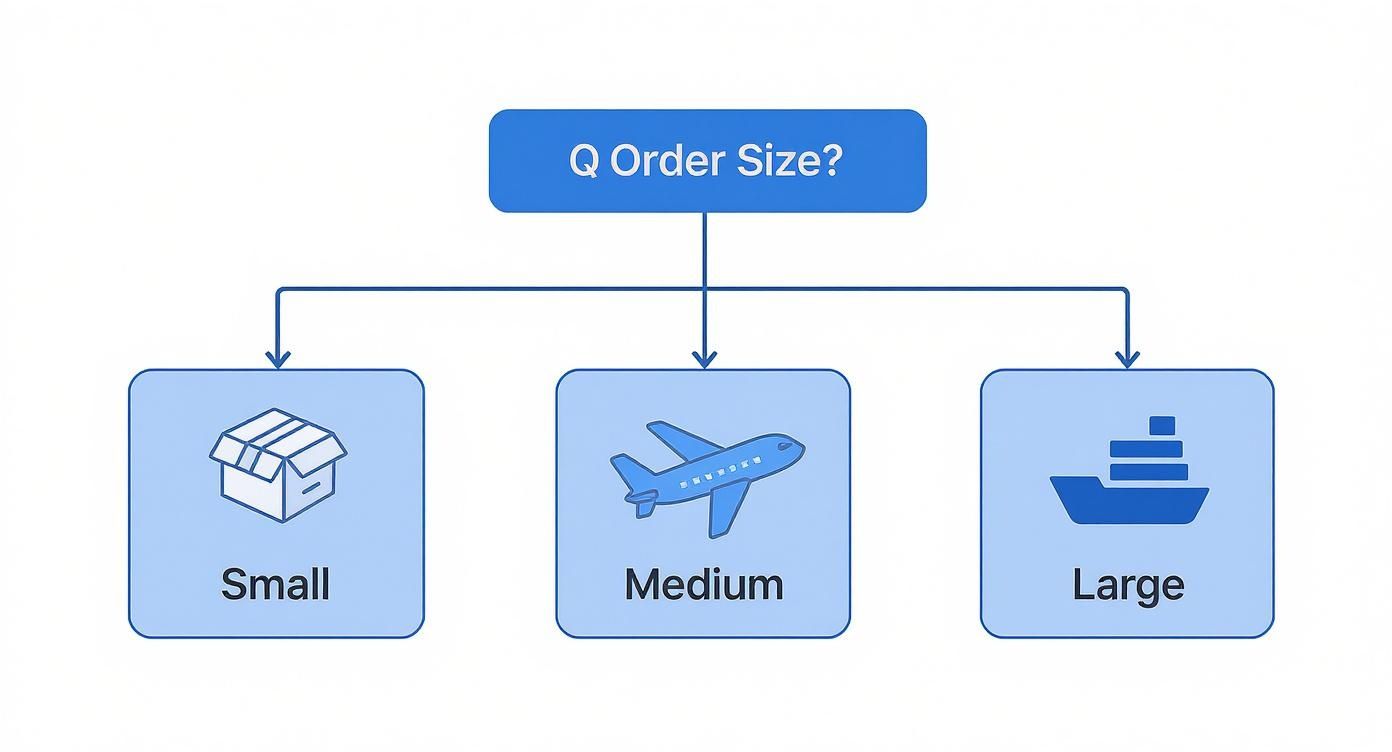
As you can see, the size of your shipment is the best place to start. It naturally points you toward the most logical and cost-effective shipping option.
When to Use Express Shipping
When speed and simplicity are everything, express shipping is your best friend. Think DHL, FedEx, and UPS. This is a true door-to-door service, which means the courier handles the entire journey—from pickup at the factory in China to your front door, customs clearance included.
This is the perfect fit for:
- Product samples you need to get your hands on ASAP.
- Small, lightweight orders, usually anything under 150 kg.
- Emergency restocks when a popular product is about to sell out.
The catch? It’s expensive. Express shipping is priced by the kilogram, making it the priciest option by a long shot. For anything beyond small or urgent shipments, the costs can absolutely destroy your profit margins.
Finding the Balance with Air Freight
Air freight hits that sweet spot between the lightning speed of express and the low cost of sea freight. You're looking at a transit time of about 5-15 days, which is a huge improvement over sea, but it's way cheaper than express for medium-to-large shipments (think anything over 150 kg).
One thing to keep in mind, though, is that air freight is typically an airport-to-airport service. This isn't door-to-door. You or your freight forwarder will have to arrange for someone to get your goods from the supplier to the departure airport, and then from the destination airport to your warehouse. It's a fantastic option for time-sensitive inventory that’s just too big and heavy for a courier. If you're just starting out, we have a more detailed guide on the https://alisavepro.com/best-shipping-for-small-business/ that you might find helpful.
Maximizing Profit with Sea Freight
For most importers buying in bulk, sea freight is the default setting. It is, without a doubt, the most economical way to ship large quantities of goods across the globe. The trade-off is patience—a sea journey can take anywhere from 30 to 60 days, sometimes even longer.
Sea freight delivers the lowest cost per unit, which is absolutely critical for maximizing your profit margins on big orders where time isn't the most pressing factor.
With sea freight, you’ll run into two main options:
- LCL (Less than Container Load): Your goods are bundled into a container with cargo from other importers. It’s a great system because you only pay for the space you actually use, making it ideal for shipments that aren't quite big enough to justify a whole container.
- FCL (Full Container Load): Here, you pay a flat rate to rent an entire 20-foot or 40-foot container for yourself. If your order is large enough to fill most of a container, this becomes the more cost-effective choice.
A quick pro-tip: when you're shipping larger volumes, especially by sea, your goods will likely be on pallets. Make sure they’re secured properly. Using a quality pallet wrap is a small investment that can save you a fortune by protecting your products from damage during their long trip.
Negotiating Incoterms with Your Suppliers
When you start digging into shipping from Alibaba, you’ll immediately run into a term called "Incoterms." It sounds like intimidating legal speak, but don't tune out—these are the single most important rules in your shipping contract. They spell out, in no uncertain terms, who pays for what and who is responsible for your products at every step of their journey.
Getting this right isn't just a suggestion; it's essential. The Incoterm you choose can drastically change your final landed cost and how much say you have over your own shipment. A simple misunderstanding here is a recipe for surprise bills and logistical headaches you just don't need.
The Three Incoterms You Must Know
Out of all the official Incoterms, you'll find that most Alibaba suppliers stick to just a few. If you can get a solid grasp on the big three, you'll be in a great position to protect your profits and control your own supply chain.
EXW (Ex Works): With this one, nearly all the responsibility lands squarely on your shoulders. The supplier’s job is done the moment they make the goods available at their factory door. From there, it's all on you: arranging the truck to pick it up, handling export customs in China, managing the main sea or air freight, and dealing with customs clearance back home.
FOB (Free On Board): This is the go-to for most experienced importers, and for good reason. Under FOB, your supplier handles getting the goods from their factory to the port in China, clearing them for export, and loading them onto the vessel. The second your cargo is safely on that ship, the responsibility (and cost) transfers over to you.
DDP (Delivered Duty Paid): This is the "hands-off" option. The supplier manages the entire process from their factory all the way to your warehouse or front door, including paying all the import duties and taxes. It sounds like a dream, but this convenience usually comes with a hefty price tag and a complete lack of control.
Why FOB Is Often Your Best Bet
The simplicity of DDP is tempting, I get it. But that simplicity hides a lot of markup. Suppliers will bake their own profit into the shipping and customs fees, leaving you with an inflated bill and zero visibility. You won't know who is carrying your freight, where it is, or why it’s delayed.
FOB strikes the perfect balance between cost and control.
Your supplier deals with the local legwork in China, which they know best. You take over for the main international transit, which is the most expensive part of the journey. This puts you in the driver's seat, allowing you to hire your own freight forwarder who works for you, not for your supplier. You can shop around for quotes, pick the carrier you trust, and get a transparent breakdown of the costs.
Here's a pro tip: When negotiating, always ask your supplier for quotes based on both FOB and EXW. This simple request forces them to itemize their local transport costs, giving you a clear picture of what they’re charging to get the goods to the port. You might find you can arrange it cheaper yourself.
Try phrasing it exactly like this: "Could you please provide the price for 1,000 units based on FOB Shanghai? Also, please provide a separate quote for EXW."
That one question gives you the leverage to compare costs and make the smartest financial move. Making the switch from DDP to FOB can easily save you 15-30% on your total shipping bill.
Getting to Your True Landed Cost
The price on your Alibaba invoice? That's just the starting line. To get a real grip on your profitability, you need to figure out your landed cost. This is the all-in, final price to get one single unit from the factory floor in China to your warehouse shelf, ready to sell. Honestly, this is the only number that truly matters for your bottom line.
So many new importers stumble right here. They get dazzled by a low per-unit price and completely forget about the cascade of fees that come after. Then the surprise bills start rolling in, and just like that, their expected profit margin evaporates. Don't let that be you.
Breaking Down the Landed Cost Formula
Calculating your landed cost isn't some dark art; it just takes a bit of diligence. The core formula is pretty simple:
(Product Cost + Shipping + Customs Fees + Overhead) / Total Number of Units = Landed Cost Per Unit
Let's quickly unpack what each of those pieces really means.
- Product Cost: This is the easy one—it's what you paid your supplier for each item.
- Shipping & Freight: This covers the main journey (air or sea) but also all the extras like fuel surcharges, port handling fees, and the cost to truck it from the port to your door.
- Customs Fees: Think of this as a bucket for duties (tariffs based on your product's HS Code), taxes (like VAT or GST), and the fee you pay the customs broker who navigates all the paperwork for you.
- Overhead: Don't forget the small stuff! This includes payment processing fees (that 3% adds up!), cargo insurance, and any costs tied to converting your money to pay the supplier.
Speaking of currency, it's a real factor. Gaining a solid understanding of the global currency exchange market is a smart move for any importer, as it can directly impact your final costs.
A Real-World Calculation Example
Let's walk through a quick example. Imagine you’re bringing in 500 custom water bottles.
| Cost Component | Total Cost |
|---|---|
| Product Cost (500 units @ $4/unit) | $2,000 |
| FOB Shipping & Freight | $450 |
| Customs Duties (e.g., 3%) | $60 |
| Brokerage & Port Fees | $150 |
| Payment & Insurance Fees | $90 |
| Total Cost | $2,750 |
Now, let's plug that total back into our formula: $2,750 / 500 units = $5.50 per unit.
See that? The bottle you thought cost $4.00 actually costs you $5.50 by the time it's in your hands. This is the real number you have to use when you set your prices and figure out if you're actually making money. For a more detailed walkthrough, our guide on how to https://alisavepro.com/calculate-cost-per-unit/ breaks it down even further.
Knowing your landed cost isn't just a boring accounting task—it's a powerful strategic tool. It tells you the true cost of your inventory, stops you from underpricing your products, and gives you a crystal-clear picture of your business's financial health.
Navigating Customs and Required Documents
Customs clearance can feel like the final boss battle when you're importing from Alibaba. I've seen it happen: one tiny mistake on a form, a single mistyped number, and suddenly your shipment is stuck. This can lead to expensive delays, surprise inspections, or—in a true worst-case scenario—customs seizing your goods. But it doesn't have to be this complicated.
The absolute key is getting your documentation perfect from the very beginning. Precision is everything. Think of these papers as your products' passport; without them, they're not getting into the country. This is not the place to rush.
The Essential Paperwork Trio
While specific requirements can vary a bit depending on your country, almost every single international shipment boils down to three core documents. Your freight forwarder will be your guide here, but you need to understand what these are and why they're so important.
- Commercial Invoice: This is the big one. It's the primary document customs officials look at. It needs to clearly list the buyer and seller, what the products are, the quantities, their value, and the Incoterms. Crucially, the value declared here determines your import duties.
- Packing List: This document breaks down exactly what's inside each box—the weight, dimensions, and number of cartons. It must line up perfectly with the Commercial Invoice because it’s what customs uses to physically verify your shipment.
- Bill of Lading (B/L) or Air Waybill (AWB): This is your contract with the shipping company. It functions as both a receipt for the shipment and, in some cases, the title to the goods. It's called a Bill of Lading for sea freight and an Air Waybill for air freight.
These three documents have to tell the same story. Any discrepancy between them is a massive red flag for customs and an open invitation for an inspection.
Cracking the HS Code
Every product you can imagine has a specific Harmonized System (HS) code. It's a universal classification system used by customs offices around the world to identify products for duty and tax purposes. Figuring out the right HS code is your responsibility, not your supplier's.
If you get this wrong, you could end up paying the wrong duty rate. You might overpay and lose money, or you might underpay and face hefty fines and penalties down the road. This is where a good customs broker really proves their worth—they can help you classify your products correctly so you pay exactly what you owe.
A classic rookie mistake is just trusting the supplier to handle all the paperwork without giving it a thorough review yourself. You have to double-check every single detail on that Commercial Invoice and Packing List before your goods leave the factory. As the importer of record, any errors are ultimately on you.
The sheer volume of e-commerce has put these processes under a microscope. In a recent fiscal year, retail revenue from Alibaba's international arms like AliExpress and Lazada soared to $16.5 billion, a massive 31% jump in just one year. This explosive growth is built on logistics, meaning customs authorities are more dialed-in on these shipments than ever. You can read more about Alibaba's international sales growth on Digital Commerce 360.
The single best move you can make is to hire a licensed customs broker or use a freight forwarder that offers brokerage services. These are the experts who live and breathe import regulations. They handle the electronic filing for you, making sure your shipment glides through customs. It’s an investment that turns a potential nightmare into just another step in the process.
Got Questions About Shipping from Alibaba? We've Got Answers
No matter how carefully you plan, your first few shipments will probably throw you a curveball. International logistics is a world of its own, full of jargon and unexpected hiccups. Knowing what to expect can save you a ton of stress.
Let's walk through some of the most common questions that trip up importers when they're shipping from Alibaba. Getting a handle on these now will help you troubleshoot on the fly and keep your goods moving.
"Why Isn't My Tracking Number Working?"
It’s a classic moment of panic: your supplier sends you a tracking number, you excitedly plug it into the carrier’s website, and you get an error message. "Not found." Don't hit the panic button just yet.
This is completely normal. It often takes 24-72 hours for a new tracking number to get scanned into the system and go live. The shipping label has been created, but your package probably hasn't hit the first major sorting hub. If you're still seeing nothing after three days, that’s your cue to send a polite message to your supplier or freight forwarder to see what’s up.
"What Are All These Surprise Fees on My Invoice?"
You did the math, calculated your landed cost down to the penny, and then the final bill arrives from your forwarder with a few extra line items you weren't expecting. What happened? These are usually legitimate—if incredibly annoying—charges that can pop up during transit.
Here are the usual suspects for those surprise fees:
- Demurrage/Detention: These are basically late fees. You get charged for not picking up your container from the port on time or for not returning the empty container fast enough.
- Customs Exam Fees: If your shipment gets pulled for a random or intensive customs inspection, you're the one who has to foot the bill for the exam itself.
- General Rate Increases (GRI): Ocean carriers sometimes tack these on during busy seasons when demand for space on ships is high.
The best way to avoid getting blindsided is to demand a detailed, all-inclusive quote from your freight forwarder from the very beginning. Ask them to list all potential charges, even the ones they think are unlikely. This forces transparency and helps you build a buffer into your budget, protecting your profit margins.
"Can I Change the Delivery Address After It's Shipped?"
Trying to change the delivery address once your goods are already on a boat or plane is tough, costly, and often, simply not possible. Once official documents like the Bill of Lading are issued with a specific delivery address, changing it is a whole bureaucratic process that can cause major delays.
With express couriers like DHL or FedEx, you might have a little more luck, but you’ll definitely pay a rerouting fee. For sea and air freight, it’s a much bigger ordeal. The best policy is to triple-check your delivery address on every single document before your shipment leaves China. It's a five-minute check that can save you weeks of headaches. If a change is absolutely unavoidable, get in touch with your freight forwarder immediately to see if anything can be done.
Streamlining your product sourcing is just as critical as managing your shipping. With AliSave Pro, you can download all AliExpress product images and videos in a single click, perfectly organized for your store listings and marketing campaigns. Stop wasting time saving files one by one and get back to growing your business. Try AliSave Pro for free today