
A solid dropshipping marketing plan isn't just a list of tactics. It's a cohesive strategy that starts with deep-dive research to find a profitable niche, moves into understanding your competition, and then gets crystal clear on your target customer. This foundation allows you to build a unique selling proposition (USP) that fuels every single marketing move you make—from paid ads to SEO.
Building Your Profitable Dropshipping Foundation
Before you even think about spending a dime on ads, you need to lay the groundwork. It's a classic mistake: so many new dropshippers find a "trending" product, throw up some TikTok ads, and wonder why their budget vanishes overnight with nothing to show for it.
The top 1% of sellers know the secret isn't just in the ads—it's in the prep work. A high-ROI strategy is built on a solid foundation, not just on fleeting tactics. This is where you make the calculated decisions that will dictate your success down the road.
You have to dig deeper than surface-level trends to find real, sustainable opportunities. The global dropshipping market is expected to hit a staggering $464.4 billion in 2025, which is a 27% jump from 2024. That's a massive pie, but with dropshipping accounting for nearly a quarter of all global ecommerce sales, you can bet the competition is fierce. This foundational work isn't optional; it's what separates the winners from the rest.
Uncovering Your Niche and Understanding the Market
The first step isn't about finding a product. It's about finding a market. A profitable niche is a focused segment of a larger market with its own unique needs, language, and culture. Don't think "I sell kitchen gadgets." Instead, think "I sell innovative tools for time-strapped vegan home cooks." See the difference? That specificity is your superpower.
To find these golden opportunities, you need to put on your detective hat. Go where your potential customers are already hanging out:
- Online Forums and Communities: Dive into Reddit subreddits like r/homegym or r/SkincareAddiction. Lurk in niche Facebook Groups. Listen to the language they use, the problems they constantly complain about, and the products they rave about to each other.
- Product Review Sites: Go to Amazon and sift through the reviews for popular products in a category you're exploring. The 1-star and 3-star reviews are goldmines. What are the common complaints? What features do people wish the product had? This is how you spot gaps in the market.
- Keyword Research Tools: Use a good keyword tool to see what people are searching for. Look for problems or product types that have decent search volume but low competition. These can be flashing green lights for an underserved market.
This whole process is about building your foundation brick by brick, starting with the right research.
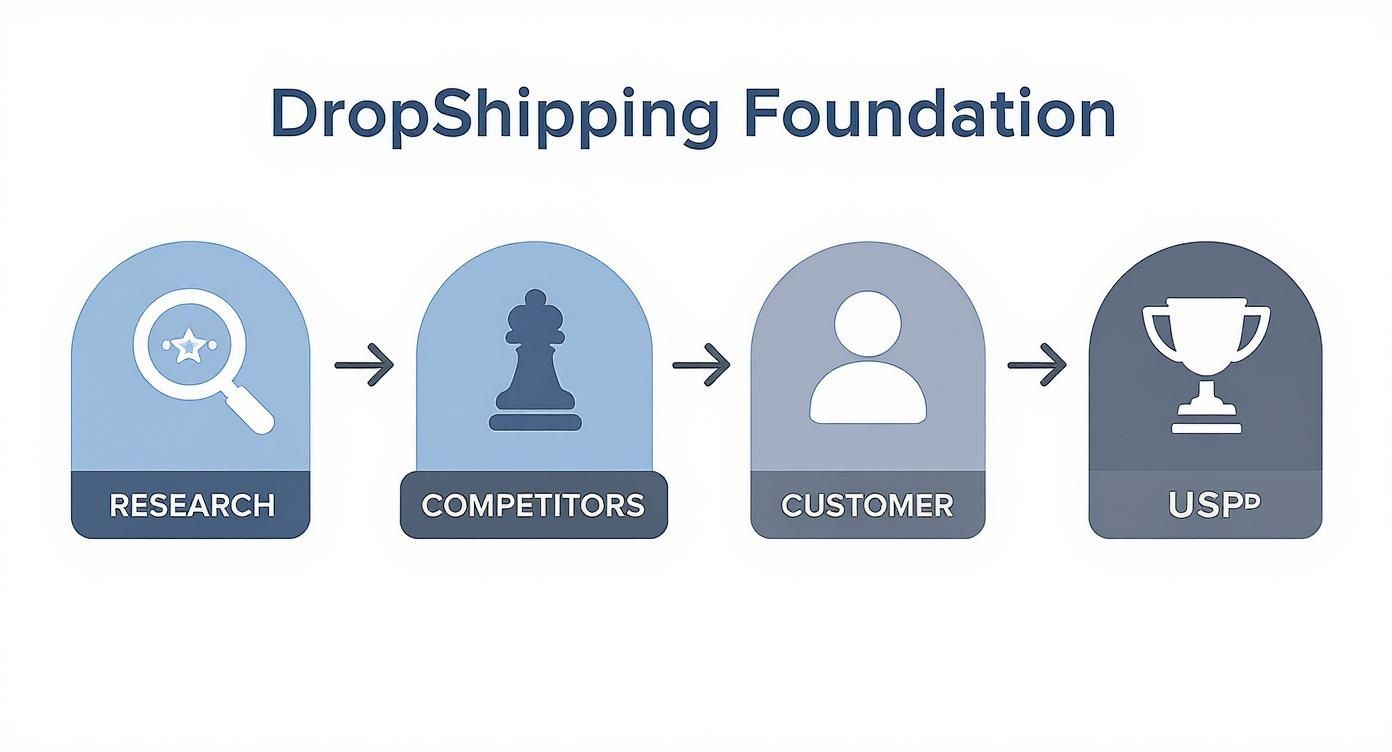
As you can see, everything starts with that deep research. Only then can you properly analyze the competition, pinpoint your ideal customer, and craft a message that actually works.
To map out your approach, here’s a quick breakdown of the core components every winning strategy needs.
Core Components of a Winning Strategy
| Strategy Pillar | Key Objective | Actionable Task |
|---|---|---|
| Market Research | Find a profitable, underserved niche with real demand. | Analyze Reddit, forums, and product reviews for customer pain points. |
| Competitor Analysis | Understand what others are doing right and wrong. | Study top competitors' ads, websites, and customer feedback. |
| Customer Targeting | Create a detailed profile of your ideal buyer. | Build a customer avatar including their values, fears, and desires. |
| Unique Selling Prop (USP) | Define why someone should buy from you. | Craft a clear statement on your unique value (e.g., speed, quality, mission). |
Getting these pillars right from the start is what separates the stores that last from the ones that fizzle out in a few months.
Defining Your Customer and Unique Selling Proposition
Once you have a market in your sights, you have to get laser-focused on who you're selling to. Building a customer avatar isn't just about listing their age and location. You need to get into their head. What do they value? What are their biggest frustrations? What keeps them up at night? When you know the answers, you can craft messaging that feels like you're reading their mind. For a more detailed walkthrough, you can check out our guide on https://alisavepro.com/how-to-start-dropshipping/.
With that deep customer insight, you can finally build your Unique Selling Proposition (USP). Your USP is the simple, powerful answer to the question, "Why should I buy from you and not the ten other guys selling something similar?"
Your USP is not about having the lowest price. It could be better product quality, a brand story people connect with, faster shipping, or over-the-top customer support. The key is that it has to be something your ideal customer genuinely cares about.
To really nail this, it helps to grow your Shopify store with better ad tracking and data-driven decisions so you can see what messaging truly resonates with your audience.
Creating Ads That Actually Stop the Scroll
Think about your own social media habits. You scroll, and scroll, and scroll. In a world where people fly through hundreds of feet of content every day, your ads have to do more than just show up—they have to be a speed bump. They need to command attention.
This is where all that deep research into your customer's pain points really starts to pay off. You don't need a Hollywood budget. You just need to pair compelling visuals with words that hit on a real problem or desire, creating an instant connection that makes someone pause.
Building Your Creative Arsenal Fast
One of the biggest time-sucks for dropshippers is getting good-quality photos and videos. You can't just slap the supplier's grainy, watermarked images on your site and expect people to pull out their credit cards. You need a fast, repeatable way to get your hands on professional-looking media.
This is where a tool like AliSave Pro becomes a game-changer. Instead of right-clicking and saving every single image, you can download all the high-res product photos, variant images, and even customer review photos from an AliExpress page with one click. This speed is your secret weapon, letting you test more ads and more products without getting bogged down.
Here’s a practical workflow I’ve used countless times:
- Gather Raw Assets: Use the tool to download every piece of media from the supplier page. This instantly gives you a library of professional shots, lifestyle photos, and real-world user content from the reviews.
- Produce Video Ads: Splice together short video clips and high-quality images to create simple, effective video ads. Your only goal for the first three seconds is to show the product solving the main problem.
- Create Static Images: Use the best downloaded photos to build out carousel ads, single-image ads for different platforms, and add trust-building graphics to your product page.
Key Takeaway: You’re not just making ads; you're building customer confidence with professional creative. A streamlined process for gathering media is a massive competitive advantage.
Writing Ad Copy That Connects Emotionally
The image makes them stop, but the words make them click. The best ad copy never just lists features—it solves a problem and tells a mini-story. One of the most reliable frameworks I always come back to is PAS (Problem-Agitate-Solution).
It's simple and it works:
- Problem: Call out the exact pain point your customer feels. "Tired of your phone dying right when you need it?"
- Agitate: Twist the knife a little. Remind them how annoying that problem really is. "Leaving you disconnected and frantically searching for an outlet at the worst possible moment."
- Solution: Present your product as the obvious hero. "Our ultra-slim power bank packs three full charges, keeping you powered up from your morning coffee to your late-night commute."
This structure is so effective because it mirrors the conversation already happening in the customer's head. You're showing them you get it. To really grab them in those critical first few seconds, mastering some killer hooks for Reels can make all the difference between a scroll and a sale.
Forging a Cohesive Brand Identity
Consistency is the bedrock of trust. When your store looks and feels professional, people are far more likely to trust you with their money. Your brand is more than a logo; it's the entire vibe.
Nail down these simple but critical elements from the start:
- Logo: Keep it clean and relevant. Don't overthink it.
- Color Scheme: Pick 2-3 primary colors and use them everywhere—your website, your ads, your social profiles.
- Tone of Voice: How does your brand talk? Is it fun and casual? Is it helpful and informative? That tone needs to be consistent across your ad copy, product descriptions, and even customer service emails.
By mastering your creative, you stop being just another person selling a product. You start building a real brand that people remember and trust. For more great ideas, check out these persuasive advertising techniques to take your campaigns to the next level.
With your product research done and your creative assets ready to go, it’s time to get your store in front of the right people. This is where the magic happens.
A winning dropshipping strategy isn't about throwing spaghetti at the wall to see what sticks. It's about being strategic and mastering the channels where your ideal customers are already hanging out.
We're going to build a marketing playbook that blends the fast wins from paid ads with the long-term, sustainable growth that comes from organic marketing and customer retention. Each piece of the puzzle has a specific job to do.
Mastering Paid Advertising on Social Platforms
Let's be real: paid social ads on platforms like TikTok and Meta (Facebook & Instagram) are the jet fuel for most dropshipping stores. They give you an incredible ability to put your product in front of the exact people most likely to buy it, sometimes within hours of launching a campaign.
The key is to start smart, not big. Don't blow your entire budget on an unproven product. I always recommend starting with a small daily budget, somewhere around $15-$25 per ad set. Your initial goal isn't to get rich overnight; it's to gather data. You need to validate that your product, your creative, and your audience targeting are all working together.
Once you find a winning combination—an ad that’s bringing in sales at a profitable Cost Per Acquisition (CPA)—it’s time to scale. This is where lookalike audiences become your best friend. After you have a decent amount of data, say 100+ purchases, you can create a lookalike audience based on your actual customers. You’re essentially telling the platform, "Go find me more people exactly like these ones," which can dramatically expand your reach to a super-qualified audience.
Pro Tip: When you're ready to scale, don't just crank up the budget on your existing ad set. Duplicate the winning ad set and increase the budget on the new one by 20-30% every 48-72 hours, but only if it stays profitable. This method avoids shocking the algorithm and helps keep your performance stable.
Driving Free Traffic with Organic Social Media
Paid ads get you quick wins, but an organic social media presence is your long-term ticket to free, sustainable traffic. It's less about being a storefront and more about building a genuine community. This is how you build real brand loyalty and open a direct line of communication with the people who love your products.
Your content needs to offer value beyond just "buy my stuff." Share things that resonate with your niche and what your customers actually care about.
Here are a few tactics that work like a charm:
- User-Generated Content (UGC): Actively encourage your customers to post photos and videos with your product. When you reshare this content, it acts as powerful social proof. It’s one of the most authentic trust signals you can have.
- Behind-the-Scenes Content: Show the person behind the brand. Even as a dropshipper, you can film yourself packing an order (with a sample product), do an unboxing video, or talk about your brand's mission. People connect with people.
- Interactive Content: Don't just post—engage. Run polls in your Stories, ask open-ended questions in your captions, and host live Q&As. The more your audience interacts, the more the algorithm will push your content to new eyeballs.
Think of it this way: when someone sees your ad and clicks over to your profile, a vibrant, active community gives them the confidence they need to pull out their credit card.
Finding Authentic Influencer Partners
Influencer marketing can be a goldmine, but you have to approach it the right way. Forget about chasing huge celebrities. The real power is with micro-influencers—creators with around 10k-100k followers—who have a highly engaged, niche-specific audience.
Their followers actually trust their recommendations, so an endorsement feels more like a genuine tip from a friend than a slick advertisement. Spend time finding influencers whose personal brand, content style, and values feel like a perfect match for your store.
Before you even think about reaching out, do your homework. Dig into their comments. Are people having real conversations, or is it just a bunch of "nice pic" comments from bots? A high engagement rate is infinitely more valuable than a huge follower count. A great way to start is by offering a free product in exchange for an honest review or a few posts. It's a cost-effective way to get authentic content that truly resonates.
Automating Sales with Email Marketing
Email marketing consistently delivers one of the highest ROIs of any channel. Why? Because it’s an asset you own. Your email list isn't at the mercy of some algorithm change on a social media platform.
Setting up a couple of key email automations is non-negotiable. These are your automated sales machines that capture revenue you'd otherwise lose.
Every single dropshipping store needs these two flows from day one:
- Abandoned Cart Sequence: This is your safety net. A simple series of 2-3 automated emails sent to people who add an item to their cart but leave without buying can recover a surprising amount of lost sales. The first email is a gentle reminder, and the next one can offer a small discount to seal the deal.
- Welcome Series: When someone new joins your list, this is your chance to make a killer first impression. A welcome series can introduce your brand story, highlight your best products, and offer a small discount for their first purchase. It turns a curious visitor into a loyal customer.
Building that list is priority number one. To help you get started, you can find a ton of effective tactics in our in-depth guide to building an email list from scratch.
Marketing Channel Strengths and Weaknesses
Choosing the right channels can feel overwhelming. This table breaks down the top options to help you decide where to focus your energy and budget.
| Channel | Best For | Key Challenge | Time to Results |
|---|---|---|---|
| Paid Social Ads | Rapidly testing products, scaling quickly, and precise targeting. | Rising ad costs and ad fatigue. Requires constant testing. | Fast (24-72 hours) |
| Organic Social | Building a loyal community, generating free traffic, and social proof. | It’s a slow burn; requires consistent effort to gain traction. | Slow (3-6+ months) |
| Influencer Marketing | Building trust and authenticity, reaching niche audiences. | Finding the right partners and tracking direct ROI can be tricky. | Medium (1-4 weeks) |
| Email Marketing | High ROI, customer retention, and recovering lost sales. | Building a quality list from scratch takes time and strategy. | Medium (Immediate for automations) |
| SEO | Sustainable, free, high-intent traffic over the long term. | Highly competitive and takes a long time to see results. | Very Slow (6-12+ months) |
Ultimately, a multi-channel approach creates a powerful synergy where each channel supports the others. The dropshipping model has absolutely exploded, with up to 33% of online retailers now using it. This growth is fueled by smart, niche-focused marketing, especially in hot markets like Fashion, which is projected to grow at a massive 26.4% CAGR. Understanding these trends shows just how much opportunity is out there if you build your marketing playbook the right way.
Scaling Beyond Ads for Sustainable Growth
If your entire business hinges on paid social ads, you're building a house on rented land. One algorithm hiccup or a sudden ad account ban, and your revenue can vanish overnight. A truly powerful dropshipping strategy has to move past the quick wins to build something that lasts.
This is where you shift from just running campaigns to actually building a brand. It’s about setting up systems that bring in traffic and sales on their own, cutting your dependency on constantly rising ad costs and creating a much more stable, predictable business. Let’s dig into how you can build these growth engines.
Unlocking Free Traffic with SEO for Dropshippers
SEO can sound complex, but for a dropshipping store, it's more straightforward than you might think. It's your ticket to grabbing the attention of high-intent customers who are already searching for things you sell. Unlike an ad that interrupts their feed, SEO provides an answer to a question they're actively asking, which is why the conversion rates are so much better.
Your first move should be mastering product page SEO. This is all about optimizing your product titles and descriptions with the exact keywords real people are punching into Google. Don't just stick with the generic product name. If you're selling a portable blender, you should be targeting phrases like "best travel blender for smoothies" or "quiet personal blender for office."
Next, start creating some simple, genuinely helpful blog content. You don't need to be a world-class writer; you just need to answer common questions your customers have.
- Product Face-Offs: Write a post comparing your product to a well-known competitor, but make sure to highlight what makes yours better.
- Actionable Guides: Create a simple how-to guide showing customers how to use your product to solve a real problem. For that portable blender, a post like "5 Healthy Smoothie Recipes You Can Make in 2 Minutes" is perfect.
- Problem-First Content: Tackle the pain points your product solves head-on. An article titled "How to Eat Healthy When You Have a Busy Schedule" can naturally introduce your blender as the perfect solution.
Key Insight: SEO is a marathon, not a sprint. You won't see traffic flood in overnight, but a single, well-ranked blog post can become an asset that pulls in free, targeted customers for months or even years. The return on that initial time investment can be massive.
Turning One-Time Buyers into Loyal Fans
Your email list is one of the most valuable assets you can build. Period. It's a direct channel to your customers that you own and control, completely free from the unpredictable whims of social media platforms. The real magic happens when you move beyond generic email blasts and get into smart segmentation.
Segmentation is simply about grouping your subscribers based on what they've done. This lets you send hyper-relevant messages that feel like a personal recommendation, not a mass advertisement.
Here are a few high-impact segments to get you started:
- The VIP Club: Create a segment for your most loyal customers—the ones who buy often or spend the most. Treat them like gold with early access to new products, exclusive discounts, or a simple loyalty program.
- The One-and-Dones: Target customers who have only bought from you once. A few weeks after their purchase, hit them with a "win-back" campaign that includes a compelling offer to entice them back for a second purchase.
- Product-Specific Buyers: If someone bought a specific item, you know what they're interested in. Did they buy a coffee grinder? A few weeks later, you can market your premium coffee beans to them. It just makes sense.
Personalized campaigns built around these segments will always outperform a generic newsletter. You stop being just a store and start building a real relationship, which is how you boost your Customer Lifetime Value (CLV).
Smart International Expansion
Once you've dialed in a profitable system in one country, the next logical step is to explore international markets. But hold on—you can't just copy and paste your ads and expect them to work everywhere. Smart expansion is all about testing and adapting.
A good starting point is to test your winning ads in English-speaking countries with similar consumer cultures, like Canada, the UK, and Australia. If you get a positive signal, you can then start venturing into non-English-speaking markets, but this requires a much more localized game plan.
Understanding regional market dynamics is absolutely critical. While dropshipping is booming globally, the opportunities look different everywhere. For example, regional data shows the Asia-Pacific region dominates with a 35.2% market share and is projected to grow by an astounding 24.5% through 2030. North America isn't far behind with up to a 35.8% share and 23.5% growth, while European shoppers are increasingly favoring locally sourced and eco-friendly products. You can dive deeper into these global dropshipping statistics on Printful.com.
This data tells you that your messaging, your ad creative, and even your product selection may need to change to fit the cultural norms of each new region. A strategy that crushes it in the US might need a total overhaul to resonate in Germany or Japan. The key is to start small, test carefully, and let the data be your guide.
Using Data to Turn Your Ads Into a Profit Machine
Trying to run a dropshipping marketing strategy without tracking your data is like driving blind. You're spending money, sure, but you have no real idea where it's going or if you're about to drive straight off a cliff. Your marketing data tells a story—you just need to learn how to read it. This is how you stop guessing and start building a predictable system for making money.
The point isn't to get buried in spreadsheets or obsess over vanity metrics that don't move the needle. Instead, we're going to zero in on the handful of Key Performance Indicators (KPIs) that actually determine whether your store is healthy or on life support. This creates a powerful feedback loop where every dollar you spend teaches you how to make the next one work even harder.
Tracking the Numbers That Actually Matter
To run a profitable dropshipping business, you have to get comfortable with a few core metrics. These are the numbers that tell you if you're making money, breaking even, or lighting cash on fire.
Here are the non-negotiables:
- Cost Per Acquisition (CPA): This is simply what you pay, on average, to get a single customer. Spend $100 on ads and get five sales? Your CPA is $20. For you to be profitable, your CPA has to be lower than your product's profit margin. It's that simple.
- Return On Ad Spend (ROAS): This is the ultimate health check for your ad campaigns. It measures the total revenue you get back for every dollar you put in. A 3x ROAS means you made $3 in revenue for every $1 you spent.
- Customer Lifetime Value (CLV): This is a bit more advanced but incredibly powerful. It's an estimate of the total profit you'll make from a customer over their entire time shopping with you. A high CLV means you can afford to pay more to acquire a customer upfront and still be wildly profitable in the long run.
Get a grip on these three numbers, and you'll have a crystal-clear picture of your business's financial health. They take the emotion out of decision-making and let you operate on cold, hard facts.
Setting Up Your Data Foundation
Before you can track any of this, you need the right tools wired up correctly. Installing tracking pixels isn't an "if I have time" task; it's the absolute bedrock of any data-driven dropshipping marketing strategy. Without them, your ad platforms are just guessing.
First things first: install the Meta Pixel on your Shopify or WooCommerce store. This little snippet of code is your lifeline to Facebook and Instagram. It tracks what people do on your site—viewing products, adding to their cart, and making a purchase—and feeds that crucial information back to your ad account. This is how you optimize ads and build killer retargeting audiences.
At the same time, get Google Analytics set up. While the Meta Pixel tells you what's happening with your ads, Google Analytics gives you the 30,000-foot view of your entire website. You'll see where your traffic is coming from (not just ads), which pages are the most popular, and how people navigate your site.
Crucial Takeaway: Don't skip this. Seriously. Taking an hour to triple-check that your Meta Pixel and Google Analytics are installed and firing correctly will save you thousands of dollars in wasted ad spend. It is the single most important technical step you'll take.
A Simple Framework for A/B Testing
With your tracking locked in, it's time to start optimizing. A/B testing (or split testing) sounds complicated, but it's just comparing two versions of something to see which one gets better results. The key is to keep it simple. Test one major thing at a time so you know exactly what made the difference.
For instance, you could run simple tests like:
- Creative: Use the exact same ad copy and targeting, but pit a video ad against a static image. See which one gets cheaper clicks and more sales.
- Ad Copy: Take your winning video or image and test two different headlines. Try a long, story-driven caption against a short, punchy one that gets straight to the point.
- Audience: Once you have a killer ad, test it on two completely different groups. Try an audience interested in "hiking" against one interested in "camping gear" and see which one responds better.
By methodically testing these core elements, you slowly but surely figure out what your audience wants. It turns marketing from a gamble into a science, and your ROI will thank you for it.
Common Dropshipping Marketing Questions Answered
Even the best-laid plans come with questions. Let's tackle some of the most common ones I hear from dropshippers so you can get started with more confidence.
How Much Should I Realistically Budget for Marketing?
There's no magic number, but a solid starting point for your initial testing phase is somewhere between $500 and $1,000. This gives you enough runway to collect meaningful data without betting the farm.
As you grow, a good rule of thumb is to dedicate 15-25% of your target revenue to marketing. If you're just starting out, think smaller. A daily budget of $15-$25 per ad set is plenty. The goal at first isn't massive profit; it's proving you can get a positive Return On Ad Spend (ROAS). Once an ad is a clear winner, you can start scaling up from there.
What's the Best Marketing Channel to Start With?
For getting results fast, you can't beat TikTok and Meta Ads (Facebook/Instagram). Their targeting capabilities are incredibly powerful, letting you zero in on specific customer groups, which is a lifesaver when you're on a tight budget.
- TikTok is a goldmine for products with that visual "wow" factor that can stop someone mid-scroll.
- Meta has been in the game longer, offering robust, data-rich targeting for almost any kind of product imaginable.
My advice? Pick one platform. Just one. Master it, get profitable, and only then should you think about adding a second channel. Trying to do everything at once is a classic rookie mistake that burns through cash and gets you nowhere.
How Soon Can I Expect to See Sales?
If you're running paid ads, you could see your first clicks and maybe even a sale within 24-48 hours. This early feedback is pure gold for validating that you're on the right track with your product and ads.
But don't mistake a few early sales for consistent profitability. That's a different beast entirely. Getting to a point where your store is a reliable income source usually takes a few weeks, sometimes even a couple of months, of serious testing. You'll be tweaking everything—products, ad copy, videos, audiences, and offers—based on real-world data.
Organic channels like SEO are a much longer game. You're typically looking at 6-12 months before you see a significant stream of free traffic. Patience is the name of the game in dropshipping.
Ready to create scroll-stopping ads in seconds? AliSave Pro lets you download all the high-resolution photos and videos from any AliExpress page with a single click. Stop wasting time and start building your creative arsenal faster. Download the free Chrome extension.