

It’s a gut-wrenching moment for any seller: the "Your Etsy Account is Suspended" email. The notification can feel like a sudden stop to your business, often without a clear explanation. It's easy to spiral into panic, but what you do in the next 24 hours is absolutely critical.
Many times, especially for newer shops, these suspensions are temporary hiccups triggered by an automated system. It could be a simple verification flag or a minor policy misunderstanding. The key is to stay calm and approach this strategically, not emotionally.
That Dreaded Email: Your First 24 Hours After Suspension
When that suspension email hits your inbox, it's a shock to the system. You're hit with a mix of frustration, confusion, and maybe even a little anger. A lot of sellers find this happens right after they open their shop, which is usually just Etsy's automated systems doing a routine check.

Your first instinct might be to fire off a frantic message to Etsy Support demanding answers. Don't. Take a deep breath. Your goal right now isn't to get an instant fix; it’s to build a solid case for your appeal.
The One Mistake You Cannot Make
Whatever you do, do not open a new Etsy shop. I can't stress this enough. It might seem like a quick workaround, but Etsy sees it as ban evasion—a cardinal sin in their book. Their systems are incredibly good at linking accounts through IP addresses, bank details, and personal info.
Trying to sneak back on with a new account is the fastest way to turn a temporary problem into a permanent, irreversible ban.
Key Takeaway: Your only path forward is through the official appeal process for your suspended account. Resisting the urge to create a new one is the most important thing you can do right now.
Your Immediate Triage Plan
Before you type a single word of your appeal, you need to play detective. The first step is to figure out why this happened. You can't fix a problem if you don't know what it is.
Here’s a quick-reference table to help you identify the likely cause and what to do immediately.
Common Etsy Suspension Triggers and Initial Actions
| Suspension Reason | What It Looks Like | Your First Action (Within 24 Hours) |
|---|---|---|
| New Shop Verification | You just opened your shop, maybe listed your first few items. The email is often generic. | Check that your ID, bank details, and tax information are all uploaded and match exactly. |
| Financial/Billing Issue | The email might mention an overdue balance or a problem with your payment method. | Log in to your payment account. Pay any outstanding Etsy fees and update your credit card on file. |
| Policy Violation (IP, Handmade) | The email specifically mentions a policy, like "Intellectual Property Infringement" or "Handmade Policy." | Scour your listings for any potential violations related to that policy. Remove or edit them immediately. |
| Unusual Account Activity | You recently had a huge spike in sales, or logged in from a different country. The email is vague. | Document the reason for the activity (e.g., "I ran a promotion," "I was on vacation"). |
| Linked to a Banned Account | The email might be blunt, stating your shop is associated with another that was closed. | Identify any possible connections: shared Wi-Fi, bank accounts, or addresses with another seller. |
Once you've got a working theory, it's time to gather your evidence. This methodical approach will make your appeal far more effective.
Dissect the Suspension Email: Read it again, slowly. Are there any keywords like "unusual activity" or specific policy names? Those are your starting clues.
Check Your Finances: Log into your payment account. An overdue balance or an expired card on file is a surprisingly common and easily fixed trigger.
Review Recent Actions: What did you do just before the suspension? List a bunch of new items? Update your bank info? Fulfill a large order? A seemingly innocent action can sometimes trip the automated system, like a data mismatch between a shipping address vs billing address.
Secure Your Data: If you can still access parts of your dashboard, download everything—order history, customer lists, and your listing data. This is crucial for keeping your business moving and for your records if the suspension drags on.
By taking these steps, you move from a place of panic to a position of control. You’ll be armed with the information you need to contact Etsy and make a clear, compelling case for getting your shop back.
Why Etsy Suspends Accounts: The Most Common Reasons
Figuring out why Etsy suspended your account is the first—and most critical—step to getting it back. Etsy's systems, many of which are automated, are constantly scanning for red flags. While getting flagged can feel sudden and random, nearly every suspension traces back to one of three core areas: intellectual property, account security, or shop performance.
You have to nail down the specific reason your shop was shut down. A generic appeal that doesn't directly address the root cause is almost guaranteed to be rejected.
Intellectual Property Violations: The Number One Culprit
This is, by a long shot, the biggest reason shops get suspended, and it trips up sellers of all experience levels. Intellectual property (IP) infringement is a fancy way of saying you used someone else's copyrighted or trademarked material without their permission. It’s an especially common minefield in the print-on-demand world, but it can catch any seller off guard.
A few real-world examples I see all the time:
- Slapping a quote from a popular movie or TV show onto a t-shirt.
- Creating fan art of a well-known cartoon character and selling it as a sticker.
- Using a famous brand's name in your tags to get seen, like "Nike-style sneakers."
- Selling a product that's a dead ringer for another company's patented design.
Etsy has to take IP complaints seriously because they are legally required to. Often, the first warning shot isn't a full suspension but a DMCA (Digital Millennium Copyright Act) takedown notice for a single listing. Ignoring these is a fatal mistake.
According to expert analyses from e-commerce legal firms, intellectual property (IP) infringement has emerged as the top culprit behind permanent suspensions. Etsy often suspends accounts when sellers accumulate a threshold of IP claims—sometimes as few as 5-10 unresolved reports—triggering automated flags that lead to full shop shutdowns. Seller forum data suggests IP violations are linked to 42% of all permanent bans, making it the leading cause. You can learn more about these findings from e-commerce legal experts.
Account Verification and Security Flags
This one is an incredibly frustrating, and common, roadblock for new sellers. Etsy’s automated systems are on high alert for fraud, so new shops get put under a microscope. It’s not unusual for a suspension to happen within hours of opening your shop, seemingly for no reason at all.
This kind of suspension is usually temporary, but you need to act fast. The most common triggers are:
- Information Mismatches: The name on your driver's license doesn't perfectly match the name on your bank account. Even a missing middle initial can cause a problem.
- VPN or Public Wi-Fi: Logging into your shop from different locations, especially using a VPN or hopping on public Wi-Fi at a café, can look like a hacking attempt to Etsy's bots.
- Linked to a Banned Account: If you share a home address, Wi-Fi network, or bank account with someone who has had their Etsy shop banned, your shop can get shut down just by association.
- Sudden Location Changes: Did you open your shop in New York and then log in from Paris while on vacation? That can trigger an automatic security freeze.
These flags are all about protecting the marketplace. Keeping your shop's information consistent and secure is a key part of any solid ecommerce fraud prevention strategy.
Poor Performance Metrics and Customer Service Issues
Etsy is constantly grading your shop's performance. While one or two unhappy customers won't get you shut down, a consistent pattern of poor service absolutely will. This is a slower path to suspension, but it's just as serious.
The system is looking for shops that fall below Etsy's Seller Service Level Standards. Here are the key metrics that can put your account in jeopardy:
- High Case Rate: This is the percentage of your orders where a customer opens a formal "case" against you. If this number creeps above 1%, you're in the danger zone.
- Late Shipping: Etsy expects you to maintain a 95% or higher on-time shipping rate. If you're constantly shipping orders after your stated processing time, it’s a huge problem.
- Unanswered Messages: You have to be responsive. Regularly failing to answer customer messages within 24 hours will tank your shop's reputation with Etsy.
- Negative Reviews: A few bad reviews are just part of doing business. But a sudden wave of one-star ratings, especially ones complaining about not receiving items, can trigger a manual review and a potential suspension.
Think about a seller using a dropshipping supplier who starts having massive delays. If that seller doesn't immediately update their processing times or communicate with their buyers, they'll rack up late shipments and a flood of angry messages. To Etsy, this pattern screams "unreliable," making a suspension almost inevitable.
Writing a Plan of Action That Actually Works
This appeal is your one shot to get your shop back online. I've seen too many sellers shoot from the hip with an emotional, frantic message, and that's the fastest way to get a final "no" from Etsy. You have to treat this as a serious business communication. Your goal is to submit a professional Plan of Action (POA) that proves you understand the mistake and are a seller worth keeping.
A strong POA isn't about begging for forgiveness. It’s a business document, plain and simple. It needs to be clear, concise, and logical. You're essentially building a case for why you should be reinstated, and it helps to think like you're putting together a formal argument. Some sellers I've worked with have even used expert tips for writing a legal brief to structure their thoughts effectively. The main objective is to make it incredibly easy for the support agent to see what went wrong, what you’ve done to fix it, and why they can trust it won't happen again.
The Three Pillars of a Winning POA
Every successful appeal I've seen is built on three core components. Think of them as the legs of a stool—if one is missing, the whole thing collapses. Each part serves a distinct purpose, showing you’ve fully grasped the situation from every angle.
First, you need to know why you were suspended. It almost always boils down to one of these three areas.
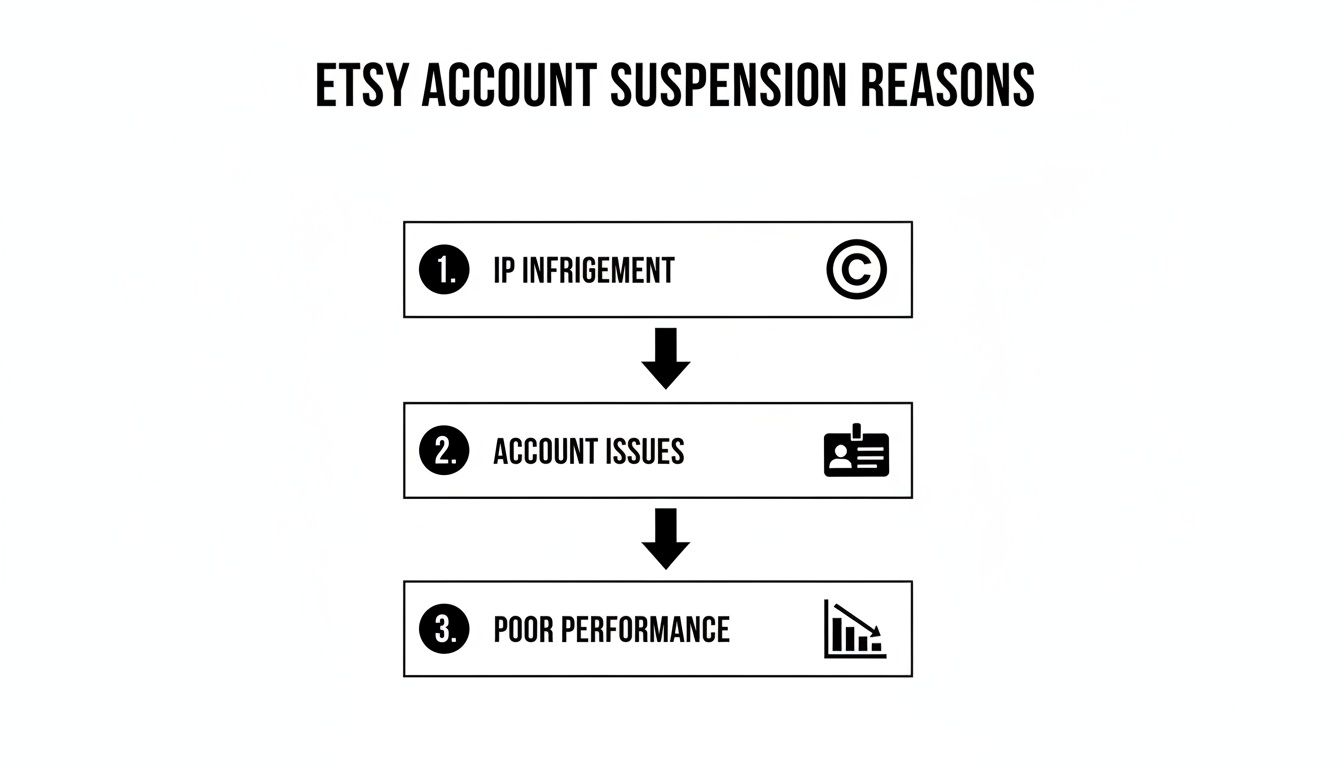
This flowchart nails it: suspensions are typically about intellectual property, account details, or performance metrics. Figure out which bucket you fall into, and you've got your starting point.
Acknowledge the Root Cause Without Excuses
First things first, you have to own it. Pinpoint the exact policy you violated and take full responsibility. This is not the time for excuses, blaming buyers, or complaining that a policy is unfair. The agent reading your appeal needs to see that you've done your homework and aren't trying to deflect.
For instance, a weak appeal says, "I think I might have violated an IP policy." A strong one is specific: "Root Cause: I have identified that my account was suspended for violating Etsy's Intellectual Property Policy. Specifically, I listed three t-shirt designs that used trademarked phrases from a popular TV show, which I did not have the license to use." See the difference? It shows you’re not guessing.
Detail Your Immediate Corrective Actions
Next, show them you’ve already fixed the mess. This part isn’t about what you plan to do; it’s about what you have already done. This is your chance to show you’re proactive and serious. These actions have to directly address the root cause you just identified.
Let's stick with the IP infringement example. Your immediate actions might look like this:
- Action Taken: I have permanently deleted the three infringing listings (ASINs: XXXXXX, YYYYYY, ZZZZZZ) from my shop.
- Action Taken: I have performed a complete audit of my 47 remaining listings to confirm that no other products violate Etsy’s IP policies.
- Action Taken: I have reread Etsy’s entire Intellectual Property Policy to ensure I fully understand the rules on trademarks and copyrights going forward.
Outline Your Long-Term Preventative Systems
This is the most critical part. You have to convince Etsy this was a one-time mistake, not a pattern of behavior. To do that, explain the new systems or processes you're putting in place to guarantee it never happens again. This is where you prove you’re a reliable business owner, not just someone who’s sorry they got caught.
For our IP violation scenario, your preventative plan could include:
- New Process: Before creating any new design, I will now use the USPTO's TESS database to conduct a thorough trademark search for all phrases and symbols.
- New System: I have created a design checklist that must be completed for every new listing, which includes a sign-off confirming the IP check was performed.
- Ongoing Education: I have blocked out time on my calendar for a quarterly review of Etsy’s Seller Policy updates to stay on top of any changes.
This approach shows you're building a sustainable, compliant business on their platform. Remember, having clear policies in your shop is also part of being a professional seller; for instance, a solid cancellation policy sample helps manage customer expectations and prevent disputes.
Gathering Your Evidence
A well-written POA is great, but a well-written POA backed by proof is even better. Your words gain immense power when you can back them up with documentation. The evidence you need will depend entirely on why you were suspended.
Pro Tip: Don't just dump a bunch of files on them. Organize everything into a single PDF or a neatly labeled ZIP file. Name each document clearly (e.g., "Supplier_Invoice_T-Shirts.pdf," "Original_Cat_Design_Sketches.jpg"). Make it easy for the agent to see your proof.
To get you started, here’s a quick checklist of the kinds of documents that can strengthen your case.
Appeal Evidence Checklist
The right paperwork can make or break your appeal. Match your suspension type to the evidence below to build a stronger case.
| Suspension Type | Primary Evidence to Include | Secondary Supporting Documents |
|---|---|---|
| IP Infringement | Letters of authorization or licensing agreements if you have them. | Invoices from suppliers proving the source of your goods; original design files or sketches to prove your work is original. |
| Account Verification | A clear, unedited photo of your government-issued ID; a recent utility bill matching the name and address on your account. | Bank statements showing the legal name of your business; business registration documents. |
| Poor Performance | Proof of shipment for all outstanding orders (tracking numbers); screenshots of communication with customers showing you resolved issues. | A revised business plan showing new inventory management or customer service protocols. |
Combining a solid, structured POA with compelling evidence turns your appeal from a simple request into a professional argument for reinstatement. You’re not just saying you’re sorry—you’re proving you are a competent business owner who deserves a place on Etsy.
What to Expect After You Submit Your Appeal
Hitting "submit" on your appeal is a strange mix of relief and pure dread. You've done the hard work of crafting your Plan of Action, but now the waiting game begins—and it’s easily one of the most stressful parts of this whole ordeal. Knowing what to expect can make it a little more bearable.
Right after you file, an automated email will land in your inbox. This is just a computer-generated confirmation that Etsy received your appeal. It doesn't mean a human has seen it yet, and it definitely doesn't give you any clues about the outcome. It's just a sign that you're officially in the queue.
How Long Will It Take? (And How to Stay Sane)
Everyone wants to know: "How long is this going to take?" I wish I had a simple answer, but it's all over the map. I've seen sellers get reinstated in just a couple of business days, while others have been left hanging for weeks. The timeline really depends on how complicated your situation is, how swamped the support team is, and how clear you made your case.
Here’s the single most important piece of advice I can give you for this phase: do not send follow-up emails. I know it's tempting to poke them for an update, but it's the worst thing you can do. Most support systems, Etsy's included, see a new email as a new ticket or an update that bumps your case. Essentially, every time you send a message, you risk sending yourself to the back of the line.
Key Insight: After you submit your appeal, your best move is to be patient. Resist the urge to reply to the automated email or open new tickets. Give the support team at least 10-14 business days before you even think about trying another angle.
What If Your Appeal Gets Rejected?
Getting that rejection email is a gut punch, but don't assume it's the end of the road. Read the email very carefully. Is it a generic, copy-paste response with no real details? If so, you might have a shot at escalating. But if they give you specific reasons for the denial, you absolutely have to address those exact points head-on if you want any chance of them reconsidering.
Escalating should be your last-ditch effort, only used when you get a rejection that feels truly unfair or completely unexplained. If that happens, you can reply to the rejection email and politely ask for your case to be reviewed by a specialist or a different team member. Think of it as asking for a second opinion, not demanding they change their minds.
Keep in mind, customer service issues can be a silent killer for successful shops. Etsy is incredibly strict, requiring a case rate below 1% and on-time shipping above 95%. Dropping below these numbers often triggers a suspension, and unfortunately, the success rate for appealing these permanent bans is only around 18%. To have a chance, you need iron-clad proof like tracking logs and a very convincing plan to fix the problems. You can find more real-world stories about seller standards in the Etsy community forums.
Building a Resilient Shop to Prevent Future Suspensions
Getting your shop reinstated is a massive relief, but the real work starts now. The goal isn't just to get back online; it's to build a business that's so solid and compliant that you never have to go through this again. This is about shifting your mindset from reactive panic to proactive prevention, making compliance a core part of how you run your shop.

A proactive approach means you're constantly looking for potential issues and fixing them before Etsy’s bots ever have a chance to flag them. When you make your shop’s health an ongoing priority, you're not just following rules—you're protecting your income and building a sustainable brand on the platform.
Performing Regular Shop Audits
Don't wait for that dreaded "Notice of Suspension" email to pop into your inbox before you take action. One of the most powerful things you can do is conduct a thorough self-audit every month or, at the very least, every quarter. I'm not talking about a quick scan; this is a deep dive into every corner of your shop.
To make sure you don't miss anything, create a simple checklist. Here's what you should be looking at:
- Intellectual Property Check: Go through every single listing. Read your titles, tags, and descriptions with a critical eye. Are you using any brand names, even casually? Are there copyrighted characters, song lyrics, or famous quotes in your designs? If it’s even a little bit questionable, get rid of it.
- Listing Accuracy: Does the product a customer receives look exactly like your photos and match the description? If you're selling handmade items, are your materials listed correctly and honestly? For those using production partners, is that information clearly disclosed on the listing page as required?
- Policy Review: This is a big one. Open your shop policies in one browser tab and Etsy’s current Seller Policy in another. Compare them side-by-side. Make sure your processing times, shipping details, and return policies are crystal clear and fully aligned with Etsy's latest standards.
This kind of regular maintenance helps you stay ahead of any policy updates and stops tiny oversights from snowballing into a full-blown crisis.
Uniqueness in a Saturated Market
If you use production partners or a dropshipping model, your risk of suspension can be significantly higher. Why? Because Etsy's entire brand is built on unique, handmade, and vintage items. Simply uploading a supplier's default stock photos and generic descriptions can set off alarm bells for Etsy’s review team.
The secret to staying compliant and successful in this space is customization. You have to add your own distinct value.
Crucial Takeaway: Never, ever use the default images and descriptions from your supplier. Your listings must look and feel original to your brand. This isn't just about avoiding suspension; it's how you stand out from the dozens of other sellers offering the exact same product.
For instance, instead of using that bland mockup photo of a t-shirt that everyone else has, order a sample. Take your own lifestyle photos of someone actually wearing it. Rewrite every product description from scratch in your brand’s voice, highlighting what makes your design special, not just rattling off the manufacturer's specs. This is how you transform a generic commodity into a unique product.
Maintaining Flawless Account Health
Think of your account health metrics as your reputation with Etsy. A poor track record is like a slow-burning fire that can suddenly erupt into suspension. A big part of building a resilient shop is understanding the broader digital trust and safety strategy that platforms like Etsy use to keep their marketplace safe for everyone.
For your part, you need to be obsessed with excellence in these three areas:
- Shipping Performance: Always ship on time, period. If you feel a wave of orders coming or know you're heading into a busy season, adjust your processing times before you get swamped.
- Case Resolution: Your goal should be a zero-case rate. Tackle customer issues directly and professionally through messages. Solve their problem before they even think about escalating it to a formal case with Etsy.
- Communication: Answer every single message within 24 hours. Fast, friendly, and helpful communication builds incredible trust and can often turn a potentially bad experience into a 5-star review.
Finally, a word of caution for new sellers: you are especially vulnerable to verification-related suspensions. Etsy's Know Your Customer (KYC) process is incredibly strict. Many new shops get tripped up by simple mistakes, like using a VPN or having tiny mismatches between the name on their ID and their bank account information. While appeal wait times can average 10-14 days, it’s a tough road—only about 31% of sellers suspended for these issues get reinstated, even if they quickly fix the problem.
By making these practices a non-negotiable part of your routine, you're doing more than just avoiding another suspended Etsy account. You're building a stronger, more professional, and ultimately more profitable business.
Etsy Suspension FAQs: Your Top Questions Answered
Getting that suspension notice from Etsy sends your head spinning. The questions come thick and fast, and the stress is real. Let's cut through the noise and get you some straight answers to the most common things sellers ask when their shop is on the line.
Can I Just Open a New Shop After Being Banned?
I have to be blunt here: absolutely not. Trying to open a new shop after a permanent suspension is a critical, often irreversible mistake.
Don't think you can outsmart the system. Etsy links accounts using a huge web of data—your IP address, the device you log in from, bank accounts, names, addresses, you name it. Opening a new shop is what they call ban evasion, and it gets flagged almost instantly. The new shop will be shut down, and it pretty much guarantees they'll never look at an appeal for your original account.
The Hard Truth: Don't waste your energy on a new shop. It's not a clever workaround; it's a move that will lock in your ban for good. Your only real shot is to focus everything on a proper appeal for the account that was suspended.
How Long Am I Going to Be Waiting for This Appeal?
This is probably the most frustrating part of the whole process—there's no set timeline. It’s a total toss-up. I've seen sellers get a response in a couple of days, while others are left in limbo for weeks on end.
What makes it take so long? A few things are at play:
- The "Crime": A simple ID verification issue is way faster to fix than a complicated trademark infringement case.
- The Queue: You're not the only one appealing. If they're swamped with cases, everyone waits longer.
- Your Appeal's Clarity: A well-written, clear Plan of Action with solid proof is much easier for a support agent to process than a rambling, emotional email.
Once you hit "send" on that appeal, you'll get an auto-reply. After that, it's a waiting game. Realistically, you should give it at least 10-14 business days before you even think about following up. Patience isn't just a virtue here; it's a core part of the strategy.
What Happens if They Reject My First Appeal?
Getting that rejection email feels like a gut punch, but it might not be the end of the road. The first thing you need to do is stop, take a breath, and read Etsy's email very, very carefully. Occasionally, they'll give you a hint about why it was denied.
If it's just a generic "nope," you might have one more shot. But before you fire off another email, you have to get brutally honest with yourself about your first attempt. Ask yourself:
- Did I really explain the root cause of the problem?
- Did I back up my words with enough evidence?
- Did I actually own my mistake without making excuses?
Your second appeal can't just be a slightly reworded version of the first. It needs to be significantly better, filling in all the gaps you missed. If that second appeal also gets rejected, your options shrink dramatically, and it's time to start preparing for the fact that the suspension is likely permanent.
Streamline your product workflow with AliSave Pro. Download high-quality AliExpress product images, videos, and review photos in a single click, saving you hours of manual work. Get the free Chrome extension and build beautiful product listings faster. Learn more at https://alisavepro.com.