
So, how much does Shopify really take from each sale?
Let's cut right to the chase. If you're using their built-in payment processor, Shopify Payments, you can expect a fee between 2.4% and 2.9% plus a fixed 30¢ on every single transaction. The exact percentage isn't random; it's tied directly to which monthly plan you're on. The more you pay for your plan, the less you pay per sale.
Your Direct Answer to Shopify Per-Sale Costs
When you're trying to nail down exactly how much Shopify costs per sale, it's best not to think of it as one single charge. Instead, see it as a couple of different operational costs that get bundled together. The final amount you pay depends on your subscription plan and, crucially, how you choose to process customer payments.
Think of it this way: your monthly Shopify plan is like paying rent for your digital storefront. The transaction fees? That's the cost of using the "credit card machine" every time a customer checks out. These two things are the bedrock of your per-sale costs.
Why Your Payment Processor Matters
Here’s where things get interesting. Your choice of payment processor is a huge factor in your final costs. If you stick with Shopify's own system, Shopify Payments, you’ll just pay their standard credit card processing fee. Simple.
However, if you decide to use a third-party gateway like PayPal or Stripe, Shopify will charge you an additional transaction fee on top of whatever your chosen gateway charges you.
Think of it like this: Shopify encourages you to stay within their ecosystem. By using Shopify Payments, they waive that extra fee. It’s their way of rewarding you for keeping your entire operation under one roof.
Shopify Fees At a Glance by Plan
To make this crystal clear, it helps to see the numbers side-by-side. Here’s a quick breakdown of the core fees associated with each main Shopify plan, so you can see how they stack up.
| Shopify Plan | Shopify Payments Rate (Online) | Third-Party Transaction Fee |
|---|---|---|
| Basic | 2.9% + 30¢ | 2.0% |
| Shopify | 2.6% + 30¢ | 1.0% |
| Advanced | 2.4% + 30¢ | 0.5% |
As you can see, the difference between the Basic and Advanced plans isn't just the monthly price—it's also about a 0.5% difference in online transaction rates. That might seem small, but for a store doing significant volume, that half-a-percent adds up to serious savings over time. Choosing the right plan is a balancing act between your monthly "rent" and your per-sale costs.
This guide will walk you through exactly how these fees work. By the end, you'll be able to calculate your true net revenue on every order and make smarter decisions to protect your profit margins.
Breaking Down Shopify’s Core Costs: Subscription Plans and Transaction Fees
Every Shopify store owner juggles two core costs that chip away at every sale: the monthly subscription plan and the per-transaction fees. Think of your subscription plan like the rent you pay for your digital storefront. It's a predictable, fixed monthly cost that gets you the space and the tools you need to do business online.
Just like a physical shop can be a small boutique or a massive superstore, Shopify offers different plan tiers—Basic, Shopify, and Advanced. Each one comes with its own price tag and a different toolkit. The Basic plan is great for getting your feet wet, whereas the Advanced plan is built for high-volume stores that need more firepower.
But the subscription is only half the story. The cost that really fluctuates and bites into every single order is the transaction fee. This is where your choice of payment processor becomes a massive decision for your business.
The Big Split: Shopify Payments vs. Third-Party Gateways
Shopify definitely has a favorite way for you to get paid, and they make it crystal clear in their fee structure. You essentially have two options for processing payments, and each one hits your bottom line differently.
Using Shopify Payments: This is Shopify’s own, built-in payment processor. When you use it, Shopify does you a big favor: they waive their separate "transaction fee." You still have to pay the standard credit card processing rate (we'll get to that next), but you dodge an extra percentage cut.
Using a Third-Party Gateway: This means you're plugging in an outside processor like PayPal, a standalone Stripe account, or Authorize.net at checkout. This can give you more flexibility, but it comes at a price. Shopify tacks on an extra transaction fee for every single sale that runs through one of these external gateways.
This extra fee isn't an accident. It's a powerful nudge to keep everything—your store, your payments, your finances—inside the Shopify ecosystem. The reward for playing along is a simpler, and usually cheaper, fee structure.
Getting this concept down is crucial if you want to accurately predict how much Shopify really takes per sale. If you opt for a third-party gateway, you're paying their processing rate plus Shopify's extra fee on top. It’s a double-dip that can seriously erode your profit margins if you're not paying attention. To get a better handle on how the platform operates, you can learn more about how Shopify works in our detailed guide.
How Upgrading Your Plan Slashes Transaction Fees
That extra fee for using third-party gateways isn't a one-size-fits-all penalty. It actually shrinks as you climb the ladder of Shopify subscription plans. This creates a really interesting strategic choice for growing stores. As your sales pick up, spending more on a higher-tier plan can paradoxically save you a ton of money by cutting down those per-sale costs.
Here’s a look at how it breaks down:
- Basic Shopify Plan: You'll hand over a 2.0% transaction fee on every sale made through a third-party gateway.
- Shopify Plan: The fee gets chopped in half to just 1.0%.
- Advanced Shopify Plan: It drops even lower, down to a mere 0.5%.
This fee structure is especially critical for business models like dropshipping. For example, if you're sourcing from AliExpress, these fees can have a huge impact on your thin margins, particularly if you aren't using Shopify Payments. On the Basic plan (around $39/month), that 2.0% extra fee from Shopify on every PayPal or Stripe sale stings. But as you scale, upgrading to the Shopify plan cuts it to 1.0%, Advanced to 0.5%, and Shopify Plus down to just 0.2%—that's a 90% reduction from the Basic plan, which makes a world of difference when you're processing thousands in monthly sales.
At the end of the day, understanding how your monthly plan and transaction fees work together is the first step to mastering your store’s finances. It clarifies the base costs you’re up against before we even touch on the credit card processing rates that apply to every single order, no matter what.
Getting to Grips With Credit Card Processing Rates
Alright, we've covered your base subscription and Shopify's transaction fees. Now, let's talk about the single biggest variable cost that hits every sale you make: credit card processing rates.
This is a fundamental cost of doing business online. No matter which payment gateway you use, someone has to securely process your customer's card details, and they take a small fee for that service. Think of it as the toll for using the digital highway that connects your customer's bank to yours.
Shopify Payments simplifies this by bundling everything into one predictable rate. It’s typically a small percentage of the total sale plus a fixed fee, like 2.9% + 30¢. The best part? This rate isn't fixed in stone. As your business grows and you upgrade your Shopify plan, that percentage actually goes down.
How Your Shopify Plan Changes Your Processing Rate
This is a crucial point: the Shopify plan you choose directly impacts how much you pay on every single credit card transaction. By investing in a higher-tier plan, Shopify rewards you with lower processing rates, which can save you a serious amount of money as your sales volume climbs.
Here’s a quick breakdown of the standard online credit card rates for stores in the United States:
- Basic Shopify Plan: You'll pay 2.9% + 30¢ per transaction.
- Shopify Plan: The rate drops to 2.6% + 30¢ per transaction.
- Advanced Shopify Plan: This plan gets you the best rate at 2.4% + 30¢ per transaction.
That tiered structure is a powerful incentive. While the fixed 30¢ fee stays the same, shaving off that percentage point can make a huge difference to your bottom line, especially when you're processing hundreds or thousands of orders.
The image below shows you just how big a difference it makes to use Shopify's own payment system versus a third-party one.
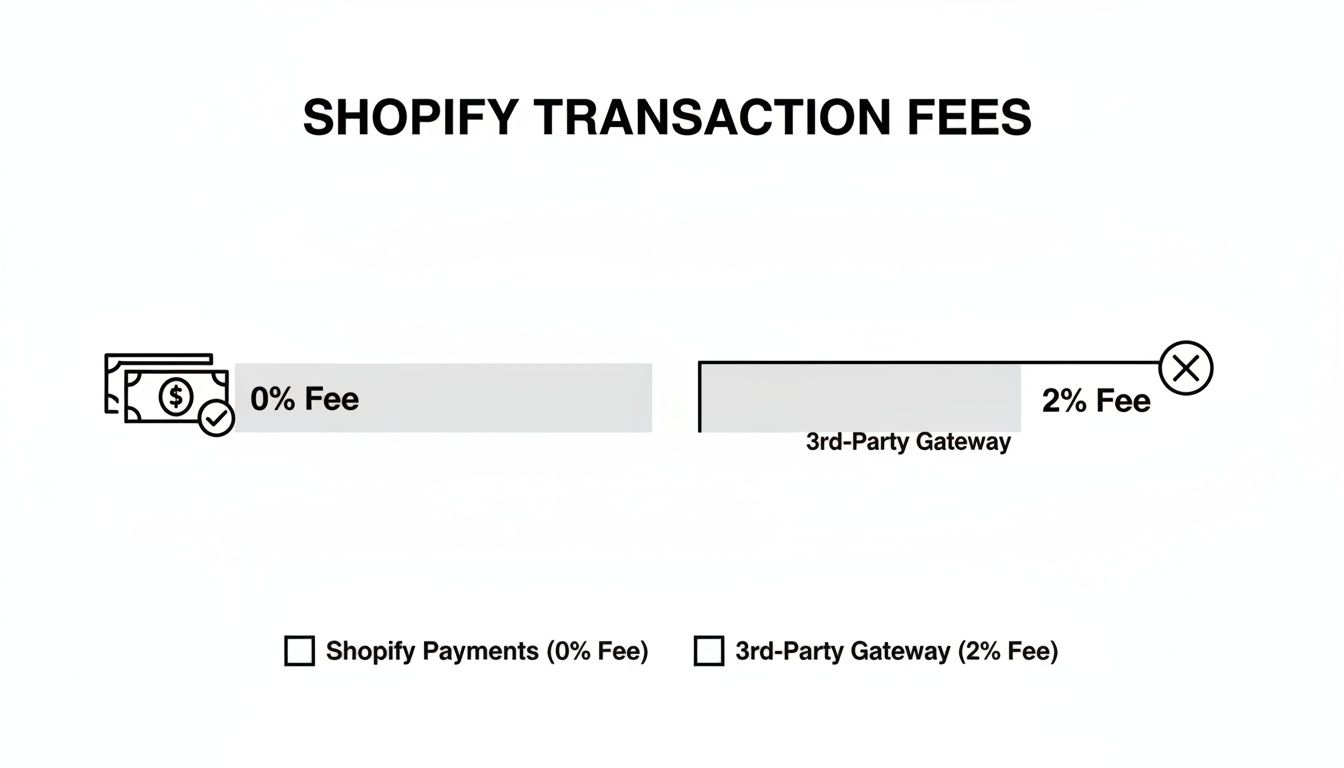
As you can see, sticking with Shopify Payments means you completely sidestep those extra transaction fees, making it the most economical choice for the vast majority of store owners.
Cost Per $100 Sale Using Shopify Payments
To really see how this works, let's look at a standard $100 sale. The table below breaks down exactly what you'd pay in fees and what you'd keep on each Shopify plan.
| Shopify Plan | Credit Card Rate | Fee on $100 Sale | Your Net Revenue |
|---|---|---|---|
| Basic Shopify | 2.9% + 30¢ | $3.20 | $96.80 |
| Shopify | 2.6% + 30¢ | $2.90 | $97.10 |
| Advanced Shopify | 2.4% + 30¢ | $2.70 | $97.30 |
The numbers speak for themselves. While a few cents per sale might not seem like much at first, these savings accumulate quickly as your business scales.
A Real-World Example: Selling a $50 Product
Let's ground this with a more concrete example. Imagine you sell a product for $50.00. What’s the actual processing fee you’d pay on each plan?
- On the Basic Plan: (0.029 * $50) + $0.30 = $1.75.
- On the Shopify Plan: (0.026 * $50) + $0.30 = $1.60.
- On the Advanced Plan: (0.024 * $50) + $0.30 = $1.50.
That quarter you save between the Basic and Advanced plans really adds up. For a store doing 1,000 orders a month, that’s an extra $250 in your pocket—or $3,000 over the course of a year. Credit card rates are a huge piece of the puzzle; you can learn more about all the Shopify payment processing fees and how they fit into your overall costs.
What About In-Person and International Sales?
It’s worth noting that the rates we've discussed are for online sales within your own country. The fees can shift depending on how and where you sell.
- In-Person Sales (POS): When a customer swipes or taps their card in person using Shopify POS, the fraud risk is lower. Because of that, you get a better processing rate.
- International Sales: Selling to customers abroad is fantastic, but processing an international credit card usually comes with an extra fee (often 1%) to cover the added complexity and risk of cross-border payments.
- American Express: Depending on your region, you might see a slightly different rate for transactions made with an American Express card.
Once you have a handle on these credit card fees, you have the last major piece of the Shopify cost puzzle. You can now see the complete picture of how your plan, your payment processor, and even where your customers are located all play a role in how much Shopify takes per sale.
Putting It All Together: Your True Cost Per Sale
Alright, theory is one thing, but what does this actually look like when you make a sale? The real test of your profitability is seeing how these fees stack up in day-to-day business.
Let’s run through a few common scenarios. Think of these as a blueprint you can use to calculate your own numbers and see just how much of each sale ends up in your pocket.
Scenario 1: The New Dropshipper
Let's imagine Alex, who's just starting out. Alex dropships cool phone cases for $35 each and is on the Basic Shopify plan. To keep things simple and avoid extra fees, Alex uses Shopify Payments for all transactions.
When a customer buys a phone case, the math looks like this:
- Order Total: $35.00
- Basic Plan Rate: 2.9% + 30¢
- Percentage Fee: $35.00 x 0.029 = $1.02
- Fixed Fee: + $0.30
- Total Shopify Fee: $1.32
So, after Shopify takes its cut, Alex receives $33.68 from that sale. This is the gross revenue—the money that lands in the bank before paying for the product itself, marketing, or any other business costs. Of course, knowing the cost of that phone case is the next crucial step. To get that right, you’ll want to https://alisavepro.com/calculate-cost-per-unit/ and make sure your pricing leaves enough room for profit.
Scenario 2: The Growing Brand Juggling Gateways
Now, meet Sarah. Her apparel brand is taking off, and she's on the mid-tier Shopify plan. One of her bestsellers is a hoodie that goes for $80. Sarah offers both Shopify Payments and PayPal at checkout because she knows some customers strongly prefer one over the other.
This is where things get interesting. Let’s say she gets two separate $80 orders—one through each payment gateway. The fees are not the same.
Order #1: Paid with Shopify Payments
- Order Total: $80.00
- Shopify Plan Rate: 2.6% + 30¢
- Percentage Fee: $80.00 x 0.026 = $2.08
- Fixed Fee: + $0.30
- Total Shopify Fee: $2.38
- Net Revenue: $77.62
Order #2: Paid with PayPal (a third-party gateway)
This one is a double-whammy. Sarah has to pay a fee to PayPal for processing the payment and a separate transaction fee to Shopify for using an outside gateway.
- PayPal's Fee: Let’s assume PayPal's standard rate of 3.49% + 49¢. They take ($80 x 0.0349) + $0.49 = $3.28.
- Shopify's Third-Party Fee: Since Sarah is on the Shopify plan, she pays a 1.0% fee to Shopify. That’s another $80 x 0.01 = $0.80.
Total Fees for the PayPal Order: $3.28 (to PayPal) + $0.80 (to Shopify) = $4.08. That's a full $1.70 more than the exact same order processed through Shopify Payments.
Scenario 3: The High-Volume Power Seller
Finally, let's look at a high-volume electronics store on the Advanced Shopify plan. They sell a drone for $500 and, wisely, stick to Shopify Payments to get the best possible rate.
Here's how their fee breaks down on a single sale:
- Order Total: $500.00
- Advanced Plan Rate: 2.4% + 30¢
- Percentage Fee: $500.00 x 0.024 = $12.00
- Fixed Fee: + $0.30
- Total Shopify Fee: $12.30
Now, what if this store had never upgraded from the Basic plan? The fee would have been ($500 x 0.029) + $0.30 = $14.80. By moving up to the Advanced plan, they save $2.50 on this one sale alone. When you're processing hundreds of these a month, that adds up to serious money.
Remember, transaction fees are just one piece of the puzzle. You also need to calculate shipping costs accurately, as that’s another major variable that can eat into your margins if you're not careful.
Uncovering Hidden Costs That Affect Your Profits

Your monthly plan and the credit card rates are the big, obvious numbers on your Shopify bill. But if that's all you're tracking, you're missing a big piece of the puzzle. Several other costs can quietly chip away at your margins, and knowing about them is the only way to protect your profits.
Think of it like buying a house. The mortgage is the main event, but you've still got to account for property taxes, insurance, and the occasional leaky faucet. Your Shopify store operates the same way—beyond the main fees, there are other operational costs you need to plan for.
These extra charges usually pop up in specific scenarios, like when you sell to a customer overseas or have to deal with a disputed payment. Let's peel back the layers on these expenses so you can build them into your budget and avoid any nasty surprises.
Navigating International Sales and Currency Conversion
Selling globally is a massive perk of e-commerce, but it comes with its own unique fee: currency conversion. When someone in another country buys from you in their local currency, Shopify has to convert that money into your store's currency before it hits your bank account.
Shopify charges for this service. The fee changes depending on your location, but it’s typically around 1.5% to 2.0% of the transaction amount. This gets tacked on after the conversion, taking another small slice out of your revenue.
Say you run a US-based store and sell a $100 item to a customer in Europe. Shopify converts their Euros to USD, and then a 2% fee is applied to that final USD total, slightly trimming your payout.
For merchants with a lot of international customers, this can add up fast. It's especially important when you start stacking these fees. For instance, you could be looking at a 1.5-2% currency conversion fee on top of a potential $15 chargeback fee. To get the full picture, it's worth exploring all the ways Shopify costs break down.
The Cost of Chargebacks and Disputes
A chargeback is a forced refund initiated by a customer's credit card company. It usually happens when a customer claims they never received a product, a transaction was fraudulent, or they're unhappy with their purchase.
When a chargeback hits your store, Shopify immediately pulls the disputed sale amount from your account. They also hit you with a non-refundable chargeback fee. In the United States, that fee is $15.
Here's how it plays out:
- You win the dispute: If you provide enough evidence to prove the transaction was legitimate, Shopify returns the original sale amount. The $15 chargeback fee, however, is gone for good.
- You lose the dispute: If the bank sides with the customer, you're out the sale amount, the product you shipped, and the $15 fee. It’s a triple-whammy.
Understanding How Refunds Impact Your Fees
Finally, let’s talk about refunds. When a customer returns an item and you process a refund, you send them back the full amount they paid. Simple enough.
But here’s the kicker: Shopify does not refund the original credit card processing fees you paid on that sale. That 2.9% + 30¢ (or whatever your plan's rate is) is a sunk cost. You've essentially paid to process a transaction that was later undone, making every return a direct hit to your profitability.
How to Lower Your Shopify Fees and Keep More Profit
Knowing what Shopify takes from each sale is one thing, but actually doing something about it is where you make more money. The good news? You have more control than you might think. A few smart adjustments can significantly lower those fees and boost what you actually take home.
The single biggest lever you can pull is picking the right Shopify plan for your current sales volume. So many store owners get stuck on the Basic plan, thinking they're saving on the monthly subscription. But as your sales grow, the higher transaction fees on that plan start eating away at your profits, often costing you way more than an upgrade would.
Find Your Plan's "Break-Even" Point
Stop thinking of your Shopify plan as just a monthly bill. It's an investment in lowering your per-sale costs. The trick is to figure out the exact point where the savings from lower credit card rates on a bigger plan completely cover the higher monthly fee.
Let's look at an example. Moving from the Basic plan (2.9% + 30¢) to the Shopify plan (2.6% + 30¢) saves you a clean 0.3% on every single transaction. Once your monthly sales are high enough, that 0.3% you're saving adds up to more than the price difference between the plans. At that point, upgrading literally pays for itself.
Pro Tip: Your plan fee isn't a fixed, unavoidable cost. It's a strategic choice. Every month or two, check your sales volume. If an upgrade would save you money on processing fees, it's time to make the switch.
Stick with Shopify Payments
This one is a no-brainer for most businesses. Unless you have a very specific, high-risk product or another compelling reason to use an outside processor, Shopify Payments is your most cost-effective bet.
Why? If you bring in a third-party gateway like PayPal or Stripe, Shopify slaps an extra transaction fee on top of what that gateway already charges you. This fee ranges from 2.0% down to 0.5%, depending on your plan. It’s a double whammy that can really hammer your margins. By using Shopify's built-in system, you dodge that extra fee entirely, making every sale instantly more profitable.
Choosing the right payment setup is a huge part of your store's foundation. You can dive deeper into these kinds of decisions in our guide to the best ecommerce platform for different business models.
Drive Up Your Average Order Value (AOV)
Sometimes, the best way to fight fees is to make each sale bigger. Think about that fixed 30¢ fee that's tacked onto every transaction—its impact shrinks as the order size grows. Selling more to each customer is a powerful way to make that fixed cost almost irrelevant.
Recent analysis shows that Shopify fees can eat up 2.5-3.5% of a typical store's sales. For dropshippers, it's even more critical—they risk losing 10-15% of their margin by not optimizing their plan and AOV.
We see this with the over 20,000 dropshippers using tools like AliSave Pro. By using high-quality product media from AliExpress, they can lift their AOV by 15-25%. That increase directly offsets the transaction fees. For a store doing $100k in revenue, combining a higher AOV with a smart plan upgrade can cut the total impact of fees by over 20%. It's a clear example of how small operational tweaks can lead to big savings.
Got Questions About Shopify Fees? We’ve Got Answers.
It's completely normal to have a few questions when you're trying to pin down the exact costs of running an online store. Let's clear up some of the most common ones we hear from merchants trying to understand what Shopify really takes from each sale.
What Happens If I Use PayPal Instead of Shopify Payments?
This is a big one. If you opt for an external payment gateway like PayPal, you're essentially getting hit with two separate fees on every single order. First, PayPal will take its cut for processing the payment (their standard rate is around 3.49% + 49¢).
But that's not all. Because you’re not using Shopify’s own system, Shopify will add its own transaction fee right on top.
- Basic Plan: An extra 2.0% goes to Shopify.
- Shopify Plan: An extra 1.0% goes to Shopify.
- Advanced Plan: An extra 0.5% goes to Shopify.
As you can see, using a third-party gateway almost always works out to be more expensive. For the vast majority of stores, sticking with Shopify Payments is the smartest financial move.
Is Shopify More Expensive Than Other Platforms?
It's easy to look at the monthly price and make a snap judgment, but you have to compare the total cost. Sure, a platform like WooCommerce is "free" to download, but that’s just the beginning. You still have to pay for web hosting, security certificates (SSL), and often a handful of premium plugins to get the features you need. Those costs can stack up fast.
Shopify, on the other hand, bundles everything—hosting, top-notch security, and a huge suite of built-in features—into one predictable monthly fee. Their transaction fees are also very competitive, particularly as you move up to the higher-tier plans.
The real question isn't about the sticker price; it's about the total cost of ownership. Shopify's all-in-one approach saves a lot of headaches and often prevents the surprise expenses that can pop up with self-hosted platforms.
When Should I Upgrade My Shopify Plan?
There’s a simple math trick to figuring this out. You should upgrade your plan the moment the savings on transaction fees outweigh the increase in your monthly subscription.
Think about it this way: going from the Basic plan (2.9% per sale) to the Shopify plan (2.6%) saves you 0.3% on every transaction.
Let's do the math. The price jump between the Basic and Shopify plans is $66/month. To find your break-even point, you just need to figure out how much in sales makes that 0.3% saving equal $66. The answer? Once your store is consistently hitting over $22,000 in monthly sales, the upgrade literally pays for itself.
Ready to create stunning product listings that drive sales and boost your Average Order Value? AliSave Pro is the fastest way to download high-quality AliExpress product photos and videos in a single click. Join over 20,000 dropshippers who use our free tool to build better stores, faster. Get started with AliSave Pro.