
When it comes to paying on AliExpress, you’ve got options. While the sheer number of choices can feel overwhelming at first, it really boils down to a few solid, secure methods that most shoppers stick with: credit/debit cards, PayPal, and AliPay. These are the big three for a reason—they offer excellent buyer protection and are accepted almost everywhere, making your checkout process a breeze.
How to Choose the Best AliExpress Payment Method for You
Let's cut through the noise and figure out the best and safest way for you to pay on AliExpress. The goal here is to help you pick the right option before you even get to checkout, so you can shop with total confidence.
Think of it this way: each payment method has its own personality. Some are all about rock-solid security, like credit cards with their chargeback features. Others are built for speed and convenience, like digital wallets that let you pay with a click. Understanding these key differences is the first step to making a smart choice.
To make things even clearer, this handy infographic breaks down the main benefits of the top payment methods on the platform.
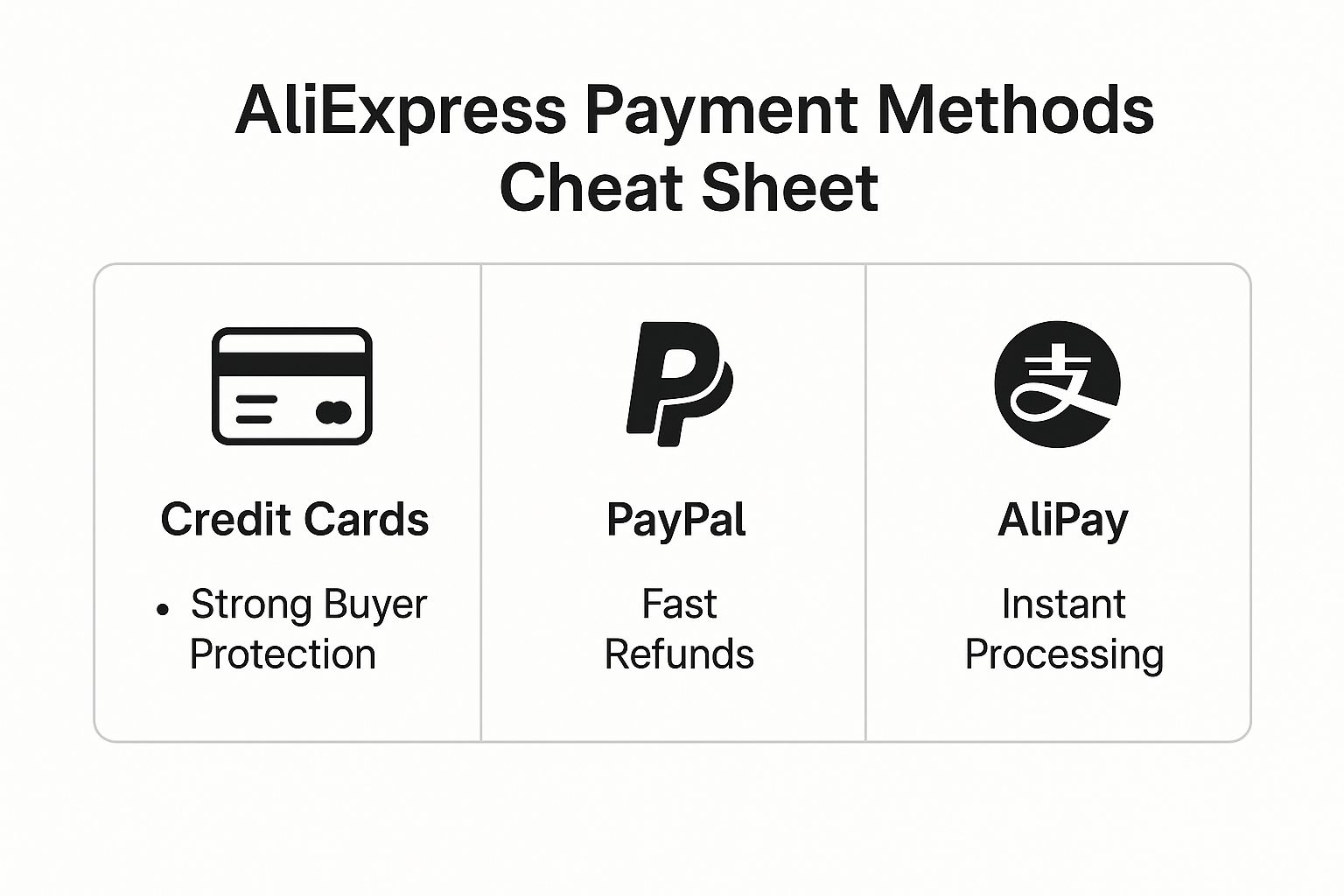
Ultimately, the best method for you hinges on what you value most—is it top-tier security, lightning-fast checkout, or the easiest refund process?
To give you a head start, here's a quick comparison of the most popular payment options on AliExpress. This table should help you see at a glance which one lines up with your shopping style.
Quick Overview of Top AliExpress Payment Options
| Payment Method | Best For | Key Feature |
|---|---|---|
| Credit/Debit Card | Shoppers who want maximum security and convenience. | Strong buyer protection and universal acceptance. |
| PayPal | Buyers who prioritize easy dispute resolution. | Well-known for its robust refund process. |
| AliPay | Regular AliExpress shoppers and mobile users. | Seamless integration and quick mobile payments. |
Each of these is a fantastic choice, but knowing the subtle differences can make your shopping experience that much smoother.
Understanding Your Primary Options
Credit and debit cards are, without a doubt, the king of the hill on AliExpress. An estimated 70-80% of international shoppers use them because they're familiar, universally accepted, and directly linked to their bank accounts. AliExpress takes all the major players—Visa, MasterCard, American Express—so it’s a reliable go-to for almost anyone.
If you're buying from outside of China, it's helpful to understand what happens behind the scenes. These transactions are a great example of modern cross-border payment solutions that make global eCommerce possible.
Pro Tip: I always recommend using a separate credit card just for online shopping. It's a simple trick that makes it much easier to track your spending and, more importantly, it adds a crucial layer of security by keeping your main bank account disconnected from online stores.
And of course, paying securely is only half the battle—you also want to pay smart. Before you finalize your purchase, it's always worth checking for extra savings. We've got a great guide on how to get the latest https://alisavepro.com/aliexpress-promo-code-2025/ that can help you shave a little extra off your total at checkout.
Using Credit and Debit Cards Securely
Let's start with the old reliable: credit and debit cards. For most people shopping on AliExpress, this is the go-to payment method, and it’s easy to see why. They’re convenient, you already know how to use them, and they're accepted almost everywhere.
The beauty of using your card is its sheer simplicity. There's no need to create a new account with another service; you just pop in your details and you're done. AliExpress is set up to handle all the major players, including Visa, Mastercard, Maestro, and American Express, so you're almost certainly covered.
But when you're buying something from halfway across the world, how can you be sure your card details are safe? This is where AliExpress steps in with a few layers of security, but the real star of the show is its escrow system.
Understanding AliExpress Escrow Protection
Think of AliExpress’s escrow service as a neutral third party holding your money in a safe. When you click "buy," your payment doesn't go straight into the seller's pocket. Instead, AliExpress holds onto it.
Only after your package arrives and you confirm that everything is as it should be does AliExpress release the funds to the seller. This system is a huge safety net for you as the buyer. It gives sellers a powerful incentive to ship your order quickly and make sure it's exactly what you paid for. If something goes wrong, AliExpress can step in to mediate while your money is still safely parked with them.
Escrow is essentially your financial bodyguard. It guarantees your payment is only handed over once you're satisfied, which pretty much eliminates the risk of paying for something that never shows up. This is the core of AliExpress's buyer protection.
This whole process gives you a ton of power and peace of mind, which is exactly what you want when dealing with a seller you've never met.
Adding and Managing Your Cards
Getting your card set up on AliExpress is designed to be quick and painless. You can either save your details during your very first checkout or add a card ahead of time through your account settings.
It’s a simple process:
- Navigate to Your Wallet: Head over to "My Account" and look for the "AliPay/Wallet" section.
- Add a New Card: You'll see an option to add a new credit or debit card.
- Enter Card Details: Carefully type in your card number, expiration date, and the CVV code.
- Confirm and Save: Give everything a once-over to make sure it's correct, then save the card to your account.
Once your card is saved, the details are encrypted and stored securely, making future purchases a one-click affair. This is a massive time-saver, especially if you're a dropshipper placing dozens of orders a day.
Watching Out for Hidden Fees
While paying by card is a breeze, you need to keep an eye out for extra costs that might pop up. The most common culprit is the foreign transaction fee. This is a charge your own bank might apply because you're making a purchase in a currency that isn't your own.
These fees are usually between 1% and 3% of your total purchase. It doesn't sound like much, but if you're buying frequently, those little charges can really start to add up. The best way to dodge this is to use a credit card that has no foreign transaction fees—a lot of travel cards offer this benefit. Making that one small change can save you a surprising amount of cash over time.
Tapping into Digital Wallets Like AliPay
Beyond swiping a physical card, digital wallets offer a much faster and more secure way to handle your online shopping. These e-wallets are exactly what they sound like—a virtual container for your payment info, saving you the hassle of typing in your card number every single time you find something you want to buy.
When it comes to AliExpress payment methods, the star of the show is undoubtedly AliPay, the platform's own built-in solution. Think of it like using the dedicated fast-pass lane at a theme park. Because it was created by AliExpress's parent company, the Alibaba Group, the integration is flawless. It’s often the quickest and most hassle-free way to get through checkout.
This tight integration isn't just about saving a few clicks. You'll sometimes find that using AliPay unlocks special discounts or offers, a little reward for sticking with the platform's native payment system.
How AliPay and Other E-Wallets Keep You Safe
The real beauty of digital wallets is their security. When you pay with an e-wallet like AliPay or WebMoney, the seller never actually sees your credit card or bank account numbers. It all works through a clever process called tokenization.
Here's a simple way to think about it: imagine your actual card number is the master key to your bank account. Instead of handing that master key over, tokenization generates a unique, single-use key (a "token") just for that one transaction. This token provides just enough access for that specific purchase to go through, and then it becomes completely useless.
This digital lockbox strategy ensures your core financial data stays locked away and private. It's one of the strongest security layers available for online shopping, giving you solid peace of mind with every purchase.
If you’re wary of entering your card details on multiple websites, using a digital wallet is an excellent way to shop more securely.
Getting Your AliPay Wallet Set Up
Getting started with AliPay is a breeze. The wallet is already built into your AliExpress account, so all you have to do is connect a payment source to it. Once it's set up, you're good to go for all future purchases.
Here are the two main ways to fund your wallet:
- Link a Card: The most popular option is to simply link your credit or debit card. AliPay saves the details securely, so it's ready for one-click payments later.
- Top-Up Your Balance: You can also pre-load funds directly onto your AliPay balance, much like a gift card. This is a fantastic tool for budgeting since you can only spend the amount you've added.
As one of the original AliExpress payment methods, AliPay has been around since 2004 and now serves over 1.3 billion users worldwide. It was specifically designed for quick and cheap cross-border payments, often without any foreign exchange fees, which is a huge plus for international shoppers. You can learn more about AliPay's global features.
Other e-wallets like WebMoney, Skrill, or QIWI Wallet function in a similar way. While they might not be as deeply woven into the AliExpress experience as AliPay, they provide the same essential benefits: speed, convenience, and that critical security layer that keeps your financial data out of sellers' hands. They are great alternatives if AliPay isn't the right fit for you.
Using PayPal on AliExpress: What You Need to Know
For most online shoppers, PayPal is a familiar and trusted name—it's often seen as the benchmark for secure payments. But on AliExpress, its role is a little different. Think of PayPal as a VIP guest: it’s not available for every single purchase, but when it is, it brings some serious advantages to the table.
The biggest draw for using PayPal is its legendary buyer protection. When you pay, your credit card or bank details are never actually handed over to the seller. PayPal acts as a secure intermediary, creating a solid wall of privacy around your financial information. For many shoppers, that peace of mind is priceless.
Is PayPal Always an Option?
Here’s the main thing to understand: PayPal isn't a standard, universally accepted payment method across AliExpress. Its availability depends heavily on the seller you're buying from and where you're located. You'll generally have more luck finding it as an option if you're shopping from countries like the United States, the UK, Spain, Germany, and other parts of Western Europe.
So, how do you know if you can use it? You'll have to go all the way to the checkout page. If the seller accepts PayPal for your specific location and item, you'll see the iconic blue logo listed among the other payment choices.
Pro Tip: There's no filter on AliExpress to search only for sellers who accept PayPal. You have to check for the option on a product-by-product basis at checkout.
This means you might find the perfect item from a seller who doesn't offer it, forcing you to decide what’s more important: the item itself or the payment method.
Weighing the Pros and Cons
So, is it worth hunting down sellers who accept PayPal? Let’s break it down. The upsides are pretty compelling.
- Rock-Solid Security: Your financial data stays under lock and key with PayPal, never shared with the merchant.
- Powerful Dispute Resolution: PayPal is well-known for siding with the buyer in disputes. If your item doesn't arrive or isn't as described, you have a very reliable way to get your money back.
- Payment Flexibility: You can pay using your PayPal balance, a linked bank account, or any credit or debit card you have on file.
On the flip side, there are a couple of drawbacks to keep in mind. The biggest one, of course, is the limited availability. You might have to pass on a great product simply because the seller doesn't take PayPal.
While it's a popular option in Western markets like the US, Europe, Canada, and Australia, PayPal's footprint on AliExpress is still limited. Some transactions might also include small fees that you wouldn't encounter with a direct card payment. You can find more details on PayPal's role on AliExpress to see if it fits your needs. For many buyers, though, the extra layer of security makes it well worth the effort to find a seller who offers it.
2. Exploring Local Payment and Bank Transfer Options
While most people think of credit cards when shopping online, AliExpress has gone to great lengths to cater to how people actually pay in different parts of the world. They’ve integrated a whole suite of local payment methods, which are essentially express lanes for shoppers in specific countries.
This is a game-changer because it means you don't necessarily need an international credit card. Instead, you can use the familiar, trusted banking services you use every day. For example, if you're in the Netherlands, you can use iDEAL to pay straight from your bank. In Brazil, you can grab a Boleto Bancário voucher. It’s all about making the platform accessible to everyone.
What Are Local Payment Gateways?
Think of a local payment gateway as a secure bridge between AliExpress and your bank. When you choose this option at checkout, you're briefly sent over to your own bank's website or app to approve the payment. It’s incredibly secure because your login details are never shared with AliExpress.
The best part? It's fast. The payment is confirmed almost instantly, so the seller can get to work on your order right away. No waiting around for days.
You’ll see different options depending on your location, but some of the most common ones are:
- iDEAL: A go-to for anyone in the Netherlands wanting to make a direct online bank transfer.
- Sofort: Very popular in Germany and several other European countries.
- Boleto Bancário: A Brazilian system that lets you generate a voucher to pay online or in person.
- Mercado Pago: A major payment platform used all across Latin America.
The Old-School Route: Direct Bank Transfers
AliExpress also allows for direct bank transfers, but frankly, this is a much clunkier and slower process. It's more like a traditional international wire transfer, where AliExpress gives you its bank details, and you have to manually send the money from your account.
A word of caution: Unlike the instant local gateways, direct bank transfers are slow. We're talking several business days for the money to arrive and be processed. Your order won't ship until the funds are confirmed, so be prepared for a delay.
This option is usually only available for bigger orders, often starting at $20, and you'll likely get hit with international transfer fees from your bank. For most everyday shopping, it just doesn't make much sense due to the extra cost and waiting time.
Bank Transfer vs. Local Payment Gateways
So, which one should you choose? It really boils down to what you value most: speed, convenience, or cost. For the vast majority of shoppers, it's a pretty clear-cut decision.
This table breaks down the key differences between these AliExpress payment methods.
| Feature | Direct Bank Transfer | Local Payment Gateway (e.g., iDEAL) |
|---|---|---|
| Speed | Slow (1-5 business days) | Instant |
| Fees | Moderate to high (bank wire fees) | Low to none |
| Convenience | Low (requires manual transfer) | High (seamless checkout integration) |
| Best For | Very large orders where fees are less of a concern. | Everyday purchases needing speed and security. |
In short, if a local payment gateway is available in your country, it's almost always the better choice. You get the iron-clad security of a bank transfer combined with the speed of a credit card payment—the best of both worlds.
How to Solve Common AliExpress Payment Issues
Nothing’s more frustrating than hitting "Pay Now" on AliExpress only to be met with an error message. But don't worry—it’s rarely a serious problem. Most of the time, it's just a simple mix-up between your bank and the platform.
Let’s walk through the most common payment hiccups and how to get them sorted out quickly.
The classic payment failure or card decline is by far the most frequent issue. It's almost never about having enough money in your account. Instead, it’s usually a security measure kicking in.
Because AliExpress is an international marketplace, your bank's fraud detection system might automatically flag the transaction as unusual to protect you. A quick call to your bank to say, "Yes, that was me trying to buy something," is usually all it takes to get the payment to go through.
When Your Order is Closed for Security Reasons
Ever seen your order status abruptly change to "Closed" due to security concerns? It’s a bit jarring, but it’s just AliExpress’s automated safety system at work. This usually happens with brand-new accounts or if you place an unusually large first order.
Fixing this is just a matter of proving you are who you say you are.
- Check Your Email: AliExpress will have sent you a message with instructions on what documents they need.
- Submit Your Documents: You'll likely need to upload a photo of your ID and the credit card you used. Make sure to cover the middle digits of your card number for security.
- Wait for a Nod: The verification process typically wraps up in a couple of business days.
Once your account is verified, you can go ahead and place the order again, and it should sail right through.
It’s easy to get annoyed by these checks, but remember they’re there for your protection. These steps help keep the platform safe for everyone and build confidence in the marketplace.
A Quick Troubleshooting Checklist
Before you spend time contacting support, run through this quick checklist. You’d be surprised how often one of these simple things is the culprit.
- Double-Check Your Details: Did you mistype a number in your card, the expiration date, or the CVV? A tiny typo is a common showstopper.
- Confirm International Transactions: Call your bank and ask if your card is cleared for international online payments. Sometimes this feature is turned off by default.
- Try a Different Card: If one card isn't playing nice, another one might work perfectly. Some banks just have stricter online security protocols than others.
Following these steps can save you a lot of time and hassle. For a deeper dive into platform safety, take a look at our guide on if AliExpress can be trusted for your purchases.
Got Questions? We've Got Answers
Even after you've picked a payment method, a few questions might pop up. Let's tackle some of the most common ones so you can finalize your order with total peace of mind.
What Is the Safest Way to Pay on AliExpress?
When it comes to security, you can't go wrong with a credit card or PayPal. Think of them as your first line of defense.
Credit card companies have your back with strong fraud protection and the power of a chargeback. If an order goes sideways, you can dispute the charge directly with your bank. PayPal adds its own layer of security, acting as a middleman so sellers never even see your financial details.
Plus, every payment is protected by AliExpress's own escrow service. They hold onto your money and only release it to the seller after you confirm your package arrived safe and sound. It’s a powerful one-two punch for security.
Can I Use Cash on Delivery?
For the most part, Cash on Delivery (COD) is not an option on AliExpress. It makes sense when you think about it—they're a massive global marketplace shipping to over 200 countries, and managing cash payments worldwide would be a logistical nightmare.
You might occasionally see it pop up in very specific regions as part of a special promotion, but don't count on it being a standard choice. Your best bet is to always check the payment options available for your specific location right at checkout.
Why Did My Payment Get Declined?
A declined payment can be frustrating, but it's usually an easy fix. More often than not, it’s simply your bank being extra cautious. They see an international transaction and might flag it as suspicious to protect you.
The quickest solution? Just give your bank a quick call to let them know you’re making the purchase. They can whitelist the transaction, and you'll be good to go.
Of course, it's also worth double-checking that you've entered all your card details correctly—a simple typo can stop a payment in its tracks. Getting these little details right is key to preventing a failed transaction and an abandoned cart. For a deeper dive, check out our guide on how to reduce shopping cart abandonment.
Ready to streamline how you gather product images and videos from AliExpress? AliSave Pro lets you download all media in one click, completely free. Get the AliSave Pro Chrome extension now.