
To make real money buying in bulk for resale, you have to stop thinking like a shopper and start acting like a business owner. The game is simple arbitrage: buy low, sell high, and pocket the difference. But executing that simple idea is where the real work begins.
Building Your Resale Business Foundation

Before you even think about spending a dollar on inventory, you need to lay the groundwork. This isn't about finding a cool product and hoping it sells; it's about building a solid, strategic plan that makes your business profitable from day one.
The entire model relies on getting your hands on products at true wholesale prices. You're tapping into a massive global industry—the wholesale distribution market is worth around $60 trillion worldwide. It's the hidden backbone of commerce. In fact, over 65% of all retail goods travel through a wholesaler before they ever hit a store shelf.
And this world is moving online fast. If you want to dive deeper, you can find more insights on the wholesale industry's scale and see how over 70% of wholesalers are now embracing digital storefronts, opening up huge opportunities for online sellers.
Finding Your Profitable Niche
Jumping into a crowded market like "electronics" or "women's fashion" without a specific angle is a surefire way to get crushed. Your first real job is to carve out a profitable niche—a focused product category where you can actually stand a chance. Stop trying to be everything to everyone.
Here's what to look for when you're hunting for that perfect niche:
- Real Demand: Is anyone actually looking for this stuff? Use tools like Google Trends or check out the Amazon Best Sellers list to see what people are actively searching for and buying.
- Room to Compete: Avoid markets completely dominated by giant brands. You're looking for underserved corners of the market or a unique spin on an existing product type.
- Your Own Interest: It sounds cheesy, but being genuinely passionate about your products makes selling them a thousand times easier. Your marketing will feel more authentic because it is.
For instance, instead of just "kitchen gadgets," you could specialize in "eco-friendly coffee accessories." Or maybe you focus on "specialty baking tools for sourdough." A tight focus like that attracts a loyal audience you can build a real brand around.
Key Takeaway: A successful resale business isn't about finding cheap stuff. It's about finding the right stuff for a specific group of people who want it. Your niche dictates your customers, your marketing, and ultimately, your bank account.
Understanding Your Potential Profit Margins
Okay, you've got a niche and a few product ideas. Now it's time for the reality check: the numbers. A product might look like a bargain on paper, but after you factor in shipping, marketplace fees, customs, and all the other little costs, your profit can vanish.
Before you ever commit to a big order, open a simple spreadsheet. Your goal is to calculate your landed cost—that's the total, all-in price to get a single unit of that product from the factory to your doorstep.
Doing this financial homework upfront is the single most important thing you can do to make sure your first investment pays off.
Finding and Vetting Trustworthy Suppliers
Let's be blunt: your supplier network is the absolute backbone of your resale business. A brilliant product idea is worthless if you can't get your hands on it reliably and at a price that makes sense. This is where the rubber meets the road, where you find the partners who will help you grow when you buy in bulk for resale.
Most sellers get their start on the massive B2B marketplaces, and it’s crucial to understand the lay of the land.
- Alibaba: This is your direct line to the factory floor. You're typically dealing straight with manufacturers, which means better pricing but much higher Minimum Order Quantities (MOQs). Alibaba is the place you go when you've already tested a product and you're ready to scale up your inventory.
- AliExpress: Think of this as Alibaba’s consumer-friendly cousin. It’s perfect for dipping your toes in the water with smaller, low-risk test orders. You can validate an idea without sinking a ton of cash into inventory. The catch? Your per-unit cost will be higher.
But don't stop there. Beyond these two giants, you've got other great options. Domestic wholesalers can cut down shipping times significantly. And if you know what you're doing, liquidation and surplus auctions can be a goldmine for one-off deals with incredible margins.
The Supplier Vetting Checklist
Finding a potential supplier is easy. The real work is in verifying they're legit. I've seen too many new sellers get burned by rushing this part—it's a costly mistake. Before you even think about talking numbers, you need to put every potential partner through a thorough vetting process. Your job is to filter out the pros from the pretenders.
A few simple checks can tell you almost everything you need to know.
- Check Their Paperwork: A legitimate supplier won't hesitate to show you their business registration details. On platforms like Alibaba, look for badges like "Gold Supplier" or "Verified Supplier." These mean they've passed at least some level of third-party verification.
- Read Between the Lines: Don't just glance at the star rating. Dig into the actual reviews. Are people consistently complaining about quality issues, shipping delays, or terrible communication? These are massive red flags.
- Test Their Communication: Send a professional inquiry with a few specific questions. A prompt, clear, and helpful response is a great sign. If you get back a vague, slow, or poorly written reply, that’s your answer right there.
Pro Tip: Never, ever put all your eggs in one basket. You should always have at least one or two backup suppliers vetted and waiting in the wings. Supply chains get disrupted all the time, and having a plan B will save your business from stockouts and angry customers.
Exploring High-Margin Alternatives
While going through traditional channels is a solid strategy, don't overlook some of the less common ways to source products. These routes often lead to unique items with way less competition.
- Liquidation Auctions: Big retailers need to offload overstock, shelf-pulls, and customer returns. They often sell this stuff by the pallet at a steep discount. You can score amazing deals on branded goods, but be warned: inventory is almost always sold "as-is."
- Surplus Wholesalers: These businesses make their living by buying up excess inventory from manufacturers. It's another fantastic way to find top-notch products for well below the standard wholesale price.
Building a solid supplier base isn't a one-and-done task; it’s an ongoing process of research, outreach, and relationship management. If you’re just getting started, our deep dive into https://alisavepro.com/how-to-find-dropship-suppliers/ has even more strategies that are directly applicable here. By mixing mainstream marketplaces with these alternative channels, you'll build a supply chain that's both resilient and profitable.
Getting Serious: How to Negotiate and Why You Must Get Samples
Finding a supplier you like is just the starting line. Now comes the real work: turning that initial contact into a solid business partnership. This is where your negotiation skills come into play, and it’s about a lot more than just haggling over the price.
Your first move should be to send a formal Request for Quotation, or RFQ. This isn't a quick DM asking "how much?"—it’s a clear, professional document that signals you're a serious buyer. Lay out your exact product specifications, the quantities you're considering, and any customizations you need. A sharp RFQ cuts through the noise, gets you the detailed information you need, and establishes a professional tone right from the get-go.
Thinking Beyond the Per-Unit Price
Look, everyone wants a lower price, but fixating only on the per-unit cost is a rookie mistake. One of the most important things you can negotiate is the Minimum Order Quantity (MOQ). A supplier’s standard MOQ can often be way too high for a new seller, which means tying up a huge chunk of your cash in a single product.
Don't be afraid to ask for a lower MOQ. Many suppliers are surprisingly flexible, especially if you position your first order as a "test run" to see how the product performs with your audience. Explain your long-term vision and how this initial, smaller order is the first step toward future, much larger purchases. Getting that MOQ down is a massive win for your cash flow and dramatically lowers your risk.
The best negotiations I've ever had were the ones where I focused on building a real partnership. If your supplier understands your goals and sees you as a long-term partner, they’re far more willing to bend on things like MOQs, payment terms, or even minor product tweaks.
Product Samples Are Not Optional
I'm going to say this as clearly as I can: Never place a bulk order without getting your hands on a physical sample first. Product photos can be deceiving, and videos can be cleverly edited. What shows up in a giant container could be a world away from what you saw on their website.
Ordering a sample is your ultimate quality control checkpoint before you buy in bulk for resale. It's your insurance policy.
When that sample arrives, don't just admire it. Put it through the wringer. Use it exactly how your future customer would.
- Feel the Quality: How are the materials? Is the stitching solid? Does it feel cheap, or does it feel like a premium product you’d be proud to sell?
- Test Everything: Does it actually work as advertised? Push all the buttons, test all the features. No exceptions.
- Check the Packaging: How is it packed? Is it going to survive a long journey across the ocean and then another trip to your customer's doorstep?
This hands-on evaluation is absolutely critical. The global retail and wholesale market is a beast, valued at over $85.13 trillion, but it's also full of landmines like supply chain chaos and skyrocketing shipping costs. You can explore the full global market report to get a better sense of these challenges. A high-quality sample is your confirmation that the product is worth the investment and can handle the journey.
Navigating Shipping Logistics and Customs
Getting your products from a factory halfway across the world to your warehouse can feel like the most intimidating part of this whole game. Let's be honest, international shipping has its own language, but figuring out a few key concepts is what separates the pros from the rookies who get hit with surprise fees.
The first thing you’ll bump into are Incoterms. These are just standardized trade terms that spell out exactly who is responsible for what, and when. Think of it as the official handover point. For instance, EXW (Ex Works) means you’re on the hook for everything—picking up the goods from the factory floor, dealing with export, handling the shipping, all of it. On the flip side, FOB (Free On Board) means the supplier handles getting the goods to the port and onto the ship. Once it's on that boat, it’s your baby.
For anyone just starting out, FOB is almost always the way to go. It’s a great middle ground. Your supplier deals with the local export headaches they know best, and you get control over the main international freight, where you can shop for better rates. This one decision has a huge impact on your final costs.
Calculating Your True Landed Cost
Your landed cost is the most critical number for your business, period. It’s the total, all-in price to get a single unit from the factory floor to your shelf, ready to be sold. If you miscalculate this, you’re not just losing profit—you could be actively losing money on every sale.
Here’s the breakdown of what you need to add up:
- Product Cost: What you paid the supplier per unit.
- Freight Charges: The cost to move your inventory by sea or air.
- Customs & Duties: The taxes and tariffs your government charges to import the goods.
- Insurance: A must-have to protect your investment against damage or loss in transit.
- Local Delivery: The final journey from the port to your warehouse or front door.
To really get a handle on moving bulk orders from global suppliers to your door, it's worth digging into a complete international supply chain management guide. Knowing this stuff cold is the key to solid financial planning.
This visual lays out the early stages, from making contact to getting that crucial sample in your hands—all of which has to happen long before you’re booking any shipments.
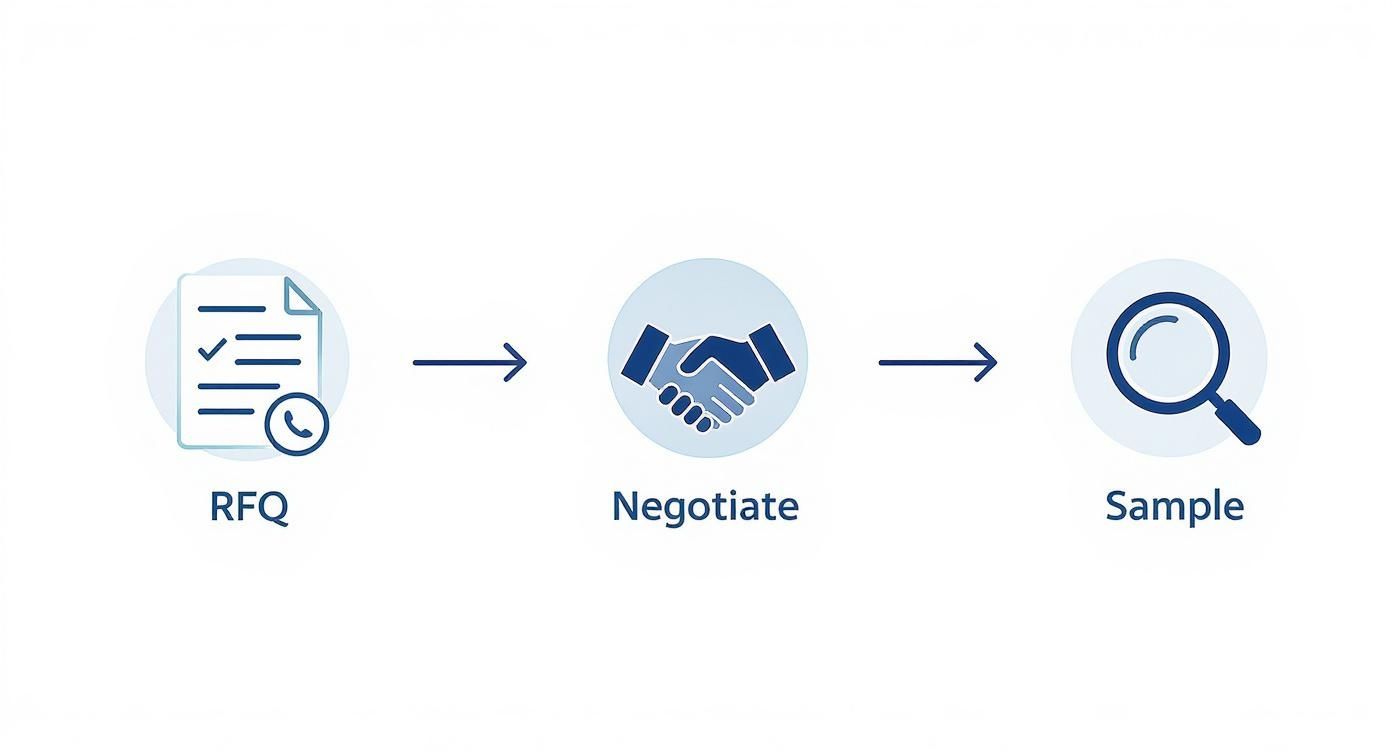
As you can see, you don't even think about logistics until after you've negotiated terms and approved a physical sample.
Working With Freight Forwarders
Here’s the good news: you don't have to orchestrate this logistical nightmare by yourself. A freight forwarder is your partner in this process. They are the experts who manage the entire shipping journey for you, from booking space on a container ship to making sure your shipment clears customs without a hitch.
For a new reseller, a good freight forwarder isn't a luxury; it's a necessity. They save you from bureaucratic headaches, ensure your paperwork is flawless, and often find cheaper shipping routes than you ever could on your own.
Picking the right shipping partner is a massive decision. If you want to explore the different options out there, we’ve put together a guide on finding the https://alisavepro.com/best-shipping-for-small-business/ to help you make the right call. Nail down your logistics, and you’re well on your way to turning those bulk purchases into real profit.
Pricing for Profit and Managing Inventory
https://www.youtube.com/embed/1dqEoz6B_pw
So, the boxes have arrived and your inventory is sitting in front of you. This is where the real work of running a business begins. Your success now comes down to two critical tasks: pricing your products to actually make money and managing that new pile of stock like a pro.
Getting these numbers right is what separates a fun side project from a real, sustainable business when you buy in bulk for resale.
Nailing Your Product Pricing
Let’s get one thing straight: just slapping a 50% markup on your cost is a surefire way to lose money. To price for real profit, you have to start with your landed cost. This isn't just what you paid the supplier; it’s the total, all-in cost to get one single unit into your hands—product, shipping, duties, customs fees, everything.
From that baseline, you then have to subtract all your selling expenses. Think about marketplace commissions, which can easily eat up 15% or more of your revenue. Then there are payment processing fees, shipping supplies, marketing costs, and software subscriptions. Your profit is what's left after all of that is paid for.
The Art of Strategic Pricing
Figuring out that final list price can feel like a headache, but it’s the most important calculation you'll make. You can simplify this by using a dedicated tool to calculate your cost per unit, which forces you to account for all those little costs that are so easy to forget. That number is the floor—the absolute minimum you can charge to break even.
Here’s a quick look at how the layers build up to your final price:
- Landed Cost: Your true, all-inclusive cost per item.
- Marketplace Fees: The cut your sales platform (like Amazon or eBay) takes.
- Operational Costs: Things like packaging, storage, and software.
- Marketing Spend: Your budget for ads and promotions to get eyes on your products.
- Profit Margin: The actual cash you want to put in your pocket from each sale.
Remember, pricing is never "set it and forget it." It has to be dynamic. Keep a close eye on your competitors, listen to what customers are saying, and don't be afraid to experiment with different price points. The goal is to find that sweet spot that maximizes both your sales volume and your profit margin.
Smart Inventory Management
Holding inventory is a constant balancing act. Order too much, and your cash is tied up in boxes that are just collecting dust and costing you storage fees. Order too little, and you're leaving money on the table with "out of stock" notices and disappointing potential buyers. This is why good inventory management isn't just a nice-to-have; it's essential.
The resale market is massive. Just look at the secondhand apparel wholesale market, which has ballooned to $48.32 billion globally. In an industry this big, effectively managing a diverse and changing stock is what keeps you in the game. Smart inventory tracking helps you avoid getting stuck with slow-movers while ensuring you reorder your bestsellers before you run out.
Having a library of top-notch product photos and videos—like the kind AliSave Pro helps you grab—is a huge piece of this puzzle. Great visuals make your listings pop, which leads to faster sales and helps you turn over your inventory more quickly.
When you're just starting, a simple spreadsheet can be your best friend. Seriously, just track what you have, what's selling, and what isn't. As your business grows, you can graduate to dedicated inventory management software. If you want to build a solid foundation from day one, check out these 10 best practices for inventory management.
Your Top Questions About Buying in Bulk, Answered
Jumping into the world of reselling always kicks up a lot of questions. It's easy to get bogged down, but getting clear answers is what separates a successful launch from a stalled idea. Let's tackle some of the biggest questions that pop up when you're ready to buy in bulk for resale.
So, How Much Money Do I Actually Need to Start?
This is the million-dollar question, isn't it? The real answer is that it completely depends on what you're selling and where you're getting it from. The good news is you don't need to take out a second mortgage to get started. Many sellers get their footing with surprisingly small investments.
For example, you can realistically dip your toes in the water with just $300 to $500. That's often enough to place a small test order on a site like AliExpress or grab a single case of product from a domestic wholesaler. The goal here isn't to make a killing on your first go. It's about learning the ropes and seeing if people actually want to buy your product without betting the farm.
My Two Cents: Think of your first investment as tuition. You're paying to learn. The lessons you'll get from that first bulk buy—about shipping times, product quality, and what customers really think—are worth every penny.
Once you have proof that a product sells and you start seeing some cash come in, you can roll those profits into bigger, more profitable orders. That's how you scale.
Is It Legal to Resell Branded Products?
Yes, you can absolutely resell authentic branded products. This is protected by a legal concept called the "first sale doctrine," which basically says once you've legally bought something, you're free to sell it to someone else. But—and this is a big but—you have to play by the rules.
The number one rule is that the products have to be 100% authentic. You are on the hook for making sure your inventory comes from a legitimate source, like the brand itself or an authorized distributor. Buying from liquidation pallets can feel like a great deal, but it can be a nightmare to prove authenticity if you're ever questioned.
To keep your business above board, you need to:
- Vet your suppliers: Always confirm that a wholesaler is actually authorized to sell the brand's products. Don't be shy about asking for proof, like an authorization letter.
- Keep a paper trail: Hang on to every single purchase invoice. These are your golden tickets if a marketplace like Amazon or eBay ever challenges your listing.
- Don't pretend you're a partner: You can't market yourself as an "official dealer" or imply any affiliation with the brand unless you have a written agreement saying so.
Cutting corners with branded goods is a fast track to getting your account suspended. It's just not worth the risk.
How Do I Handle Returns on Bulk Purchases?
Returns are just a part of the ecommerce game. When you've bought a hundred units of something, getting one back can feel like a headache, but it’s totally manageable if you have a plan.
First off, your return policy needs to be crystal clear and easy for customers to find. Figure out your return window (30 days is pretty standard) and be upfront about who pays for the return shipping. More importantly, know what you're going to do with the item once it's back in your hands.
Here are a few options for dealing with returned stock:
- Inspect and Restock: If it comes back in pristine, unopened condition, great! Just add it back to your inventory.
- Sell as "Used" or "Open-Box": For products with opened packaging or a tiny scuff, you can often resell them on a platform like eBay. Just be honest about the condition and price it accordingly.
- Bundle or Liquidate: If you start to accumulate a small pile of returns, you can package them together as a "lot" and sell them to other resellers who specialize in used goods.
A fair and simple returns process builds a ton of trust with buyers. It removes their risk, which often makes them more likely to click "buy" in the first place.
Ready to find winning products and create stunning listings that convert? AliSave Pro lets you download high-quality product images and videos from AliExpress in just one click, giving you the professional assets you need to stand out. Streamline your workflow and start building a better-looking store today. Download it for free and get started.