
It all boils down to a simple distinction: your billing address is what your bank uses to verify you are who you say you are, while the shipping address is just the spot on a map where you want your stuff to end up.
Think of it this way: the billing address confirms who's paying, and the shipping address tells us where it's going. They're often the same place, but they play two completely different roles in getting an order from a click to your doorstep.
Understanding The Core Components Of Your Order
Every time you buy something online, you're providing two key addresses that kickstart the entire process, from payment validation to the final delivery. Getting them right is crucial. Confusing the two can lead to frustrating payment declines, annoying shipping delays, and sometimes, even fraud alerts from your bank.
This infographic breaks down the core purpose of each address in a really straightforward way.
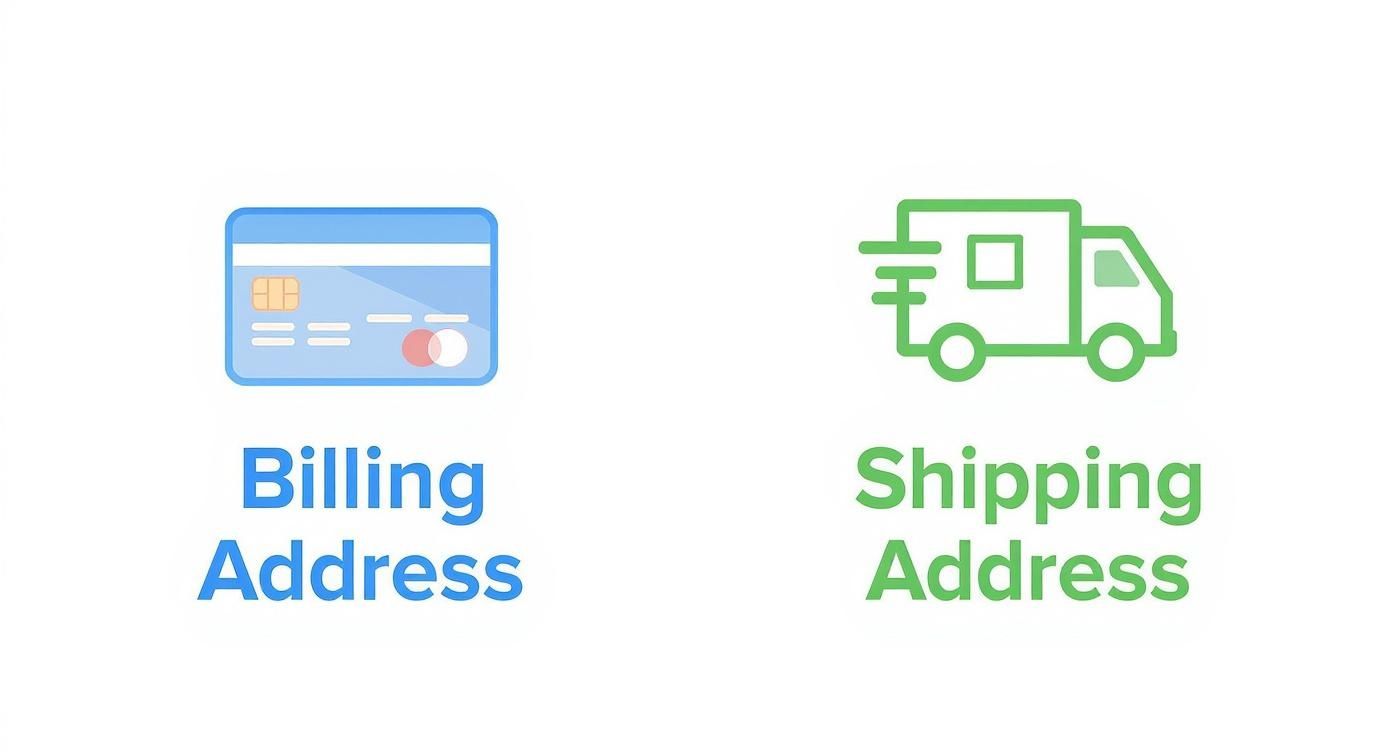
As you can see, one is all about financial security and validation. The other is purely for logistics—getting the package from point A to point B.
Defining The Billing Address
The billing address is the address your bank or credit card company has on file for you. It's where they mail your monthly statements and the address tied directly to your payment method.
Its main job isn't about delivery at all; it’s a security checkpoint. Payment systems use a tool called the Address Verification System (AVS) to cross-reference the address you type in with what the bank has on record. It’s a simple but effective way to help prevent someone else from using your card.
Defining The Shipping Address
The shipping address, on the other hand, is exactly what it sounds like: the physical location where you want your package delivered.
This could be your house, your office, or your cousin’s place if you're sending a birthday gift. This address has nothing to do with verifying your payment. Its only function is to give the delivery driver the correct destination. An accurate shipping address is key to getting your order on time and helps merchants avoid the extra costs that come from failed delivery attempts.
For a quick summary, this table lays out the core differences side-by-side.
Shipping vs Billing Address At a Glance
| Attribute | Billing Address | Shipping Address |
|---|---|---|
| Primary Purpose | Verifying the cardholder's identity and preventing fraud. | Guiding the package to its final physical destination. |
| Who Uses It | Payment processors and banks for security checks (AVS). | Merchants, warehouses, and shipping carriers for logistics. |
| Associated With | Your credit/debit card or other payment methods. | The recipient of the physical goods. |
| Common Example | The address on your bank statement. | Your home, office, or a gift recipient's location. |
While they seem similar on the surface, their roles in a transaction couldn't be more different. One is for security, the other for logistics.
While your shipping address is all about logistics, getting your package from point A to point B, your billing address is all about security. Think of it less as a location and more as a key. Its job is to protect your financial information, acting as the first line of defense against someone trying to use your card without permission.
When you punch in your card details online, you're kicking off a quick but critical security check. This is handled by something called the Address Verification System (AVS), a standard tool for virtually every payment processor out there. AVS instantly cross-references the billing address you entered with the one your bank has on file for that card. It's a simple, elegant way to confirm you are who you say you are.
How AVS Protects Your Purchase
Imagine AVS as a bouncer checking IDs at the door. A thief might have managed to get your credit card number, expiration date, and even the CVV code from the back. But the one thing they almost never have is your exact home address tied to that card.
So, when they try to make a purchase, the AVS check hits a wall. The address they enter doesn't match what the bank has on record. That mismatch instantly flags the transaction as suspicious, and in most cases, it gets automatically declined. This stops the fraud dead in its tracks, saving you from a financial headache and the merchant from dealing with chargebacks. You can see how various platforms build in these security layers by checking out our guide to AliExpress payment methods.
This isn't just a trivial feature; it's a pillar of e-commerce security. AVS is credited with cutting down credit card fraud globally by an estimated 20-30%. For online store owners, this is massive. Especially when you consider that about 15-25% of all orders have different shipping and billing addresses—a common scenario that often triggers closer scrutiny. In fact, a mismatch between the shipping address vs billing address is a red flag in a whopping 60-70% of confirmed fraud cases, which is why payment processors take it so seriously.
The billing address check is the first and most effective gatekeeper in a secure online transaction. It validates the user's identity by confirming a piece of information that only the legitimate cardholder should know.
What Happens During an AVS Mismatch
If the AVS check comes back with a mismatch, the payment processor shoots a response code back to the merchant's system. These codes explain what went wrong—maybe the street address was right but the ZIP code was off, or maybe nothing matched at all.
From there, merchants decide what to do based on their own rules and risk level:
- Full Match: The transaction sails through.
- Partial Match: The sale might go through but get flagged for a human to review later.
- No Match: The transaction is almost always declined on the spot to prevent potential fraud.
This is why getting your billing address right, down to the last detail, is so important. A simple typo can get your own purchase declined. It’s a small inconvenience that keeps the entire online shopping ecosystem safer for everyone involved.
While the billing address is all about security, the shipping address is the operational nerve center of every online order. Think of it as the starting pistol for your entire logistics chain. It dictates everything—from which warehouse pulls the product to the final handshake at the customer's door.
This address isn't just a destination; it's a precise set of instructions for every single person and machine touching that package. As soon as an order is confirmed, the shipping address springs into action. It tells the system which fulfillment center is closest, calculates the most efficient shipping route, and helps select the right carrier for the job. Logistics providers rely on it for everything from quoting shipping costs to mapping a driver's daily drop-offs.
The Financial Fallout of a Simple Typo
It’s amazing how a single misplaced digit can grind the entire, well-oiled machine to a halt. A wrong house number or a misspelled street name can send a package on a wild goose chase to another city or leave it stranded in a sorting facility, marked "undeliverable."
These little mistakes aren't just frustrating; they're incredibly expensive. In the U.S. alone, delivery failures due to bad shipping info cost businesses over $30 billion every year. A single bad address can balloon the cost of delivering a package by up to 25% thanks to rerouting fees and storage charges. For a deeper dive into how businesses can tackle these costs, FreightAmigo offers some great insights on e-commerce address accuracy.
An accurate shipping address is the bedrock of efficient e-commerce logistics. Without it, the promise of a seamless customer experience quickly falls apart, leading to wasted resources, financial loss, and customer dissatisfaction.
Last-Mile Delivery and Keeping Customers Happy
That final stretch of the journey—what we call the "last mile"—is notoriously the most complex and costly part of shipping. And here, the accuracy of the shipping address is everything. A mistake almost guarantees a failed delivery attempt, which not only irritates the customer but also doubles the cost for the carrier who has to try again.
This is where technology has become a lifesaver. Many modern e-commerce platforms now integrate address validation tools right at checkout. These systems instantly cross-reference the address with official postal databases, flagging potential typos before the customer even clicks "buy." Businesses using these tools can cut their failed delivery rates by 15-20%, a direct boost to their efficiency and bottom line. To find the right logistics partners, small businesses can explore our guide on the best shipping for small business.
At the end of the day, getting the shipping address right isn't just about dodging extra fees. It’s about delivering on your promise to the customer. A smooth, reliable, and timely delivery is what builds trust and keeps people coming back.
It’s a common misconception that an order's shipping and billing addresses should always be the same. In reality, there are plenty of perfectly normal reasons why they'd be different. Seeing a mismatch isn't an automatic red flag for fraud; more often than not, it just reflects the way people live and shop today.
The most obvious example? Gift-giving. When you buy a birthday present for a friend across the country, your billing address stays tied to your credit card, but the shipping address points straight to their front door. It’s what makes e-commerce so great for sharing a little joy from a distance.
Life's Transitions and Practical Needs
Beyond sending gifts, everyday life often calls for two separate addresses. This is especially true for students and people on the go.
College Students: Think about a student living in a dorm. They'll need textbooks and supplies sent directly to their campus address, but the credit card they're using is likely still linked to their parents' home. It's a classic case of sending goods where they're needed while the payment originates from a permanent, verifiable location.
Workplace Deliveries: How many times have you worried about a package sitting on your porch all day? Many professionals solve this by shipping personal orders to their office. There’s always someone there to sign for it, which means no missed deliveries or stolen goods. The billing address remains their home, but the shipping is routed to their workplace for pure convenience and security.
Then there's the simple matter of how people manage their mail. Some people use a P.O. Box for all their official correspondence, like bank statements and bills, making it their de facto billing address.
This image shows a wall of P.O. boxes, a common choice for a secure billing address.
The catch is that most couriers can't deliver packages to a P.O. Box. So, they have to provide a separate, physical street address for the actual shipment.
When you boil it down, the difference between a shipping and billing address is often a matter of practicality. One is for financial verification; the other is for the simple logistics of getting a box from point A to point B.
Other Perfectly Valid Scenarios
The list of legitimate reasons for an address mismatch doesn't stop there. Life is complicated, and shopping habits reflect that.
Vacation Homes & Temporary Stays: If you're on a long vacation or staying in a temporary rental for a work project, you might need something delivered there. Your billing address won’t change, but your shipping address will be your home-away-from-home for a while.
Business Purchases: A small business owner might use their personal credit card (linked to their home) to order supplies. But they won't ship those supplies to their house; they'll send them directly to their office, warehouse, or even a client's worksite.
Split Households: It’s common for family members living in different homes to buy things for one another. One person pays, and the item gets shipped to someone else entirely.
For any store owner, recognizing these situations is key. It's how you balance smart fraud prevention with a great customer experience. Instead of just looking at the data, it's about understanding the real-world context behind an order so you don't end up canceling a perfectly good sale.
Checkout Best Practices for Shoppers and Retailers
A smooth checkout process is what everyone wants. For shoppers, it’s about getting your order placed without any annoying hiccups. For store owners, it means a finalized sale and another happy customer. The secret often comes down to getting the shipping and billing addresses right from the start.
By following a few straightforward practices, both sides of the transaction can sidestep the common mistakes that cause declined payments, delayed shipments, and a whole lot of frustration. This isn't just about typing in an address; it's about making sure the entire purchase is secure and reliable.
Tips for a Flawless Shopper Checkout
As a customer, the single most important thing you can do for a hassle-free purchase is to double-check your address details. Even a tiny typo can get your payment declined or send your package on a wild goose chase.
Run through this quick checklist before you hit that final "confirm order" button:
- Tame Your Autofill: We all love autofill, but it can be surprisingly stubborn, often pulling up an old address or mixing up your shipping and billing info. Always give it a quick once-over to make sure it's correct.
- Match Your Bank Statement: This one is crucial. Your billing address must be an exact match to the address your bank or credit card company has on file. Pay attention to small details like "St." versus "Street" or "Apt" versus "#"—any little discrepancy can trigger a security check and block the payment.
- Confirm the Shipping Destination: Before you finalize the purchase, take one last glance at the shipping address. Is the house number right? Is the zip code correct? This is especially important when you’re sending a gift to someone else's home.
Taking a few extra seconds on these steps can save you a major headache later and ensure your order arrives right on time.
If your card gets declined because of an address mismatch, it's not a glitch. That's the Address Verification System (AVS) working exactly as it should. It's a security feature designed to protect you from fraudulent purchases that don't look quite right.
Smart Strategies for Online Retailers
For anyone running an online store, the real art is finding the sweet spot between strong fraud prevention and a frictionless customer experience. If your checkout is too rigid, you risk frustrating and losing legitimate customers. If it's too relaxed, you open the door to fraud. Getting this balance right is a key part of learning how to reduce shopping cart abandonment.
The good news is that you can guide customers toward accuracy without making things difficult.
Here are a few powerful best practices to put in place:
Use Clear Field Labels: Don't make customers guess. Label your fields as "Shipping Address" and "Billing Address" in plain language. A simple checkbox that says, "My billing address is the same as my shipping address," is one of the easiest ways to streamline the process and clarify the difference between shipping address vs billing address.
Implement Real-Time Address Validation: Look into integrating an address validation service. These tools check shipping addresses against official postal databases as the customer types, suggesting corrections for typos or formatting issues on the spot. This single feature can dramatically cut down on failed deliveries.
Develop a Mismatch Protocol: Instead of just automatically canceling an order when the shipping and billing addresses don't match, set up a simple review process. You could flag these orders for a quick manual check or have an automated email sent to the customer to confirm the details. This way, you can catch potential fraud without penalizing legitimate customers who might be sending a gift or shipping a package to their office.
Got Questions? We’ve Got Answers
Let's be honest, navigating the checkout process can sometimes feel like a pop quiz. When it comes to the shipping vs. billing address, a few common questions pop up all the time. Here are some quick, no-nonsense answers to help clear things up, whether you're buying something online or running your own store.
Can I Use a PO Box for My Billing Address?
Absolutely. You can definitely use a P.O. Box as your billing address. The whole point of the billing address is for your bank to verify it's really you making the purchase. As long as that P.O. Box is the one your credit card statements are sent to, you're good to go.
Just remember, you can't get most packages delivered there. You'll still need a physical street address for the actual shipping.
What Happens If I Type in the Wrong Billing Info?
More often than not, the transaction will simply be declined. This isn't a glitch; it's a security system called the Address Verification System (AVS) doing its job to prevent fraud.
A decline doesn't mean you're out of cash. It just means the address you typed didn't quite match what your bank has on file. The fix is usually simple: double-check your bank statement and carefully re-enter the address, paying close attention to things like abbreviations (St. vs. Street) and the ZIP code.
Do My Billing and Shipping Addresses Have to Be in the Same Country?
Nope, they don't. This is super common for people buying gifts for family abroad, expats, or anyone traveling. You can easily have a billing address in one country and ship your order to another.
A quick heads-up, though: some smaller online stores, especially those selling high-risk items, might have rules against it to protect themselves from fraud. It's always a smart move to peek at the store’s shipping policy before you buy if you're planning an international shipment.
When a merchant sees an order with billing and shipping addresses in different countries, it often triggers a manual review. They're just taking an extra step to make sure the order is legitimate, balancing good customer service with smart fraud prevention.
Why Do Some Stores Insist on Shipping Only to the Billing Address?
You'll sometimes see a "ship-to-billing-address-only" rule, and it's almost always about security. This is a hardcore anti-fraud measure, especially common for sellers of high-value goods like jewelry, designer bags, or the latest tech gadgets.
By making sure the item lands directly at the cardholder's verified address, they dramatically lower their risk of getting hit with a fraudulent chargeback. It can be a pain if you're trying to send a gift or get a package at the office, but for the seller, it offers maximum protection.
For e-commerce store owners, this is a trade-off. A strict policy like this makes fraud detection easier but might frustrate some perfectly good customers. It really boils down to your risk tolerance and what you're selling.
Streamline your e-commerce workflow by downloading all the product media you need in a single click with AliSave Pro. Get high-resolution images and videos from any AliExpress product page instantly, saving you hours of manual work. Get started for free at alisavepro.com.