
Protecting your online store from fraud isn't just about damage control; it's about building a multi-layered defense to stop thieves in their tracks. Think of it as a combination of smart technology, common-sense rules, and a sharp eye on orders after they're placed. Get this right, and you can shut down criminals before they ever touch your bottom line.
Navigating Modern Ecommerce Fraud Threats
Let's get real—the world of ecommerce fraud has gotten incredibly complicated. We're not just talking about someone using a stolen credit card number anymore. Today, dropshippers and online sellers are facing off against organized fraudsters who use sophisticated tools and clever schemes to find and exploit any crack in your defenses. A proactive plan isn't just a nice-to-have; it's essential for survival.
The numbers here are genuinely eye-watering. Global losses from e-commerce fraud are projected to hit $44.3 billion in 2024 alone. If that's not bad enough, experts predict that figure could balloon to a massive $107 billion by 2029—a 141% jump in just five years. This explosion is fueled by new, complex tactics that can easily overwhelm unprepared merchants.
The New Wave of Digital Threats
Forget the simple scams of the past. Modern fraud is a whole different beast, and basic security checks just don't cut it. The first step to building a solid defense is knowing exactly what you're up against.
Three major threats are dominating the scene right now:
- AI-Driven Attacks: Fraudsters are using artificial intelligence to work at an insane scale. They can run bots that test thousands of stolen credit card numbers in minutes or launch automated attacks to take over customer accounts.
- Triangulation Fraud: This one is particularly nasty. A fraudster sets up a fake online store, takes a real order from a legitimate customer, and then uses a stolen credit card to buy that same item from your store to fulfill it. You ship the product, but when the real cardholder sees the charge, the chargeback hits you, not the scammer.
- Deepfake Technology: While it’s still on the horizon for most, deepfakes are a growing concern. This tech can be used to fool video or photo ID checks, making it incredibly difficult to be sure you're dealing with a real person.
The chart below paints a clear picture of just how quickly this problem is growing.
This steep climb makes one thing obvious: sitting back and waiting for fraud to happen is a losing game.
Your goal shouldn't be just to react to fraud. It should be to create a storefront so secure that criminals decide you're not an easy target and move on. A strong defense is your best deterrent.
To get a deeper understanding of the challenges ahead, this strategic guide to ecommerce fraud prevention is a great resource. It breaks down the various threats and defenses in much more detail. With this foundation, you'll be ready to dive into the actionable steps you can take to protect your business.
Building Your Pre-Transaction Defense System
The best way to handle ecommerce fraud isn't by dealing with chargebacks after the fact—it's by stopping bogus orders before they ever get through. A solid pre-transaction defense acts like a smart bouncer for your store, automatically flagging shady visitors while giving legitimate customers a smooth path to checkout. This is your chance to get ahead of the game and shut fraudsters down early.

The heart of this system is something called risk scoring. It's not about looking for a single red flag. Instead, it's about analyzing a bunch of different data points in real-time to figure out the odds that an order is fraudulent. This gives you a much clearer picture of who's really on the other side of the screen.
Tapping into Key Data for Risk Scoring
Your first line of defense is always data. Every person who lands on your site leaves behind digital breadcrumbs, and your job is to learn how to read them. Thankfully, modern fraud prevention tools can do a lot of this heavy lifting for you, piecing together a risk profile for every single session.
Here are the data points I always pay close attention to:
- IP Geolocation: This simply tells you where in the world the customer's internet connection is coming from. If someone in New York places an order using an IP address from Vietnam, that’s a massive red flag that you absolutely need to look into.
- Proxy and VPN Detection: Scammers love using proxies or VPNs to mask their true location and identity. Sure, some everyday people use VPNs for privacy, but when one pops up during a transaction, it definitely bumps up the risk score.
- Device Fingerprinting: This cool bit of tech gathers info about a user's device—their browser, operating system, screen resolution, and more. If you see multiple orders coming from different names and locations but they all share an identical device fingerprint, you might be looking at a coordinated fraud ring.
- Email Address Analysis: You'd be surprised how much an email address can tell you. A brand-new Gmail account used for a high-value purchase is way more suspicious than a corporate email or a personal one that's been around for years.
When you start weaving these signals together, you get a powerful, multi-layered view of just how risky any given transaction might be.
Setting Up Automated Fraud Detection Rules
Once you're pulling in the right data, the next move is to build automated rules that take action based on the risk score. The trick is to flag suspicious activity without annoying your good customers. As a dropshipper, you'll want to tune your rules to the specific headaches you're likely to face.
For instance, I've seen this simple set of rules work wonders for stores dropshipping from AliExpress:
- High-Value First-Time Orders: Automatically flag any order from a new customer over a certain amount (say, $200) for a manual review. Scammers sometimes go big right out of the gate with a stolen card.
- Rapid Purchase Attempts: If the same user tries to make multiple purchases with different credit cards in a short window (like 5 minutes), block them. This is a classic sign they're "card testing" to see which stolen numbers work.
- Address Mismatches: Automatically flag any order where the billing and shipping addresses are in different countries. While there are legitimate reasons for this, it’s a high-risk indicator that needs a second look.
Pro Tip: Start with just a few simple, high-impact rules. It's much better to have a small set of effective rules than a complicated system that ends up blocking legitimate sales. Keep an eye on the orders you flag and tweak your rules based on what you’re actually seeing in your store.
This proactive approach is quickly becoming the industry standard. By 2025, most ecommerce companies are expected to use five or more fraud detection tools. It's a sign that the industry is maturing, with real-time evidence tracking becoming a normal part of the workflow.
Before an order is even placed, there are plenty of digital clues that can tip you off to potential fraud. Being able to spot these indicators is key to building an effective, automated defense.
Here's a breakdown of some of the most common red flags to watch for.
Key Pre-Transaction Fraud Indicators
| Indicator | What to Look For | Why It's a Risk |
|---|---|---|
| IP & Geolocation Mismatch | The IP address location is far from the billing/shipping address (e.g., IP in Nigeria, shipping to Florida). | The user is likely masking their true location, a common tactic for fraudsters using stolen credentials. |
| Proxy or VPN Usage | The connection is routed through an anonymizing service like a VPN or a proxy server. | While some use VPNs for privacy, fraudsters use them to hide their identity and location, making them untraceable. |
| New or Suspicious Email | The email address was created very recently, uses random characters (e.g., [email protected]), or is from a high-risk domain. | Legitimate customers typically use established email addresses. Throwaway emails are a hallmark of fraud. |
| Multiple Failed Payments | A user attempts to check out multiple times with different credit cards in a short period. | This is a classic sign of "card testing," where criminals are checking a list of stolen card numbers to see which are active. |
| Device & Browser Anomalies | The device fingerprint is unusual (e.g., mismatched time zones, language settings, or an outdated browser). | These inconsistencies can indicate that the fraudster is using emulators or other tools to spoof their identity. |
Monitoring these signals allows you to create a much more nuanced and effective fraud detection system. Rather than relying on a single data point, you're building a comprehensive risk profile for every visitor.
Spotting Common Pre-Transaction Red Flags
Beyond what an automated rule can catch, you need to train your eye to spot behaviors that just feel… off. One of the oldest tricks in the book is a mismatch between the shipping and billing address.
Now, this can be perfectly normal—someone could be sending a gift, for example. But it’s also a go-to tactic for criminals who need products shipped somewhere other than the real cardholder's address. To really get why this is a big deal, you can learn more about the differences between shipping and billing addresses and see why this is such a critical data point. A major discrepancy, especially across states or countries, should always trigger an immediate manual review.
Another classic red flag is an unusually large order for multiple popular items, especially if it's from a first-time customer. This is common in reseller fraud, where criminals use stolen cards to buy up in-demand products they can flip for quick cash. For a dropshipper, this might look like an order for ten of your best-selling smartwatches out of the blue.
By building a robust pre-transaction defense, you can filter out the vast majority of threats before they ever touch your bottom line, protecting both your revenue and your hard-earned reputation.
Fortifying Your Checkout and Payment Gateway
Think of your checkout as the final, most critical checkpoint. It's where you either stop a fraudster dead in their tracks or wave them right through the front door. A sloppy, unsecured gateway is an open invitation for trouble, but a properly fortified one acts as a powerful bouncer, keeping criminals out while giving legitimate customers a smooth, hassle-free experience.
This is where the rubber meets the road—using the right tools to confirm the person paying is actually who they say they are.
Your payment processor is your most important ally in this fight. Choosing one with solid, built-in security features isn't just a good idea; it’s an absolute must. At the bare minimum, your processor needs to automatically run the basic checks that verify a cardholder’s info. These tools are your first line of defense against the most common types of card-not-present fraud.
The Non-Negotiable Security Basics
Before you even think about more advanced tactics, make sure you have the fundamentals completely locked down. These two checks are the bedrock of secure online payments and should be active on every single transaction. No exceptions.
- Address Verification System (AVS): This system simply checks the numbers in the billing address a customer enters against the address the bank has on file for that card. A mismatch is a huge red flag that the person using the card might not be its rightful owner.
- Card Verification Value (CVV): This is that three- or four-digit code on the back of the card. Requiring it proves that the customer physically has the card in their hand, since that code isn't supposed to be stored anywhere online.
If your payment processor doesn't support these two things, it's time to find one that does. Having solid strategies for preventing credit card fraud starts right here.
Leveling Up with 3D Secure Authentication
AVS and CVV are great, but determined fraudsters can sometimes find ways around them. That's when you need another layer of security, and that’s where 3D Secure comes in.
You've probably seen it before as "Verified by Visa" or "Mastercard SecureCode." The latest version, 3D Secure 2.0, is a lot smarter and way less annoying for your customers. Instead of bugging everyone with a pop-up and a password, 3D Secure 2.0 quietly analyzes over 100 data points behind the scenes. If everything looks good, the transaction sails through. Only the genuinely risky ones get flagged for an extra step, like a one-time code sent to the cardholder's phone.
Here's the best part: using 3D Secure often shifts the liability for fraudulent chargebacks from you, the merchant, over to the card-issuing bank. For a dropshipper running on tight margins, that liability shift can be an absolute lifesaver.
Offload Risk with Alternative Payment Options
Another really effective tactic is to let other companies handle the risk for you. Offering payment methods like PayPal, Apple Pay, or Google Pay can drastically reduce your direct exposure to fraud.
When a customer checks out with PayPal, for instance, they are authenticated inside PayPal’s own secure system. PayPal takes on a huge chunk of the fraud risk, and their Seller Protection policies can cover you if you get hit with an "unauthorized transaction" claim, as long as you have your proof of shipment.
Offering a mix of payment options isn't just about boosting conversions; it's a savvy fraud prevention move. For dropshippers, it’s also worth looking into the various https://alisavepro.com/aliexpress-payment-methods/ to see which ones offer better protections. By integrating these trusted gateways, you're putting another layer of security between your business and the bad guys.
What to Do After the Order is Placed
Just because an order clears your payment gateway doesn't mean you're in the clear. The real cat-and-mouse game often begins after the customer clicks "buy." This post-order window is your last, best chance to catch clever fraud that your automated tools might have missed.
Think of manual review as the human intelligence layer in your fraud defense. It's not about being paranoid and checking every single sale. It’s about taking a closer look at the orders your system rightly flagged as high-risk, using your intuition to connect dots an algorithm can't. This is how you confidently approve legitimate customers and stop thieves before you ship the goods.
The Manual Order Review Process
When an order is flagged, speed and consistency are everything. A slow review process just means a longer wait for a good customer or more time for a fraudster to get away with it. You need a game plan—a systematic checklist to run through every single time.
It’s rarely one single thing that gives a fraudster away. Instead, you're looking for a collection of small, odd details that just don't add up.
Here’s what I look for in a high-risk order:
- Order Mismatches: Does the name on the card match the customer's name and email? A brand-new customer placing a huge order with a mix of high-demand items (like electronics and sneakers) using a generic Gmail address is an instant red flag.
- IP Address Geolocation: A quick IP lookup is one of the most powerful free tools you have. If the order was placed from an IP address in Vietnam, but the billing is in Ohio and shipping is to Florida, you have a serious problem. Be wary of IPs linked to data centers or known proxy services—these are classic signs of someone hiding their true location.
- Address Verification: Pop the shipping and billing addresses into Google Maps and take a look around with Street View. Are they actual homes or apartments? An order going to a freight forwarder, a mail drop, or a vacant lot is highly suspect, especially for expensive items.
- The Social Media Test: Can you find the person online? A quick search for their name or email on Facebook, LinkedIn, or even just Google can be very telling. Most legitimate customers have some kind of digital footprint. A complete ghost is often another warning sign.
If you’ve gone through these checks and still feel uneasy, it's time to reach out.
How to Verify an Order Without Insulting Your Customer
Contacting a customer to verify their purchase is a delicate dance. You need to confirm their identity without making them feel like a suspect. The key is to frame it as a routine security check done for their protection.
Never, ever ask for a full credit card number or other highly sensitive data. The goal is to ask a simple question that only the true cardholder would know.
My Go-To Approach: I always word my verification emails as a quick, final step to protect the customer's account. This positioning turns a moment of potential friction into a positive sign that you take security seriously.
Here’s a simple template you can adapt:
Subject: Quick check on your order #[Order Number]
Hi [Customer Name],
Thanks for your recent order!
As part of our routine security measures to protect all our customers, we just need to quickly verify one detail. Can you please confirm the billing ZIP code associated with the card used for this purchase?
As soon as we hear back, we'll get your order on its way.
Thanks for your understanding!
Best,
The [Your Store Name] Team
A legitimate customer will reply in seconds. A fraudster usually just disappears.
Now that we have a process for reviewing flagged orders, let's turn it into a concrete checklist.
Below is a table outlining the exact steps to take. This isn't just a list; it's a decision-making framework to help you decide whether to approve, investigate further, or cancel an order outright.
Manual Order Review Checklist
| Check | Action Steps | Decision Criteria |
|---|---|---|
| Email & Name | Compare the customer's name to their email address. Check for typos or nonsensical names (e.g., "asdf asdf"). | Proceed: Name matches email (e.g., john.doe@). Flag: Generic or gibberish names/emails. |
| IP Geolocation | Use a free IP lookup tool. Compare the IP location to the billing and shipping addresses. | Proceed: All three locations are in the same general area. Flag: Locations are in different states or countries. |
| Address Mismatch | Check if the billing and shipping addresses are different. | Proceed: Addresses are the same. Flag: Different addresses, especially if one is a P.O. box or freight forwarder. |
| Google Maps View | Use Google Street View to look at the shipping address. | Proceed: Looks like a standard residence or business. Flag: Appears to be an empty lot, mail drop, or suspicious location. |
| Order Value & Size | Analyze the order. Is it unusually large for a first-time customer? Does it contain many high-value, easy-to-resell items? | Proceed: Normal-sized order for your store. Flag: A huge, high-value order from a brand new account. |
| Phone Number | If provided, do a quick search on the phone number. Is it a VoIP number (like Google Voice) or a real mobile/landline? | Proceed: Standard mobile or landline number. Flag: VoIP number, disconnected number, or number from a different country. |
By running through this checklist, you can systematically evaluate risk and make an informed decision, dramatically reducing your chances of shipping a fraudulent order.
Your Best Defense Against "Friendly Fraud"
One of the biggest modern challenges in ecommerce is friendly fraud. This is where a legitimate customer buys something, receives it, and then initiates a chargeback, falsely claiming they never got the item or didn't authorize the purchase.
This isn't a small problem. The practice, along with return abuse, has created a massive financial black hole for merchants. By 2025, abusive returns had already surged by 64% compared to early 2024, contributing to an $890 billion problem for retailers. With friendly fraud making up 18% of all disputes, the only way to protect yourself is with airtight documentation. You can see more on these ecommerce fraud trends on signifyd.com.
As a dropshipper, this is where you need to be extra vigilant since you don't physically handle the products.
- Tracked Shipping is Non-Negotiable: Every single order must have a tracking number. No exceptions. This is your primary piece of evidence.
- Archive Everything: Save every email, order confirmation, shipping notification, and customer service chat.
- Screenshot Delivery Confirmations: The moment the carrier's site says "Delivered," take a screenshot. Make sure it clearly shows the date, time, and full delivery address.
This evidence is your lifeline when fighting a chargeback. For those of you dropshipping from AliExpress, knowing how their tracking system works is crucial. You can learn everything you need about managing AliExpress tracking numbers to build a bulletproof case. When a customer files an unjust dispute, your detailed records are what will win you the case.
Your Go-To Incident Response Playbook
Even with the best defenses in place, a fraudulent order or a chargeback is going to slip through eventually. It’s just part of the game. When it happens, panic is your worst enemy. A calm, methodical response not only helps you cut your losses but also teaches you how to tighten your defenses for next time. This is where having a solid incident response playbook becomes your secret weapon, turning a potential disaster into a manageable, step-by-step process.
A clear plan means you know exactly what to do, in what order, every single time. It’s all about acting fast to stop the bleeding and meticulously gathering the evidence you need to protect your business. For dropshippers, this is even more critical because you’re juggling communications with suppliers and trying to get proof for a product you never physically handled.
This flow breaks down the core stages of what happens after an order gets flagged. It's the journey from spotting a red flag to deciding whether you need to get the customer on the phone.
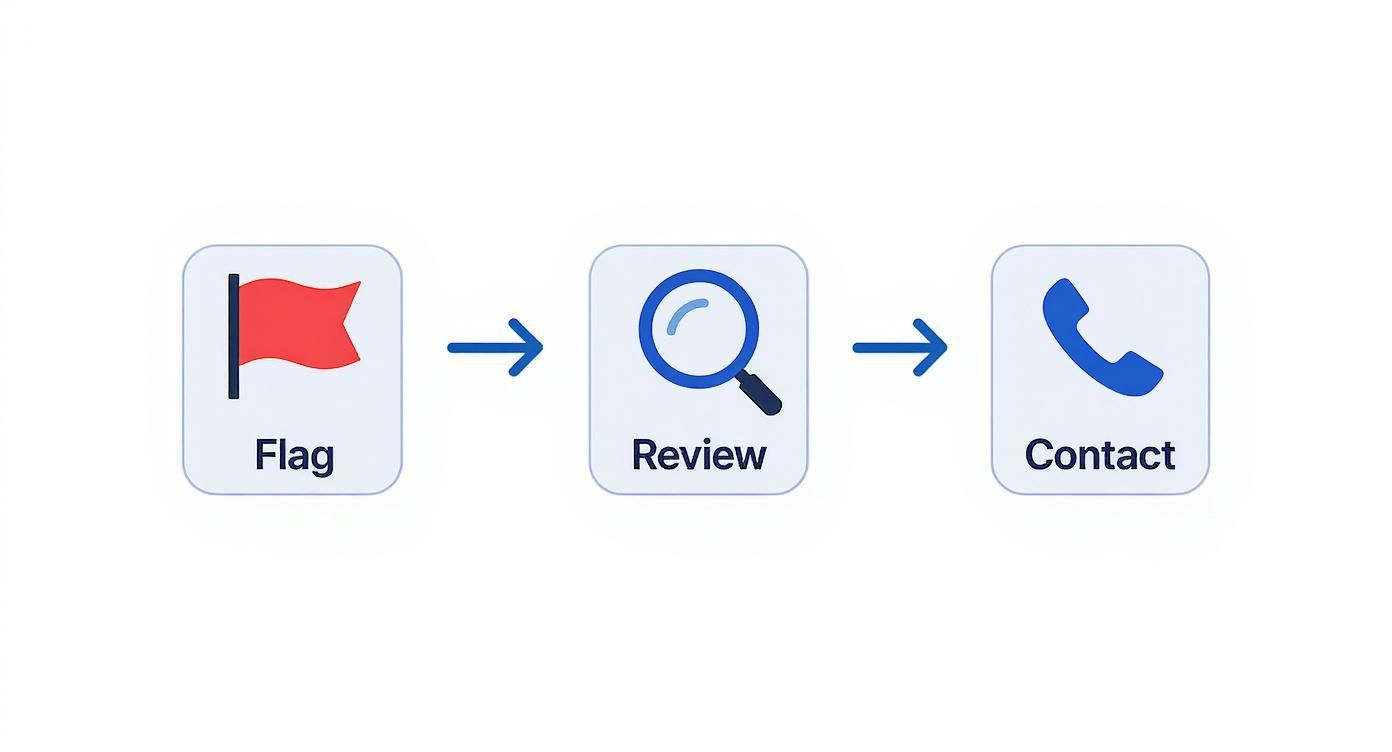
This simple three-step process—Flag, Review, Contact—is the foundation of any good incident response. It ensures that no shady-looking order gets pushed through to fulfillment without a second look.
Immediate Actions When You Suspect Fraud
The second you confirm an order is likely a scam, the clock starts ticking. Every moment you hesitate is another chance for the fraudster to get away with your money and your product. Your first moves need to be quick and decisive.
Your number one priority is to stop the fulfillment process cold. If you're dropshipping, that means you need to contact your supplier on AliExpress, CJdropshipping, or wherever else immediately. Send them the order number and tell them in no uncertain terms to cancel it because it’s fraudulent. Don’t wait.
At the same time, you need to be doing this:
- Cancel and Refund the Order: Jump into your Shopify or WooCommerce dashboard, cancel the order, and issue a full refund. This stops a chargeback from ever being filed, which is crucial for keeping your merchant account in good standing.
- Notify Your Payment Processor: Give your payment gateway a heads-up about the fraudulent transaction. They can often add the card to their internal blocklists, which helps protect the entire network of merchants.
- Block the Customer: Ban the customer’s account, email, and IP address. Make sure they can't come back and try again from the same digital location.
The Art of Fighting Chargebacks
Getting hit with a chargeback feels like a punch to the gut, but it doesn't have to be a knockout. If you have the right evidence, you can absolutely fight back and win. The tricky part is "friendly fraud"—where legitimate customers dispute charges—which accounts for a staggering 34% of all e-commerce fraud. Your response needs to be an ironclad case built on documentation.
The bank doesn't care about your story; they only care about cold, hard evidence. Your job is to build a case so compelling that it proves you fulfilled a legitimate order placed by the person who actually owns the credit card.
Pro Tip: Never submit a half-baked chargeback response. Throwing in just one or two pieces of evidence is a guaranteed loss. You need to treat every single dispute like you're going to court and have to prove your case beyond a reasonable doubt.
Building Your Chargeback Evidence Checklist
Think of your dispute submission as a complete evidence package. You want to leave zero room for interpretation. Get everything on this list together and present it clearly to the bank.
- Proof of AVS and CVV Matches: This is your foundation. Provide screenshots from your payment processor showing that the Address Verification System (AVS) and Card Verification Value (CVV) checks passed. It’s the first piece of proof that the real cardholder made the purchase.
- Customer Communications: Dig up every single email, live chat log, or support ticket related to that order. If the customer emailed you asking where their package was, that’s powerful proof they knew they bought something from you.
- Order and Shipping Confirmations: Include copies of the order confirmation and all the shipping notification emails you sent. This shows you followed your standard, professional process and kept the customer in the loop.
- Proof of Delivery: This is the heavyweight champion of your evidence. You absolutely need a screenshot from the carrier’s tracking page showing the "Delivered" status, complete with the full delivery address, date, and time. If you got a signature, that’s even better—include it.
- Digital Footprints: Don't forget the tech side. Include the customer’s IP address from the time of purchase and any device fingerprinting data you collected. If that IP address geolocates to the same city as the shipping address, it makes an "unauthorized transaction" claim look incredibly weak.
By having this playbook ready to go, you shift from being a potential victim to a prepared defender. You’ll know exactly what to do, who to contact, and what evidence to pull to protect your hard-earned revenue.
Your Top Dropshipping Fraud Questions, Answered
When you're trying to build a business, the last thing you want to deal with is fraud. It can feel confusing and overwhelming, so let's clear up some of the most common questions I hear from fellow dropshippers.
What’s the Most Common Fraud I’ll Face as a Dropshipper?
Hands down, the biggest problem for most dropshipping stores is friendly fraud, which almost always leads to chargeback fraud.
Here’s how it usually plays out: a customer buys a product, receives it, and then calls their credit card company to falsely claim it never arrived or that they didn't authorize the purchase. It's a real gut punch.
This hits dropshippers particularly hard because of the typical shipping times from suppliers like AliExpress. That longer delivery window gives impatient or dishonest customers more time to get buyer's remorse and file a dispute. Since you don't control the final delivery scan yourself, fighting these chargebacks requires you to be incredibly diligent with your record-keeping.
Another one to watch out for is triangulation fraud. In this nasty little scheme, a scammer sets up a fake online store, gets an order from a legitimate customer, and then uses a stolen credit card to buy that same item from your store, shipping it directly to their buyer. You send the product, the real buyer gets it, but you're the one who gets hit with the chargeback when the actual cardholder discovers the fraudulent charge.
How Much Should I Actually Spend on Fraud Prevention?
There's no magic number here, but you can figure it out by looking at what you're currently losing to chargebacks. Many great fraud prevention apps, especially for platforms like Shopify, will charge a small percentage of your sales (say, 0.5%) or a fixed monthly fee.
Here's a simple way to think about it: if a tool costs you $50 a month but prevents just one chargeback on a $100 order, it's already paid for itself twice over. The goal is to invest in something that saves you far more than it costs.
Before you spend a dime, make sure you’re using all the free, built-in tools your ecommerce platform offers, like basic AVS/CVV checks or features like Shopify Protect. Once your sales volume picks up or you see your fraud rate starting to climb, that's the time to look into a dedicated, paid tool that can automate more of the heavy lifting.
Is It Possible to Completely Eliminate Fraud?
Honestly? No. Trying to get to zero fraud is not only impossible, but it’s also bad for business. If you set your rules too tight, you’ll end up blocking perfectly good customers and destroying your conversion rate.
The real goal isn't elimination; it's smart management.
You want to get your fraud and chargeback rate to a comfortable, low level—ideally, well below 1% of your total orders. The best way to do this is with a layered approach: use automated rules to catch the obvious stuff, manually review any orders that seem a bit fishy, and stick to secure, reputable payment gateways.
Fraudsters are always changing their tactics, so your prevention plan can't be a "set it and forget it" thing. It needs to be an active part of how you run your store. Focus on making your business a tough target so scammers just move on to easier prey, and have a solid process for the few fraudulent orders that will inevitably slip through. It's all about being prepared, not impenetrable.
Running a dropshipping store is a serious hustle. Between finding winning products and dialing in your ads, your time is gold. Don't waste it manually downloading product images one by one. AliSave Pro is a free Chrome extension built to save you time, letting you download all AliExpress product media—images, variant photos, videos, even customer review pictures—in a single click. Join over 20,000 sellers streamlining their workflow with AliSave Pro. Grab it for free from the Chrome Web Store.