
The fundamental difference in the Ecwid vs Shopify debate really comes down to one thing: Ecwid is a plugin built to add a store to an existing website. In contrast, Shopify is a complete, all-in-one platform designed for building an online store from the ground up. The right choice for you hinges on whether you're adding e-commerce to your current setup or building a brand new one.
Ecwid vs Shopify: A Quick Guide for Entrepreneurs

Choosing the right e-commerce platform can feel like a huge commitment, but it often boils down to where your business stands right now. Are you a blogger, an artist with a portfolio site, or a local shop that already has a web presence? Or are you launching a completely new venture and need a dedicated, powerful online store to be its home base?
Ecwid is a fantastic solution for anyone who already has an audience and a website. Think of it as a nimble little "widget" that lets you start selling almost anywhere—your WordPress blog, a Squarespace site, or even directly on your Facebook page. It’s all about bringing the store to where your customers already are.
Shopify, on the other hand, is the foundation. It’s a full-blown ecosystem for entrepreneurs who are serious about building a scalable online brand from scratch. It gives you everything you need in one package: the website builder, inventory management, marketing tools, and payment processing.
Key Takeaway: Go with Ecwid if you want to quickly and affordably add a shopping cart to a website or social page you already own. Choose Shopify if your primary goal is to build a comprehensive, brand-focused online store that can grow with you.
To make the choice even clearer, let's look at their core differences side-by-side. This quick overview will help you see where each platform excels before we get into the nitty-gritty of features and pricing.
Ecwid vs Shopify: Key Differences at a Glance
This table outlines the fundamental differences between Ecwid and Shopify to guide your initial decision based on your business model and technical needs.
| Factor | Ecwid | Shopify |
|---|---|---|
| Primary Function | An e-commerce widget for existing websites and platforms. | An all-in-one platform for building a standalone store. |
| Ideal User | Bloggers, artists, and small businesses with an existing site. | Startups, growing brands, and serious online retailers. |
| Starting Price | Offers a permanent free plan for up to 5 products. | Starts with a low-cost trial, then paid plans from $29/mo. |
| Technical Skill | Very beginner-friendly; simple copy-and-paste setup. | Beginner-friendly but offers deep customization for experts. |
Seeing the platforms laid out like this really highlights their different approaches. Ecwid is about accessibility and integration, while Shopify focuses on providing a robust, self-contained solution for serious sellers.
Understanding the Fundamental Platform Differences
Before we get into the nitty-gritty of the Ecwid vs Shopify debate, it's crucial to understand their core philosophies. These platforms aren't just two sides of the same coin; they were built with fundamentally different ideas about how you should sell online. One is a nimble add-on, the other is a full-blown ecosystem.
Ecwid, which is short for "e-commerce widget," works exactly how it sounds. It’s a brilliant, lightweight store designed to be embedded almost anywhere you already exist online.
Think of it as a portable storefront. You can plug Ecwid into:
- An existing WordPress blog to sell merchandise to your followers.
- A Squarespace portfolio to sell prints of your artwork.
- Your Facebook or Instagram page to make social selling a breeze.
- Even a simple landing page you’ve built with another tool.
This "add-on" model is its biggest advantage. It lets creators and small businesses dip their toes into e-commerce quickly and affordably, without the headache of building a brand-new website from scratch.
The All-In-One Ecosystem Approach
Shopify, on the other hand, is an all-in-one platform. It's not meant to be added to something else; it is the something else. When you sign up for Shopify, you're building your entire business—from the website and inventory to marketing and analytics—within its powerful ecosystem.
This approach gives you a unified, rock-solid foundation for a brand you plan to scale. Instead of duct-taping different tools together, everything works seamlessly from the get-go. You get a robust website builder, a solid blogging platform for SEO, and a central command center to run your entire operation. This cohesion is precisely why Shopify has become such a titan in the e-commerce world.
Shopify is built for entrepreneurs who see their online store as the heart of their brand, not just a feature tacked onto an existing project.
Comparing Real-World Applications
Let's ground this in reality with two different business owners.
First, imagine a freelance photographer with a beautiful portfolio website already showcasing her work. She just wants a simple way to sell prints directly from her gallery pages. For her, Ecwid is a no-brainer. She can embed "Buy Now" buttons or a small product gallery right into her existing site in minutes, keeping her established branding and web traffic exactly where they are.
Now, think about an entrepreneur launching a new direct-to-consumer coffee brand. They need a custom domain, a blog for content marketing, advanced inventory tracking for different roasts, and the ability to scale with powerful marketing apps. Shopify is the obvious winner here. It provides the entire infrastructure needed to build and grow a serious e-commerce brand from the ground up. Looking at a general ecommerce platforms comparison can offer a wider view of how these distinct approaches fit into the market.
This fundamental difference in strategy is clear in their market share. As of 2025, Shopify holds a commanding 10.32% of the global e-commerce platform market. Its dominance is backed by 4.8 million active stores worldwide, with a huge concentration in the United States, proving its appeal as a primary business platform. You can dig into more of this data on Shopify's market share at RedStagFulfillment.com.
Analyzing the True Cost of Ecwid and Shopify

When you're sizing up Ecwid vs. Shopify, the monthly subscription fee you see advertised is really just the starting point. To get a real picture of what you'll spend, you have to dig into the variables that truly impact your bottom line—things like transaction fees, payment processing rates, and the cost of essential apps.
Ecwid’s biggest hook is its permanently free plan. It's a fantastic way to dip your toes in the water or sell a few items without any upfront cost. But be warned, it's quite restrictive. You’re limited to just five products and miss out on crucial features like abandoned cart recovery or even using your own custom domain.
Shopify takes a different route. There’s no forever-free plan, but they offer a trial that costs just $1 per month for your first three months. This gives you full access to its powerful feature set right away, which is often a much more practical way to see if the platform is the right fit for your business.
Breaking Down Ecwid Pricing
At first glance, Ecwid’s paid plans seem like a bargain, making them a go-to for sellers watching every penny. The tiers are straightforward:
- Venture Plan ($21/mo): Bumps your product limit to 100, lets you connect a custom domain, and unlocks selling on social channels like TikTok.
- Business Plan ($39/mo): Expands your catalog to 2,500 products and adds mission-critical tools like automated abandoned cart emails.
- Unlimited Plan ($89/mo): Just as it sounds—unlimited products and priority support.
For most growing stores, the Business plan is the real sweet spot. The ability to automatically chase down abandoned carts is a non-negotiable feature for driving revenue, easily justifying the price jump from the Venture tier.
Here's where Ecwid really stands out: it charges zero transaction fees on all its plans. That’s a huge plus. You'll still have to pay the standard credit card processing fees from your payment gateway (like Stripe or PayPal), but Ecwid won't take an extra cut.
Decoding Shopify's Cost Structure
Shopify's plans start higher, with its Basic plan at $29 per month. While that looks more expensive on paper, it comes loaded with unlimited products, abandoned cart recovery, and a ton of powerful built-in features from day one. This makes even its entry-level plan a more complete package than Ecwid's lower-cost tiers.
The most critical piece of Shopify's pricing puzzle is how it handles transaction fees. If you use its own integrated payment gateway, Shopify Payments, you pay 0% in transaction fees. Your only cost is the standard credit card processing rate, which keeps things simple.
However, if you decide to use a third-party gateway like PayPal or Stripe, Shopify tacks on its own transaction fee on top of what the processor charges. This extra fee gets smaller as you upgrade:
- Basic Plan: 2.0% additional fee
- Shopify Plan: 1.0% additional fee
- Advanced Plan: 0.5% additional fee
This fee structure is a powerful nudge to use Shopify Payments. For the vast majority of merchants, sticking with the native gateway is the most cost-effective and headache-free option.
A Practical Cost Scenario: $10,000 in Monthly Revenue
Let's run the numbers to see how this plays out in the real world. Imagine two online stores, each pulling in $10,000 per month.
Ecwid Cost Analysis (Business Plan)
- Monthly Subscription: $39
- Transaction Fees: $0 (Ecwid doesn't charge any)
- Payment Processing (Stripe at 2.9% + 30¢, avg. $50 order): (0.029 * $10,000) + (200 orders * $0.30) = $290 + $60 = $350
- Total Estimated Monthly Cost: $389
Shopify Cost Analysis (Basic Plan with Shopify Payments)
- Monthly Subscription: $29
- Transaction Fees: $0 (when using Shopify Payments)
- Payment Processing (Shopify Payments at 2.9% + 30¢): (0.029 * $10,000) + (200 orders * $0.30) = $290 + $60 = $350
- Total Estimated Monthly Cost: $379
In this head-to-head matchup, the Shopify Basic plan actually comes out slightly cheaper than the comparable Ecwid Business plan, even though Ecwid has the lower monthly fee. This is a perfect example of how transaction fees—or the lack of them—can completely flip the script. As your sales grow, those small percentages make a bigger and bigger difference.
Comparing Core Ecommerce Tools and Features
Once you get past the price tags, the real test of a platform is how it handles the daily grind of running a store. When we put Ecwid vs Shopify under the microscope, their core tools for inventory, marketing, and payments reveal two very different philosophies.
Shopify comes loaded for bear right from the start, built to handle growth. Ecwid, on the other hand, lets you start small and simple, with more advanced features unlocking as you move up its subscription tiers. Your choice really boils down to your business's current needs and where you see it going.
Inventory and Product Management
The heart of any online shop is, well, the stuff you sell. Both platforms cover the basics, but the devil is in the details when it comes to product limits and customization.
Shopify immediately sets a high bar by offering unlimited products on all its plans. For businesses with massive catalogs or big growth plans, this is a game-changer. You never have to worry about hitting a wall. Shopify also has "smart collections," a fantastic tool that automatically groups products using rules you define, like price or tags, saving you countless hours of manual sorting.
Ecwid ties its product limits directly to its plans. You start with just five products on the free plan, and even the popular Venture plan caps you at 100. To get unlimited products, you have to jump to their highest-priced Unlimited plan.
But here’s where Ecwid lands a solid punch: product options. It places no restrictions on how many variants like size, color, or material you can add. Shopify, famously, limits you to just three options per product, a major headache for anyone selling highly customizable goods.
Key Differentiator: If you sell a t-shirt that needs options for size, color, material, and sleeve length, Ecwid handles it out of the box. On Shopify, you'd be forced to find and pay for a third-party app to work around that three-option limit.
Marketing and SEO Capabilities
Getting eyes on your products is everything. As an all-in-one website builder, Shopify has a clear advantage here. It gives you total control over all the important SEO knobs—meta descriptions, URL slugs, image alt text—across your entire site.
Crucially, Shopify includes a powerful, built-in blogging platform. This is a must-have for content marketing, letting you pull in customers through organic search without juggling a separate system.
With Ecwid, your SEO power depends entirely on where you’ve plugged it in. Add Ecwid to a well-optimized WordPress site, and you’re golden. But if you’re using Ecwid’s standalone "Instant Site," the SEO tools are pretty basic compared to Shopify’s arsenal.
Then there's abandoned cart recovery, a feature that can single-handedly boost your revenue.
- Shopify: Includes automated abandoned cart emails on all its plans, right from the entry-level Basic plan.
- Ecwid: Makes you wait until the Business plan ($39/mo) or higher to unlock this tool.
Considering that abandoned cart emails can bring back up to 28% of lost sales, getting this feature from day one with Shopify is a massive plus.
Payment Gateways and Shipping Tools
Both platforms play nice with a ton of payment processors like Stripe, PayPal, and Square. Shopify integrates with over 100 gateways, while Ecwid supports more than 70.
The real difference is in how they handle their in-house solutions and fees. Shopify strongly nudges you toward Shopify Payments. The incentive is hard to ignore: use it, and they waive all of their own transaction fees.
Ecwid, which uses Lightspeed Payments, takes a different approach. It charges zero transaction fees on all plans, no matter which payment gateway you choose. This gives you the freedom to pick your favorite processor without getting dinged for it.
When it's time to ship, both platforms have you covered. But Shopify has used its massive scale to negotiate some serious discounts with carriers like USPS, UPS, and DHL. Merchants can see savings of up to 88% on shipping labels, which can have a huge impact on your bottom line.
Point of Sale (POS) Systems
For merchants selling both online and in person, a solid POS system is non-negotiable.
Shopify's POS is a core part of its ecosystem. POS Lite comes free with every Shopify plan and handles the basics like taking payments and managing orders. For heavy-duty retail features like staff management and advanced inventory tracking, you’ll need to upgrade to POS Pro for $89/month per location.
Ecwid’s POS is primarily an integration with its parent company, Lightspeed, but it also works seamlessly with other big names like Square and Clover. This is great if you’re already set up with one of those systems, but you'll often need a higher-tier Ecwid plan to connect them.
For businesses leaning into automation, particularly in dropshipping, the platform choice can open or close doors. Shopify’s gigantic app marketplace offers far more tools for linking with suppliers and automating fulfillment. You can see what’s out there by exploring the best dropshipping automation tools for each ecosystem.
Evaluating Design Flexibility and Storefront Customization
How your store looks and feels is often the very first impression a customer gets. This makes design flexibility a massive deal in the Ecwid vs Shopify debate. Your choice here really comes down to whether you want to build a fully-branded, standalone destination or simply add a clean, functional storefront to a digital home you already have.
Shopify is a design-first platform, built from the ground up to create beautiful, standalone online stores. Its biggest strength is the Shopify Theme Store, which is packed with over 200 professionally designed, mobile-ready themes. Sure, only about 12 of them are free, but the premium themes—which usually run between $200 to $400—are polished, packed with features, and designed to sell.
Think of these themes as a starting point. From there, you can jump into a user-friendly drag-and-drop editor to tweak colors, fonts, and layouts. For anyone with a bit of coding knowledge, Shopify opens up the hood completely, giving you full access to the theme code via its own templating language, Liquid. This is where the magic happens, letting developers build a totally unique brand experience.
Ecwid's "Blend-In" Design Philosophy
Ecwid plays a completely different game. It’s all about seamless integration, not standalone creation. The goal is to make your embedded store look like it’s always been a natural part of your existing website, whether that’s built on WordPress, Squarespace, or Wix. It cleverly pulls the fonts and colors from your host site to make everything feel cohesive.
You can still adjust things like the widget’s colors, product card layouts, and image sizes, but the creative freedom is intentionally reined in. Ecwid is more focused on function and consistency than deep, from-the-ground-up brand customization.
For those starting completely from scratch, Ecwid offers the Instant Site. It’s a simple, one-page storefront that’s clean and gets the job done. It’s perfect for getting products online fast but doesn't have the multi-page structure or design depth you’d get from a full Shopify store.
What This Looks Like in the Real World
Let's make this practical. Imagine two different businesses:
An Ecwid Store: Picture a travel blogger who's built a loyal following on their WordPress site. They decide to sell branded travel gear and embed an Ecwid widget on a new "Shop" page. The product listings just appear, automatically using the blog's existing fonts and color palette. It feels like a natural extension of the blog, not a separate store bolted on.
A Shopify Store: Now think of a new skincare brand launching directly to consumers. They build their entire world on Shopify. Their homepage has big, beautiful video banners, curated collections, and a blog full of skincare tips—all wrapped in a custom theme that reflects their minimalist, clean aesthetic. The store is their brand's home base.
Key Takeaway: Shopify gives you the keys to build a powerful, brand-focused online destination. Ecwid gives you an adaptable and functional storefront designed to blend in, not necessarily stand out.
At the end of the day, the right choice depends entirely on what you're trying to achieve. A great-looking storefront is non-negotiable, but how you get there has to fit your business model. To get more insight into making your site sell better, check out our guide on how to improve ecommerce conversion rates. Deciding between Ecwid's integration-first approach and Shopify's creative powerhouse is a huge first step.
Making the Right Choice for Your Business Model
Deciding between Ecwid and Shopify isn't about finding the "best" platform—it’s about matching the right tool to your specific business plan. The features and costs we've covered land differently depending on your goals, budget, and where you're starting from. This final section cuts through the feature lists to give you clear advice for real-world situations.
The simplest way to start is by answering one fundamental question: do you already have a website you love?
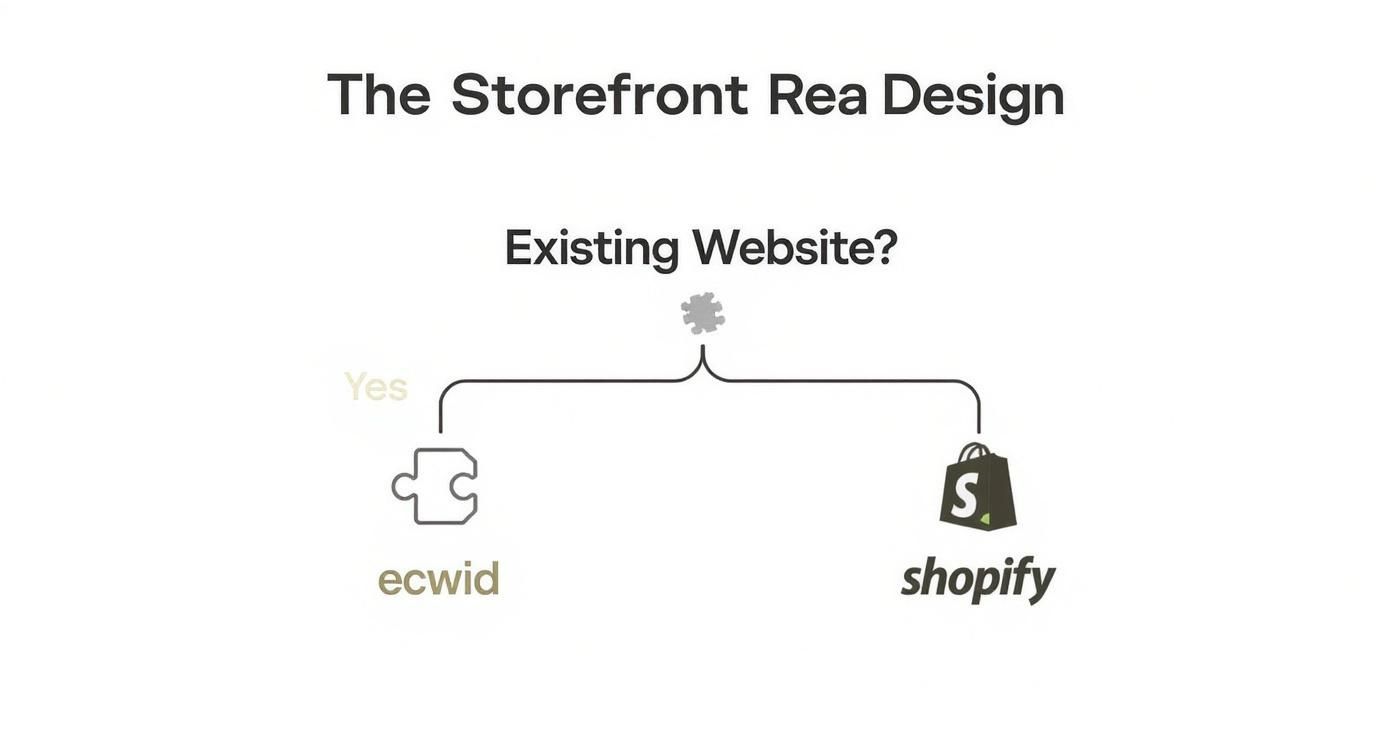
This image nails the core difference. Ecwid shines when you need to plug into something that already exists. Shopify is the go-to for building a dedicated e-commerce brand from the ground up.
The Creative Professional Adding a Store
Verdict: Ecwid
If you're a photographer, artist, or consultant with an established portfolio site on a platform like WordPress or Squarespace, you're looking to sell without starting over. Ecwid was practically built for this. It acts like a widget, letting you embed a clean, fully functional storefront directly into your existing site.
You don't need to build a second website or juggle two different brands. You can start selling prints, digital files, or coaching sessions almost instantly. The free or low-cost Venture plan makes this a low-risk, high-reward move to monetize the audience you've already built.
The Local Retailer Expanding Online
Verdict: It Depends (but likely Shopify)
For a brick-and-mortar shop venturing into online sales, the right choice really boils down to your tech skills and long-term vision. If all you need is a basic online catalog that plays nice with an existing POS system like Square, Ecwid is a perfectly straightforward solution.
That said, most retailers will get more mileage out of Shopify. Its tightly integrated ecosystem, especially with Shopify POS, creates a powerful, single source of truth for your entire business. Inventory, sales, and customer data sync seamlessly across your physical and online stores, which is absolutely critical for preventing stockouts and giving customers a smooth experience.
The Ambitious Brand Built for Growth
Verdict: Shopify
When your goal is to build a scalable, standalone e-commerce brand, the Ecwid vs Shopify debate swings firmly toward Shopify. It's an all-in-one platform engineered for growth. You get a robust website builder, a built-in blog for content marketing, advanced SEO tools, and a massive app store to add any feature you can dream up.
This market positioning is clear in their traffic; Shopify's main site pulls in 76.7 million visits per month, reflecting a huge brand presence that attracts serious entrepreneurs ready to scale. For a closer look at these kinds of platform trends, check out these insightful Shopify statistics on BloggingWizard.com. If you need more guidance on your overall strategy, this guide on choosing your e-commerce marketing platform offers some great advice.
The Dropshipper Focused on Automation
Verdict: Shopify
For dropshippers, it's all about efficiency and automation. While Ecwid does support dropshipping via apps, Shopify's app marketplace is in a different league entirely—it’s vastly larger and more specialized for this business model. You'll find a much deeper well of sophisticated tools for product sourcing, order fulfillment, and supplier integration.
Shopify’s entire architecture is designed to support the kind of high-volume, automated workflows that make a dropshipping business successful. It's the clear winner for anyone serious about this model. If you're just getting started, our complete guide on how to start dropshipping will help you build a solid foundation.
Frequently Asked Questions
When you're deep in the weeds comparing Ecwid and Shopify, a few key questions always seem to pop up. Let's tackle some of the most common ones to help you clear up any lingering doubts.
Can I Migrate from Ecwid to Shopify Later On?
Absolutely. Making the jump from Ecwid to Shopify is a well-trodden path for businesses that are ready to level up. It’s actually a good sign—it means you've outgrown your initial setup and are ready for more power.
The migration itself is pretty straightforward. You can use specialized third-party apps like Cart2Cart or LitExtension to handle the heavy lifting. These tools will pull over your most important data, including:
- Products, along with their images and descriptions
- Customer lists and their order histories
- Your existing category structure
Here's the catch, though: your store's design won't come with you. You’ll need to pick a new theme from the Shopify Theme Store and rebuild your site's look and feel. To avoid any major hiccups, I always recommend planning the switch during a naturally slow season for your business.
Which Platform Is Better for SEO?
For most businesses, Shopify has the edge when it comes to search engine optimization (SEO). Since it’s a complete, all-in-one platform, you get full control over your site's technical SEO right out of the box—think URL structures, meta tags, and site architecture.
If organic search is a critical part of your growth strategy, Shopify's built-in SEO toolkit gives you a much stronger foundation to work from.
Shopify also comes with a native blogging platform, which is a must-have if you're serious about content marketing and attracting customers through search.
Ecwid’s SEO capabilities really depend on where you use it. If you plug it into a well-optimized WordPress site, for example, you can get fantastic SEO results. But if you’re just using Ecwid’s basic "Instant Site," the tools are far more limited. You can still tweak SEO details for individual products, but the overall authority of your store is tied to whatever platform it lives on.
Do I Need an Existing Website to Use Ecwid?
Nope, and this is one of the biggest misconceptions about Ecwid. You can get started without having any website at all.
Every single Ecwid plan, even the permanently free one, includes a simple one-page storefront they call an "Instant Site." It’s perfect for new sellers who just want to get their products online quickly without the hassle of building a full-blown website. And once you move to a paid plan, you can connect your own custom domain, making it look every bit as professional as a traditional site.
Ready to supercharge your product media workflow? AliSave Pro is the ultimate tool for dropshippers who need high-quality product images and videos from AliExpress in seconds. Download everything you need with a single click and create stunning product listings and ads faster than ever before. Get started for free at https://alisavepro.com and see why over 20,000 sellers trust AliSave Pro to streamline their business.