
Think of your domain name as the digital address for your online store. It’s not just a technical detail; it’s one of the first and most critical branding decisions you'll make. This choice sets the stage for customer perception, impacts your ad performance, and echoes through all your future marketing.
Your Digital Foundation: Why Your Domain Name Matters
For dropshippers and e-commerce entrepreneurs, your domain is your digital storefront's permanent address. A great one builds credibility and makes you easy to find and share. A clunky, confusing one? It just creates friction, leading to lost traffic and a brand that’s hard to remember.
Nailing this from the start saves you the massive headache and expense of rebranding later. It's a foundational asset that needs to be chosen with care.
Key Factors in Your Decision
When you're brainstorming, a few core principles should guide your decision. These factors determine how effectively your domain works for your business.
- Brandability: Does the name feel unique and sound professional? Think about a name like Allbirds. It’s memorable and distinct, unlike a generic, forgettable name like BuyWoolShoesOnline.
- Memorability: If someone heard your store's name once, could they easily type it into their browser? Steer clear of awkward spellings, hyphens, and numbers that are easy to mess up.
- Relevance: Does the name hint at what you sell? This helps manage customer expectations right from the get-go, even before they click through to your site.
This visual breaks down the thought process perfectly.
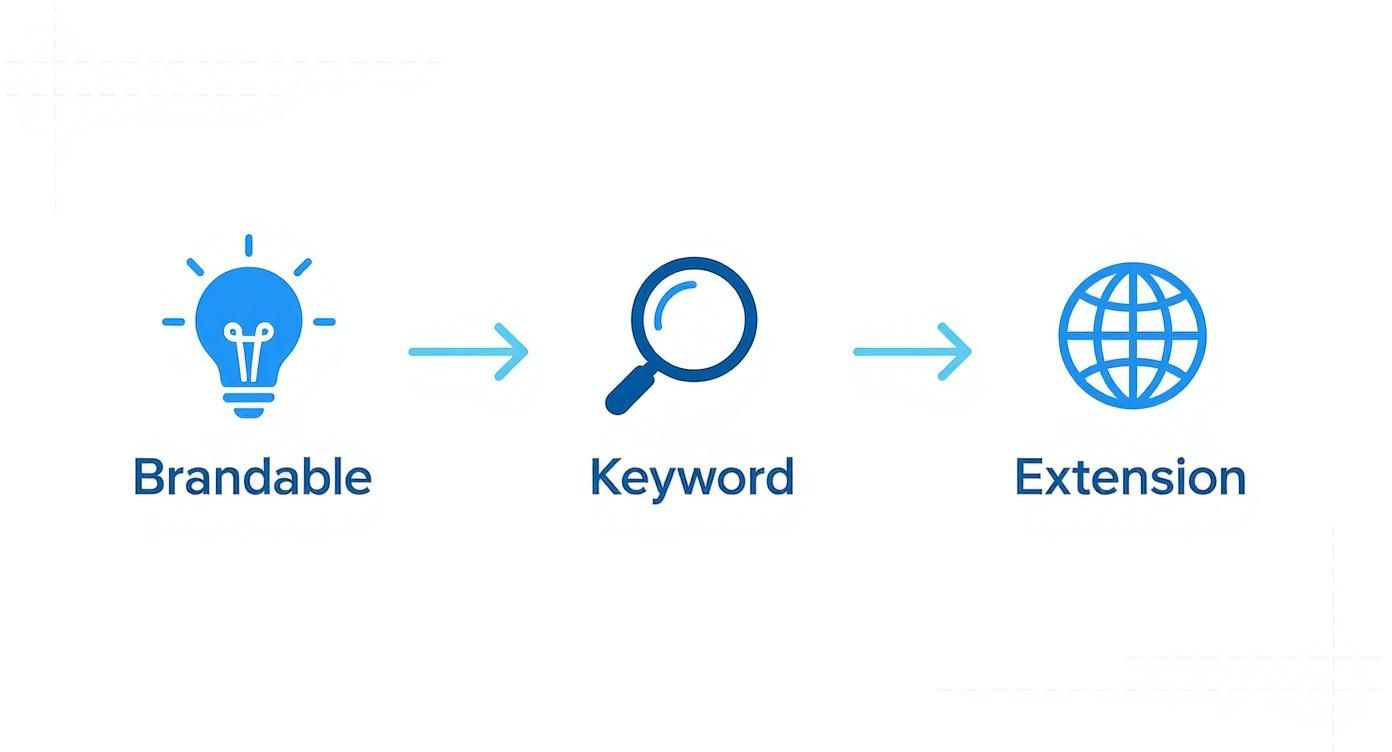
You can see the natural progression: start with a brandable concept, refine it with keywords in mind, and lock it in with the right extension. A well-chosen domain is a surprisingly powerful tool when you want to improve ecommerce conversion rates.
Key Takeaway: Stop thinking of your domain as just a URL. It’s a core marketing asset. Give its selection the same strategic weight you'd give your business name or logo design.
The competition for good names is fierce. Global domain registrations hit around 368.4 million at the start of the year. The classic .com still dominates, making up about 42.5% of all registered domains. This is the TLD customers know and trust most.
Key Domain Name Decision Factors at a Glance
This table sums up the most important things to consider as you narrow down your choices for your online store's domain.
| Factor | Why It Matters for Online Sellers | Quick Tip |
|---|---|---|
| Brandability | A unique name sticks in customers' minds and separates you from competitors. | Aim for something creative and distinct, not just descriptive. Think Gymshark, not BuyGymClothes. |
| Length & Simplicity | Shorter domains are easier to type, share on social media, and remember. | Keep it under 15 characters if possible. Two simple words often work better than one complex one. |
| Extension (TLD) | The .com extension carries the most trust and authority for e-commerce. | Always try for the .com first. Only consider alternatives if your top choice is unavailable. |
| Keyword Relevance | Including a relevant keyword can signal your niche to both users and search engines. | Balance keywords with brandability. PeakPaddles.com is better than BestKayakingPaddlesForSale.com. |
| Legal & Social Checks | You must ensure the name isn't trademarked and that matching social handles are free. | Do a quick search on the USPTO and check handle availability on platforms like Instagram and TikTok before you buy. |
Brandable vs. Keyword-Rich Naming Strategies
So, you're ready to pick a domain name. This is one of the first big forks in the road for any online seller. Do you invent something totally unique and catchy, like Gymshark? Or do you go for a super-direct, descriptive name like BuyYogaMatsOnline? This is the classic showdown: brandable vs. keyword-rich domains.
Each route has its own set of pros and cons. The best choice for you really boils down to your long-term vision for your store. Let's dig into what each strategy actually means in the real world so you can make a call that sets you up for success right from the start.
The Case for a Brandable Domain
A brandable domain is a name you create from scratch. Think of giants like Shopify, Asos, or Allbirds—those names don't literally describe what they sell, but they've become powerhouses in their industries. Choosing this path is all about building a memorable, long-term brand asset.
Why go brandable?
- You'll Stand Out: A creative name is your best friend in a crowded market. It’s sticky and helps you avoid sounding like a dozen other generic dropshipping sites.
- Room to Grow: A brandable name doesn't box you in. If Amazon had started as BuyBooksOnline.com, their pivot to… well, everything… would have been a lot more awkward.
- It Just Feels More Legit: Custom names often sound more professional and credible. They give you a blank slate to build a brand personality and connect with customers on a deeper level.
The main hurdle? A brandable name starts with zero built-in recognition. You've got to put in the work—and the marketing budget—to teach people what you're all about. It's a long game, for sure, but the reward is a much stronger, more defensible brand.
The Lure of a Keyword-Rich Domain
On the other side, you have keyword-rich domains. These are also known as exact-match domains (EMDs), and they spell out exactly what you sell. We're talking about names like OrganicDogTreats.com or WaterproofHikingBoots.store. The appeal is all about clarity and a potential little SEO boost.
Here’s why some sellers are drawn to this approach:
- Crystal Clear: Customers know what you're selling before they even click. This can lead to higher-quality traffic because visitors land with the right expectations.
- A Small SEO Nod: Back in the day, having keywords in your domain was a huge SEO ranking factor. Now? Not so much. Its impact is tiny, but it can still give search engines a faint signal about your site's topic. For a deeper dive into what really moves the needle in SEO today, check out our guide on how to outrank your competitors.
- Niche Authority: For a super-specific niche, a domain like BestDrillBits.com can instantly make you seem like the specialist.
But there are some serious downsides. These names can sound generic, are harder to remember, and can really hamstring you if you ever want to expand your product catalog. They also risk coming off as spammy or low-quality if you're not careful.
A brandable name is an empty vessel you fill with meaning over time. A keyword-rich name comes pre-filled but offers little room to add anything else.
To help you visualize the trade-offs, here’s a quick comparison:
Brandable vs. Keyword-Rich Domain Name Comparison
| Attribute | Brandable Domain (e.g., Shopify) | Keyword-Rich Domain (e.g., BuyPetSupplies) |
|---|---|---|
| Memorability | High; unique and catchy names stick. | Low; often generic and forgettable. |
| Scalability | High; easy to expand product lines. | Low; name limits future growth. |
| SEO Impact | Builds authority through branding and links. | Minor, diminishing boost from keywords. |
| Credibility | Tends to feel more professional and established. | Can sometimes appear spammy or low-quality. |
| Marketing Effort | Requires initial effort to build brand awareness. | Instantly communicates what you sell. |
Ultimately, a brandable name is an investment in your future, while a keyword-rich name is a shortcut for today.
The Smart Middle Ground: A Hybrid Approach
You don't have to pick a side. Often, the sweet spot is a hybrid approach that blends a brandable word with a keyword. Think of fantastic examples like DeathWishCoffee.com or SoloStove.com. They're unique and memorable, but they still give you a pretty good clue about what they sell.
This strategy gives you the best of both worlds: the stickiness of a brand and the clarity of a keyword. It’s a powerful choice for many e-commerce sellers, balancing long-term brand building with the need for customers to "get it" right away.
The domain industry is booming, with a total of 378.5 million registrations across all top-level domains (TLDs). And while old guards like .com and .net still account for a massive 171.9 million registrations, newer TLDs have grown to 42.9 million—a 21% jump year-over-year. This explosion of options means you have more creative freedom than ever to find the perfect hybrid name.
How to Make the Final Call
To land on the right strategy, sit down and honestly answer these questions:
- What's my long-term vision? If you dream of building an iconic brand that might one day sell more than just one type of product, a brandable or hybrid name is, without a doubt, the way to go.
- How will I market my store? If you’re banking on social media buzz, word-of-mouth, and brand recall, a unique and catchy name is your greatest asset.
- How crowded is my niche? In a market where everyone sounds the same, a truly distinct brandable name can be the single biggest thing that sets you apart.
For the vast majority of modern e-commerce stores, a brandable or hybrid domain is the strategic winner. It gives you the flexibility and memorability you need to build a sustainable business that customers actually love and remember.
What About the Domain Extension? (.com, .store, .co)
That little part after the dot in a web address—the extension or Top-Level Domain (TLD)—often feels like an afterthought. It really shouldn't be. This small detail plays a huge role in how customers perceive your store, how easily they remember you, and the overall strength of your brand.
For as long as the internet has been mainstream, .com has been the undisputed king. It’s what people automatically think of and type into their browser. If you tell someone your brand is "PeakPaddles," their first instinct will be to go to "PeakPaddles.com."
This mental shortcut is incredibly powerful. If you choose something other than a .com, you're constantly fighting against that habit. You risk sending potential customers to an error page or, far worse, to a competitor who was smart enough to grab the .com version of your name. Because of this, your number one goal should always be to lock down the .com.
When to Look Beyond .com
But what happens when your perfect .com is already taken? Don’t throw in the towel. The digital world has expanded, and there are now plenty of other great options that, when chosen wisely, can be just as effective.
This isn't just a fleeting trend. We've seen a massive expansion of the internet's naming system with new generic top-level domains (ngTLDs). Initial registrations sat around 3 million, but that number has since exploded to nearly 37 million—a growth of 922% in about a decade. This shows that people are getting much more comfortable with extensions beyond the classic .com. You can find more insights on this domain registration boom and see what it means for online sellers.
The trick is to use these newer extensions to add meaning to your brand. For an e-commerce business, TLDs like .store, .shop, or even .co are fantastic, logical alternatives.
Here’s how that plays out in the real world:
- For Niche Stores: If you're selling artisanal coffee, a name like
artisancoffee.storeis incredibly clear and modern. The extension itself tells people exactly what you do. - For a Modern Brand: A company selling cool tech gadgets might find that
gadget.iohas a more innovative feel that resonates with its target audience. - The Best Alternative: If
peakpaddles.comis gone,peakpaddles.shopis a strong second choice. It immediately signals that you're in the retail business.
The rule of thumb I always follow is this: If you can't get the .com, pick an alternative that makes sense for your business. For a dropshipper, .store or .shop is a no-brainer. A .pizza extension? Not so much.
A Quick Word on Country-Specific Domains
There's another whole category of TLDs you should know about: country-code TLDs (ccTLDs). These are the ones like .ca (Canada), .co.uk (United Kingdom), and .au (Australia). These extensions serve a very specific, and very powerful, purpose: targeting customers in a single country.
Using a ccTLD sends a crystal-clear message to both shoppers and search engines that your business is laser-focused on a particular local market. This can be a huge trust-builder for local customers, who often prefer buying from businesses in their own country to avoid crazy shipping times and surprise customs fees.
Google also pays close attention. From an SEO standpoint, a ccTLD is one of the strongest signals for geotargeting. A store using a .ca domain is simply more likely to rank higher for someone searching from Canada.
Here’s a simple way to think about it:
| TLD Type | When to Use It | SEO Impact |
|---|---|---|
| .com | You're targeting a global audience or want maximum authority. | The gold standard. Strong for all markets, everywhere. |
| ngTLD (.store, .shop) | The .com you want is taken; adds industry context. | Mostly neutral for SEO, but can boost user perception and trust. |
| ccTLD (.ca, .co.uk) | You're exclusively targeting customers in one specific country. | A massive boost for local SEO within that country's search results. |
Bottom line: if you want to sell to the world, fight for the .com. But if your entire business is built around serving customers in, say, Australia, then a ccTLD isn't just an option—it’s a strategic move.
Ultimately, picking the right extension is a balancing act between what's available and what makes sense for your brand. The .com is still the best all-around choice, but a smart, strategic use of a newer TLD or a country code can create a domain name that's just as memorable and effective.
3. Keep It Short, Simple, and Memorable
The best domain names are the ones that stick. They’re easy to remember, a breeze to type, and simple to say out loud. When you're brainstorming, remember that complexity is your enemy. A confusing name creates a barrier, making it that much harder for a potential customer to find their way to your store.
I always tell people to use the "radio test." Imagine you hear your store's name on a podcast. Could you pull up the website later without having to guess the spelling? If there's any doubt, you're likely creating a problem for future customers and losing sales before they even happen.
Shorter is Almost Always Better
When it comes to domain length, shorter is sweeter. My personal rule of thumb is to aim for under 15 characters, but even that can be pushing it. Shorter domains are just plain easier to manage—they fit perfectly on business cards, look clean in social media profiles, and are less prone to typos.
Think about it. A name like PremiumHandcraftedLeatherGoodsOnline.com is a nightmare. It’s long, clunky, and people will forget it the second they hear it. Something like ArtisanHide.com is punchy, memorable, and gets the point across instantly.
Your goal is to find that sweet spot between short and descriptive. Don't sacrifice clarity just to shave off a few letters, but always be on the lookout for a more concise way to say the same thing. A name that people can recall without effort will always win.
Avoid Clever Spellings and Punctuation at All Costs
I see this all the time. In the frantic search for an available name, sellers get "creative" by swapping letters, adding numbers, or throwing in hyphens. Trust me, this is a classic mistake that can seriously damage your brand's credibility before you even launch.
Stay away from these common pitfalls:
- Creative Misspellings: Using "xpress" for "express" or "kool" for "cool" isn't clever; it's confusing. Your customers will almost always default to the correct spelling and end up on a 404 page or, even worse, your competitor's website.
- Hyphens: Hyphens are a huge red flag for a lot of online shoppers. They scream "spam" and are a total pain to explain to someone. Compare
my-cool-store.comtomycoolstore.com. The second one is cleaner and far more professional. - Numbers: Unless a number is absolutely central to your brand name (like Four Sigmatic or Soylent), avoid it. Does "4" mean the digit or the word "four"? That little bit of confusion is all it takes to lose a customer.
Make Sure It's Easy to Say and Spell
Before you get too attached to a name, say it out loud a few times. Does it roll off the tongue, or do you stumble over it? If you have to spell it out every time you mention it, that’s a clear sign it's too complicated.
For instance, a name with tricky double letters, like PressSetup.com, is just asking for typos. It's incredibly easy for someone to type presetup.com by mistake and get lost.
Here's a quick gut-check for your top contenders:
- Is it easy to say? Say it five times fast. If it's a tongue-twister, ditch it.
- Is the spelling obvious? Avoid words with multiple common spellings.
- Does it sound legitimate? Run it by a few friends. Their first impression is usually a good indicator.
Nailing down a name that’s simple, short, and easy to spell isn’t just about aesthetics. It’s a foundational piece of your marketing, ensuring that when people look for you, they actually find you.
How to Secure Your Brand and Avoid Legal Issues
So, you found a domain name that feels just right. It's available, it's catchy, and you're ready to hit that "buy" button. Hold on a second. Finding an available name isn't the finish line; it’s a critical checkpoint. Before you commit, you need to do some due diligence to make sure your great new name is actually yours to use.
This part is all about making sure the name you love is legally sound and available everywhere your customers will look for you. Skipping these checks is a huge gamble. You could spend months and a small fortune building your brand, only to get a cease-and-desist letter that forces you to scrap everything and start over. A few minutes of research now can save you a world of pain later.
Perform a Basic Trademark Search
First up, and most importantly, is the trademark check. A trademark protects a name, symbol, or slogan in a specific industry. If your chosen name is even remotely similar to an existing trademark in your niche, you’re walking straight into a potential legal fight—one you're not likely to win.
You don't need to be a lawyer to run a preliminary search. Here's a simple process I always follow:
- Run a smart Google search: Don't just type in the name. Search for your name plus keywords like "brand," "shop," or your industry. For example, search for
"Peak Paddles" brandor"Peak Paddles" kayaks. See what comes up. Are there any other businesses in a similar space? - Check the official database: If you're selling in the U.S., head over to the United States Patent and Trademark Office (USPTO) website and use their free TESS search tool. It looks a bit complex, but a simple word search for your name will uncover any direct conflicts.
- Look globally: If you have international ambitions, check the World Intellectual Property Organization's (WIPO) global brand database. This gives you a broader view of who's using what, where.
This quick screening process isn't a replacement for professional legal advice, but it's an incredibly effective way to spot obvious red flags before you get too attached to a name.
A word of caution from experience: A name doesn't have to be officially registered to have legal protection. If a company has been using a name for years, they may have "common law" trademark rights. If your search uncovers a well-established competitor with the same name, even if it's not trademarked, it’s best to just walk away.
Check Social Media Handle Availability
Your brand doesn't just live on your website. It lives on Instagram, TikTok, Facebook, Pinterest—wherever your audience spends their time. Consistent branding across every single platform is absolutely essential for building trust and recognition.
Imagine your domain is PeakPaddles.com, but the Instagram handle @peakpaddles was snapped up by an inactive account back in 2015. Now you're stuck with something clunky like @peak.paddles.store, which just looks less professional and is harder for customers to find and tag.
This kind of inconsistency creates friction. It confuses customers and can even send your potential traffic to someone else's account. Before you purchase any domain, you have to verify that you can get the exact same handle (or something very, very close) on all your key social media channels.
Tools for Quick and Easy Checks
Manually searching every social network and trademark database one by one is a drag. Luckily, a few smart tools can do the heavy lifting for you in seconds.
- Namechk: This is my go-to. It’s a free tool that lets you type in a name and instantly see its availability across dozens of domain extensions and social networks.
- KnowEm: Very similar to Namechk, KnowEm also checks your username across a huge list of social sites, giving you a quick snapshot of your potential digital footprint.
Using one of these tools will give you a clear answer in under a minute. If your name is available as a .com and on your top three social platforms, that's a fantastic sign to move forward.
And if you’ve already got a store name but need to align it with a new, better domain, you can find solid advice on how to change the name of your Shopify store to get everything in sync.
Ultimately, digging into broader intellectual property law is key to building a secure foundation. Taking these extra steps ensures your brand is built to last, free from legal worries and ready for scalable growth.
Common Questions About Choosing a Domain Name
https://www.youtube.com/embed/SW-ka9St4ac
Even after you've done all your homework, picking a domain name can still leave you with some nagging last-minute questions. It’s a big decision, and hitting a few snags is completely normal. This section is all about tackling those common hurdles head-on, giving you clear answers so you can finalize your choice with confidence.
Think of this as your quick-reference guide for all those "what if?" moments. We'll dive into what to do when your perfect name is taken, how much SEO really matters for your domain today, and whether you should bother buying up extra domain extensions.
What Should I Do If My Perfect Domain Name Is Taken?
Finding out your ideal .com is already registered feels like hitting a brick wall, but trust me, it’s not a dead end. Before you toss out your brilliant idea, do a little digging. Is the domain an active, legitimate business, or is it just sitting on a parked page plastered with ads?
If it looks like it's just being held, the owner might be open to selling. You can try to find their contact details through a WHOIS lookup or use a domain broker to handle the negotiation for you. A word of caution, though: this can get pricey, fast. Premium domains can easily run into thousands of dollars.
A much more practical route is to get creative with variations. Here are a few simple tweaks that work surprisingly well:
- Add an action word: If
peakpaddles.comis gone, trygetpeakpaddles.comorshoppeakpaddles.com. They're intuitive, clear, and very often available. - Tack on a prefix: A simple prefix can be a lifesaver. Think
thepeakpaddles.comor even something more personal likemypeakpaddles.com. - Explore other TLDs: For an e-commerce store, extensions like .store or .shop are incredibly relevant and look professional.
peakpaddles.storeinstantly tells visitors what your site is about.
Honestly, sometimes being forced to pivot leads you to an even stronger, more brandable name. Don't let it discourage you; see it as a chance to find something even better.
How Much Does SEO Matter in a Domain Name Today?
This question comes up all the time. A decade ago, having an exact-match keyword in your domain gave you a massive SEO boost. Today? The impact is tiny. Google's algorithms have gotten way smarter, and they now prioritize things like site authority, user experience, and amazing content over everything else.
While a relevant keyword might give Google a small clue about your site’s topic, it’s nowhere near as important as a strong, memorable brand name. I mean, look at Amazon. The name has zero to do with what they sell, but they built incredible authority, which is the real secret sauce for SEO success.
Focus your energy on a name that builds trust and is easy for people to remember and type. Your content, your backlinks, and your on-page optimizations will have 99% more impact on your rankings than a keyword in your URL.
Should I Buy Multiple Domain Extensions for My Brand?
Yes, this is a smart, defensive play, especially as your business starts to gain traction. Buying multiple extensions (like yourbrand.com, yourbrand.net, yourbrand.store) is all about protecting your brand identity.
This strategy helps you avoid two major headaches:
- Cybersquatters: These are people who register variations of popular domains hoping to sell them back to the brand owner for a hefty profit.
- Competitors: A rival could snatch up an alternative extension just to confuse your customers or siphon away your hard-earned traffic.
It also helps catch typos. If your main site is mybrand.com but you also own mybrand.co, you can just redirect it. That way, anyone who mistypes the ending still lands on your site. When you're just starting, securing the .com is priority number one. Once you're established, investing a few extra bucks to lock down common alternatives is a wise move to protect your brand.
Is It a Bad Idea to Use a Domain Name Generator?
Not at all! In fact, they can be fantastic brainstorming tools, especially when you're feeling stuck. Domain name generators are designed to mash up your keywords with interesting prefixes, suffixes, and creative words you might not have thought of on your own. Most will even check for availability in real time.
The trick is to use these tools for inspiration, not to make the final call for you. Take the list of suggestions they spit out and run them through the checklist we've already covered:
- Is it brandable and unique?
- Is it short and easy to spell?
- Does it pass the radio test?
- Are the social media handles free?
Use a generator to get the creative juices flowing, but then apply your own strategic thinking to pick the true winner. If you want to dig even deeper into this or have more specific questions, I'd recommend checking out this comprehensive guide on domains.
Ready to start sourcing products for your new store? AliSave Pro is the ultimate tool for downloading high-quality AliExpress product images and videos in just one click. Speed up your workflow and create stunning product listings for free. Get started at https://alisavepro.com.