
Think about the last time you grabbed a value meal at a fast-food joint. You got the burger, fries, and a drink for one single price, and it felt like a way better deal than buying everything separately, right? That’s bundle pricing in action. It’s simply the strategy of selling two or more products together as a single package deal.
Getting to the Core of Bundle Pricing
For anyone running an ecommerce store, this is more than just a slick way to offer a discount. It's a seriously powerful tool for boosting your average order value (AOV), making shopping easier for your customers, and even clearing out stagnant inventory. The whole point is to create a situation where everybody wins.
Your customer gets a great deal and the convenience of a ready-made solution. Instead of hunting around and making three separate purchase decisions, they get everything they need in one click. This cuts down on decision fatigue and makes hitting that "buy now" button a whole lot easier.
On your end, the benefits are just as tangible. A smart bundle can drive up revenue and make your marketing dollars go further. By pairing items strategically, you can even introduce shoppers to new products or nudge them toward items they might have otherwise overlooked.
The Psychology That Makes Bundles Work
So, why is this strategy so effective? It all comes down to human psychology. When a customer sees a bundle, their brain immediately perceives a lower price-per-item and a higher overall value, even if the actual savings are pretty modest. That feeling of "getting a deal" is a huge motivator.
This isn't some new marketing fad, either. Economists figured out decades ago that bundling was a great way to extract more value from a diverse customer base. The early thinking was that businesses could actually increase their profits by offering packages, especially when customers were more certain about the value of the bundle than they were about the individual items.
A successful bundle isn't just about randomly throwing products together. It's about crafting a thoughtful offer that solves a real problem for your customer, making the whole package genuinely more valuable than the sum of its parts.
The Upside for Ecommerce Sellers
If you're an online seller or dropshipper, getting bundle pricing right can have a direct impact on your bottom line. It's a crucial part of a toolkit of effective pricing strategies for ecommerce that can really move the needle.
Here are the key advantages you can expect:
- Higher Average Order Value (AOV): Bundles are one of the surest ways to get customers to spend more in a single purchase than they might have planned.
- Smarter Inventory Management: Got a product that just isn't moving? Pair it with a bestseller to clear out that excess stock without having to slash prices on it alone.
- Simpler Marketing: It’s almost always easier (and cheaper) to promote one awesome bundle than it is to market three or four separate products.
- A Better Customer Experience: Curated kits and packages are incredibly convenient. You're saving your customers the time and mental energy of figuring out which products go well together.
At the end of the day, a good bundle transforms a simple sale into a value-packed solution for your customer.
Exploring the Main Types of Product Bundles
Once you've got a handle on why bundling works, it's time to dig into the how. Not all bundles are the same, and the specific strategy you pick can make or break your results. Think of these different types as plays in your ecommerce playbook—each one is designed for a specific situation and a specific goal.
The right approach really comes down to your products, your customers, and what you're trying to achieve. Are you trying to move a slow-selling item? Make your star product seem even more valuable? Or just give customers more ways to buy?
Let’s get into the four main types of product bundles and see which one fits your store.
Pure Bundling: The All-or-Nothing Approach
Pure bundling is exactly what it sounds like. You offer a group of products only as a package deal. Customers simply can't buy the items on their own. This creates a sense of exclusivity and works wonders when the bundled items are a perfect match, creating a complete solution for the customer.
Think about a software company selling a creative suite. They might offer a "Creator's Pack" with their video editor, photo editor, and audio software, all for one price. You can't just subscribe to the video editor; it's the whole package or nothing. This strategy works because the tools are meant to be used together, making the bundle far more valuable than any single piece of software.
Another classic example is a cable TV package. You don't subscribe to individual channels; you buy a pre-set group like a "Sports Package" or "Movie Lovers" tier.
Key Takeaway: Pure bundling is your go-to when the combined value of the items is so much higher than any single item that it compels customers to buy the whole set.
Mixed Bundling: The Power of Choice
Mixed bundling gives your customers the best of both worlds. With this strategy, you offer products both individually and as part of a discounted bundle. This flexibility is a huge win for shoppers and is a big reason why it's one of the most popular bundling methods out there.
A great example is a skincare brand that sells a cleanser for $20 and a moisturizer for $25. They could also create a "Daily Essentials Kit" with both products for a bundled price of $40. Customers who only need the cleanser can still grab it, but the $5 savings gives anyone considering both items a nice little nudge to buy the bundle.
This approach respects the customer's choice while gently guiding them toward a higher average order value. It’s also a fantastic tactic for dropshippers looking to move more inventory. By understanding how to buy in bulk for resale, you can get better prices on complementary items and pass those savings on to your customers in an irresistible mixed bundle.
Leader Bundling: The Strategic Pairing
Leader bundling is a clever way to boost sales of a product that's new or not getting much love. The idea is to pair a best-selling, popular item (the "leader") with a lesser-known item (the "follower") at a great price. The leader product's popularity essentially gives the follower a piggyback ride right into the customer's cart.
Imagine a coffee company with a wildly popular espresso blend. To promote a new line of biscotti that isn't selling well, they could create a "Morning Ritual Bundle" with a bag of the famous coffee and a box of the biscotti for a small discount. Coffee lovers who were already coming to buy their favorite blend are suddenly much more likely to try the new snack.
This bundle pricing strategy is perfect for:
- Introducing new products to your most loyal customers.
- Clearing out slow-moving stock without resorting to deep, standalone discounts.
- Getting more eyes on your wider product catalog.
Tiered Bundling: The Good, Better, Best Model
With tiered bundling, you create several versions of a bundle at different price points, often labeled as "Basic," "Pro," or "Gold" packages. Each tier offers more value than the last, whether that means more products, extra features, or premium versions of items. This strategy is brilliant because it appeals to different types of customers with different needs and budgets.
Take a company that sells home security systems. They could offer:
- Basic Tier: One camera and a door sensor.
- Standard Tier: Three cameras, two door sensors, and a smart lock.
- Premium Tier: Five cameras, a full sensor suite, a smart lock, and professional monitoring.
This model makes the decision-making process much simpler. Instead of getting overwhelmed by a dozen individual products, customers can quickly pick the tier that fits their needs. It guides them up the value ladder and often encourages them to spend a bit more than they originally planned to unlock the benefits of a higher tier.
Choosing the Right Product Bundling Strategy
This table compares the four main types of bundling to help you decide which strategy best fits your business goals and product catalog.
| Strategy Type | Best For | Primary Goal | Example |
|---|---|---|---|
| Pure Bundling | Highly complementary products that form a complete solution (e.g., software suites, starter kits). | Create an exclusive, high-value offer and maximize profit on a curated set. | A "New Parent Kit" with a crib, changing table, and dresser sold only as a set. |
| Mixed Bundling | Popular products that can be paired with related items, giving customers flexibility. | Increase Average Order Value (AOV) by encouraging add-ons without forcing a purchase. | Selling a gaming mouse and keyboard separately, but also as a "Gamer Bundle" for a 10% discount. |
| Leader Bundling | Pairing a best-seller with a new or slow-moving product to increase exposure. | Move specific inventory and introduce customers to new products. | A popular "Vanilla Protein Powder" bundled with a new, unknown "Berry Blast" flavor shaker cup. |
| Tiered Bundling | Product lines with clear "good, better, best" options or varying levels of service. | Appeal to different customer segments and guide them toward a higher-priced option. | A "Basic," "Pro," and "Ultimate" car cleaning kit with progressively more products. |
Each strategy serves a unique purpose. The key is to align your choice with what you want to achieve, whether that's clearing inventory, increasing AOV, or simply providing more value to your customers.
How to Calculate Your Bundle Price for Profit
Getting your bundle price right is make-or-break. Go too high, and you'll scare off shoppers. Too low, and you're just giving away your profits. Let's ditch the guesswork and walk through how to find that sweet spot: a price that customers love and your bottom line can depend on.
Before you can price anything, you have to know your costs. Cold. The bedrock of any good pricing strategy is your Cost of Goods Sold (COGS). This isn't just what you paid for the product; it's every direct cost involved in getting it onto your virtual shelf.
To really nail this, you need to account for everything, including less obvious expenses like e-commerce photography pricing considerations. From your shipping tape to credit card fees, every penny counts.
The infographic below shows the different kinds of bundles you might be creating. Each type has a different goal—whether it's to move more units or get customers to try something new—which will influence your pricing strategy.
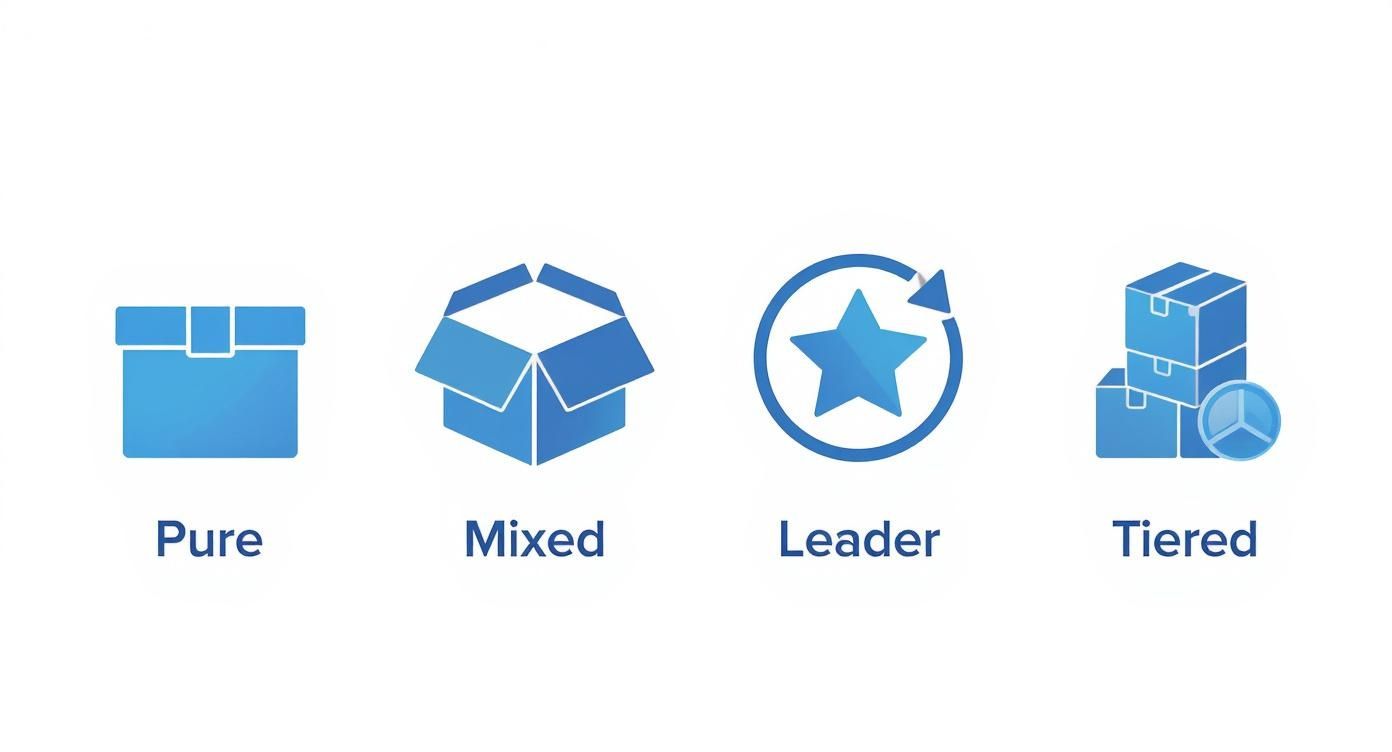
As you can see, a Pure bundle that's only sold as a package will be priced differently than a Mixed bundle where customers can still buy the items individually.
Start with Cost-Plus Pricing
The easiest place to start is Cost-Plus Pricing, sometimes called markup pricing. It's simple, it guarantees your costs are covered, and it gives you a predictable profit on every single sale.
Here’s the basic formula:
Total COGS of All Items + Desired Profit Margin = Bundle Price
Let's put it into practice. Say you're building a "New Parent Survival Kit" with three items:
- Item A (Baby Swaddle): COGS = $12
- Item B (White Noise Machine): COGS = $25
- Item C (Pacifier Set): COGS = $8
Your total COGS for this bundle is $12 + $25 + $8 = $45. Now, if you want a 50% markup on that cost, your calculation looks like this:
$45 (Total COGS) x 1.50 (1 + 0.50 Markup) = $67.50
This method is a solid, no-frills way to ensure you're profitable. But it completely ignores what the market will bear or how much customers feel the bundle is worth. It's a great starting point, but rarely the final price. If you want to get more precise with this, it helps to calculate retail margin to fine-tune your numbers.
Layer in Value-Based Pricing
While Cost-Plus gives you a floor, Value-Based Pricing flips the whole script. Instead of looking inward at your costs, you look outward to your customer. You price based on the perceived value your bundle offers, which is almost always higher than the sum of its parts.
That "New Parent Survival Kit" isn't just three products in a box. It's a solution. It's convenience, a little bit of sanity, and an answer to a new parent's sleep-deprived prayers. That emotional value is worth a lot, and it means you can probably charge more than the simple cost-plus math suggests.
Your bundle's value is more than its components. It's the convenience of a curated solution, the joy of discovery, or the satisfaction of a complete set. Price according to the problem you solve, not just the products you sell.
To start thinking this way, ask yourself:
- How much time and hassle does this bundle save my customer?
- Does it fix a major pain point or frustration they have?
- What's the emotional payoff of buying this all-in-one package?
If buying the swaddle, noise machine, and pacifiers separately would cost $85, your $67.50 bundle is already a good deal. But the added value of having it all curated for them might let you push the price to $75. The customer still gets a discount, and you capture more profit by pricing based on the real value you're providing.
Consider Competitive Pricing
Finally, you don't sell in a bubble. Competitive Pricing means taking a hard look at what your rivals are charging for similar bundles. This market research is non-negotiable—it keeps your pricing grounded in reality.
Find your top three competitors. Are they offering something similar? If so, what’s in their bundle, what does it cost, and what’s the perceived quality?
Once you have that intel, you can position your bundle in one of three ways:
- Price Below Competitors: A great tactic for grabbing quick market share, especially if your cost structure is leaner than theirs.
- Price On-Par with Competitors: This takes price off the table and forces customers to choose based on other things, like your brand, faster shipping, or amazing customer service.
- Price Above Competitors: Tread carefully here. You should only do this if your bundle is clearly superior—it includes a premium item, offers better quality, or provides a value so obvious that it justifies the higher price tag.
Putting Your Bundle Strategy into Action
Alright, you've done the math and mapped out your strategy. Now for the exciting part: bringing it all to life. Moving from a plan on a spreadsheet to a live offer on your store is where the magic happens, but it's also where things can get tricky.
A successful launch really boils down to two things: getting the technical setup right on your store and then creating a marketing push that gets customers genuinely excited about the deal. Let's dig into both.
Building Your Bundles on the Backend
First things first, you need to actually create the bundles in your store. The goal here is a completely smooth experience for everyone involved—that means you, your team, and especially your customers. Bundles should be easy to find, inventory needs to be spot-on, and the checkout has to be flawless.
Most ecommerce platforms like Shopify or WooCommerce don't handle sophisticated bundling out of the box. You'll almost certainly need an app or plugin to get the job done right.
Dive into your platform's app store and look for tools designed specifically for product bundling. Think about what you need. Are you offering a fixed kit? A "build your own" style bundle? Make sure the app supports your specific strategy.
When you're comparing apps, focus on these must-have features:
- Inventory Syncing: This is the big one. It's absolutely non-negotiable. The app has to track the stock of each individual item within a bundle. If a single component sells out, the entire bundle needs to be marked as "out of stock" automatically. This prevents the nightmare of overselling.
- Ease of Use: You shouldn't need a degree in computer science to set up a new offer. Look for a clean, intuitive interface that lets you create and tweak bundles without any headaches.
- Customization Options: The tool should give you control over how your bundles look on the product page. You need to be able to show off the products with great images and make the pricing and savings crystal clear.
The best bundling app is one you can set and forget. It should work silently in the background, keeping your inventory accurate and your checkout process flawless, letting you focus on marketing your great offers.
Getting this right can have a huge impact on your bottom line. In fact, research analyzing transaction data from a major online retailer found that a personalized bundle pricing algorithm could increase revenue by 2% to 7%. That's the power of a data-driven system that can run these kinds of offers in real-time. You can learn more about how personalized bundles enhance profits and the data behind it.
Marketing Your Bundles for Maximum Impact
Once your bundles are set up and working perfectly, it’s time to shout about them. A fantastic deal is completely useless if your customers never find out it exists. Your marketing should scream value and convenience from the virtual rooftops.
Start with your product pages—this is your main sales pitch. Give each bundle its own dedicated landing page that clearly lays out every single item included. Use high-quality photos of the products by themselves and as a complete set. Most importantly, make the savings obvious. A "strikethrough" price showing the original total next to the new bundle price is a classic and effective visual cue.
With your pages polished, it's time to drive traffic.
- Homepage Banners: Your homepage is prime real estate. Slap a banner featuring your most attractive bundle right at the top where no one can miss it.
- Email Campaigns: Fire off an announcement to your email list. Don't just say "we have bundles now." Frame it as a solution, like a "Complete Morning Routine Kit" or the "Perfect Gift for Dad Bundle."
- Social Media Promotion: Get creative on social. Post eye-catching images and maybe even short unboxing videos to show off everything that's inside. These are super effective for grabbing attention.
At the end of the day, your marketing's job is to get people to those optimized bundle pages. If the pages do a great job of communicating the value, the sales will follow. For more tips on sealing the deal, take a look at our guide on how to improve ecommerce conversion rates. A solid technical foundation paired with a creative marketing push is the recipe for a killer bundle launch.
Learning from the Brands That Nailed Bundling
Theory is great, but the real magic happens when you see how the pros do it. Some of the world's most recognizable brands have built empires by turning simple product pairings into iconic offers. Let's break down how they did it, so you can borrow from their playbooks.
These examples prove that bundling is so much more than just slapping a discount on a few items. It's about crafting a better experience for your customer through sheer convenience, the joy of discovery, and undeniable value.
McDonald’s: The Master of the All-in-One Experience
McDonald's might not have invented the bundle, but they perfected it with the Happy Meal. Think about it: it's not just a meal. It's a main, a side, a drink, and a toy. It's a complete, hassle-free solution for parents who need to feed a hungry kid quickly and without any fuss.
The real genius here is psychological. That little toy transforms a food purchase into a full-blown experience, creating a powerful sense of anticipation that drives repeat business. This is leader bundling at its absolute best—the popular food items (the leaders) pull the exciting new toy (the follower) right into the hands of kids.
Adobe Creative Cloud: The Pure Software Powerhouse
In the software world, Adobe's switch to the Creative Cloud is a legendary example of pure bundling. In the old days, creative professionals had to shell out a small fortune for individual licenses for tools like Photoshop or Premiere Pro. Now, Adobe offers its entire arsenal of creative software under one subscription.
This move was brilliant for a few reasons:
- It opened the floodgates: The lower upfront cost made professional-grade tools accessible to a massive new audience of freelancers, students, and small businesses.
- It created "stickiness": Once you're plugged into the Adobe ecosystem, the convenience of having every tool you could possibly need makes it incredibly hard to leave.
- It stabilized their income: The subscription model gave Adobe a predictable, recurring revenue stream, which is music to the ears of investors and allows for much better long-term planning.
The Creative Cloud bundle works so well because all the products are designed to integrate seamlessly, making the whole package far more valuable than just the sum of its parts.
Dollar Shave Club: The Subscription Starter Kit
Dollar Shave Club exploded onto the scene by using a starter kit bundle to hook subscribers. Their initial offer wasn't just a razor. It was the handle, the cartridges, and the shave cream—everything you need for a great shave, all delivered for a ridiculously low price.
This is a masterclass in removing friction. It takes away the chore of having to research and buy multiple products by presenting a simple, all-in-one solution. This initial bundle acts as a low-risk entry point into their subscription, masterfully turning a one-time purchase into a long-term customer relationship.
"A great bundle simplifies a complex decision. It anticipates the customer's needs and delivers a complete solution, turning a simple transaction into a moment of relief and satisfaction."
This strategy isn't just for ecommerce. Decades ago, in the 1990s, Chrysler streamlined its vehicle options into just 42 bundle combinations. This radically simplified their manufacturing process, allowing them to slash the price of a fully-loaded car by over $1,000 and smoke the competition. You can read more about how Chrysler leveraged bundling for market advantage to see just how powerful this can be on a massive scale.
Each of these stories drives home one core truth: the best bundles solve a real problem. Whether it's convenience for a busy parent, access for a creative pro, or simplicity for someone tired of overpaying for razors, a winning bundle pricing strategy always puts the customer first.
Common Bundling Mistakes and How to Avoid Them
It’s easy to think of bundling as a magic bullet for increasing sales, but a few common missteps can turn a great idea into a profit-draining headache. Getting this right is about making your bundles feel like a smart discovery for your customers, not a confusing mess that hurts your bottom line.
One of the biggest traps is creating illogical bundles. You can't just throw a random assortment of products together and hope for the best. A bundle with a coffee mug, a phone case, and a dog leash doesn’t solve a clear problem for anyone—it just feels like you’re cleaning out your warehouse.
Instead, every bundle needs a purpose. It should tell a story or solve a specific problem.
Forcing Unwanted Products
Another classic blunder is forcing customers into buying things they just don't want. This is the main danger of pure bundling, where products are only available as part of a package deal. Imagine a customer loves your best-selling face serum but has zero interest in the toner it's bundled with. You've just created a reason for them to walk away, potentially losing the sale altogether.
The whole point of a bundle is to add value, not to make customers feel like they're being forced to take on your slow-moving inventory. A great bundle feels like a helpful suggestion, not a compromise.
The easiest way around this? Stick with mixed bundling for most of your offers. Give shoppers the choice. They can grab the bundle for a great deal or buy the items individually if that’s all they need. This simple flexibility shows you respect their choice and is a great way to prevent abandoned carts.
Setting Discounts That Miss the Mark
Finally, getting the discount wrong can kill an otherwise perfect bundle. A tiny discount, like just 5% off, usually isn't enough to get anyone excited. It’s not a compelling enough reason for a customer to commit to buying multiple items at once.
But going too far in the other direction is just as bad. A massive discount can cheapen your brand over time, conditioning shoppers to only buy when there's a steep sale. Even worse, it can lead to sales cannibalization. This happens when your bundle deal is so good that it pulls customers away from buying those same items individually at their full, higher-margin price.
You might sell more units, but you could end up making less profit overall. The sweet spot is a discount that feels valuable enough to nudge a purchase without destroying your profit margins or your brand’s perceived worth.
Common Questions About Product Bundling
Even the best-laid plans come with questions. When you're rolling out a new pricing strategy, a few things are bound to pop up. Let's tackle some of the most common questions ecommerce owners have about bundling, so you can clear those final hurdles and launch with confidence.
How Do I Decide Which Products to Bundle?
Your own sales data is the best place to start. Dig into your analytics and look for products that are frequently bought together. These are pairings your customers have already validated for you. Think about a new camera and a memory card—they’re a natural fit.
Another great tactic is to build curated “starter kits.” These are fantastic for new customers, bundling several of your most popular introductory items into one easy purchase. You can also get strategic and use bundles to move slower-selling inventory. Just pair a less popular item with one of your bestsellers.
The golden rule is to always ask yourself: does this bundle actually solve a customer's problem or make their life easier?
Will Bundles Hurt My Individual Product Sales?
This is a fair question, and it gets at a real concern called sales cannibalization. The fear is that a great bundle deal might stop customers from buying your higher-margin products on their own. The good news? This is completely manageable if you're smart about it.
The point of a bundle isn't just to shift a sale from one product to another; it's to increase the total cart value. Success means higher overall profit, even if the sales mix changes a bit.
The easiest way to sidestep this is to lean on a mixed bundling strategy. This gives customers the choice to buy items separately at full price or grab the discounted set. You respect their freedom to choose. Just make sure your bundle discount is tempting enough to nudge them toward the bigger purchase, but not so steep that it makes the individual items look overpriced.
Once you launch, keep a close watch on your numbers. If a star product's sales dip and you don't see a bigger lift in overall profit, that’s your cue to tweak the bundle’s price or its contents.
What Is the Best Way to Market My Bundles?
Bundles can't sell if nobody knows they exist. Visibility is everything.
Start by giving them prime real estate on your homepage with some attention-grabbing banners. It’s also a smart move to create a dedicated "Kits" or "Bundles" category right in your main navigation menu so they’re easy to find.
Invest in high-quality photos that show all the products together, making the value proposition instantly clear. Fire off an email campaign highlighting the convenience and savings. And of course, hit up social media. Bundles make for amazing gift ideas, so think about running targeted ads around holidays or special events to catch that wave of shoppers. Your goal is simple: make the offer impossible to ignore.
Ready to streamline your product media workflow? AliSave Pro lets you download high-resolution AliExpress product photos, videos, and reviews in just one click. Get started for free and build your store faster. Download AliSave Pro at https://alisavepro.com.