
Your entire dropshipping business is built on a single, critical foundation: your WooKOMMERCE DROPSHIPPING-LEVERANDØRER. Get this right, and you’re on the path to success. Get it wrong, and you're in for a world of headaches.
They control everything that happens after the customer clicks "buy." Product quality, how fast it ships, the condition it arrives in—it's all in their hands. Your brand's reputation is literally at their mercy, so treating this decision lightly is a mistake you can't afford to make.
Hvorfor Din Leverandør Er Din Vigtigste Forretningsbeslutning
Let's be blunt: your WooCommerce dropshipping store's success lives or dies by the quality of your supplier. Before we get into how to find one, you need to internalize why this is so important.
A great supplier means your customers get what they ordered, on time, and in good condition. That leads to positive reviews, repeat business, and a brand people trust. A bad supplier? Expect fulfillment nightmares, a flood of negative feedback, and a brand reputation that's permanently tarnished.
Think about it. You never touch the inventory. Your supplier acts as your warehouse, your shipping department, and your quality control team. When a customer buys from you, they're placing their trust in your brand, but it's your supplier who's actually delivering on that promise.
De Reelle Konsekvenser af et Dårligt Leverandørvalg
Imagine finding a hot, trending product with a supplier offering it for an unbelievable price. The orders start rolling in, and everything seems great. Then, the customer complaints begin.
Packages are showing up weeks late. The items are arriving in flimsy, damaged packaging. Worst of all, the product quality is nothing like what you advertised. Your days are now spent apologizing to angry customers and processing refunds, watching your profits and your store's reputation go down the drain. This isn't just a story; it's a common trap for new entrepreneurs who chase low prices instead of reliability.
This is precisely why finding a partner you can count on is non-negotiable. It's no surprise that a staggering 84% of ecommerce entrepreneurs say that finding dependable WooCommerce dropshipping suppliers is their single biggest challenge. You can dig deeper into these dropshipping statistics and challenges to see just how common this issue is. That number alone should tell you where your focus needs to be.
Choosing a supplier is like choosing a co-founder. Their performance is a direct reflection of your brand's promise and its potential for growth. A weak link in your supply chain will eventually break your business.
The impact of your supplier's performance on your business isn't abstract; it directly affects your key metrics.
Sådan Former Leverandørens Præstation Dine Forretningsmål
This table breaks down how specific supplier actions directly influence key ecommerce metrics, highlighting the tangible impact of your choice.
| Supplier Action | Impact on Your Store | Customer Experience Outcome |
|---|---|---|
| Slow Order Processing | Increased order fulfillment time | Frustration, "Where is my order?" emails |
| Inaccurate Stock Levels | Selling out-of-stock items, order cancellations | Disappointment, loss of trust |
| Poor Quality Products | High return rates, negative reviews | Dissatisfaction, brand damage |
| Damaged Packaging | Increased claims and returns | Poor unboxing experience, perceived low value |
| Fast, Reliable Shipping | Higher customer satisfaction scores | Happiness, positive reviews, repeat purchases |
| Proactive Communication | Ability to manage customer expectations | Feeling valued and informed, even with delays |
As you can see, every move your supplier makes has a ripple effect that ultimately lands on your customer's doorstep and in your financial reports.
This guide is your roadmap to avoiding these common pitfalls. By taking the vetting process seriously, you can build a resilient and profitable business from the ground up.
Understanding the World of WooCommerce Suppliers
Picking the right dropshipping supplier is one of the most critical decisions you'll make for your WooCommerce store. It's not just about finding products; it's about defining your customer experience, shipping speeds, and ultimately, your brand's reputation.
The dropshipping market is booming. Valued at $290.7 billion in 2025, it's projected to hit an incredible $1.84 trillion by 2035. This massive growth means more options than ever, but it also means you need a clear strategy to navigate the landscape and find partners who won't let you down.
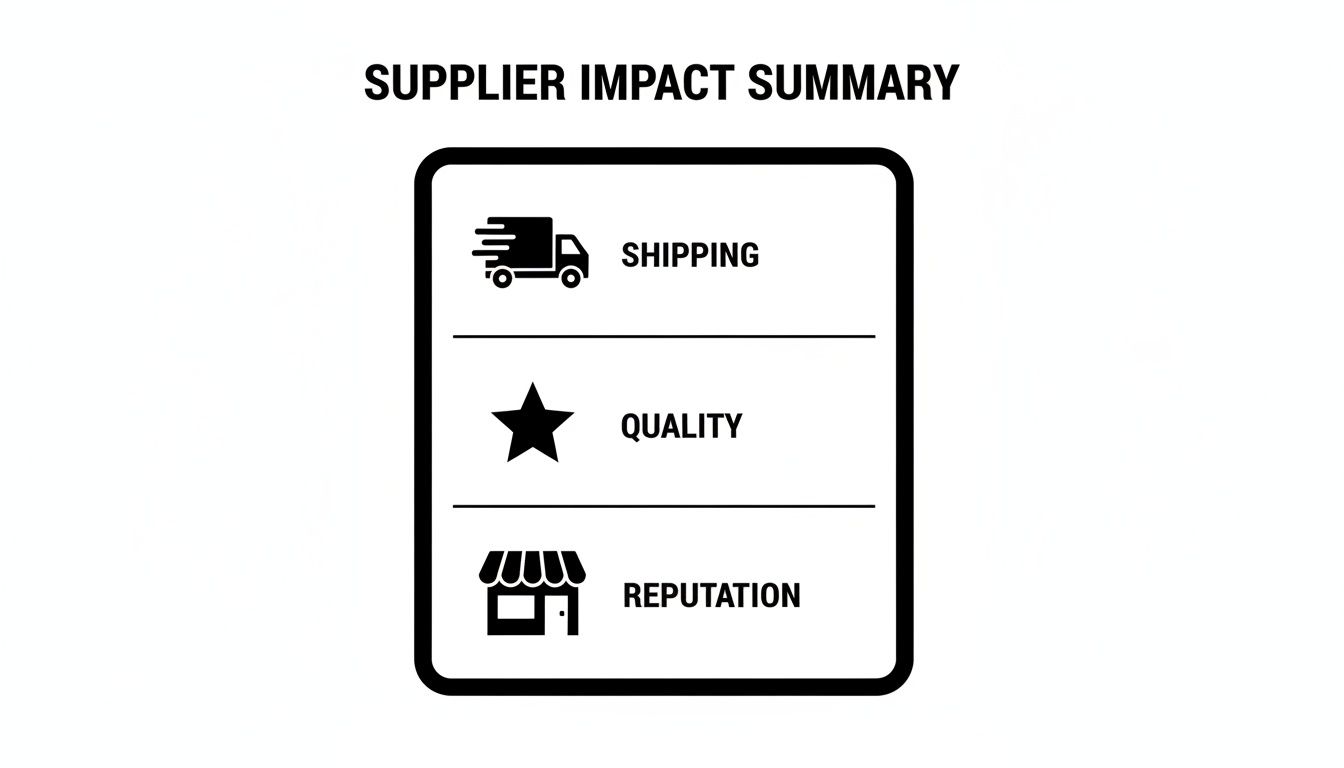
As you can see, your choice of supplier sends ripples through every part of your business. Let's break down the main types you'll encounter.
Global Marketplaces: The Wild West of Sourcing
For many people starting out, global marketplaces like AliExpress are the first port of call. It makes sense—they offer a seemingly endless ocean of products at rock-bottom prices. This makes it incredibly easy to test different product ideas without a huge upfront investment.
But there's a catch. This "wild west" environment comes with some significant trade-offs. Shipping times can be a major headache, often stretching into weeks for customers in the US or Europe. You'll also find that product quality can be a real coin toss, forcing you to become a detective and vet every single seller meticulously. The low cost is tempting, but you have to weigh that against the risk of unhappy customers dealing with long waits and inconsistent quality.
Curated Supplier Platforms: Quality and Speed Take Center Stage
This is where platforms like Spocket and CJ Dropshipping come in. Think of them as the gatekeepers. They do the heavy lifting by vetting suppliers, often prioritizing those with warehouses in key markets like the US and EU. The result? Shipping times that are worlds away from what you get on AliExpress.
These platforms essentially act as a trusted middleman, adding a layer of quality control and reliability.
- Seriously Faster Shipping: Many partners on these platforms can get products to your customers in a matter of days, not weeks.
- Vetted for Quality: Since suppliers and their products are pre-screened, you're taking a much smaller risk.
- Smooth Integration: They're built for e-commerce and usually offer slick plugins that automate order fulfillment and keep your inventory synced with WooCommerce.
The downside? You're typically looking at slightly higher product costs and a monthly subscription fee. For most store owners, though, the boost in customer satisfaction and the operational headaches you avoid make it a worthwhile investment. Of course, this all assumes you have your store set up correctly; getting the fundamentals right by following a guide for creating your WooCommerce store is a crucial first step.
Niche Suppliers & Wholesale Directories: The Road Less Traveled
Your third path is to venture off the beaten track and work with traditional wholesale directories or find independent, niche suppliers. This route is definitely more hands-on and requires some old-fashioned legwork. You might be building a direct relationship with a small manufacturer or an artisan who is open to dropshipping their unique products.
This approach is for the brand-builders—the entrepreneurs who want to offer something truly different. It requires more effort to establish relationships and logistics, but the reward is a unique product catalog that your competitors simply can't copy.
Comparing Supplier Models for Your WooCommerce Store
To help you decide, here’s a side-by-side comparison to quickly evaluate which supplier type fits your business goals, budget, and ideal customer experience.
| Supplier Type | Best For | Average Shipping Time | Typical Product Cost |
|---|---|---|---|
| Global Marketplaces | Testing new products, budget-conscious startups | 15-45+ days | Lowest |
| Curated Platforms | Scaling businesses, prioritizing customer experience | 4-14 days | Moderate |
| Niche/Direct | Building a unique brand with exclusive products | Varies widely | Moderate to High |
Ultimately, the best WooCommerce dropshipping suppliers for you depend entirely on your priorities. Are you playing the volume game where low cost is king? Or are you building a premium brand where speed and reliability are non-negotiable? Your answer will point you down the right path.
A Practical Vetting Process for Potential Suppliers
Finding a list of potential WooCommerce dropshipping suppliers is just the starting line. The real work—the part that separates successful stores from the ones that fizzle out—is figuring out who you can actually trust. A great-looking website doesn't mean much if the supplier can't get a package out the door on time.
This is where you need to put on your business owner hat and dig a little deeper.
We're not just trying to dodge outright scams; we're building the foundation of your brand's reputation. Every order a customer places is a test of that foundation. Forget relying solely on online reviews, which can be faked. You need to get a feel for their actual day-to-day operations.
Initiate Contact and See How They Respond
Your first real move is to reach out and ask some smart questions. Pay close attention here, because how a supplier communicates with you before they have your money is a crystal-clear preview of the support you'll get when a customer's order inevitably goes missing.
Shoot them an email. Use their contact form. Whatever you do, don't be shy. A slow, evasive, or boilerplate response is a massive red flag. If it takes them three days to answer a simple question now, what happens when you have an urgent problem with a customer's shipment?
Here are the absolute must-ask questions:
- What's your typical order processing time? You're looking for a specific window, like "we process all orders within 24-48 hours." Anything vague is a bad sign.
- How do you handle out-of-stock items? A professional supplier will have a system, like notifying you right away so you can update your store.
- Can I see your return and refund policies? Make sure their rules don't conflict with the policies you want to offer your own customers.
- Do you offer branded invoicing or custom packaging? This is a game-changer for building your brand instead of just being another reseller.
Their answers are important, but how they answer—the speed, the clarity, the tone—is just as telling. For a deeper dive into these trust signals, check out this guide on how to find dropshipping suppliers that really gets into the nitty-gritty.
Place a Sample Order—It's Non-Negotiable
Looking at a product online and actually holding it are two completely different things. That’s why placing a sample order is, without a doubt, the most important step in this entire process. It's a tiny investment that can save you from a world of headaches and refunds down the road.
I once worked with a store owner who was excited to launch a line of "premium" leather wallets. The supplier's photos looked incredible. But when the samples arrived? The "leather" was a cheap, smelly plastic. That one sample order saved his brand's reputation before it even launched.
When you order a sample, you get to evaluate three things you can't see on a screen:
- True Product Quality: Does it feel cheap? Does it look like the pictures? Is it something you'd be proud to sell?
- Packaging: Was the item thrown in a flimsy bag, or was it packed securely to survive the journey?
- Real-World Shipping Time: Forget their estimates. How long did it actually take to arrive at your doorstep?
By testing their communication and then getting your hands on the actual product, you're not just finding a supplier. You're building a reliable supply chain, and that's the bedrock of any dropshipping business that lasts.
Automating Your Workflow with Supplier Integrations
Finding a great supplier is a huge win, but the real game-changer is hooking their system directly into your WooCommerce store. This is where you graduate from a manual, time-sucking grind to a business that can actually scale. Without it, you’re stuck forwarding orders by hand, guessing at inventory levels, and chasing down tracking numbers—a recipe for burnout as soon as you get any traction.
The right tech lets you step away from being the "order processor." Instead of getting swamped by administrative tasks, you can put your energy where it really counts: marketing, talking to your customers, and thinking about your next big move.
Choosing Your Integration Method
So, how do you get your store and supplier talking to each other? It usually comes down to one of two paths. Your choice will hinge on what your supplier offers and how comfortable you are with the tech side of things.
The most hands-off and reliable option is almost always a dedicated plugin. Many of the bigger supplier platforms and services built for AliExpress have developed their own WooCommerce plugins. These tools are specifically designed to create a live, direct connection between your storefront and the supplier’s warehouse.
- Dedicated Plugins: Tools like AliDropship or Spocket are built to live right in your WordPress dashboard. They handle just about everything, from importing products with one click to automatically sending orders out for fulfillment.
- CSV File Uploads: This is the old-school method. Your supplier gives you a spreadsheet (a CSV file) with all the product data, and you manually upload it to your store. It works, but it’s far more labor-intensive and prone to error.
For anyone serious about growing, a dedicated plugin is the way to go. It offers real-time syncing that a CSV upload just can’t touch, which is critical for avoiding the nightmare of selling something that just went out of stock. Beyond these direct connections, it's also worth exploring broader guides on workflow automation for small businesses to find other ways to save time.
Setting Up Your Automated Systems
Once you've picked your tool, the next step is to set up the core functions that will let your business practically run itself.
First up is automated order forwarding. This is the bread and butter of dropshipping automation. When a customer buys from you, the plugin instantly grabs the order details—what they bought, how many, and where it's going—and zaps it over to your supplier. No copy-pasting, no typos, and no delays. Fulfillment can start within minutes.
Take a look at the AliDropship plugin's dashboard, a popular choice for anyone working with AliExpress.
You can see how it pulls everything into one place—product sourcing, pricing rules, and order fulfillment. It becomes your mission control.
Next, you need real-time inventory syncing. The plugin will constantly monitor your supplier’s stock. The second a product is no longer available, it’s automatically marked as "out of stock" on your website. This single feature prevents so many headaches and customer complaints. Most quality integrations for WooCommerce dropshipping suppliers will have this.
Finally, you’ll want to configure tracking number updates. As soon as the supplier ships the package, the system automatically pulls the tracking number and attaches it to the order in WooCommerce. This usually triggers an email to your customer, giving them peace of mind and saving you from a flood of "Where's my stuff?" emails. There are many different dropshipping automation tools out there, so it's worth seeing what fits your needs best.
Automation isn't just about moving faster; it’s about being reliable. A solid automated system ensures every single order is handled correctly and consistently, which is exactly how you build customer trust.
A tight integration with your WooCommerce dropshipping suppliers also gives you a serious edge. For instance, many US-based suppliers offer slick integrations that can lead to 35% faster shipping and a 20% higher rate of repeat customers. These aren't small numbers, especially when you learn that a staggering 84% of dropshippers name unreliable suppliers as a major roadblock.
5. Crafting Product Pages That Convert
Your supplier handles the logistics, but you're in charge of the sale. One of the biggest mistakes I see new dropshippers make is just copying and pasting whatever the supplier gives them. This usually means you're stuck with low-quality, generic, and sometimes even watermarked photos that scream "amateur" and kill any trust you're trying to build.
Think about it: your customers can't physically touch the product. Your images, videos, and descriptions are all they have to go on. When your visuals are sharp, professional, and show the product in action, you're building confidence. Generic, blurry photos do the exact opposite.
Elevate Your Visuals Beyond the Basics
To make your store look like a real brand, you have to put some effort into creating a rich, visually appealing product page. This isn't just about having one or two decent pictures. We're talking a full gallery of high-resolution images, clear photos for every single product variant, and—if you can get it—a video that shows off what makes the product special.
This is where working with WooCommerce dropshipping suppliers from huge marketplaces like AliExpress can get tricky. Manually saving dozens of images for every product is a painfully slow process that will absolutely drain your motivation.
This is exactly why tools like AliSave Pro were created. Instead of right-clicking and saving image after image, you can download all the product media you need in one go. This includes the main photos, all the different variant images, product videos, and even photos from customer reviews, which are pure gold for social proof.

With the right tool, you can grab all those media files from a single supplier page and get them neatly packaged in a ZIP file, ready to upload. It turns a mind-numbing task into a quick, efficient part of your workflow, giving you the professional assets you need to build a listing that actually sells.
Think of your product page as your digital salesperson. If it looks unprofessional or lazy, customers will assume your products and your service are the same. High-quality visuals are your first and best chance to make a great impression.
Ultimately, building compelling product pages is where you differentiate yourself. By taking control of your product media, you immediately stand out from the sea of competitors who are all using the same tired, generic supplier photos. For a deeper dive into turning your website visitors into paying customers, check out our guide on how to improve ecommerce conversion rates. It’s this attention to detail that builds a brand people trust and want to come back to.
Common Questions About Dropshipping Suppliers
Once you start working with your chosen WooCommerce dropshipping suppliers, you're going to have questions. It's just part of the process. Getting through these early hurdles is what builds a strong, lasting business. Let's tackle some of the most common issues store owners run into.
How Many Suppliers Should I Use for My Store?
When you're first starting out, keep it simple. Seriously. Sticking with one solid, reliable supplier is the best way to learn the ropes without getting completely overwhelmed. You can focus on mastering that single relationship and workflow.
But as your store grows, you'll want to diversify. Most seasoned dropshippers I know work with two or three different suppliers. Think of it as a safety net. If your main supplier suddenly goes out of stock on a best-seller, has a massive shipping delay, or jacks up their prices overnight, you won't be left high and dry. Having those backups means your business doesn't grind to a halt. It also lets you build a more diverse and interesting product catalog.
What Is the Best Way to Handle Customer Returns?
Returns are all about building customer trust, and the number one rule is this: your store's return policy must mirror your supplier's policy. You're the middleman here.
When a customer wants to return something, you'll give them the shipping address for your supplier's warehouse. Once the supplier gets the item back and confirms it's in good shape, they'll refund you. Then, you turn around and refund your customer. You absolutely have to get this sorted out with your supplier before you make your first sale, especially regarding who pays for return shipping.
A mismatch in return policies is a classic rookie mistake, and it can cost you dearly. If you offer a 30-day return window but your supplier only gives you 14 days, guess who's eating the cost of those extra 16 days? You are.
Can I Effectively Dropship to the US or EU from AliExpress?
You sure can, but you have to be smart about it. The default shipping from many AliExpress sellers can take 20 days or more, and that’s a non-starter for most shoppers in the US or Europe. They just won't wait that long.
The key is to filter your search aggressively. Look specifically for suppliers who offer premium shipping lines or, even better, have warehouses located directly in the US or EU. Finding a supplier with local inventory is a game-changer. It slashes delivery times and gives your customers a much better experience. This is exactly why specialized platforms have popped up—they vet suppliers who already have fast, reliable logistics for Western markets.
Ready to build product pages that actually convert? AliSave Pro lets you grab all the high-res images, videos, and customer review photos from any AliExpress supplier in one click. Stop wasting time and start creating stunning listings that crush the competition. Get the free extension at https://alisavepro.com.