

Let's get one thing straight: there are no secret tricks or silver bullets in SEO. If you want to genuinely outrank your SEO competitors, you need a solid game plan—one built on a smarter strategy and better execution. This is your roadmap to taking apart their success, piece by piece, and building something stronger in its place.
Your Blueprint to Winning at SEO
Getting to the top of the search results means moving past the basics. Real success isn't about stumbling upon one magic tactic; it's about a battle-tested process. It's about finding your competitors' weak spots, hitting them with better content, making your site technically perfect, and becoming the undisputed authority in your space.
To climb the SERPs, you need a clear framework. We're going to walk through the core pillars of SEO domination, from digging deep into your competitors' playbook to strategically earning links and tracking what actually works. It's less of a guessing game and more like a calculated campaign. It’s the same strategic thinking e-commerce sites use when figuring out how to reduce shopping cart abandonment—they analyze every step and optimize the process.
What to Expect in This Guide
I've structured this guide to give you a repeatable plan for systematically climbing the rankings. We'll focus on:
- Competitive Intelligence: I'll show you how to dissect what your competitors do well and, more importantly, where they're dropping the ball.
- Content and Technical Excellence: We'll cover building a website that search engines love to crawl and that users find incredibly valuable.
- Authority Building: You'll learn how to build a backlink profile that screams "trustworthy" to Google, making your site the go-to resource.
To make this whole process faster, I'll also introduce you to a powerful tool I use that's built for exactly this kind of work.
The goal here isn't just to compete; it's to methodically dominate. When you understand and execute these foundational principles, you create a lasting advantage that's incredibly difficult for anyone else to copy.
To help you get started, I’ve partnered with a platform that can give you a serious edge. You can use my affiliate link for Outrank and pop in the code OUTRANK10OFF to get a special discount.
Alright, let's dive into the strategies that will get you to the top.
Finding Your Competitors' Hidden Weaknesses

Winning at SEO isn't just about doing your own thing well; it's about understanding the battlefield. You need to know who your competitors are, but more importantly, you need to know why they're ranking. This is where we move beyond a simple list of rivals and into real competitive intelligence.
The goal here is surgical precision. Instead of just chasing broad, high-volume keywords, you’re going to pinpoint the specific cracks in their strategy. This lets you focus your time and money where they’ll make the biggest splash, giving you a clear path to systematically siphon off their traffic.
Reverse-Engineering Their Content Strategy
First things first, you have to figure out what’s already working for them. This is where tools like Ahrefs and SEMrush become your best friends. They give you an x-ray view into exactly which pages and keywords are sending the most traffic to your competition.
Just pop a competitor’s domain into one of these tools and head straight for their "Top Pages" report. Think of this as more than just a list of blog posts; it's a treasure map. It shows you precisely which topics and content formats are winning over both Google and your shared audience.
With this list in hand, start digging into the "why." Ask yourself some tough questions about their top-performing content:
- What's the format? Are they pumping out massive 5,000-word guides, quick-and-dirty listicles, or detailed case studies?
- How deep do they go? Is their content a surface-level overview, or is it the most comprehensive resource on the web for that topic?
- What's their unique angle? Are they using original data, exclusive interviews with experts, or killer custom graphics to make their point?
This kind of analysis gives you a blueprint. You now know the standard you have to beat to outrank their SEO. You're learning from their successes to build something that's ten times better.
Uncovering High-Value Keyword Gaps
One of the most powerful plays in the SEO game is the keyword gap analysis. In simple terms, it's about finding the valuable keywords your competitors rank for, but you don't. This is where you find the low-hanging fruit.
Look at it this way: if two or three of your main competitors are all ranking for the same keyword, that’s a massive signal that the term has real commercial intent. If you're nowhere to be found for that query, you are literally leaving money on the table. Platforms like Outrank have features designed to make this dead simple, turning what used to be a messy spreadsheet task into a few quick clicks.
By focusing on these keyword gaps, you're not just finding random content ideas. You are strategically targeting proven, traffic-driving terms that your audience is already using and your competitors are already cashing in on.
This is how you build a content plan designed to intercept their traffic, not just compete for it. To fast-track this, you can get a discount on the Outrank platform with the code OUTRANK10OFF and get your analysis done in a fraction of the time.
Dissecting Search Intent for a Perfect Match
Knowing what people search for is only half the battle. You have to understand why they're searching for it. We call this search intent, and it’s everything in modern SEO.
Generally, searches fall into a few buckets.
| Intent Type | User Goal | Example Search Query |
|---|---|---|
| Informational | Trying to learn something or get an answer. | "how to improve site speed" |
| Navigational | Looking for a specific website or page. | "google analytics login" |
| Commercial | Researching options before making a purchase. | "best seo tools for small business" |
| Transactional | Ready to buy or take immediate action. | "buy ahrefs subscription" |
Here’s where you can often find a competitor's weak spot. They might be ranking for a term, but are they actually satisfying the user's intent? It’s a common mistake. For example, you might see a high-level, "what is" style blog post ranking for a keyword that clearly has commercial intent (like "best X for Y").
That's your opening.
By creating content that perfectly matches what the searcher is looking for, you create a better user experience. Google sees this and rewards it with better rankings. The numbers don't lie: the top organic result gets about 27.6% of all clicks, and nearly 75% of people never even click to the second page. You can discover more insights about SEO statistics on Keyword.com to see just how critical that top spot is.
When you analyze your competitors through the lens of search intent, you can easily spot these mismatches and build a superior asset. It’s a subtle but incredibly effective way to show Google your page is the best answer, making your efforts to outrank their SEO that much easier.
Perfecting Your On-Page and Technical SEO
Once you’ve found the cracks in your competitor’s strategy, it's time to build something better. This is where you create web pages that are not only technically flawless but also perfectly tuned for the keywords you’re targeting. We're not just talking about stuffing keywords into a page; we’re talking about creating an experience that both people and search engines will reward.
The gap between a page one ranking and getting buried on page two often comes down to the details. Getting these on-page and technical elements right is how you build a solid foundation to truly outrank your SEO competitors for the long haul.
Crafting Pages That Command Attention
Your on-page SEO work begins long before you write the first sentence. It starts with the very first things people see in the search results: your title tag and meta description. Think of these as your digital billboard—they have to be good enough to earn that click.
Your title tag is your headline. It needs to be compelling, include your main keyword, and ideally stay within 50-60 characters so it doesn't get cut off. Your meta description is your quick sales pitch. While it doesn't directly influence your rank, a great one can make a huge difference in your click-through rate (CTR).
A few hard-earned tips for getting these right:
- Front-load your keyword. Try to place your most important keyword near the beginning of the title tag.
- Use action words. Verbs like “Discover,” “Learn,” and “Find” can nudge people to click.
- Promise an answer. Your meta description should make it crystal clear that your page has the solution to the user's problem.
This all sits on top of a solid technical base, which is the structural backbone of any high-performing website.
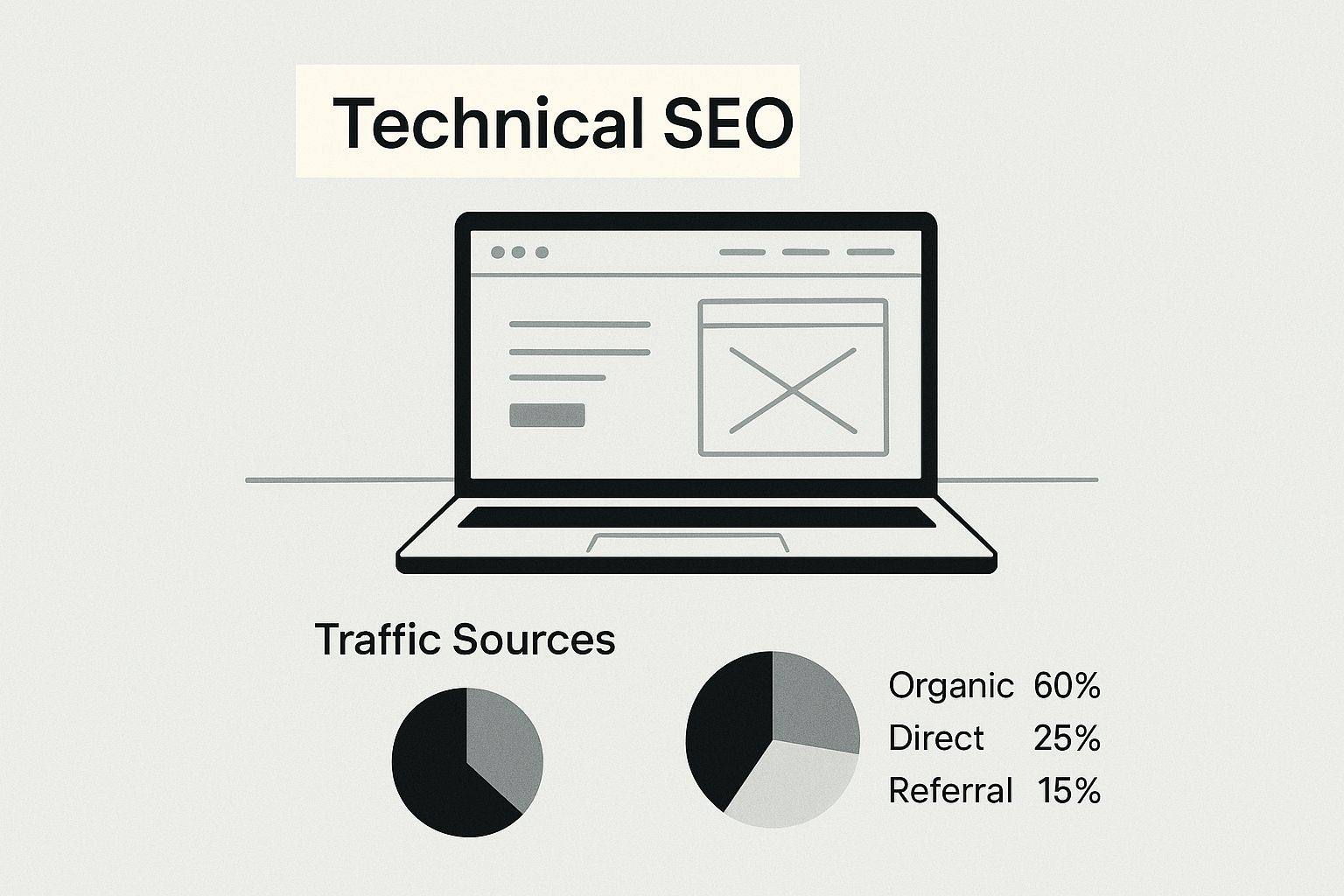
As the infographic shows, a clean site structure and good technical health are the bedrock for any content strategy that actually works.
Structuring Content for Humans and Search Engines
Once someone lands on your page, its structure determines if they stick around or hit the back button. Nobody wants to read a giant wall of text. Use headings (H2s, H3s) to create a logical flow and break your content into easy-to-scan sections.
Each heading should tell the reader what’s coming next and, where it makes sense, include some of your secondary keywords. This organization also helps Google understand the page's hierarchy and topics. Don't forget image alt text—describing your images gives search crawlers another layer of context.
Internal linking is another powerhouse tactic that’s easy to overlook. When you link to other relevant pages on your website, you're essentially drawing a map for search engines, helping them find more of your content and spreading authority across your site. For anyone running an online store, this is fundamental, much like how you'd set up an ecommerce category page to make it easy for shoppers to navigate.
A strong internal linking structure acts like a web, connecting your content and signaling to Google which pages are the most important pillars of your website.
Nailing the Technical SEO Fundamentals
While on-page SEO is about your content, technical SEO is about making sure search engines can find, crawl, and understand your site without any issues. The best content in the world won't rank if your technical foundation is shaky.
These days, site speed is huge. People expect pages to load in a blink, and Google's Core Web Vitals have made speed a direct ranking factor. A slow site doesn’t just frustrate visitors; it sends a strong signal to search engines that you’re providing a subpar experience.
Beyond speed, a few other technical checks are non-negotiable:
- Mobile-Friendliness: Your site has to work perfectly on a phone. Period. Most searches happen on mobile, so a clunky mobile experience will kill your rankings.
- Clean URLs: Your URLs should be short, easy to read, and include your primary keyword. Something like
yourdomain.com/outrank-seo-guideis infinitely better thanyourdomain.com/p?id=123. - Crawlability: Make sure you have a clean XML sitemap to give search engines a map of your site, and a properly set up robots.txt file to tell them what to crawl (and what to ignore).
There's a reason so many businesses invest here: SEO delivers an incredible return. Organic search converts 84.62% more users than PPC ads, attracting visitors who are much closer to making a decision. In fact, for every dollar spent on SEO, companies see an average return of $22.
Getting both on-page and technical SEO right might feel like a lot, but it's a systematic process. And thankfully, you don't have to do it all by hand. Tools can make this a whole lot easier. For instance, a platform like Outrank can run technical audits and content checks for you in just a few minutes. Use the code OUTRANK10OFF for a discount and get a head start on building a technically superior site that your competitors can't touch.
Building an Unbeatable Backlink Profile
If great content and technical SEO get you to the starting line, a powerful backlink profile is what helps you win the race. It’s that simple. Think of backlinks as votes of confidence from other websites. When a site with real authority links to your page, it’s a massive signal to Google that your content is trustworthy and valuable.

We're going to skip the generic advice here and jump straight into the proven, white-hat tactics that build real authority. The goal isn’t just to get links; it’s to build a profile your competitors can’t easily copy, cementing your spot at the top and making it incredibly difficult for anyone to outrank your SEO efforts.
The Modern Skyscraper Technique
You’ve probably heard of the classic "Skyscraper Technique": find popular content, make something way better, then ask everyone linking to the original to link to you instead. The modern version of this adds a much-needed layer of precision.
Instead of just making your content longer, focus on making it genuinely better. How?
- Bring in original data: Run a small survey or analyze some public data. Fresh insights are link magnets.
- Create knockout visuals: Can you explain the concept better with a custom infographic, chart, or short video? Do it.
- Offer a unique angle: Find an expert to interview or present a smart counter-argument to the conventional wisdom.
Once your masterpiece is live, use a tool like Ahrefs to see who links to the content you’re trying to one-up. Your outreach email shouldn't just be a simple ask—it needs to clearly explain why your resource is a more valuable, up-to-date addition for their audience. Always lead with value.
Mastering Broken Link Building
This is easily one of the most efficient ways to earn high-quality links. The process is straightforward: you find a dead link (a 404 error) on a relevant website, create a piece of content that would be a perfect replacement, and then let the site owner know.
You’re not just asking for a link; you’re helping them fix an issue on their site that hurts their user experience. It's a true win-win.
This tactic works so well because you're providing a solution, not just asking for a favor. Your email shifts from "Can you link to me?" to "I found a problem on your site, and here's how you can fix it."
Success here comes down to two things: finding these opportunities at scale and creating a replacement resource that is a genuinely perfect fit. The payoff is huge, earning you links your competitors almost certainly missed.
Creating Linkable Assets with Digital PR
The most sustainable way to build links? Create content so good that people link to it without you even asking. These "linkable assets" are the holy grail of link building.
We’re not talking about your average blog post. Think bigger.
- Original Data Studies: Publish unique research from your industry. This instantly makes you the primary source.
- Free Tools and Calculators: A simple tool that solves a common problem for your audience can attract links for years.
- Definitive Guides: Become the go-to resource on a core topic in your niche. Make it exhaustive and incredibly well-researched.
Once your asset is ready, it's time for promotion—and that's where digital PR comes in. You’re not just emailing bloggers asking for a link. You’re reaching out to journalists and industry publications to share your resource because it’s genuinely newsworthy and interesting for their readers.
The data doesn't lie: backlinks are still a cornerstone of Google's algorithm. Top-ranking pages have about 3.8 times more backlinks than pages further down. Even more telling, nearly 96% of sites in the top 10 have links from over 1,000 different domains. You can read the full research about these SEO statistics to dig deeper. This proves that building a strong, diverse link profile isn't just a good idea—it's essential.
Why Quality Always Trumps Quantity
It’s easy to get caught up in the numbers, but one link from a major industry publication is worth more than a hundred links from spammy, low-quality directories. It’s not even close.
When you're looking for link opportunities, your mantra should be relevance and authority. A link from a site in a completely unrelated niche is, at best, useless and, at worst, a red flag for search engines. Use metrics like Domain Rating (DR) or Domain Authority (DA) as a rough guide, but always do a manual review. Ask yourself: is this a real website with a real audience? If not, move on.
Deciding where to focus your energy can be tough, as not all link-building tactics are created equal. This table breaks down some of the most common strategies to help you prioritize.
Comparing Effective Link Building Tactics
This table compares common link building strategies based on their typical difficulty, resource investment, and potential SEO impact, helping you prioritize your efforts.
| Tactic | Difficulty | Time/Cost Investment | Potential Impact |
|---|---|---|---|
| Guest Posting | Medium | Medium | High |
| Broken Link Building | High | Medium | High |
| Digital PR/Linkable Assets | High | High | Very High |
| Skyscraper Technique | Medium | High | High |
Each of these tactics requires a systematic approach to create a lasting competitive advantage. Trying to manage this manually can quickly become a headache, which is why a dedicated platform can make all the difference. Using a tool like Outrank can help you streamline your outreach and manage your entire link-building workflow in one place. You can also use the code OUTRANK10OFF for a discount.
Tracking Performance to Stay Ahead
Getting to the top of the search results is a huge win, but let's be real—the work isn't over. SEO is absolutely not a "set it and forget it" game. The second you ease up, you can bet a competitor is already working to snatch your spot.
To hold onto your rankings and even push further ahead, you have to treat SEO as a cycle: monitor, analyze, and constantly refine your approach. This is what truly separates the pros from the amateurs. It shifts your efforts from one-off tasks into a smart, data-driven system that keeps you on top. When you consistently track the right numbers, you can see what’s working, double down on it, and fix problems before they start dragging you down.
Focusing on the Metrics That Matter
It's way too easy to get buried in a mountain of data. Instead of trying to track everything under the sun, zero in on the key performance indicators (KPIs) that actually show you're winning the battle to outrank your SEO rivals. Your two best friends for this are going to be Google Search Console and Google Analytics 4.
Here’s what I keep a close eye on:
- Organic Traffic Growth: This is the big one. Is your overall organic traffic consistently trending up? It’s the clearest sign that your strategy is paying off.
- Keyword Ranking Improvements: Are you actually climbing the SERPs for your money-making keywords? Watching your positions helps you see which pieces of content are really hitting the mark.
- Click-Through Rate (CTR): Pulled straight from Google Search Console, this tells you the percentage of people who see your site in the results and actually click. A low CTR is a huge red flag that your title tags and meta descriptions just aren't compelling enough.
- Conversions: All the traffic in the world doesn't mean much if it isn't leading to action. Whether it's a sale, a lead form submission, or a newsletter signup, you have to track conversions.
That last point is non-negotiable. For any e-commerce site, connecting traffic directly to sales is the whole point. You can learn more about how to improve ecommerce conversion rates and make sure all that hard-earned traffic actually turns into revenue.
Conducting Regular SEO Health Checks
You don’t need to do a massive, soul-crushing audit every single month. Instead, think of it like preventative maintenance for your website. A regular, quick health check can spot technical gremlins before they cause any real damage to your rankings.
Once a month, run a quick crawl on your site. I'm usually looking for the common culprits that can quietly kill your SEO: broken links (404 errors), slow-loading pages, and sneaky duplicate content issues. These seem like small problems, but they add up and send all the wrong signals to search engines.
A proactive approach to technical SEO is your best defense. It's so much easier to fix a crawl error or a sudden drop in page speed right away than it is to claw your way back up the rankings after you've already fallen.
This is where a good platform becomes invaluable. Instead of bouncing between five different tools, a single dashboard can monitor your site's health and track keyword performance. My personal go-to for this is Outrank, which makes both performance tracking and technical checks a breeze. Plus, you can use the code OUTRANK10OFF to get a nice discount.
Keeping a Close Eye on Competitors
Your competition isn't just sitting around. If you want to stay ahead, you can't either. You need a constant pulse on what they’re doing now, not what they were up to six months ago.
Set up some alerts to keep tabs on their activity. I pay closest attention to two things:
- New Content: What are they publishing? New blog posts and landing pages give you a direct look into their current content strategy and what they're prioritizing.
- New Backlinks: Where are they getting fresh links from? This is a goldmine for discovering new link-building opportunities you can go after for yourself.
This kind of competitive intel should feed directly back into your own strategy. If a competitor drops a killer guide that starts ranking, that's your cue to create something ten times better. If they land a link from a major industry publication, it's time to brainstorm how you can get one, too. This constant cycle of adaptation is how you don't just reach the top spot—you own it.
So, What's the Real Secret to Dominating Search?
Let's pull it all together. If you're looking for that one "magic bullet" to shoot you to the top of Google, you're going to be disappointed. The truth is, lasting SEO success comes from doing the hard work consistently. It’s a powerful mix of deep competitor research, spotless technical SEO, genuinely better content, and a backlink profile that screams authority.
This isn't just theory. It's the repeatable framework that separates the sites you see on page one from everyone else. Think of it as a continuous cycle: you analyze, you execute, you measure, and then you refine. Remember, climbing the SERPs is a marathon, not a sprint. Consistency is your secret weapon.
Your Game Plan to Get Started
To make this feel less overwhelming, I've boiled down the key actions from this guide into a simple checklist. Use this as your roadmap when you're ready to start making moves.
- Competitor Analysis: Find their best-performing pages and look for the keyword gaps they've completely missed. That's your opening.
- On-Page SEO: Write title tags and meta descriptions that make people want to click. Structure your content logically with clear headings.
- Technical SEO: Make sure your site works great on a phone, loads fast, and is a breeze for Google to crawl. No excuses here.
- Link Building: Actively hunt for high-quality links. Tactics like broken link building or creating truly valuable, "linkable" assets are your best bet.
- Performance Tracking: Keep a close eye on your organic traffic, keyword rankings, and, most importantly, conversions. This tells you what's actually working.
When you follow this kind of systematic approach, you stop guessing and start operating from a place of data-driven confidence. Each piece builds on the last, creating a powerful momentum that your competitors will find incredibly difficult to stop.
The single most important thing to remember is this: winning in SEO means consistently out-working and out-smarting your competition in these core areas. There are no shortcuts, but there is a clear path to the top if you're willing to put in the effort.
How to Accelerate Your Success
You now have the knowledge and the strategic roadmap to get going. But executing all of this requires serious diligence, and the right tools can make all the difference. Trying to do this all manually is not just slow; it's a surefire way to miss critical details. This is where specialized platforms give you a massive edge.
To put these strategies into practice more effectively, you should really consider using a tool built to handle everything from competitor deep dives to tracking your results. A solid platform automates the grunt work, freeing you up to focus on the things that actually require a human touch—like creating amazing content and building real relationships. With the right toolkit, you can get this entire action plan in motion much faster and start seeing results sooner.
For a tool that streamlines this entire process, I personally recommend checking out Outrank. It was designed specifically for the kind of strategies we've just walked through. You can get started with a special discount by using my affiliate link: Get Outrank SEO Tool. Just be sure to use the code OUTRANK10OFF when you check out.