
So, what exactly are dropshipping automation tools? Think of them as software designed to take over the repetitive, time-sucking tasks that come with running an e-commerce store. They become your digital workforce, handling everything from processing orders and updating inventory to sourcing new products, so you can stop working in your business and start working on it.
Why Dropshipping Automation Is No Longer Optional
Ever tried to run a popular restaurant by yourself? Imagine being the host, chef, server, and dishwasher all at once. It wouldn't take long before you were completely swamped, orders got messed up, and customers started walking out. That’s pretty much what running a dropshipping business manually feels like once you start to get some traction.
As your store grows, the sheer volume of daily tasks can bring everything to a grinding halt.
This is exactly where dropshipping automation tools come into play. They aren't a luxury; they're the essential crew that keeps your restaurant—or in this case, your online store—humming along smoothly, even when you're hit with the dinner rush.
For instance, this dashboard from AliSave shows just how simple a specific automation task can be. Instead of manually saving product photos and videos one by one, a clean interface lets you grab all the media you need in a few clicks.
This is a perfect example of how specialized tools turn tedious manual work into something effortless.
The Shift From Side Hustle to Scalable Business
When you’re just starting out, processing maybe 10 orders a day by hand seems doable. But that approach has a hard ceiling. What happens when a TikTok video goes viral and you wake up to 1,000 new orders? Without automation, you're looking at pure chaos—shipping delays, wrong addresses, and a brand reputation that's tanking fast.
Automation is the bridge that turns a time-consuming hobby into a scalable, profitable asset. It removes you from the day-to-day grind, effectively eliminating the ceiling on your growth.
This isn't just about making your life easier; it's a strategic move to stay competitive. The market stats back this up, too. The global dropshipping software market was valued at USD 1.31 billion in 2024 and is on track to hit around USD 3.25 billion by 2032. This explosive growth shows just how much the industry relies on these tools to operate efficiently.
Core Problems Solved by Automation
So, what headaches do these tools actually solve? They target the most common breaking points in a manual dropshipping setup. If you're new to the game, our step-by-step guide for beginners can give you a bird's-eye view of the whole process.
Here are the fundamental issues that automation fixes:
- Eliminating Costly Human Error: Manually copying a customer’s address from Shopify to AliExpress is a recipe for typos. Automation makes sure that data is transferred perfectly every single time, which means no more paying for reshipments or dealing with frustrated customers.
- Reclaiming Your Most Valuable Asset—Time: Tasks like checking supplier stock levels, updating your prices to match, and sending order details can easily eat up your entire day. Automation works 24/7, giving you back those hours to focus on marketing, customer support, and big-picture strategy.
- Enabling True Scalability: An automated system doesn't care if it's processing 10 orders or 10,000. It handles both with the same robotic efficiency. This is what allows your business to grow exponentially without the operational foundation cracking under the weight.
The Five Pillars of Dropshipping Automation
If you're going to truly get a handle on dropshipping automation, don't think of it as a single piece of software. Instead, picture it as a powerful engine built on five core pillars. Each pillar is designed to solve a specific, time-sucking manual headache. When they all work in harmony, they create a business that practically runs itself.
Let's break down exactly what these pillars are and how they completely change the way you run your store day-to-day.
Pillar 1: Product Sourcing and Importing
We've all been there. Manually adding a new product to your store is an absolute grind. You're saving images one by one, copying and pasting descriptions, tediously creating variants, and then trying to figure out your pricing. This slog can take hours for just a few products, which makes building a big, interesting catalog feel completely out of reach.
This is where automation first steps in to save the day. Product sourcing and importing tools let you browse massive marketplaces like AliExpress and pull any product into your store with a single click. The software instantly grabs all the essential data—titles, descriptions, high-res images, and all the variants—and builds a new product page for you.
- The Manual Way: Saving dozens of images and copy-pasting endless product details.
- The Automated Way: One-click product importing directly into your Shopify or WooCommerce store.
- The Real Benefit: You can build out your product catalog 10x faster and test new items with almost zero effort.
Pillar 2: Inventory Synchronization
One of the cardinal sins of dropshipping is selling a product that your supplier just ran out of. This mistake is a fast track to canceled orders, angry customers, and a brand reputation that's hard to repair. The only manual "fix" is to constantly check your supplier's stock levels, which is something no sane person has time to do.
Inventory sync is the magic wand that makes this problem disappear. An automation tool constantly pings your supplier's inventory and updates your store's stock levels in real time, without you lifting a finger.
Think of it this way: If your supplier has 50 units, your store shows 50. The moment they sell out, your store automatically marks the item as "Out of Stock." You're completely protected from overselling.
Honestly, this pillar isn't just a nice-to-have; it's a non-negotiable for running a professional and reliable store.
This infographic really drives home how core automation benefits like saving time, cutting costs, and enabling growth all sprout from these foundational pillars.
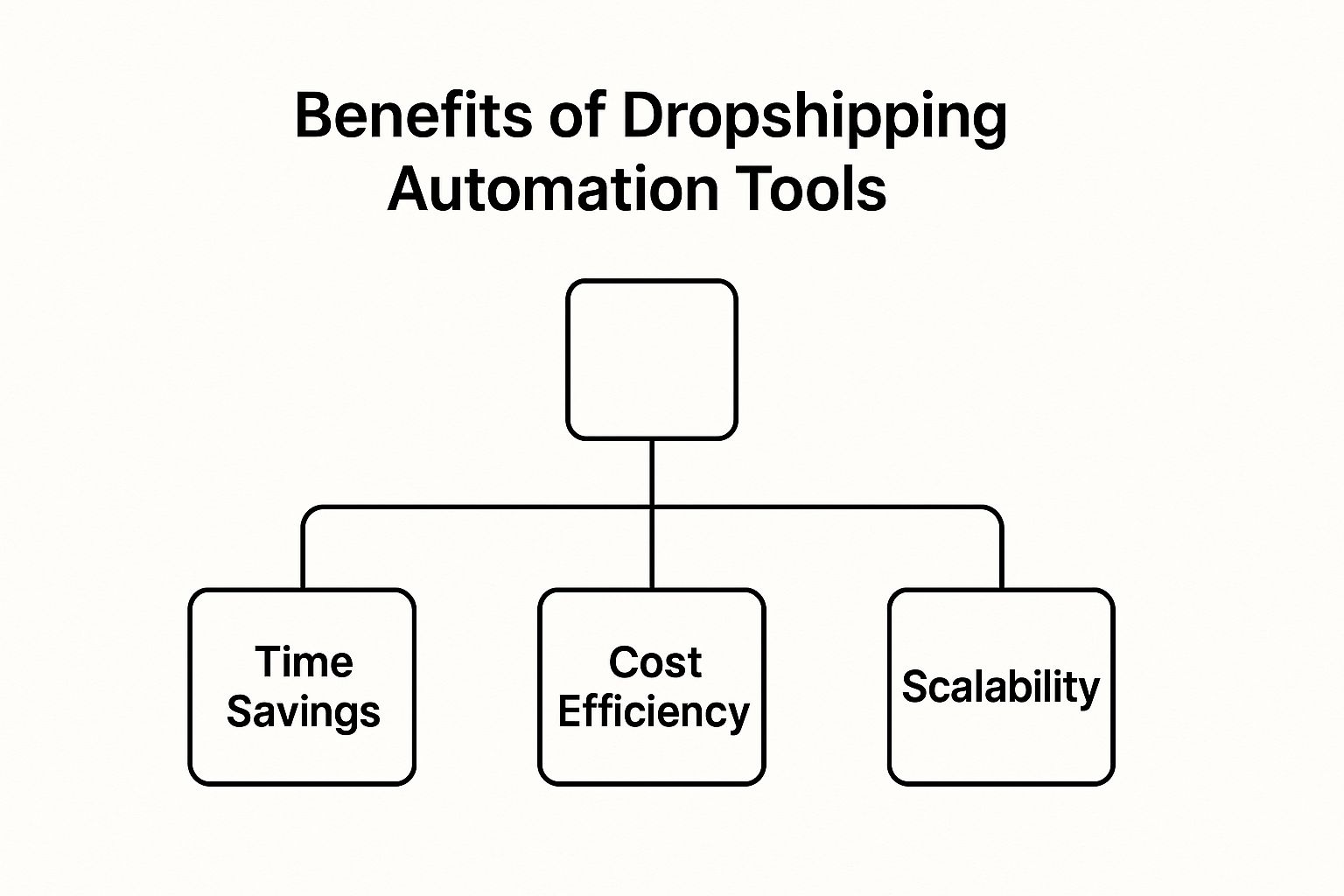
As you can see, each piece of the automation puzzle contributes to a much more lean and scalable business, freeing you up to focus on what actually grows your brand.
Pillar 3: Automated Order Fulfillment
Okay, a customer just bought something. Awesome! Now for the tedious part. Manually, you have to copy the customer's name, their shipping address, and the specific product they ordered, then navigate to your supplier's website and paste it all into their checkout form. A single typo in that address can mean a lost package, an unhappy customer, and you paying for shipping twice.
Automated order fulfillment just wipes this entire process off your to-do list. The second an order hits your store, the software automatically forwards all the necessary details directly to your supplier. All you have to do is click to approve the payment, and the product is on its way. This is the secret behind how stores handle hundreds, or even thousands, of orders a day without a massive fulfillment team.
Pillar 4: Dynamic Price Monitoring
Here's a fun fact: suppliers change their prices all the time, often without any warning. If your supplier bumps up their price and you don't catch it, you could easily start selling products at a loss. Trying to monitor prices manually across a catalog of hundreds of items isn't just hard—it's impossible.
This is why you need a 24/7 financial watchdog. Dynamic price monitoring tools scan your suppliers' listings around the clock and automatically adjust your store's retail price based on rules you create. For example, you can set a rule to always maintain a 40% profit margin. If the supplier's cost goes up by $2, your price instantly increases to protect your profit.
Pillar 5: Efficient Media Management
Let’s be real: high-quality images and videos are what convince people to buy. But manually downloading all those assets from a supplier's page is slow and clunky. You often end up with fuzzy, low-resolution pictures, images plastered with watermarks, or just a chaotic mess of files in your downloads folder.
This is where specialized dropshipping automation tools like AliSave Pro become absolutely essential. Forget right-clicking and saving dozens of individual files. With a tool like this, you can download all the product media—we're talking main images, variant photos, customer review pictures, and even videos—in a single, organized click.
- Get High-Resolution Visuals: Instantly grab crisp, clean images that give your store a premium look.
- Ditch the Watermarks: Download media that's clean and ready for your product pages and marketing campaigns.
- Stay Organized: All the assets are neatly bundled into a single ZIP file, saving you from digital clutter.
By automating how you gather your media, you can build beautiful, conversion-optimized product pages in minutes instead of hours. That's a serious competitive edge.
To put it all together, let's look at how each of these pillars tackles a specific business problem.
Key Automation Areas and Their Impact
This table breaks down the core functions of dropshipping automation and shows you the direct business problem each one solves. It's a clear look at the "before" and "after" of implementing these tools.
| Automation Pillar | Manual Task It Replaces | Primary Business Benefit |
|---|---|---|
| Product Importing | Copying/pasting images, titles, and descriptions | Rapidly build and test a large product catalog |
| Inventory Sync | Constantly checking supplier stock levels | Prevents overselling and protects brand reputation |
| Order Fulfillment | Manually entering customer data on supplier's site | Frees up hours per day and eliminates costly shipping errors |
| Price Monitoring | Daily checks of supplier pricing for every product | Guarantees profit margins and prevents unexpected losses |
| Media Management | Right-clicking to save individual, often low-quality, images | Creates professional-looking product pages quickly |
As you can see, automation isn't just about saving a bit of time. It's about building a more resilient, profitable, and scalable business from the ground up.
How Automation Actually Changes the Game
It’s one thing to read a list of features for dropshipping automation tools, but it's another thing entirely to see what they do to a business in the real world. Moving from a manual setup to an automated one isn't just a small tweak—it's a complete overhaul of how you operate, digging up potential you never knew you had because it was buried under endless busywork.
Let's paint a picture. Think of a typical dropshipper, we'll call her Alex. Before automation, Alex was chained to her desk for four hours a day, just pushing orders through. That meant manually copying customer addresses, pasting them into supplier forms, and then meticulously tracking down shipping numbers to update her store. It was a soul-crushing, repetitive grind that left zero time for anything else.
Now, fast forward. After plugging in an automation system, Alex's daily routine is unrecognizable. She spends maybe 30 minutes checking in on the system and handling the rare exception. The rest of her day? It's wide open for creative marketing, scouting new products, and actually talking to her customers—the stuff that makes a business grow.
This isn't just a made-up story; it’s the reality for thousands of entrepreneurs who take the leap. Let’s break down the five biggest changes you can expect.
Unlocking a Ridiculous Amount of Time
The first thing you'll notice is you get your time back. All those mind-numbing tasks like processing orders, checking inventory, and updating prices are perfect for software to handle around the clock. You're no longer stuck in operational quicksand, which means you can finally start working on your business, not just in it.
So, what do you do with all this extra time? You pour it into high-impact activities that actually make you money:
- Marketing and Branding: Finally build out those ad campaigns, create great social media content, and craft a brand people remember.
- Product Research: Get ahead of the curve and find the next hot-ticket item before everyone else does.
- Customer Engagement: Deliver the kind of amazing support that turns a one-time buyer into a lifelong fan.
Slashing Costly Human Errors
Look, no matter how careful you are, mistakes happen when you're entering data by hand. A single typo in a shipping address can mean a lost package, an angry customer, and you footing the bill to ship it all over again. These "small" mistakes add up fast, eating away at your profits and your store's credibility.
Automation tools are ruthlessly precise. They move data from point A to point B without error, ensuring order details, tracking numbers, and stock counts are always correct. This practically eliminates the financial bleed from human mistakes, which in turn builds customer trust and protects your bottom line.
Think of automation less as an expense and more as an investment in your store's reputation and long-term health. By patching the weak spots in your operations, you build a much stronger, more reliable brand.
Making it Possible to Actually Scale
A manually-run dropshipping store has a hard ceiling. What happens when a product goes viral and your orders jump from 20 a day to 2,000? The whole system breaks. You simply can't keep up with that volume by hand without creating massive delays and fulfillment nightmares.
Automation blows that ceiling right off. A good system handles a massive sales spike with the same cool efficiency as a slow Tuesday. This gives you the confidence to run aggressive marketing campaigns, knowing your backend can handle whatever success you throw at it.
The industry data backs this up. In 2024, North America accounted for about 38.7% of the global dropshipping software market. That market is expected to balloon to nearly USD 4.57 billion by 2033, all because stores need powerful automation to keep up. You can dig into the numbers and see the full report over at CognitiveMarketResearch.com.
Taking the Customer Experience to the Next Level
In e-commerce, speed and communication are king. Customers expect their orders to be processed quickly and to know exactly where their package is. Automation nails both. It sends orders to suppliers in an instant and pushes tracking information to the customer the second it becomes available.
This smooth, fast process leads to shorter shipping times and happier customers. And happy customers lead to better reviews, more repeat business, and a brand reputation that practically sells itself.
How to Choose the Right Automation Tools
With so many dropshipping automation tools flooding the market, picking the right one can feel like a shot in the dark. The secret isn't finding the single "best" tool—it's about finding the best tool for your business. Think of it like a toolkit. A carpenter and a plumber both need tools, but they certainly don't carry the same ones. Your store has its own unique needs, too.
It’s easy to get sidetracked by flashy features you'll probably never use. A much smarter approach is to measure each option against a simple, practical checklist. This will help you cut through the marketing fluff and choose a tool that actually helps you grow, not just another bill to pay each month.
Let’s walk through the essential things you need to look at before you commit to any software.
Nail Down Your Platform Compatibility
First things first, and this one is non-negotiable: does the tool actually work with your e-commerce platform? If a tool can't connect seamlessly with your store, it's useless, no matter how many bells and whistles it has. An incompatible tool just creates more manual work, which defeats the whole point of automation.
Make sure it has a solid, native integration with your platform:
- Shopify: The giant in the room. Almost every serious automation tool supports it.
- WooCommerce: If you're on WordPress, you need a tool built to work specifically with its ecosystem.
- BigCommerce, Wix, and Squarespace: Don't just assume a tool works with these. Look for dedicated apps or proven integrations.
A smooth, one-click integration means your data flows back and forth without a hitch, saving you from sync errors and a whole lot of frustration.
Verify Supplier Network and Support
Your automation software acts as the bridge between your online store and your suppliers. If that bridge doesn't connect to the right places, you're going nowhere. Before you even think about signing up, double-check that the tool supports the suppliers you already use or want to use in the future.
For example, if your entire product line comes from AliExpress, a tool that only syncs with US-based suppliers is a complete dead end. Most dropshippers find their winning products first, so your software has to support that workflow. You can dive deeper into various dropshipping insights and supplier strategies to get a better handle on sourcing.
A great automation tool should expand your sourcing options, not limit them. Look for software that supports a wide network of suppliers, giving you the flexibility to pivot and find better products or shipping times as your business evolves.
Evaluate the Core Features You Need Now
It's tempting to get drawn in by a long list of advanced features, but you need to stay focused on what will solve your biggest problems right now. According to industry analysis, a staggering 84% of e-commerce store owners say finding and managing suppliers is their biggest headache. That tells you just how critical good sourcing and fulfillment automation really is.
Prioritize tools that absolutely master the fundamentals:
- One-Click Product Importing: Can it pull all the images, descriptions, and product variants into your store without making a mess?
- Inventory and Price Syncing: How fast does it update? You need real-time or near-real-time syncing to avoid selling products that are out of stock.
- Automated Order Fulfillment: Does it push order details to your supplier automatically, without you having to touch it?
- Tracking Number Updates: When the supplier ships the order, does the tool automatically grab that tracking number and send it to your customer?
Once you’ve confirmed a tool handles these four things perfectly, then you can start looking at the nice-to-have features like marketing tools or complex pricing rules.
Consider Pricing and Future Scalability
Your goal is to grow, and your software needs to be able to grow with you without costing a fortune. Look closely at the pricing tiers. Many tools charge based on how many products you list or how many orders you process each month.
Ask yourself these questions:
- Does the cheapest plan have the core features I need to get started?
- As my sales grow, will the cost per order go down or get ridiculously expensive?
- Are there hidden fees, like transaction percentages, that I need to know about?
You want to partner with a tool whose pricing makes sense for your journey. A tool that’s cheap today but becomes a massive expense once you’re successful can seriously eat into your profits down the road.
Improving Your Storefront With Media Automation
In dropshipping, your product images and videos are your most valuable employees. Seriously. They work around the clock, catching a customer's eye, showing off your product, and ultimately sealing the deal. A store packed with sharp, professional-looking visuals just feels trustworthy, right? On the flip side, a site with blurry, watermarked photos looks amateurish and sends potential buyers running for the hills.
This is why managing your product media is so critical, but it's an area many dropshippers still tackle the hard way.
Manually grabbing product photos is a soul-crushing task. You land on a supplier's page and begin the mind-numbing ritual: right-click, save image, right-click, save image… again and again. Before you know it, you've spent an hour building a messy folder of low-res images, many of them covered in supplier logos. It's a massive time drain that leaves you with a second-rate storefront.
Thankfully, this is exactly where specialized dropshipping automation tools come in to save the day.
From Manual Hassle to One-Click Efficiency
Now, picture this: instead of all that manual clicking, you download every single visual for a product—the main images, all the variant photos for every color and size, and even the promo video—with a single click. That’s the magic a dedicated tool like AliSave Pro brings to your workflow. It turns a painful, multi-hour chore into a job that’s done in seconds.
Instead of a chaotic mess in your downloads folder, you get a perfectly organized ZIP file ready to go. This isn't just about saving time; it's a real competitive edge. It means you can get new products listed faster, keep your store looking fresh, and maintain a high standard of quality across your entire catalog.
High-quality media is directly tied to better conversion rates. When customers can see a product clearly from every angle and watch it in action, their confidence in both the product and your store skyrockets.
The Power of Specialized Media Tools
A tool like AliSave Pro is built to do one thing and do it exceptionally well. That sharp focus brings a ton of benefits that broader, all-in-one platforms just can't match.
Here’s a quick look at what that means for you:
- Image Quality: You get instant access to the best available resolution for every image, completely free of watermarks. Your products will look premium, not cheap.
- Video Access: Easily download those engaging product videos that are proven to grab attention and boost sales.
- Variant Images: It pulls every single variant photo. This ensures your customers see exactly what they're buying, which is a huge factor in reducing returns.
- Review Photos: You can even download images from customer reviews—perfect for adding authentic social proof to your ads and product pages.
Manual Media Download vs AliSave Pro
The difference between the old manual way and using an automated tool is night and day. It's not just a small improvement; it fundamentally changes how you build and manage your store.
This table really puts the efficiency gains into perspective:
| Task | Manual Method (Time & Effort) | Using AliSave Pro (Time & Effort) |
|---|---|---|
| Download 20 Images | 10-15 minutes of right-clicking and saving | ~5 seconds with one click |
| Download Product Video | Often impossible or requires clunky third-party tools | Included in the one-click download |
| Organize Files | 5-10 minutes of renaming and folder creation | Instantly organized in a single ZIP file |
| Ensure Quality | Hit-or-miss; often results in low-res files | Guaranteed access to the best available quality |
By automating this one crucial step, you claw back hours of your time. Hours you can now pour into what really matters: marketing your products, talking to your customers, and actually growing your business. You get to stop fighting with files and start building a brand people love.
The Future of Dropshipping Automation
Dropshipping automation has always been about taking repetitive tasks off your plate, but where it's headed is far more exciting than just auto-fulfilling orders. We're on the verge of a genuinely intelligent e-commerce era, powered by AI and machine learning.
Think about it this way: today’s automation is like a reliable employee diligently working through a checklist. The future? It's like having an entire management team that predicts inventory shortages, spots breakout products before they go viral, and makes strategic calls on its own.
This isn't some far-off sci-fi concept; the shift is already happening. The next wave of dropshipping automation tools isn't being built to just react to what’s happening—they’re being designed to anticipate what’s about to happen.
The Rise of Predictive Ecommerce
Imagine knowing which product is going to be the next big thing before everyone else is talking about it. That's precisely what AI-powered product discovery tools are starting to do. By digging through social media trends, search data, and online sentiment, these systems can forecast demand with a pretty startling degree of accuracy. This lets you get ahead of the curve, sourcing and marketing hot products weeks before your competition even knows what hit them. You stop being a trend-follower and become a trendsetter.
That’s just one piece of the puzzle. A few other key advancements are really changing the game:
- Intelligent Chatbots: We're moving past those clunky, pre-programmed chatbots that everyone hates. Modern AI assistants can handle genuinely complex customer questions, process returns, and even upsell products using natural, conversational language. It's like having a real 24/7 support agent.
- Dynamic Pricing Algorithms: These tools are like having a stock trader for your store. They automatically adjust your prices in real-time based on what competitors are doing, fluctuations in demand, and even how your ad campaigns are performing, all to keep your profit margins as healthy as possible.
The end goal is shifting from simply automating individual tasks to building a completely integrated and intelligent e-commerce ecosystem. Getting on board with automation now isn't just about solving today's headaches—it's about setting your business up to win tomorrow.
This evolution is clearly reflected in the market's explosive growth. The global dropshipping automation software market was valued at around USD 0.67 billion in 2024, and it's projected to shoot up to USD 1.67 billion by 2033. This surge is happening because these tools give even a one-person startup the power to compete with the big guys by handling complex jobs like order management and supplier logistics. If you're curious, you can explore more data on this market trend to see just how fast things are moving.
When you pull it all together, these advancements are creating a smarter and more resilient way to do business. By embracing this next wave of automation, you’re not just trying to keep up. You're building an engine for a modern, profitable, and future-proof dropshipping business that can adapt to whatever the market throws at it next.
Frequently Asked Questions About Automation Tools
Diving into dropshipping automation for the first time always kicks up a few questions. Getting straight answers is the first step toward building a set of tools that actually helps you grow, instead of just adding another complication to your plate.
Let's clear up some of the most common things people wonder about before they start.
What Should I Automate First?
If you want the biggest bang for your buck right away, zero in on two things: order fulfillment and inventory synchronization. These are the two tasks that will absolutely wreck your reputation and your profits if you mess them up.
Automating your orders gets rid of those tiny, costly typos in shipping addresses and literally gives you back hours of your day. At the same time, keeping your inventory synced is your safety net. It stops you from selling an item that your supplier just ran out of—which is a surefire way to get angry emails and bad reviews. Nailing these two first gives your business a solid foundation to build on.
Are These Automation Tools Too Expensive For Beginners?
It's natural to see a monthly subscription and think of it as just another cost. But that’s not really the right way to look at it. You have to think in terms of return on investment (ROI).
Let's say a great tool costs you $30 a month. If it saves you 20 hours of mind-numbing manual work, what's your time worth? Even at a low hourly rate, the tool has already paid for itself.
Automation isn't a cost; it's an investment in efficiency and error prevention. The price of one lost package due to a manual typo can often exceed the monthly cost of the software designed to prevent it.
On top of that, these tools prevent expensive blunders like selling out-of-stock products or forgetting to update a price change from your supplier. They directly protect your bottom line.
Can I Use More Than One Automation Tool?
Not only can you, but you probably should. The most successful dropshippers don’t rely on a single, magical piece of software. They build what’s called a "tech stack"—a curated collection of different tools that work together, each one chosen because it’s the best at what it does.
For instance, you might use a big, all-in-one platform to handle your core operations like placing orders and managing stock levels. But then you could add a specialized tool like AliSave Pro to solve one specific, nagging problem: downloading clean, high-quality product images and videos without watermarks. For more on this kind of strategy, check out our dropshipping blog.
The trick is making sure your tools play well together and don't create conflicts. This approach lets you build a custom automation engine that’s perfectly tuned to your store's specific needs.
Ready to eliminate the tedious task of manually downloading product media? AliSave Pro lets you grab every high-resolution image and video from any AliExpress product page in a single click. Download it for free and start building better product pages in seconds at https://alisavepro.com.